
SAMBA Supporting Asthma Management Behaviors in Aging Adults
SAMBA: Supporting Asthma Management Behaviors in Aging Adults Program Background, Description, and Outline SAMBA Care Coach Training
These slides were compiled from materials by: • Melissa Martynenko, MPA, MPH • Division of General Internal Medicine Project Manager at the Icahn School of Medicine at Mount Sinai • Adam M. Karp • Clinical Research Coordinator at the Icahn School of Medicine at Mount Sinai SAMBA Care Coach Training – Program Background and Description

SAMBA Background SAMBA Care Coach Training – Program Background and Description
What Is SAMBA? • SAMBA = Supporting Asthma Management Behaviors in Aging Adults • SAMBA is an self-management support intervention looking to help older adults manage their asthma • It originated as part of a study on different types of treatment for older adults with asthma. This work is sponsored by the Patient Centered Outcomes Research Institute (PCORI) SAMBA Care Coach Training – Program Background and Description
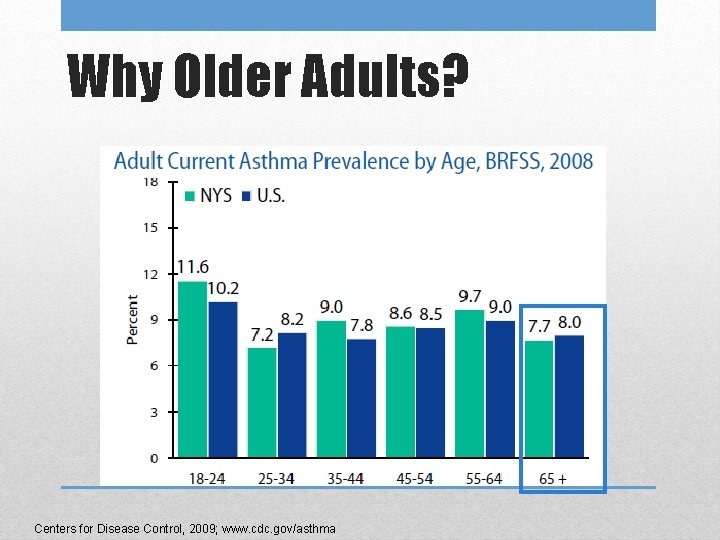
Why Older Adults? Centers for Disease Control, 2009; www. cdc. gov/asthma
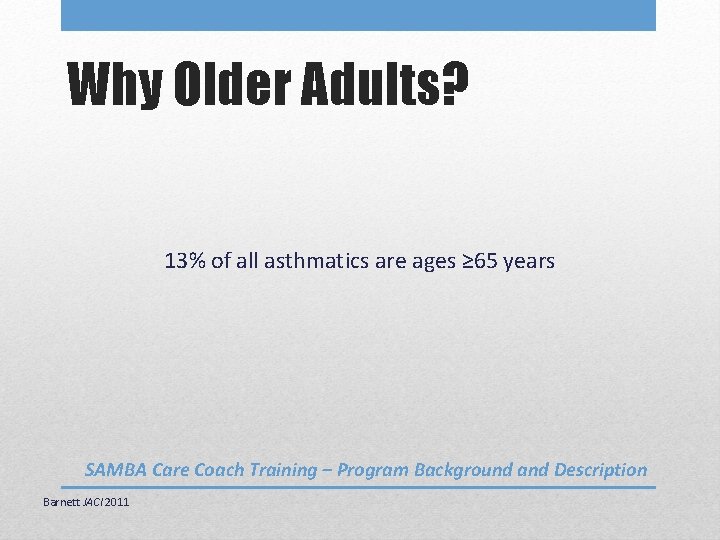
Why Older Adults? 13% of all asthmatics are ages ≥ 65 years SAMBA Care Coach Training – Program Background and Description Barnett JACI 2011
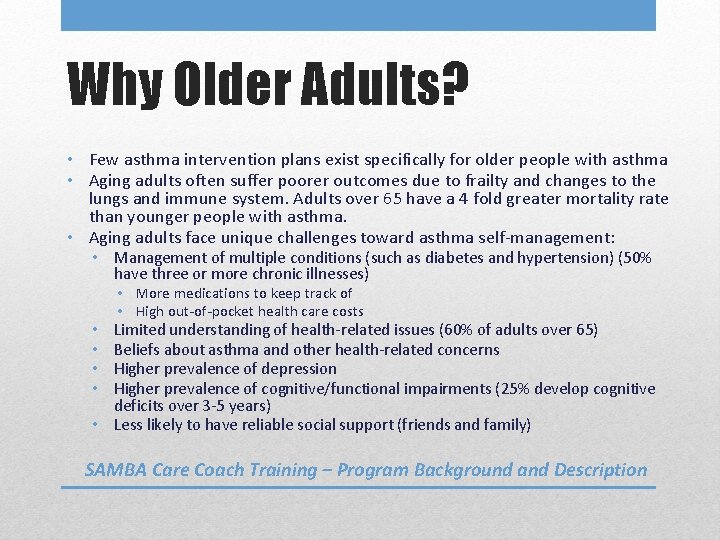
Why Older Adults? • Few asthma intervention plans exist specifically for older people with asthma • Aging adults often suffer poorer outcomes due to frailty and changes to the lungs and immune system. Adults over 65 have a 4 fold greater mortality rate than younger people with asthma. • Aging adults face unique challenges toward asthma self-management: • Management of multiple conditions (such as diabetes and hypertension) (50% have three or more chronic illnesses) • More medications to keep track of • High out-of-pocket health care costs Limited understanding of health-related issues (60% of adults over 65) Beliefs about asthma and other health-related concerns Higher prevalence of depression Higher prevalence of cognitive/functional impairments (25% develop cognitive deficits over 3 -5 years) • Less likely to have reliable social support (friends and family) • • SAMBA Care Coach Training – Program Background and Description
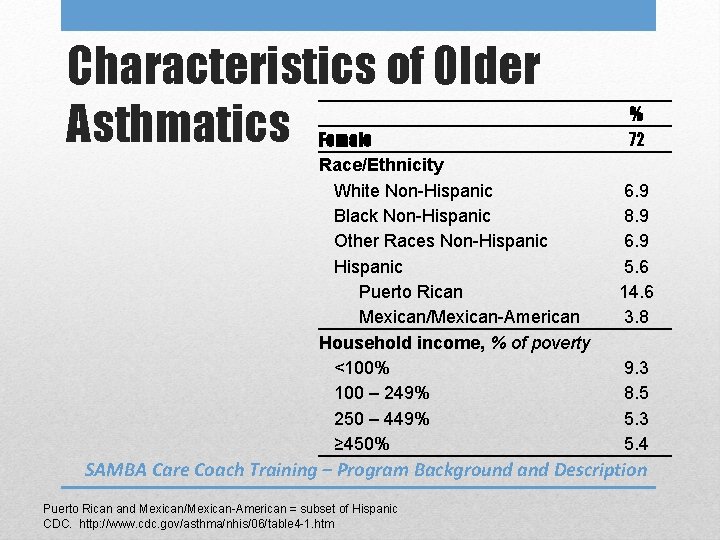
Characteristics of Older Asthmatics Female Race/Ethnicity White Non-Hispanic Black Non-Hispanic Other Races Non-Hispanic Puerto Rican Mexican/Mexican-American Household income, % of poverty <100% 100 – 249% 250 – 449% ≥ 450% % 72 6. 9 8. 9 6. 9 5. 6 14. 6 3. 8 9. 3 8. 5 5. 3 5. 4 SAMBA Care Coach Training – Program Background and Description Puerto Rican and Mexican/Mexican-American = subset of Hispanic CDC. http: //www. cdc. gov/asthma/nhis/06/table 4 -1. htm
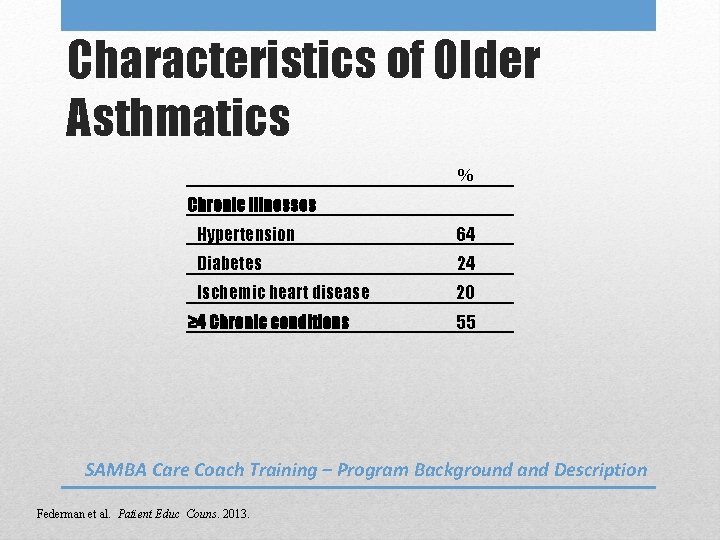
Characteristics of Older Asthmatics % Chronic illnesses Hypertension 64 Diabetes 24 Ischemic heart disease 20 ≥ 4 Chronic conditions 55 SAMBA Care Coach Training – Program Background and Description Federman et al. Patient Educ Couns. 2013.
SAMBA Asthma Care for Older Adults • Funding • Patient-Centered Outcomes Research Institute (PCORI) • Objective • To improve care and outcomes for older asthmatics • Focus on African-Americans and Latinos • Comparative effectiveness • Office vs. home-based self-management support SAMBA Care Coach Training – Program Background and Description
SAMBA Partners Mount Sinai Northwestern University in Chicago Institute for Family Health St. Luke’s Hospital • City Health Works • Little Sisters of the Assumption Family Health Service • Greater New York Hospital Association • Union Settlement Health • NYS Department of Health • • SAMBA Care Coach Training – Program Background and Description
Goals of SAMBA • Engaging patients in their own care and improving their ability to manage their asthma in order to live a better life. • Experiences with asthma and asthma severity differ patient by patient, so the specific goals you and your patients set out to meet will also differ person by person. SAMBA is designed to help you tailor your work to the specific needs of each and every patient. SAMBA Care Coach Training – Program Background and Description

SAMBA Description and Outline SAMBA Care Coach Training – Program Background and Description
How does it all work? • Patients who enroll are randomly assigned either: • Home-Based Support: a Community Health Worker (CHW) visits the patient in their home • Clinic-Based Support: an Asthma Care Coach (ACC) meets with the patient in the clinic or medical office • Both the ACC and the CHW will use the SAMBA intervention in almost exactly the same way SAMBA Care Coach Training – Program Background and Description
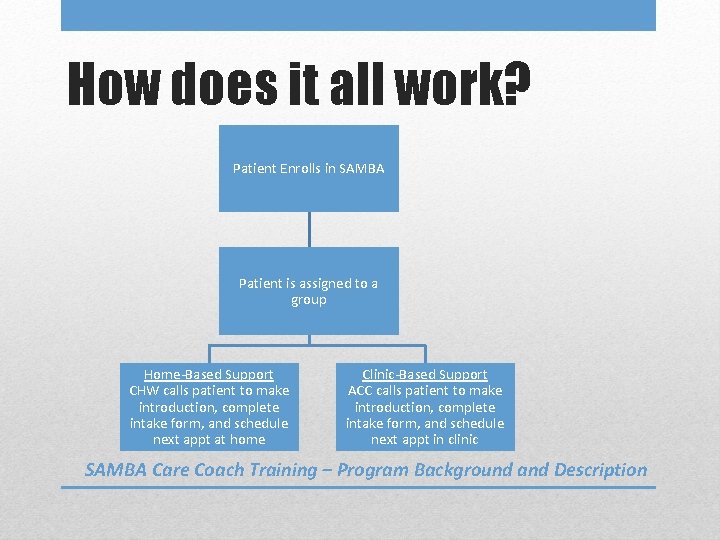
How does it all work? Patient Enrolls in SAMBA Patient is assigned to a group Home-Based Support CHW calls patient to make introduction, complete intake form, and schedule next appt at home Clinic-Based Support ACC calls patient to make introduction, complete intake form, and schedule next appt in clinic SAMBA Care Coach Training – Program Background and Description
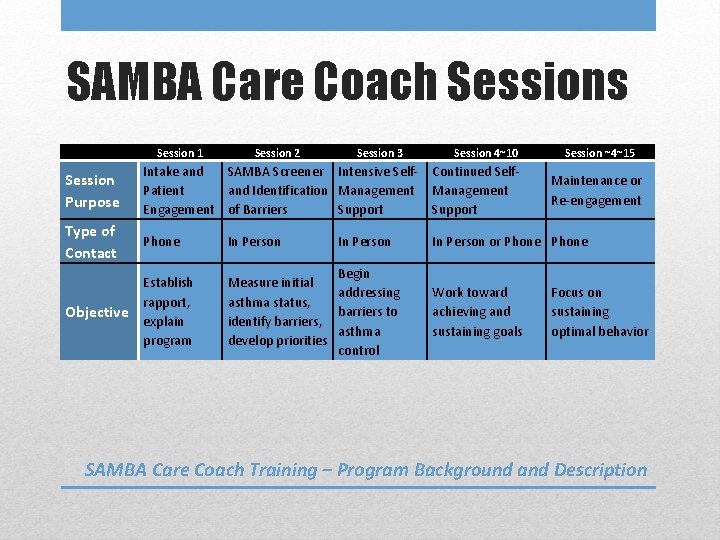
SAMBA Care Coach Sessions Session 1 Session 2 Session 3 Session 4~10 Session ~4~15 Session Purpose Intake and SAMBA Screener Intensive Self. Patient and Identification Management Engagement of Barriers Support Continued Self. Management Support Type of Contact Phone In Person or Phone Objective Establish rapport, explain program Begin Measure initial addressing asthma status, barriers to identify barriers, asthma develop priorities control In Person Work toward achieving and sustaining goals Maintenance or Re-engagement Focus on sustaining optimal behavior SAMBA Care Coach Training – Program Background and Description

SAMBA Intervention Materials • Training Manual • SAMBA Workbook • • SAMBA Sessions Overview Intake form Asthma Control Test SAMBA Screener Summary SAMBA Modules SAMBA Goal Sheet • Asthma 1 -2 -3 SAMBA Care Coach Training – Program Background and Description
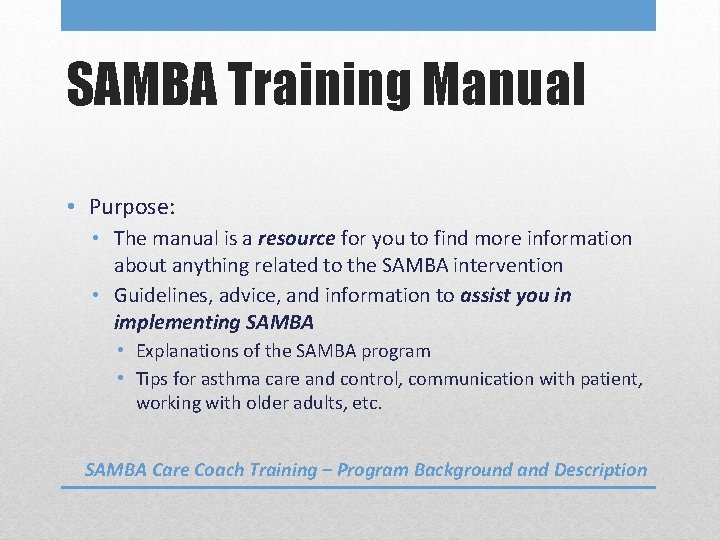
SAMBA Training Manual • Purpose: • The manual is a resource for you to find more information about anything related to the SAMBA intervention • Guidelines, advice, and information to assist you in implementing SAMBA • Explanations of the SAMBA program • Tips for asthma care and control, communication with patient, working with older adults, etc. SAMBA Care Coach Training – Program Background and Description
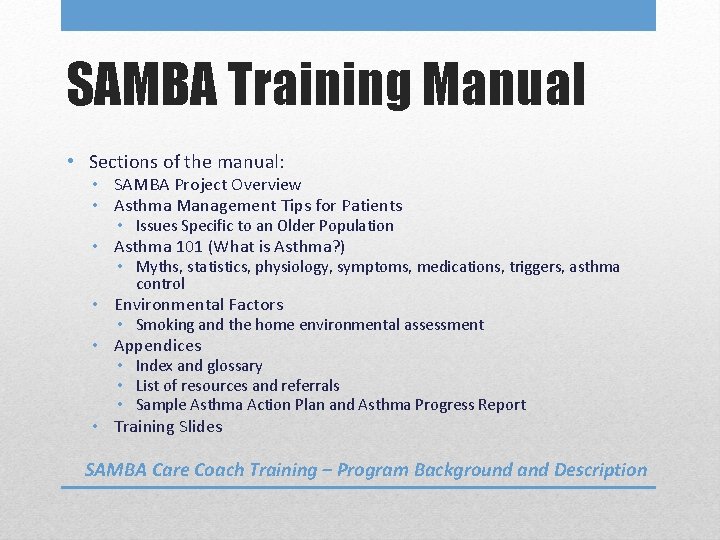
SAMBA Training Manual • Sections of the manual: • SAMBA Project Overview • Asthma Management Tips for Patients • Issues Specific to an Older Population • Asthma 101 (What is Asthma? ) • Myths, statistics, physiology, symptoms, medications, triggers, asthma control • Environmental Factors • Smoking and the home environmental assessment • Appendices • Index and glossary • List of resources and referrals • Sample Asthma Action Plan and Asthma Progress Report • Training Slides SAMBA Care Coach Training – Program Background and Description
SAMBA Workbook • Purpose: • One document with all SAMBA materials needed for patient encounters • Components: • • SAMBA Sessions Overview Intake form Asthma Control Test SAMBA Screener Summary SAMBA Modules SAMBA Goal Sheet SAMBA Care Coach Training – Program Background and Description
SAMBA Sessions Guide • Explains the objectives, goals, and tasks for each type of session in the SAMBA intervention SAMBA Care Coach Training – Program Background and Description
Intake Form • Allows you to collect necessary background information on new patients you are assigned. • • Demographics Healthcare help they receive or need Medications Asthma symptoms, priorities, and goals • Schedules first in person visit for the SAMBA Screener • Completed over the phone SAMBA Care Coach Training – Program Background and Description
Asthma Control Test (ACT) • Assesses patient asthma control • Completed at ALL sessions (unless it has already been done in the last 2 weeks) • 5 questions long • A score of <19 represents uncontrolled asthma SAMBA Care Coach Training – Program Background and Description
SAMBA Screener • Series of questions used to identify barriers to improving asthma control • Completed in person with each patient • Areas addressed: • • • • Asthma Medications Inhaler Technique (MDI and DPI) Medication Adherence Medication Beliefs Complementary and Alternative Medications Asthma Illness Beliefs Peak Flow Meter Usage Prioritizing Illnesses and Managing Multiple Medications Medication Organization Medication Costs Emotional Triggers of Asthma Depression and Anxiety Cognitive Impairment Smoking Alcohol/Drug Use Environmental Triggers of Asthma SAMBA Care Coach Training – Program Background and Description
SAMBA Screener Summary • Keeps track of barriers identified in the Screener and provides scripts to prioritize with the patient on how to address these issues • Facilitates a decision-making discussion with the patient • Organizes barriers that need to be addressed SAMBA Care Coach Training – Program Background and Description
SAMBA Modules • Walks you through how to address each barrier • Talking points for a targeted patient-centric, problemspecific intervention for each barrier identified in the Screener and marked in the Screener Summary • Divided into 3 intervention components • Educational Intervention • Clinical Intervention • Goal Setting SAMBA Care Coach Training – Program Background and Description
SAMBA Modules • Educational Intervention • A discussion based lesson plan for you, as the care coach, to teach the patient new information about asthma and to guide them with ideas and strategies to improve their asthma control, medication adherence, etc. • Clinical Intervention • Points of referral for you to reach out to other individuals, such as the patient’s doctor, in order to pass along important information about the patient or to help ensure that the patient is receiving the highest quality of care possible. • Goal Setting • These are opportunities for you to set goals for your patient in order to work towards improved asthma control. Goals can consist of behavioral changes, environmental changes, etc. that the patient will need to work towards over some period of time. SAMBA Care Coach Training – Program Background and Description

SAMBA Modules • The SAMBA workbook contains modules for the following topics: • Asthma Overview • Asthma Medications • MDI Technique • DPI Technique • Asthma Medication Side Effects • No Controller Medication • Peak Flow Meter • Organization and Routine • Environmental Triggers • Smoking Cessation • Alcohol Use • Medication Costs • Emotional Triggers: Mindfulness • Depression and Anxiety • Cognition SAMBA Care Coach Training – Program Background and Description
SAMBA Goal Sheet • At the end of each session, you will set a goal with the patient that is relevant to something discussed. The goal sheet will aid you to set specific, practical goals. This sheet will be given to the patient to keep at the end of the encounter and will remind them when the next session is. SAMBA Care Coach Training – Program Background and Description
Asthma 1 -2 -3 • A health education booklet designed for the SAMBA intervention • All patients will receive a copy of Asthma 1 -2 -3 • You will use Asthma 1 -2 -3 to reinforce material you discuss, as needed SAMBA Care Coach Training – Program Background and Description
The SAMBA Care Coach • You embody SAMBA’s multifaceted, individualized approach to empowering older adults with asthma, improving their self-management, and their asthma control • You are an educator, coach, facilitator, navigator, and care coordinator • You will then take steps to help the patient overcome their barriers to achieving asthma control • Your patients will become more engaged in their care and gain the confidence and skills needed to take control of their asthma and to improve their quality of life SAMBA Care Coach Training – Program Background and Description
Role of the Care Coach • As a SAMBA Care Coach, you will: • Deliver all aspects of the SAMBA intervention • Be an asthma expert, able to understand asthma and help your patients to live better with asthma. • Identify the barriers that stand in the way of asthma control. • Communicate with physicians and other health care providers to ensure your patients receive the best possible care. • Improve your patient’s quality of life. SAMBA Care Coach Training – Program Background and Description
- Slides: 32