
SALTS When H ion of an acid is

- Slides: 24
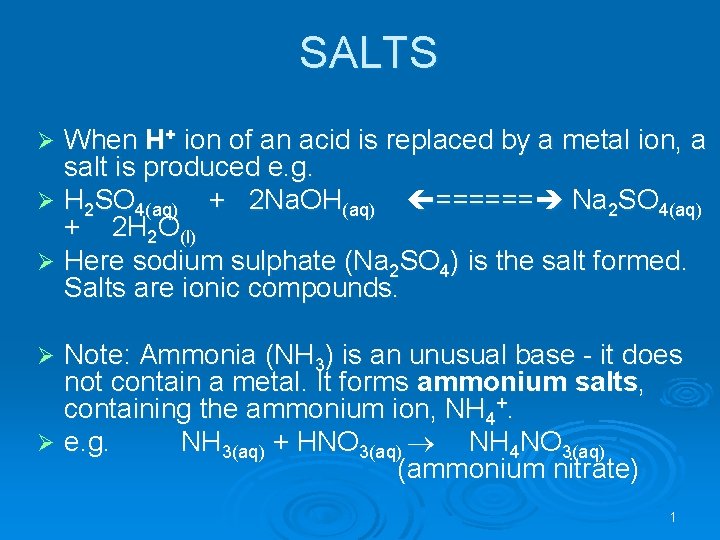
SALTS When H+ ion of an acid is replaced by a metal ion, a salt is produced e. g. Ø H 2 SO 4(aq) + 2 Na. OH(aq) ====== Na 2 SO 4(aq) + 2 H 2 O(l) Ø Here sodium sulphate (Na 2 SO 4) is the salt formed. Salts are ionic compounds. Ø Note: Ammonia (NH 3) is an unusual base - it does not contain a metal. It forms ammonium salts, containing the ammonium ion, NH 4+. Ø e. g. NH 3(aq) + HNO 3(aq) NH 4 NO 3(aq) (ammonium nitrate) Ø 1
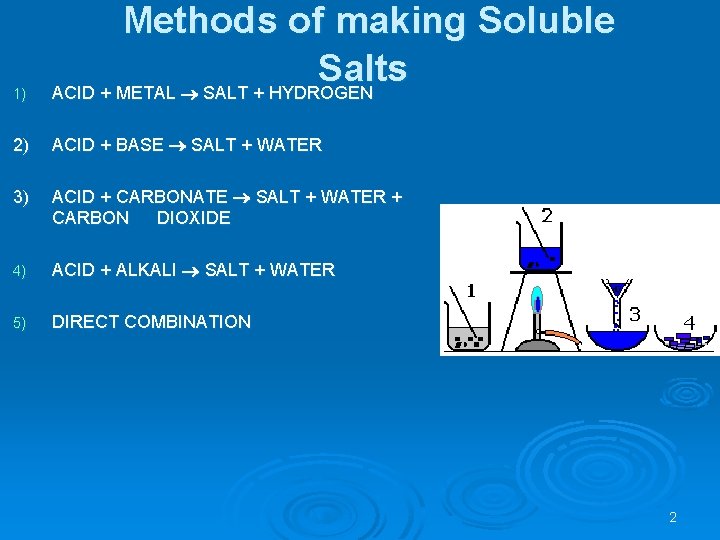
1) Methods of making Soluble Salts ACID + METAL SALT + HYDROGEN 2) ACID + BASE SALT + WATER 3) ACID + CARBONATE SALT + WATER + CARBON DIOXIDE 4) ACID + ALKALI SALT + WATER 5) DIRECT COMBINATION 2
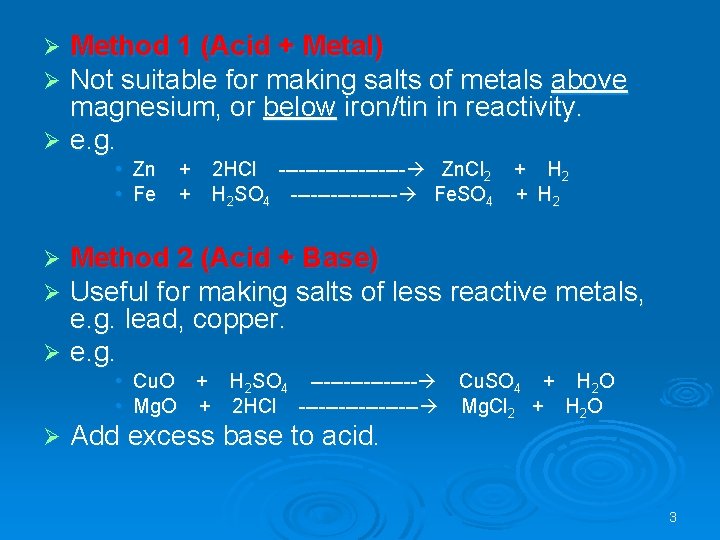
Method 1 (Acid + Metal) Not suitable for making salts of metals above magnesium, or below iron/tin in reactivity. Ø e. g. Ø Ø • Zn • Fe + + 2 HCl ---------- Zn. Cl 2 + H 2 SO 4 -------- Fe. SO 4 + H 2 Method 2 (Acid + Base) Useful for making salts of less reactive metals, e. g. lead, copper. Ø e. g. Ø Ø • Cu. O + H 2 SO 4 -------- Cu. SO 4 + H 2 O • Mg. O + 2 HCl --------- Mg. Cl 2 + H 2 O Ø Add excess base to acid. 3
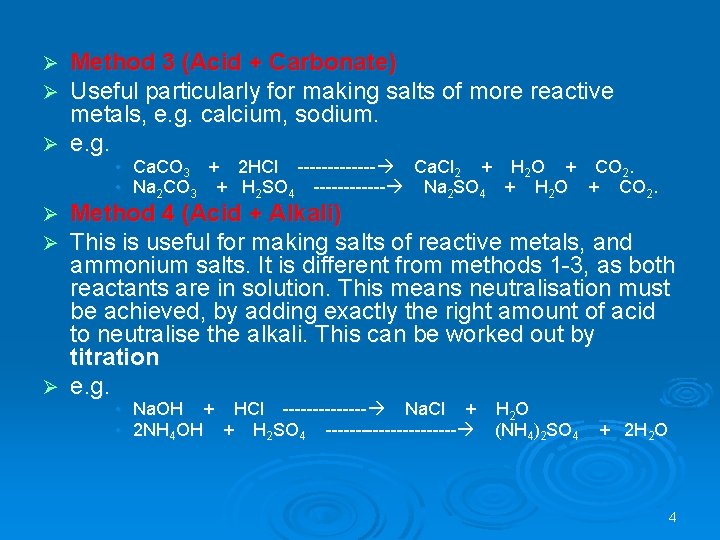
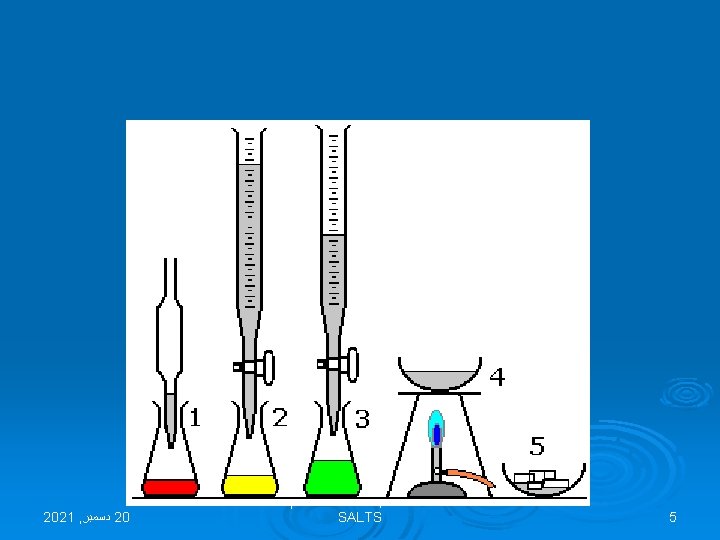
Method 3 (Acid + Carbonate) Useful particularly for making salts of more reactive metals, e. g. calcium, sodium. Ø e. g. Ø Ø • Ca. CO 3 + 2 HCl ------- Ca. Cl 2 + H 2 O + CO 2. • Na 2 CO 3 + H 2 SO 4 ------ Na 2 SO 4 + H 2 O + CO 2. Method 4 (Acid + Alkali) This is useful for making salts of reactive metals, and ammonium salts. It is different from methods 1 -3, as both reactants are in solution. This means neutralisation must be achieved, by adding exactly the right amount of acid to neutralise the alkali. This can be worked out by titration Ø e. g. Ø Ø • • Na. OH + HCl ------- Na. Cl + 2 NH 4 OH + H 2 SO 4 ----------- H 2 O (NH 4)2 SO 4 + 2 H 2 O 4
2021 , ﺩﺳﻤﺒﺮ 20 Topic 10: ACIDS, BASES & SALTS 5
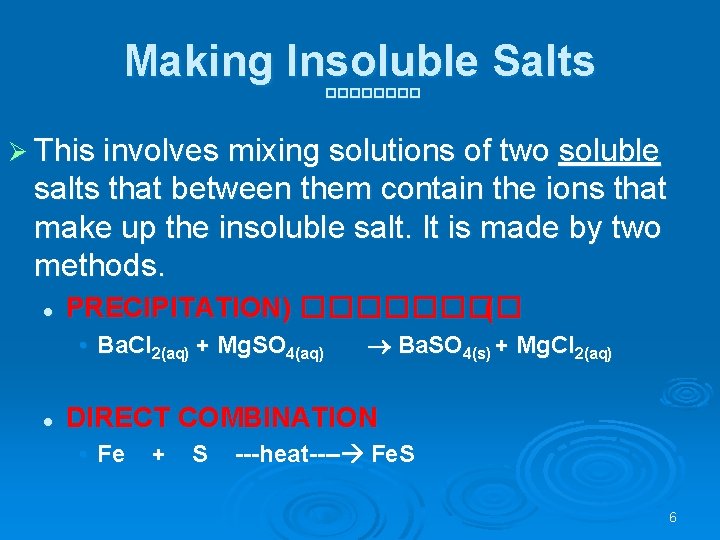
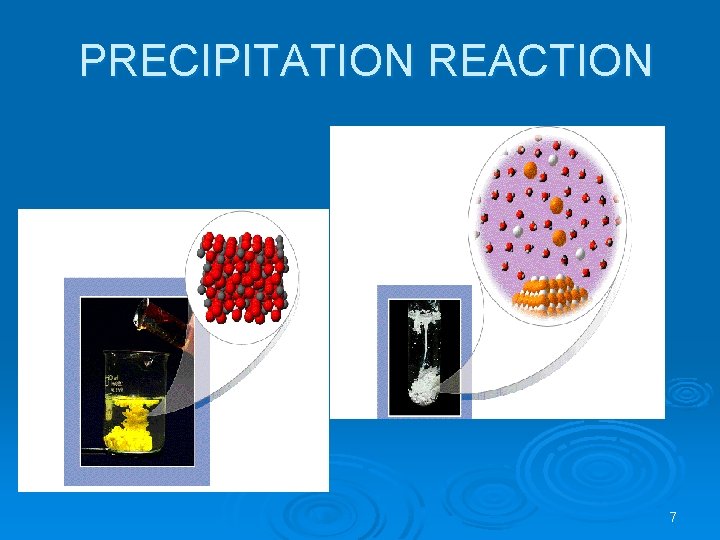
Making Insoluble Salts ���� Ø This involves mixing solutions of two soluble salts that between them contain the ions that make up the insoluble salt. It is made by two methods. l PRECIPITATION) ���� ( • Ba. Cl 2(aq) + Mg. SO 4(aq) l Ba. SO 4(s) + Mg. Cl 2(aq) DIRECT COMBINATION • Fe + S ---heat---- Fe. S 6
PRECIPITATION REACTION 7
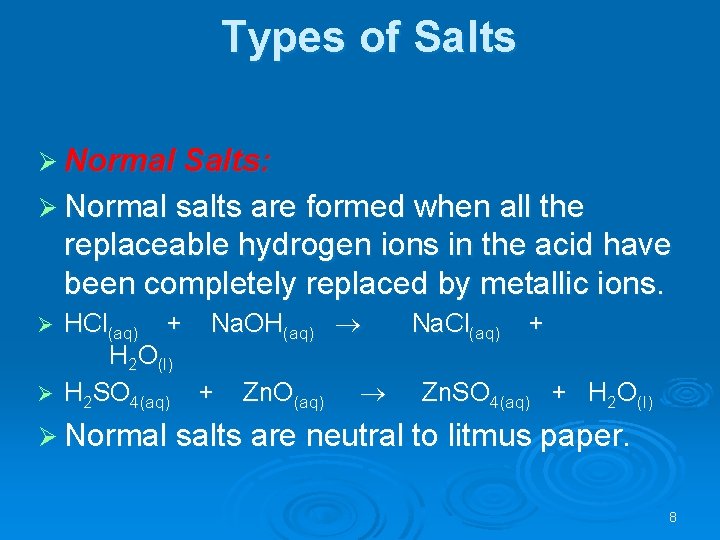
Types of Salts Ø Normal Salts: Ø Normal salts are formed when all the replaceable hydrogen ions in the acid have been completely replaced by metallic ions. HCl(aq) + Na. OH(aq) Na. Cl(aq) + H 2 O(l) Ø H 2 SO 4(aq) + Zn. O(aq) Zn. SO 4(aq) + H 2 O(l) Ø Ø Normal salts are neutral to litmus paper. 8
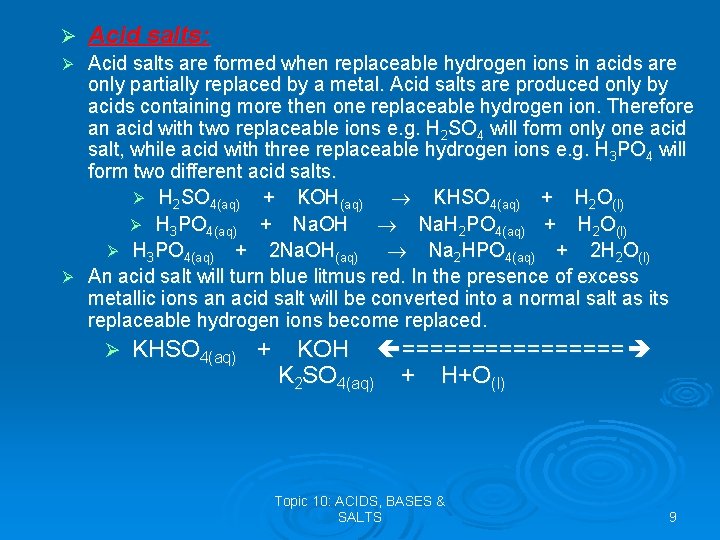
Ø Acid salts: Acid salts are formed when replaceable hydrogen ions in acids are only partially replaced by a metal. Acid salts are produced only by acids containing more then one replaceable hydrogen ion. Therefore an acid with two replaceable ions e. g. H 2 SO 4 will form only one acid salt, while acid with three replaceable hydrogen ions e. g. H 3 PO 4 will form two different acid salts. Ø H 2 SO 4(aq) + KOH(aq) KHSO 4(aq) + H 2 O(l) Ø H 3 PO 4(aq) + Na. OH Na. H 2 PO 4(aq) + H 2 O(l) Ø H 3 PO 4(aq) + 2 Na. OH(aq) Na 2 HPO 4(aq) + 2 H 2 O(l) Ø An acid salt will turn blue litmus red. In the presence of excess metallic ions an acid salt will be converted into a normal salt as its replaceable hydrogen ions become replaced. Ø Ø KHSO 4(aq) + KOH ======== K 2 SO 4(aq) + H+O(l) Topic 10: ACIDS, BASES & SALTS 9
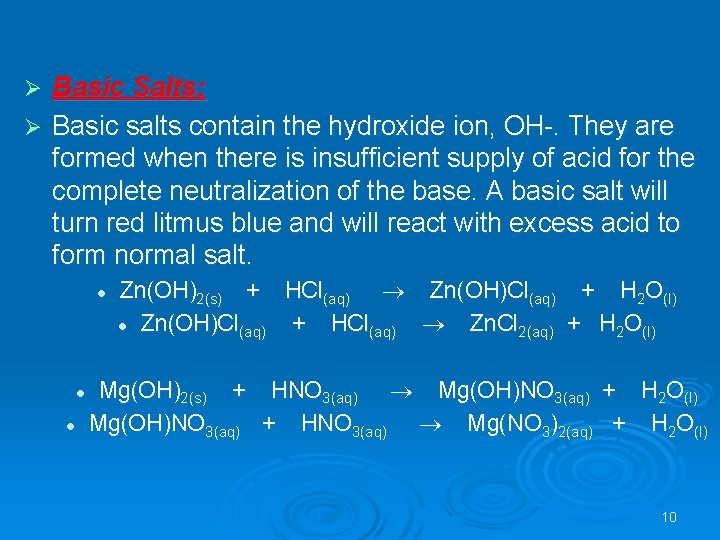
Basic Salts: Ø Basic salts contain the hydroxide ion, OH-. They are formed when there is insufficient supply of acid for the complete neutralization of the base. A basic salt will turn red litmus blue and will react with excess acid to form normal salt. Ø l l l Zn(OH)2(s) + HCl(aq) Zn(OH)Cl(aq) + H 2 O(l) l Zn(OH)Cl(aq) + HCl(aq) Zn. Cl 2(aq) + H 2 O(l) Mg(OH)2(s) + HNO 3(aq) Mg(OH)NO 3(aq) + H 2 O(l) Mg(OH)NO 3(aq) + HNO 3(aq) Mg(NO 3)2(aq) + H 2 O(l) 10
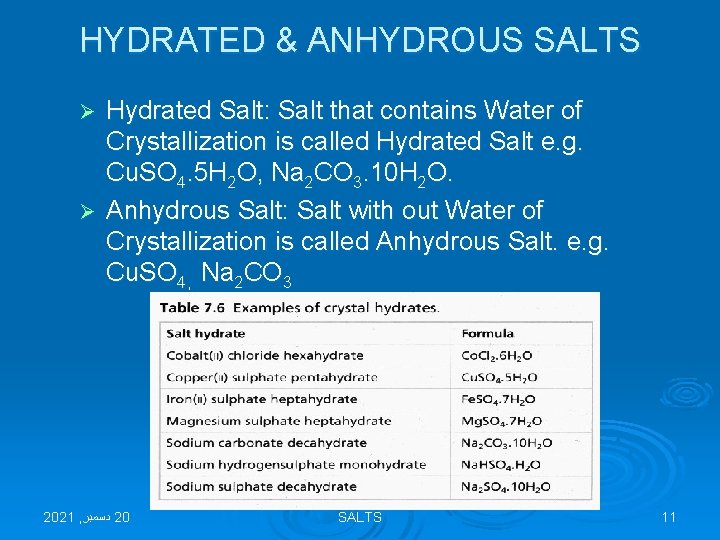
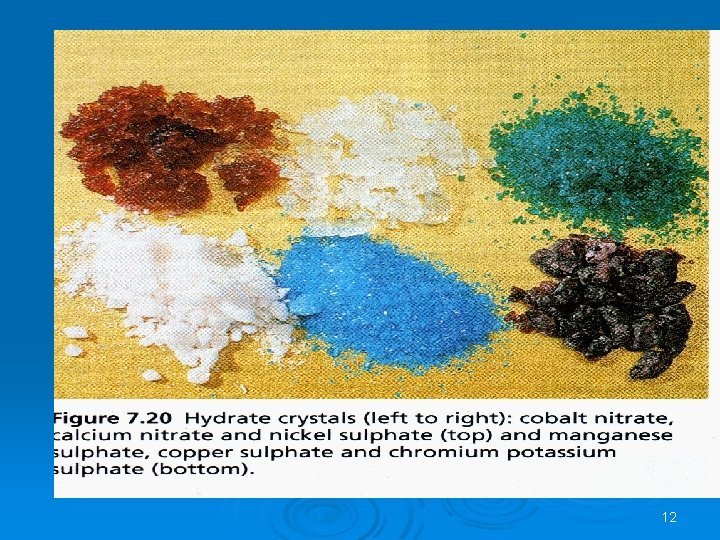
HYDRATED & ANHYDROUS SALTS Hydrated Salt: Salt that contains Water of Crystallization is called Hydrated Salt e. g. Cu. SO 4. 5 H 2 O, Na 2 CO 3. 10 H 2 O. Ø Anhydrous Salt: Salt with out Water of Crystallization is called Anhydrous Salt. e. g. Cu. SO 4, Na 2 CO 3 Ø 2021 , ﺩﺳﻤﺒﺮ 20 Topic 10: ACIDS, BASES & SALTS 11
12
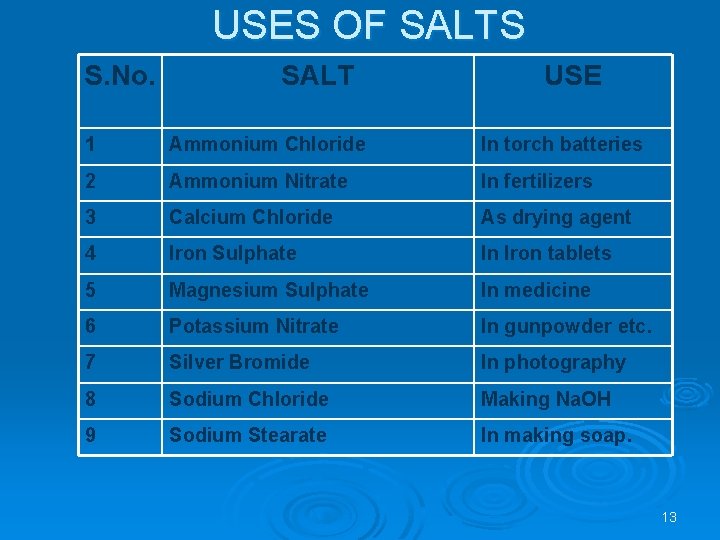
USES OF SALTS S. No. SALT USE 1 Ammonium Chloride In torch batteries 2 Ammonium Nitrate In fertilizers 3 Calcium Chloride As drying agent 4 Iron Sulphate In Iron tablets 5 Magnesium Sulphate In medicine 6 Potassium Nitrate In gunpowder etc. 7 Silver Bromide In photography 8 Sodium Chloride Making Na. OH 9 Sodium Stearate In making soap. 13
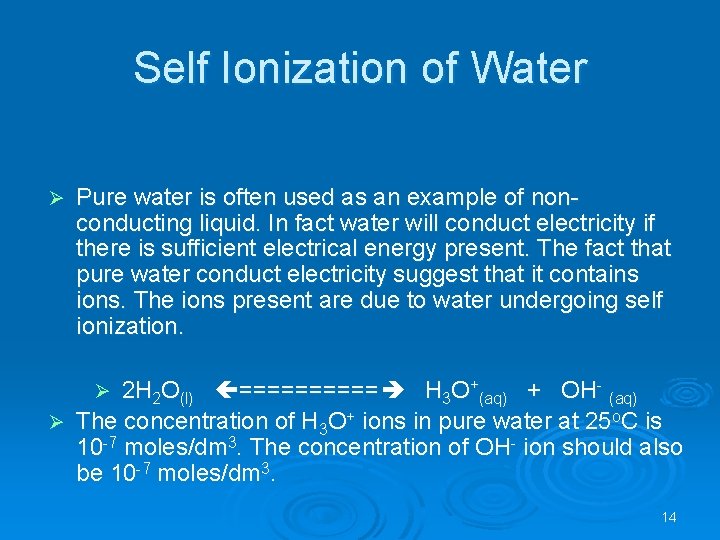
Self Ionization of Water Ø Pure water is often used as an example of nonconducting liquid. In fact water will conduct electricity if there is sufficient electrical energy present. The fact that pure water conduct electricity suggest that it contains ions. The ions present are due to water undergoing self ionization. 2 H 2 O(l) ===== H 3 O+(aq) + OH- (aq) Ø The concentration of H 3 O+ ions in pure water at 25 o. C is 10 -7 moles/dm 3. The concentration of OH- ion should also be 10 -7 moles/dm 3. Ø 14
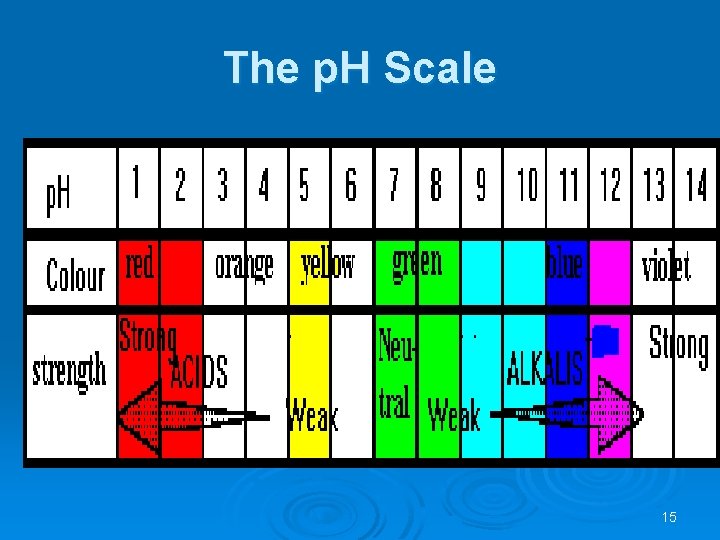
The p. H Scale 15
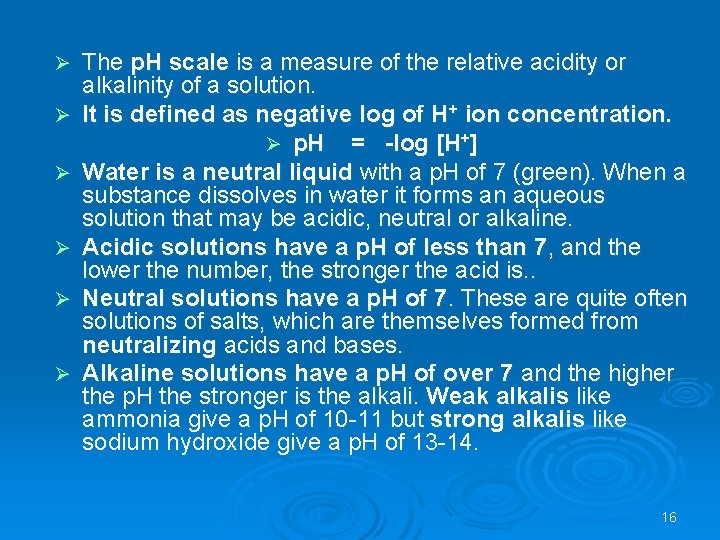
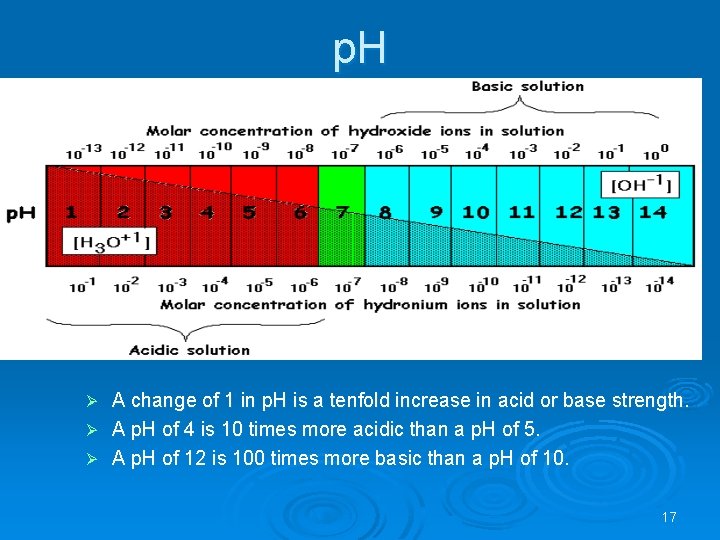
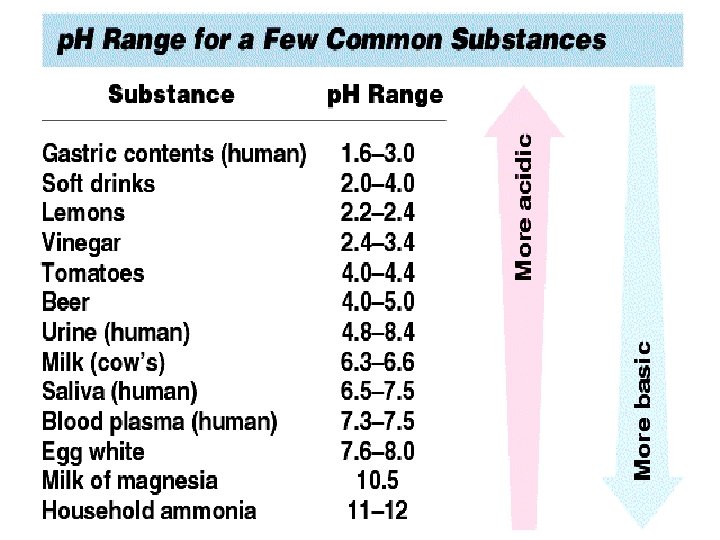
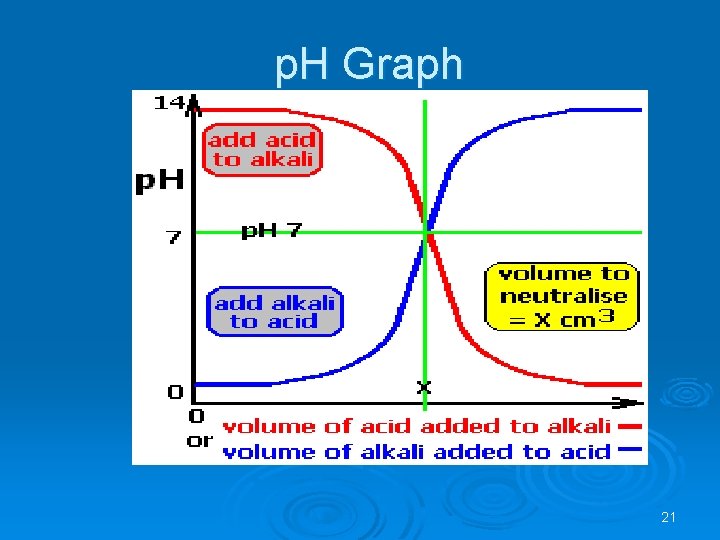
Ø Ø Ø The p. H scale is a measure of the relative acidity or alkalinity of a solution. It is defined as negative log of H+ ion concentration. Ø p. H = -log [H+] Water is a neutral liquid with a p. H of 7 (green). When a substance dissolves in water it forms an aqueous solution that may be acidic, neutral or alkaline. Acidic solutions have a p. H of less than 7, and the lower the number, the stronger the acid is. . Neutral solutions have a p. H of 7. These are quite often solutions of salts, which are themselves formed from neutralizing acids and bases. Alkaline solutions have a p. H of over 7 and the higher the p. H the stronger is the alkali. Weak alkalis like ammonia give a p. H of 10 -11 but strong alkalis like sodium hydroxide give a p. H of 13 -14. 16
p. H A change of 1 in p. H is a tenfold increase in acid or base strength. Ø A p. H of 4 is 10 times more acidic than a p. H of 5. Ø A p. H of 12 is 100 times more basic than a p. H of 10. Ø 17
Topic 10: ACIDS, BASES & SALTS 18
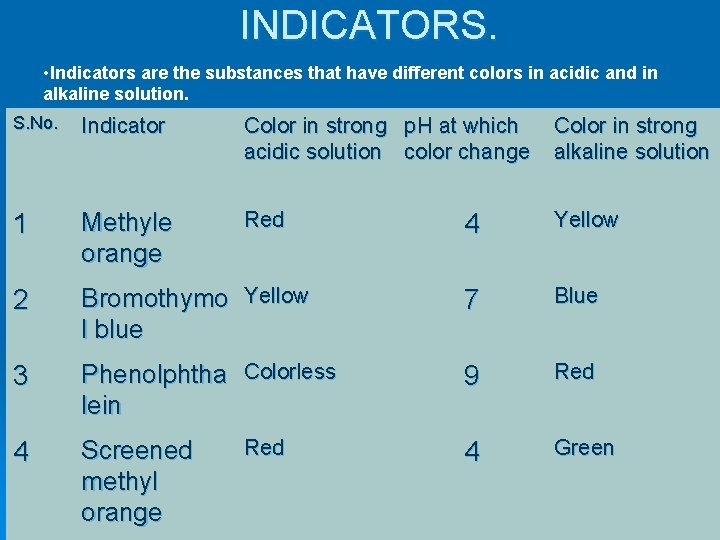
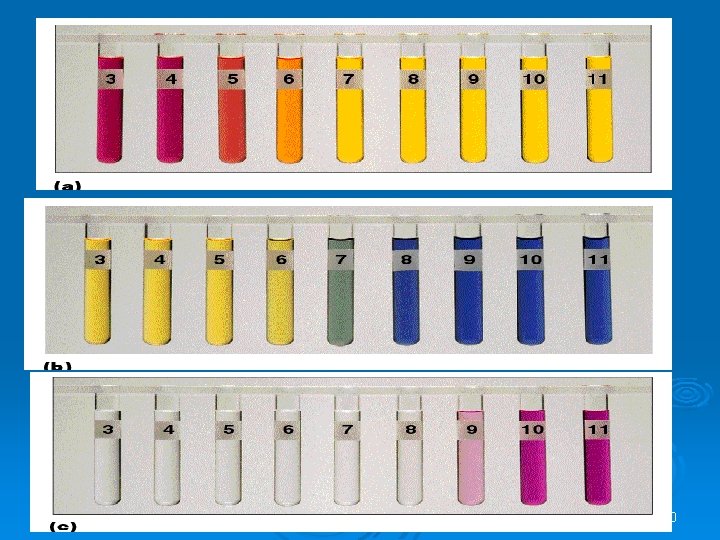
INDICATORS. • Indicators are the substances that have different colors in acidic and in alkaline solution. S. No. Indicator Color in strong p. H at which acidic solution color change Color in strong alkaline solution 1 Methyle orange Red 4 Yellow 2 Bromothymo Yellow l blue 7 Blue 3 Phenolphtha Colorless lein 9 Red 4 Screened methyl orange 4 Green Red Topic 10: ACIDS, BASES & SALTS 19
Topic 10: ACIDS, BASES & SALTS 20
p. H Graph 21
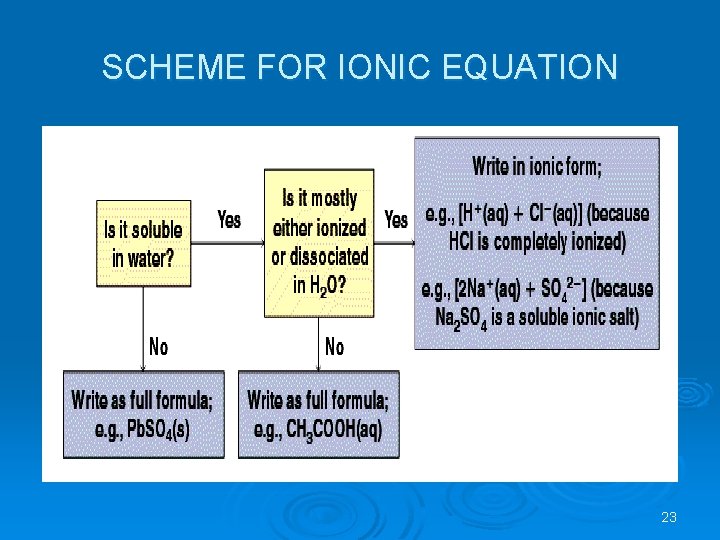
IONIC EQUATIONS In many reactions only certain ions change their 'chemical state' but other ions remain in exactly the same original physical and chemical state. Ø The ions that do not change are called 'spectator ions'. Ø The ionic equation represents the 'actual' chemical change and omits the spectator ions. Ø To write a net ionic equation: • Write a balanced molecular equation. • Rewrite the equation showing the ions that form in solution when each soluble electrolyte dissociates into its component ions. Only dissolved strong electrolytes are written in ionic form. • Identify and cancel the spectator ions that occur unchanged on both sides of the equation. • Write correct state symbols. 22
SCHEME FOR IONIC EQUATION 23
ØTHE END 24