
Salts can also be prepared in redox reactions

Salts can also be prepared in redox reactions of metals with acids. A student prepares a solution of aluminium sulfate by reacting aluminium with dilute sulfuric acid. 2 Al(s) + 3 H 2 SO 4(aq) → Al 2(SO 4)3(aq) + 3 H 2(g) Using oxidation numbers, show which element has been oxidised and which has been reduced in this reaction. State the changes in oxidation numbers, including all signs. element oxidised. . . . . . Element aluminium/Al 0 to +3 ✓ oxidation number change: from. . . to. . . . . oxidised: Element hydrogen/H/H+ +1 to 0 ✓ element reduced. . . . . . reduced: oxidation number change: from. . . to. . . . . [2]
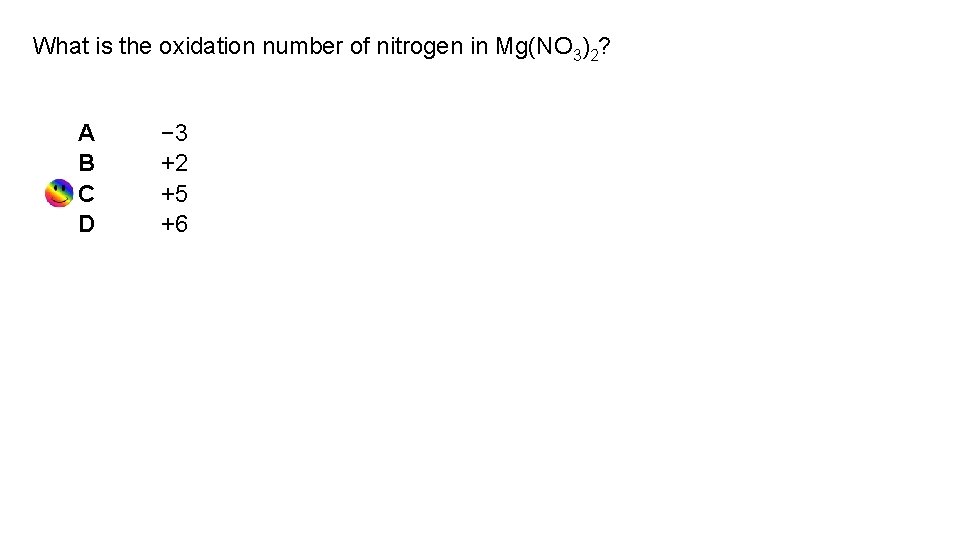
What is the oxidation number of nitrogen in Mg(NO 3)2? A B C D − 3 +2 +5 +6

Magnesium will undergo redox reactions with aqueous salts of less reactive metals. i. A student reacts magnesium with aqueous copper(II) sulfate. Mg(s) + Cu. SO 4(aq) → Cu(s) + Mg. SO 4(aq) Explain, in terms of numbers of electron transferred, the redox processes taking place in this reaction. Magnesium (atoms) has been oxidised AND Because it has lost two electrons ✓ Copper (ions) has been reduced AND Because it has gained two electrons ✓ [2]
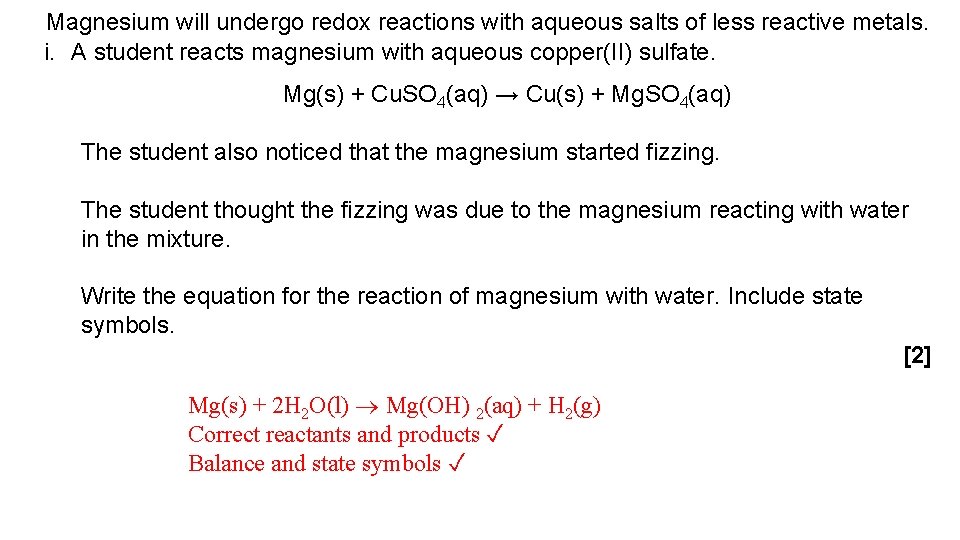
Magnesium will undergo redox reactions with aqueous salts of less reactive metals. i. A student reacts magnesium with aqueous copper(II) sulfate. Mg(s) + Cu. SO 4(aq) → Cu(s) + Mg. SO 4(aq) The student also noticed that the magnesium started fizzing. The student thought the fizzing was due to the magnesium reacting with water in the mixture. Write the equation for the reaction of magnesium with water. Include state symbols. [2] Mg(s) + 2 H 2 O(l) Mg(OH) 2(aq) + H 2(g) Correct reactants and products ✓ Balance and state symbols ✓
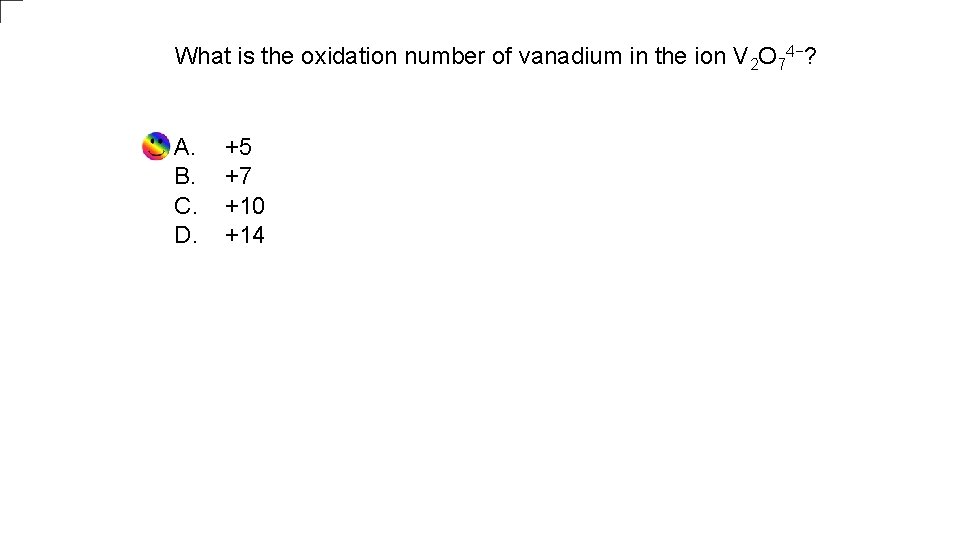
What is the oxidation number of vanadium in the ion V 2 O 74−? A. +5 B. +7 C. +10 D. +14
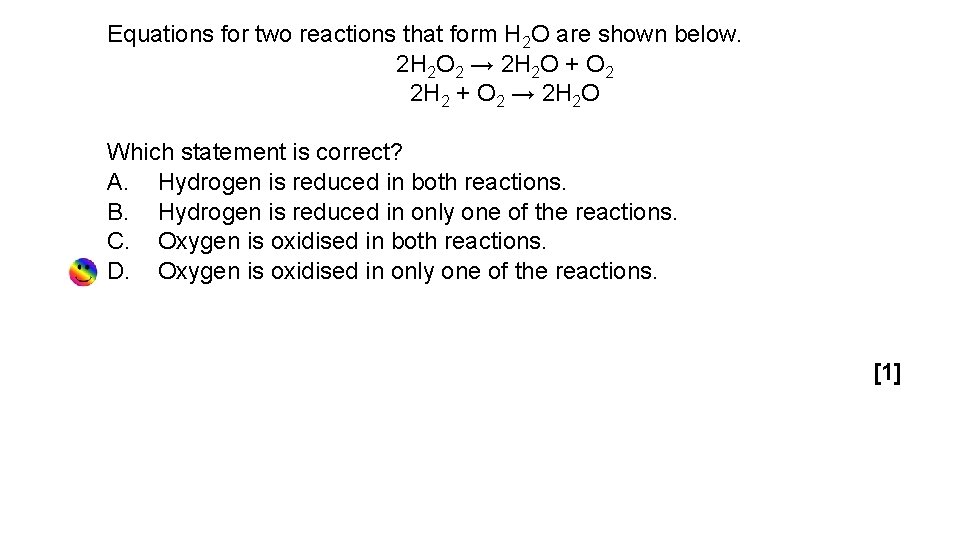
Equations for two reactions that form H 2 O are shown below. 2 H 2 O 2 → 2 H 2 O + O 2 2 H 2 + O 2 → 2 H 2 O Which statement is correct? A. Hydrogen is reduced in both reactions. B. Hydrogen is reduced in only one of the reactions. C. Oxygen is oxidised in both reactions. D. Oxygen is oxidised in only one of the reactions. [1]
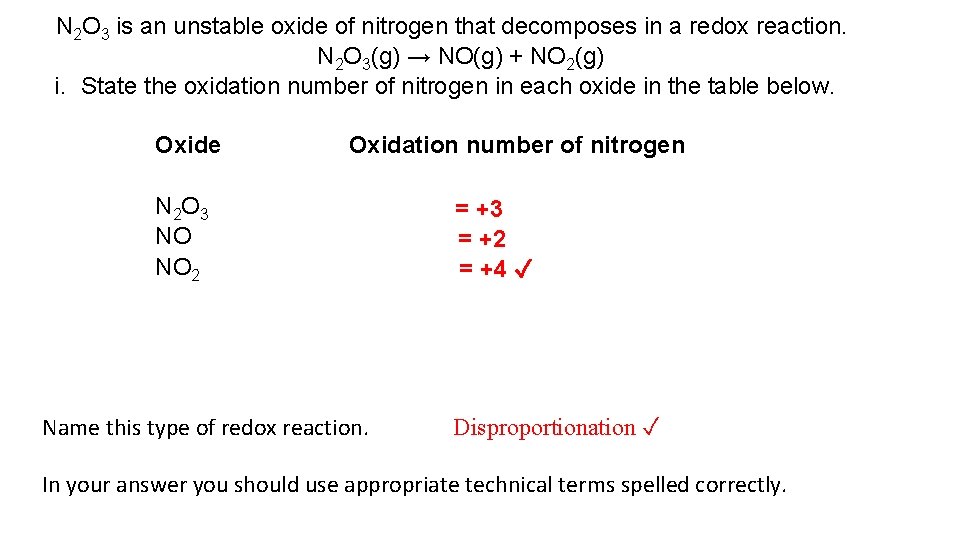
N 2 O 3 is an unstable oxide of nitrogen that decomposes in a redox reaction. N 2 O 3(g) → NO(g) + NO 2(g) i. State the oxidation number of nitrogen in each oxide in the table below. Oxide Oxidation number of nitrogen N 2 O 3 NO NO 2 = +3 = +2 = +4 ✓ Name this type of redox reaction. Disproportionation ✓ In your answer you should use appropriate technical terms spelled correctly.
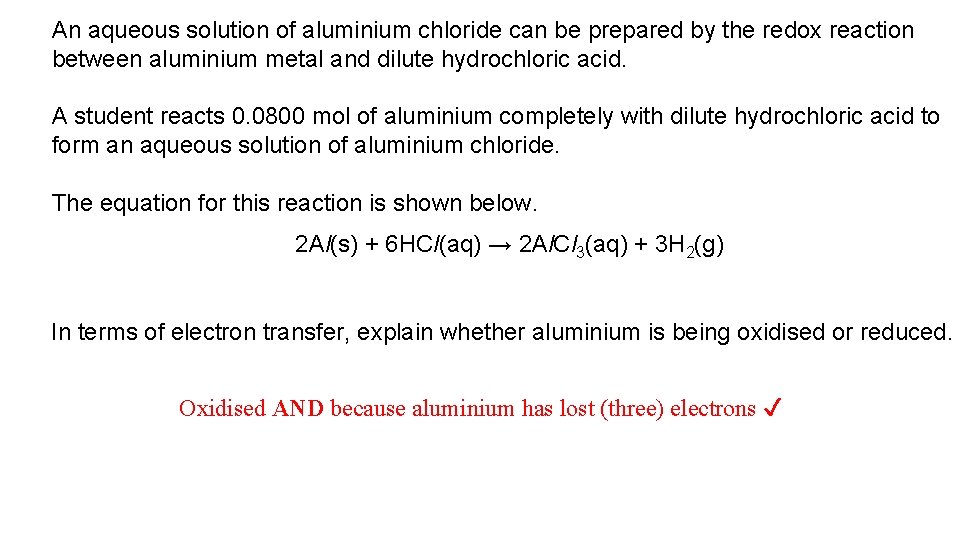
An aqueous solution of aluminium chloride can be prepared by the redox reaction between aluminium metal and dilute hydrochloric acid. A student reacts 0. 0800 mol of aluminium completely with dilute hydrochloric acid to form an aqueous solution of aluminium chloride. The equation for this reaction is shown below. 2 Al(s) + 6 HCl(aq) → 2 Al. Cl 3(aq) + 3 H 2(g) In terms of electron transfer, explain whether aluminium is being oxidised or reduced. Oxidised AND because aluminium has lost (three) electrons ✔
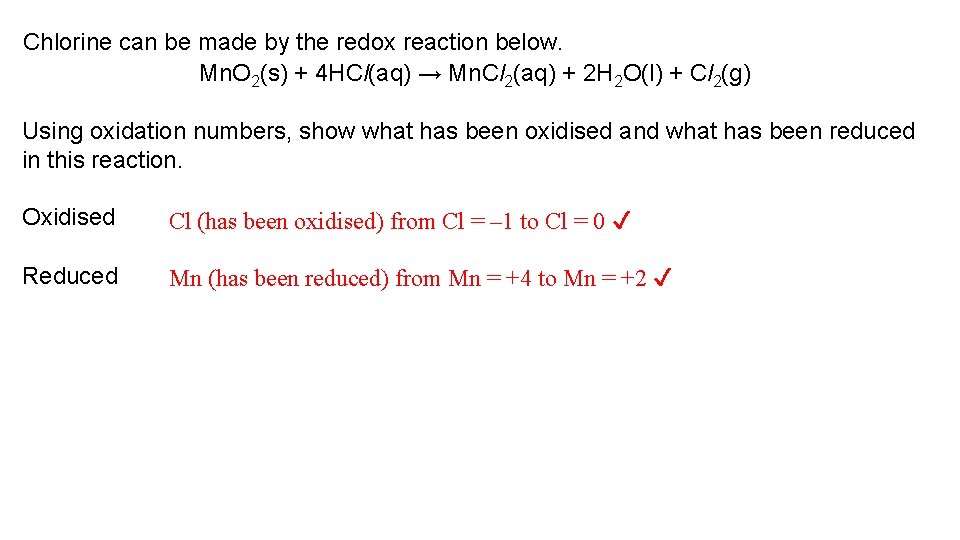
Chlorine can be made by the redox reaction below. Mn. O 2(s) + 4 HCl(aq) → Mn. Cl 2(aq) + 2 H 2 O(l) + Cl 2(g) Using oxidation numbers, show what has been oxidised and what has been reduced in this reaction. Oxidised Cl (has been oxidised) from Cl = – 1 to Cl = 0 ✔ Reduced Mn (has been reduced) from Mn = +4 to Mn = +2 ✔
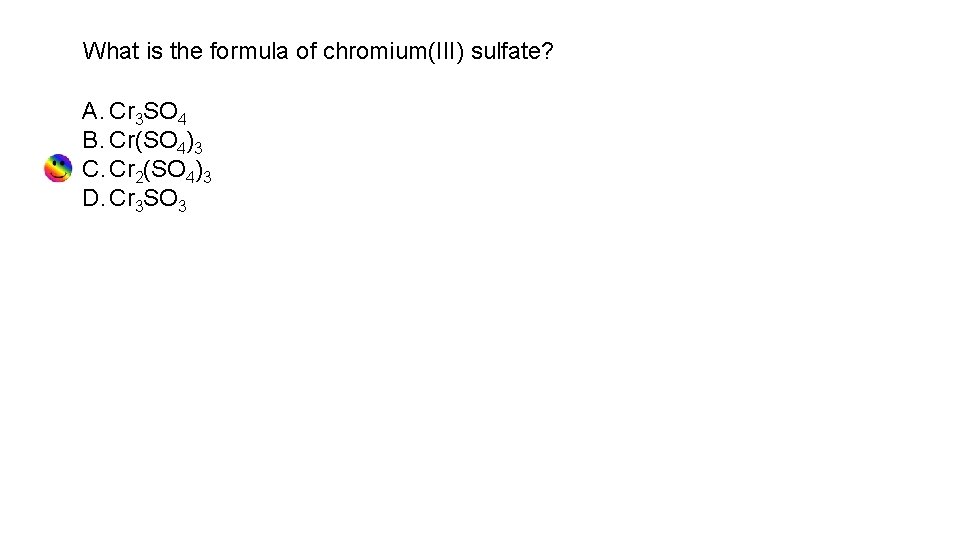
What is the formula of chromium(III) sulfate? A. Cr 3 SO 4 B. Cr(SO 4)3 C. Cr 2(SO 4)3 D. Cr 3 SO 3
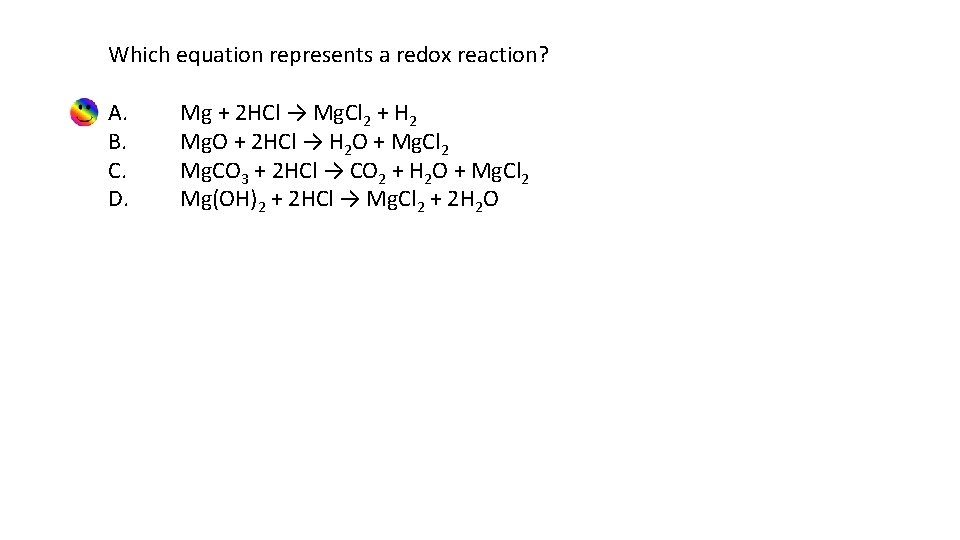
Which equation represents a redox reaction? A. B. C. D. Mg + 2 HCl → Mg. Cl 2 + H 2 Mg. O + 2 HCl → H 2 O + Mg. Cl 2 Mg. CO 3 + 2 HCl → CO 2 + H 2 O + Mg. Cl 2 Mg(OH)2 + 2 HCl → Mg. Cl 2 + 2 H 2 O

Carbon monoxide can be made in the laboratory by heating a mixture of zinc metal and calcium carbonate. An equation for this reaction is shown below. Zn(s) + Ca. CO 3(s) → Zn. O(s) + Ca. O(s) + CO(g) This reaction is a redox reaction. Deduce which element has been oxidised and which has been reduced, and state the change in oxidation number in each case. element oxidised. . . . oxidation number change: from. . . . to. . . . element reduced. . . . oxidation number change: from. . . . to. . . .
- Slides: 12