
Salt Water vs Fresh Water A closer look
- Slides: 13
Salt Water vs. Fresh Water A closer look
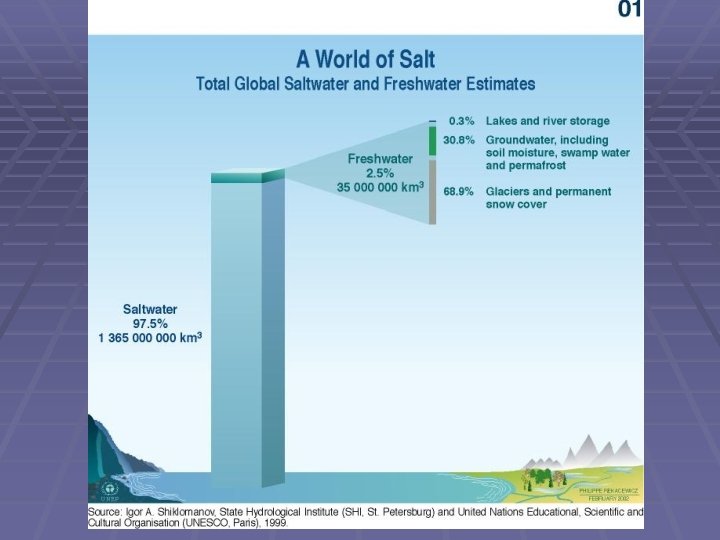
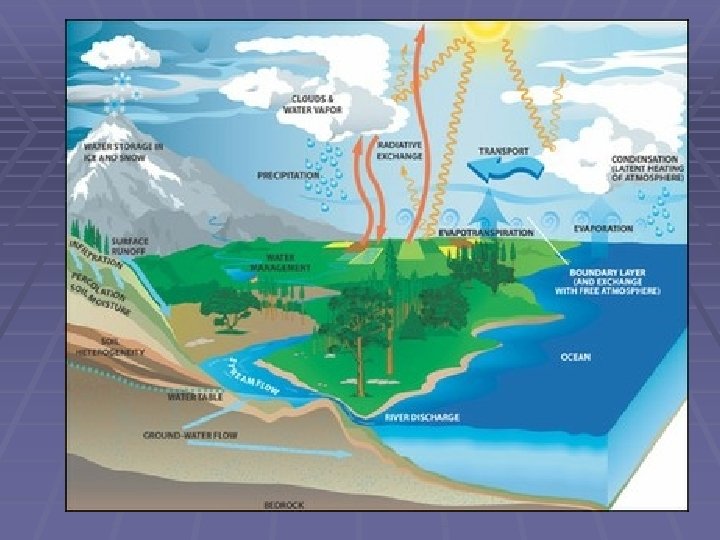
Salt Water vs. Fresh Water § Approximately 97% of the Earth’s water is salt water in seas and oceans. Only 3% of our global water supply is fresh water. § Most of this fresh water is not being used, as it is locked up in glaciers and polar icecaps. The rest is located in rivers, lakes, rain clouds, water vapour in the air and in groundwater.
Salt Water vs. Fresh Water § When ocean water evaporates, the salt is left behind. The water in clouds falls into lakes and rivers as fresh water. As water seeps through the soil, however, it can pick up salts and minerals. This ‘salty’ water seeps into streams and rivers, which then carry it back to the oceans.
§ Salinity is a measure of the quantity of dissolved salt in water § Recall the density of fresh water and salt water § Is there a way to change salt water into fresh water?
Desalination § Desalination is the technology of removing salt and other minerals from water. § There are 2 processes by which this can be done: 1. Distillation 2. Reverse Osmosis
Distillation § Distillation uses evaporation to separate impurities, such as salt, from pure water. The water must be heated until it evaporates, so the pure water rises as steam and particulates stay behind in brine water. The steam condenses in another collection container while brine is ejected. § Distillation has the advantage of using thermal energy, such as sunlight, thus saving electricity costs. However, it creates less fresh water as a percentage of impure water (the recovery rate) than reverse osmosis.
Reverse Osmosis § In reverse osmosis, the feedwater can be either saltwater or recovered "gray" water from a city's waste supply. The force of a fan presses feedwater through membranes with pores that let water molecules to permeate, but don't allow salt and pollutants through. A series of filtering membranes, with progressively sensitive membranes, are more effective and don't clog as easily. § Reverse osmosis requires a lot of electricity to power the fans, as well as chemical treatment of gray water, but has a recovery rate of close to 50%.
GE Desalination Process § http: //www. gewater. com/what_we_do/wate r_scarcity/desalination. jsp § http: //www. youtube. com/watch? v=n. CCimp Aa. Iz. I&feature=related&safety_mode=true &persist_safety_mode=1&safe=active § http: //www. youtube. com/watch? v=nb. PNw 3 Ja. L 7 w&feature=related&safety_mode=tr ue&persist_safety_mode=1&safe=active
Israeli Desalination Process § http: //video. google. com/videoplay? docid=533393068543996960
Off-shore Desalination § http: //www. dailymotion. com/video/x 4 y 8 x 4_ water-desalination_shortfilms
Science Homework § Discuss how salt gets into Ocean water.