
Salt Lake County Intercepts An Integrated Behavioral Health
Salt Lake County Intercepts: An Integrated Behavioral Health – Criminal Justice Response System RCPA 2014 Conference October 2014 Patrick Fleming Ken Anderson Director SLCO Behavioral Health VP Business Development – Optum
Salt Lake County Intercepts • • • Optum Salt Lake County Overview System Redesign Outcomes and Results What Remains to be Done Lessons Learned
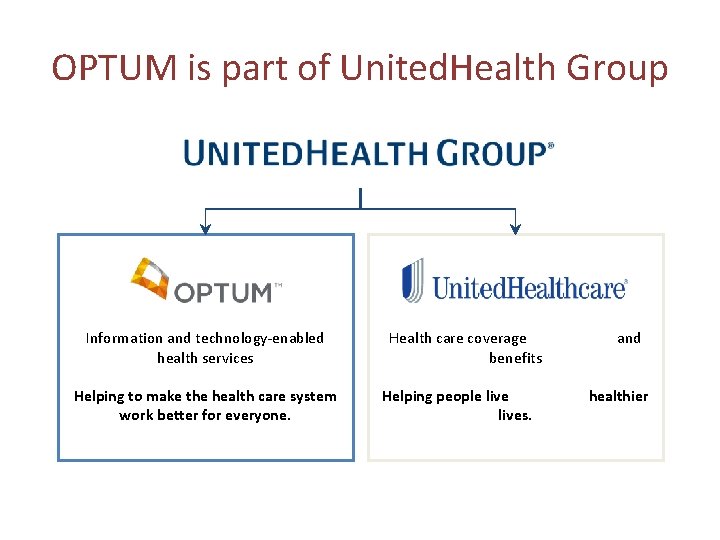
OPTUM is part of United. Health Group Information and technology-enabled health services Helping to make the health care system work better for everyone. Health care coverage and benefits Helping people live healthier lives.
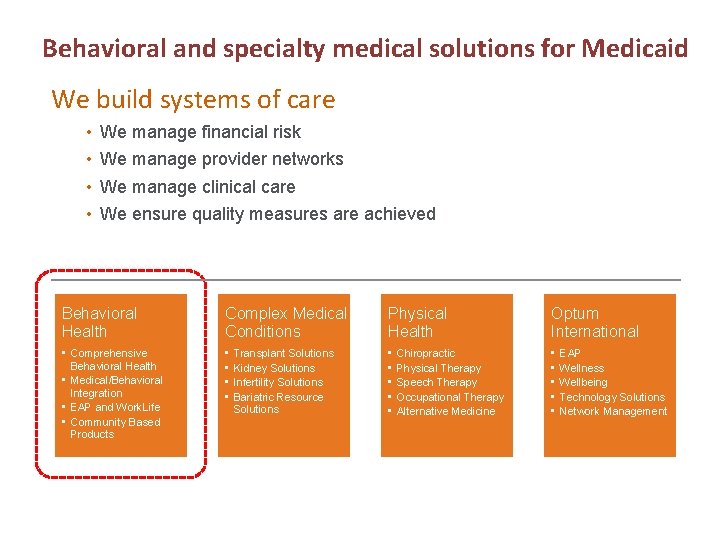
Behavioral and specialty medical solutions for Medicaid We build systems of care • • We manage financial risk We manage provider networks We manage clinical care We ensure quality measures are achieved Behavioral Health Complex Medical Conditions Physical Health Optum International • Comprehensive Behavioral Health • Medical/Behavioral Integration • EAP and Work. Life • Community Based Products • • • • Transplant Solutions Kidney Solutions Infertility Solutions Bariatric Resource Solutions Chiropractic Physical Therapy Speech Therapy Occupational Therapy Alternative Medicine EAP Wellness Wellbeing Technology Solutions Network Management
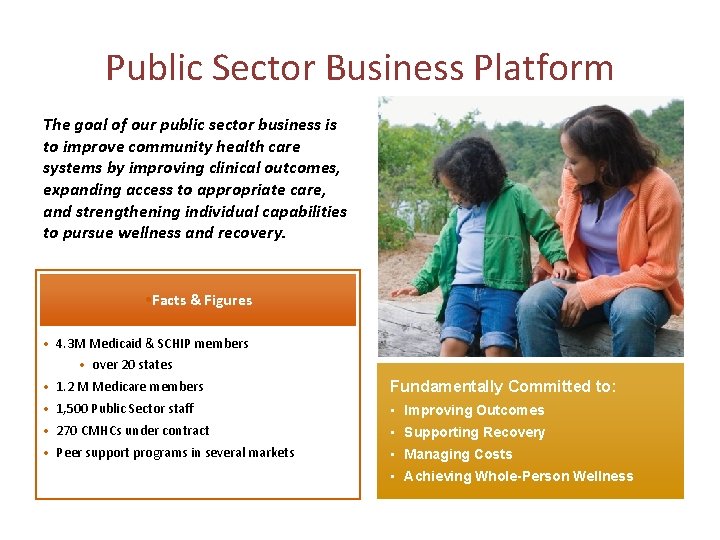
Public Sector Business Platform The goal of our public sector business is to improve community health care systems by improving clinical outcomes, expanding access to appropriate care, and strengthening individual capabilities to pursue wellness and recovery. • Facts & Figures • 4. 3 M Medicaid & SCHIP members • over 20 states • 1. 2 M Medicare members Fundamentally Committed to: • 1, 500 Public Sector staff • Improving Outcomes • 270 CMHCs under contract • Supporting Recovery • Peer support programs in several markets • Managing Costs • Achieving Whole-Person Wellness
Our footprint: County/State contracts • OPTUM manages county behavioral health carve-outs in: – – • Pierce County, Washington since 2009 Salt Lake County, Utah since 2010 San Diego County, California (ASO) since 1997 New York City , New York (ASO) since 2011 OPTUM serves as the BHO for the following states: – Idaho since 2013 – New Mexico since 2009 (ASO since January 2014) • OPTUM provides behavioral health specialty network services in integrated models for several states: – – – Tennessee Kansas Texas Ohio (including MME effective 4/1/2014) Washington (including MME effective 7/1/2014) 15 other states (for total of 20)
Salt Lake County Overview • Demographics of County • County Government Structure – Human Services Agency – County Jail – Criminal Justice System – Law Enforcement – Services Funding – Medicaid and General Fund • State Operated Services
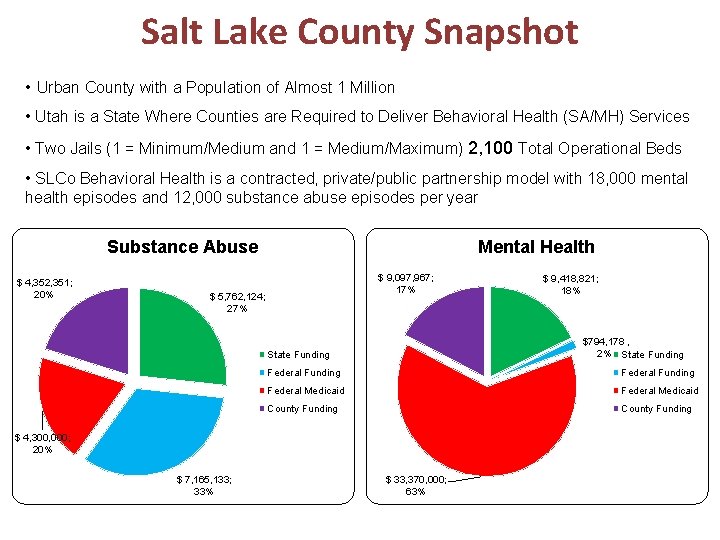
Salt Lake County Snapshot • Urban County with a Population of Almost 1 Million • Utah is a State Where Counties are Required to Deliver Behavioral Health (SA/MH) Services • Two Jails (1 = Minimum/Medium and 1 = Medium/Maximum) 2, 100 Total Operational Beds • SLCo Behavioral Health is a contracted, private/public partnership model with 18, 000 mental health episodes and 12, 000 substance abuse episodes per year Substance Abuse $ 4, 352, 351; 20% Mental Health $ 9, 097, 967; 17% $ 5, 762, 124; 27% $794, 178 , 2% State Funding Federal Medicaid County Funding $ 4, 300, 000; 20% $ 7, 165, 133; 33% $ 9, 418, 821; 18% $ 33, 370, 000; 63%
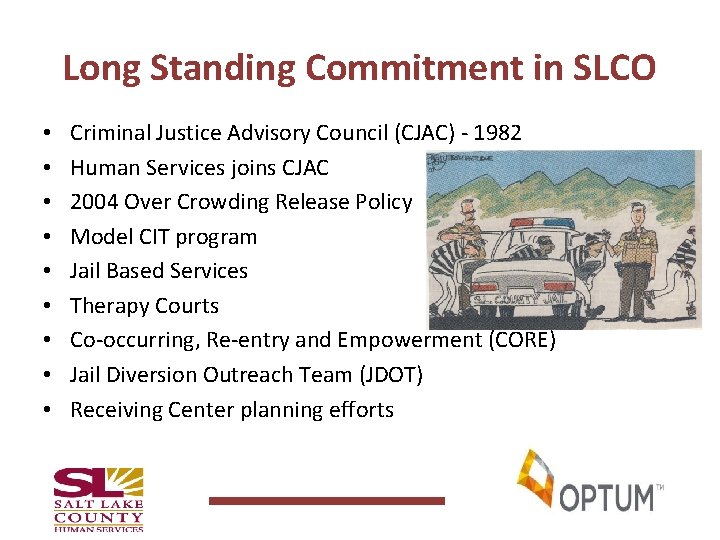
Long Standing Commitment in SLCO • • • Criminal Justice Advisory Council (CJAC) - 1982 Human Services joins CJAC 2004 Over Crowding Release Policy Model CIT program Jail Based Services Therapy Courts Co-occurring, Re-entry and Empowerment (CORE) Jail Diversion Outreach Team (JDOT) Receiving Center planning efforts
System Redesign • Move to Managed Care – Contract directly with State as PIHP – RFP for selection of MBHO Partner – Selection of Optum • Renewed Crisis System Planning – Part III – Inclusive process – Report to County Council – Release of procurement RFPs for services
What has been Added or Reconfigured • • Mobile Crisis Outreach Team (MCOT) New Receiving Center New Wellness Recovery Center Community Response Team (CRT) Crisis Line and New Warm Line Peer Bridger Alternative to Incarceration (ATI) Transportation
What has been added, cont. • Housing Initiatives – RIO Housing – HARP Housing – Mental Health Court Housing • • Top Ten review process and planning Jail Mental Health Release process Case Resolution Coordinator DORA
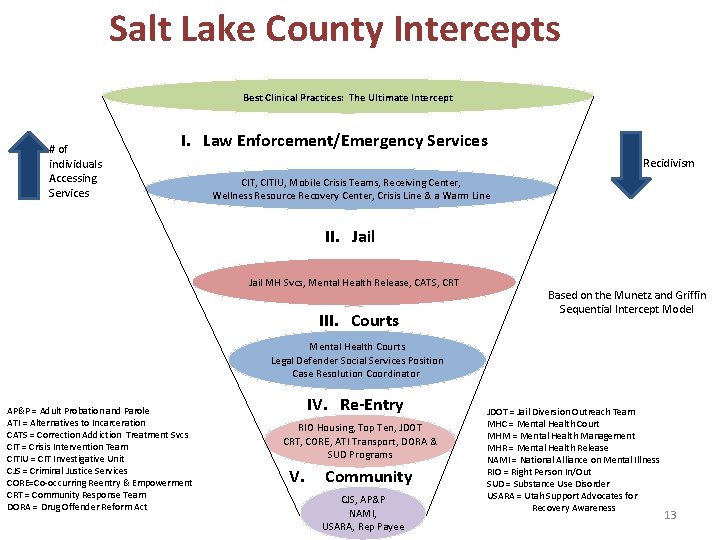
Salt Lake County Intercepts Best Clinical Practices: The Ultimate Intercept # of individuals Accessing Services I. Law Enforcement/Emergency Services Recidivism CIT, CITIU, Mobile Crisis Teams, Receiving Center, Wellness Resource Recovery Center, Crisis Line & a Warm Line II. Jail MH Svcs, Mental Health Release, CATS, CRT III. Courts Based on the Munetz and Griffin Sequential Intercept Model Mental Health Courts Legal Defender Social Services Position Case Resolution Coordinator AP&P = Adult Probation and Parole ATI = Alternatives to Incarceration CATS = Correction Addiction Treatment Svcs CIT = Crisis Intervention Team CITIU = CIT Investigative Unit CJS = Criminal Justice Services CORE=Co-occurring Reentry & Empowerment CRT = Community Response Team DORA = Drug Offender Reform Act IV. Re-Entry RIO Housing, Top Ten, JDOT CRT, CORE, ATI Transport, DORA & SUD Programs V. Community CJS, AP&P NAMI, USARA, Rep Payee JDOT = Jail Diversion Outreach Team MHC = Mental Health Court MHM = Mental Health Management MHR = Mental Health Release NAMI = National Alliance on Mental Illness RIO = Right Person In/Out SUD = Substance Use Disorder USARA = Utah Support Advocates for Recovery Awareness 13
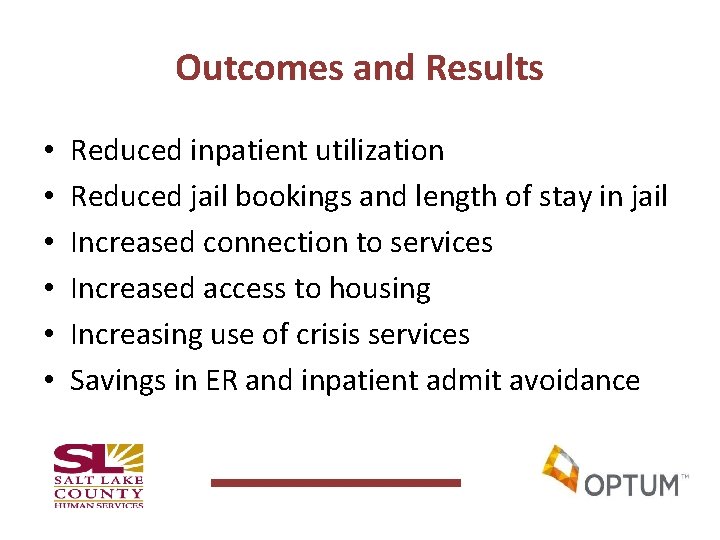
Outcomes and Results • • • Reduced inpatient utilization Reduced jail bookings and length of stay in jail Increased connection to services Increased access to housing Increasing use of crisis services Savings in ER and inpatient admit avoidance
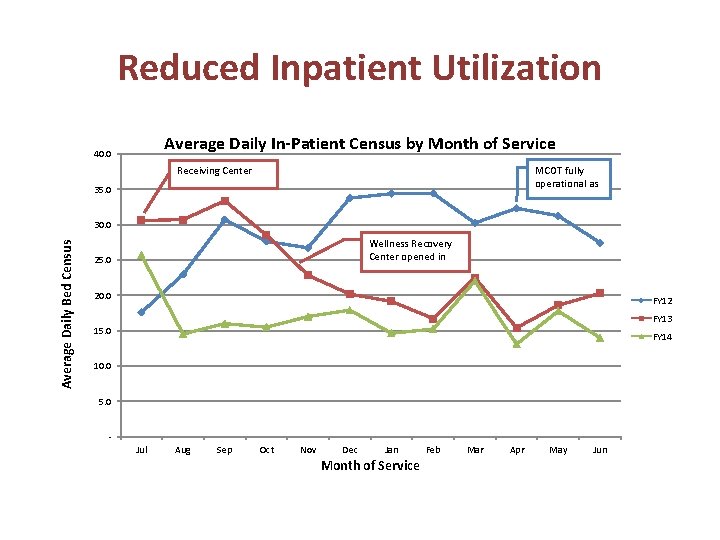
Reduced Inpatient Utilization Average Daily In-Patient Census by Month of Service 40. 0 MCOT fully operational as Receiving Center 35. 0 Average Daily Bed Census 30. 0 Wellness Recovery Center opened in 25. 0 20. 0 FY 12 FY 13 15. 0 FY 14 10. 0 5. 0 Jul Aug Sep Oct Nov Dec Jan Month of Service Feb Mar Apr May Jun
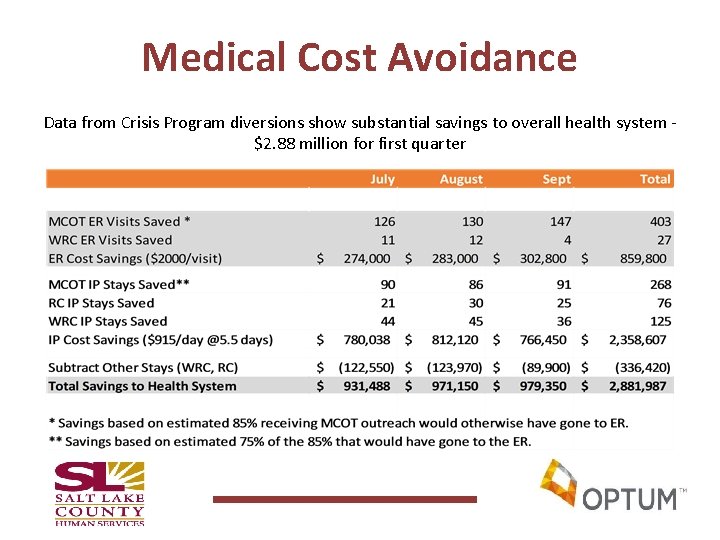
Medical Cost Avoidance Data from Crisis Program diversions show substantial savings to overall health system - $2. 88 million for first quarter
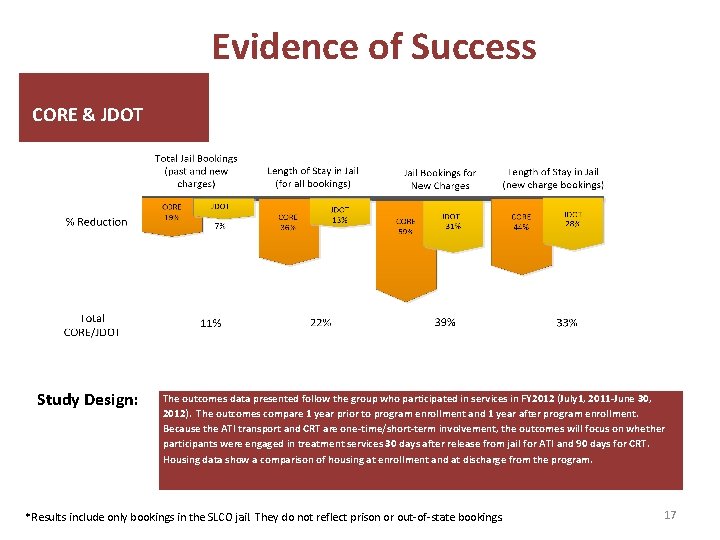
Evidence of Success CORE & JDOT Study Design: The outcomes data presented follow the group who participated in services in FY 2012 (July 1, 2011 -June 30, 2012). The outcomes compare 1 year prior to program enrollment and 1 year after program enrollment. Because the ATI transport and CRT are one-time/short-term involvement, the outcomes will focus on whether participants were engaged in treatment services 30 days after release from jail for ATI and 90 days for CRT. Housing data show a comparison of housing at enrollment and at discharge from the program. *Results include only bookings in the SLCO jail. They do not reflect prison or out-of-state bookings. 17
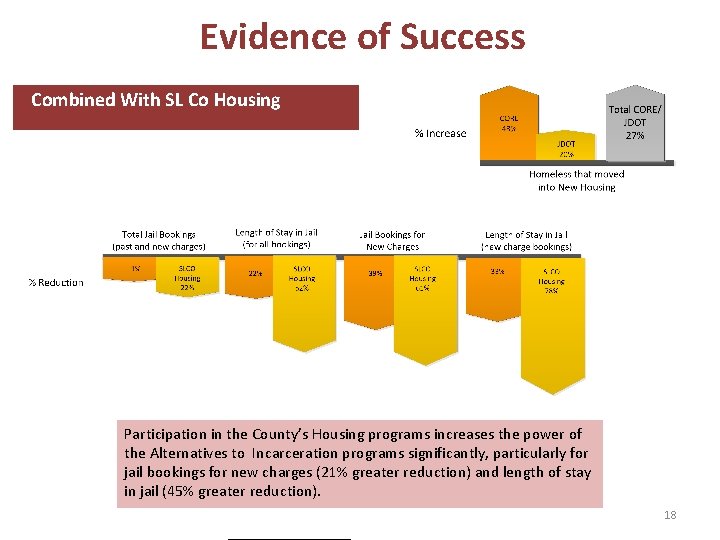
Evidence of Success Combined With SL Co Housing Participation in the County’s Housing programs increases the power of the Alternatives to Incarceration programs significantly, particularly for jail bookings for new charges (21% greater reduction) and length of stay in jail (45% greater reduction). 18
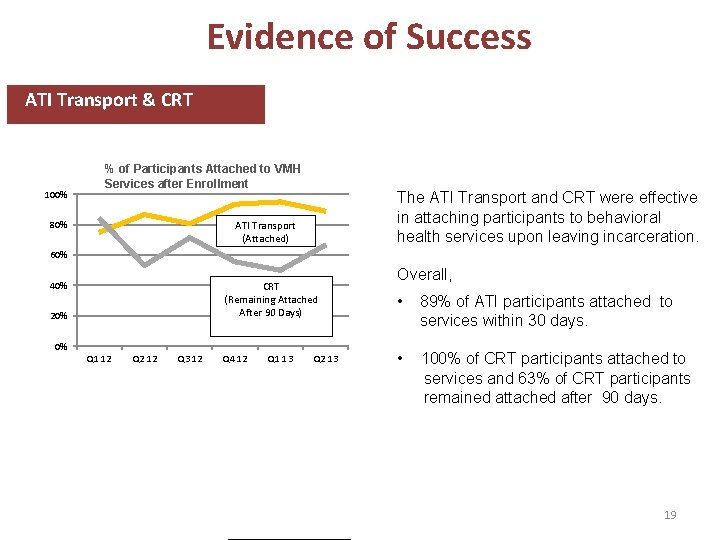
Evidence of Success ATI Transport & CRT 100% % of Participants Attached to VMH Services after Enrollment 80% The ATI Transport and CRT were effective in attaching participants to behavioral health services upon leaving incarceration. ATI Transport (Attached) 60% 40% CRT (Remaining Attached After 90 Days) 20% 0% Q 1 12 Q 2 12 Q 3 12 Q 4 12 Q 1 13 Q 2 13 Overall, • 89% of ATI participants attached to services within 30 days. • 100% of CRT participants attached to services and 63% of CRT participants remained attached after 90 days. 19
What Remains to be Addressed • Programs specific for women • Youth Services programs (MCOT and FAST) • Address DCFS Medicaid carve-out and Coordination • Medicaid Enrollment Process at Corrections • ACA Impacts – Utah’s version of Medicaid Expansion • Council of State Governments Study
Lessons Learned • Political Support and Alignment • Everyone is welcome – needed at the table • County is a single payer for all these services- what delivers best outcomes and efficiency • Align incentives with mission and vision • Persistence is a virtue and strength • OK to proceed incrementally
Contact Information Salt Lake County Optum Patrick Fleming Ken Anderson Director, SLCO Behavioral Health 385 -468 -4707 pfleming@slco. org Vice President – Optum Public Sector Business Dev. 360 -239 -1394 Kenneth. anderson@optum. com http: //behavioralhealthservices. slco. org Tim Whalen Rick Elorreaga Director, SLCO Behavioral Health twhalen@slco. org http: //behavioralhealthservices. slco. org Executive Director-Public Sector Solutions Optum Salt Lake County 801 -963 -6088 Richard. Elorreaga@optum. com www. optumhealthslco. com SLCO PSA Video http: //www. youtube. com/embed/qe. W 2 YBzz. SRA
- Slides: 22