
SALT Image Quality May 2006 SALT Science Working


- Slides: 47
SALT Image Quality: May 2006 SALT Science Working Group: May 2006 SAAO, Cape Town Darragh O’Donoghue SALT Operations: Optical Support & The SALT Operations Team: SALT Astronomers Hitesh Gajjar SALT Image Luis Balona James O’Connor + unswerving support Quality Status Report from Herman, David, Phil + SAAO staff (e. g. mech Web-based documentation of the problem, workshop) updated on an ongoing basis, at: + Arek http: //www. salt. ac. za/partners-login/ ®Partners Pages Data Quality The Image Quality Story Username (salt) and password (tlas) needed 1
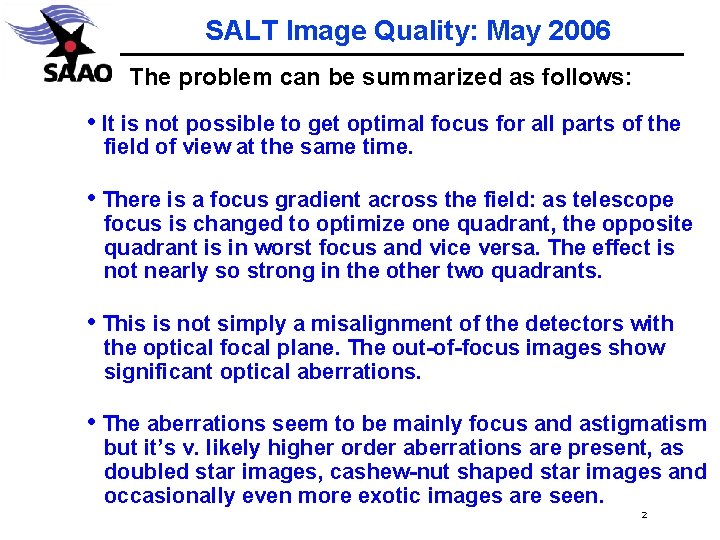
SALT Image Quality: May 2006 The problem can be summarized as follows: • It is not possible to get optimal focus for all parts of the field of view at the same time. • There is a focus gradient across the field: as telescope focus is changed to optimize one quadrant, the opposite quadrant is in worst focus and vice versa. The effect is not nearly so strong in the other two quadrants. • This is not simply a misalignment of the detectors with the optical focal plane. The out-of-focus images show significant optical aberrations. • The aberrations seem to be mainly focus and astigmatism but it’s v. likely higher order aberrations are present, as doubled star images, cashew-nut shaped star images and occasionally even more exotic images are seen. 2
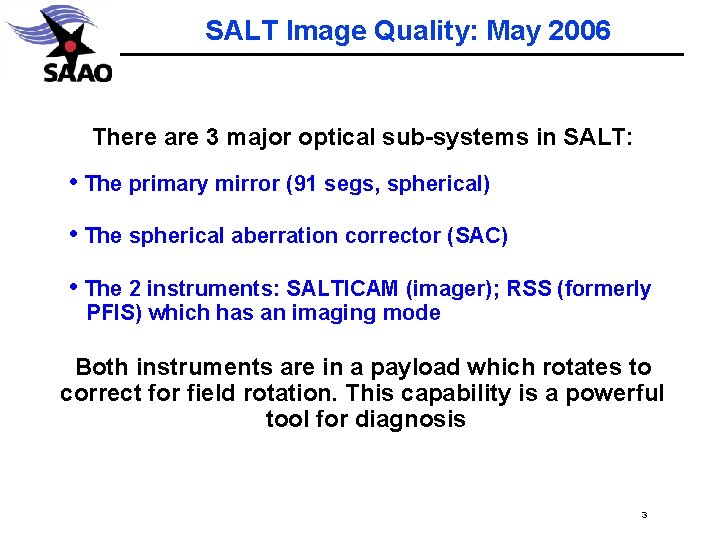
SALT Image Quality: May 2006 There are 3 major optical sub-systems in SALT: • The primary mirror (91 segs, spherical) • The spherical aberration corrector (SAC) • The 2 instruments: SALTICAM (imager); RSS (formerly PFIS) which has an imaging mode Both instruments are in a payload which rotates to correct for field rotation. This capability is a powerful tool for diagnosis 3
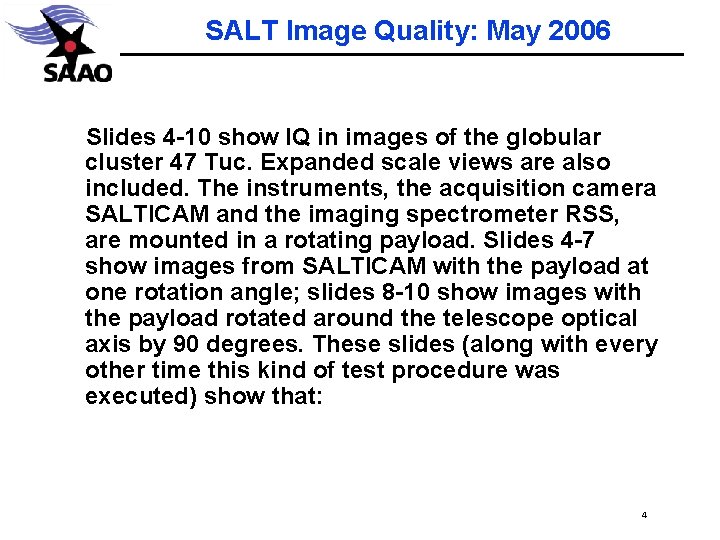
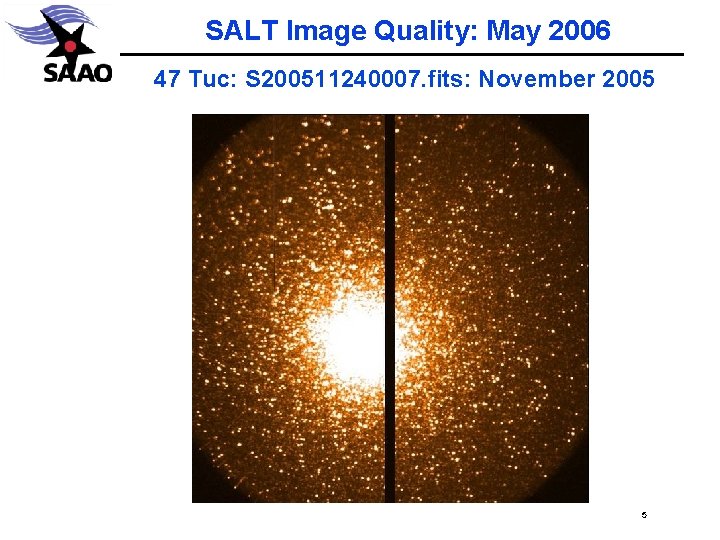
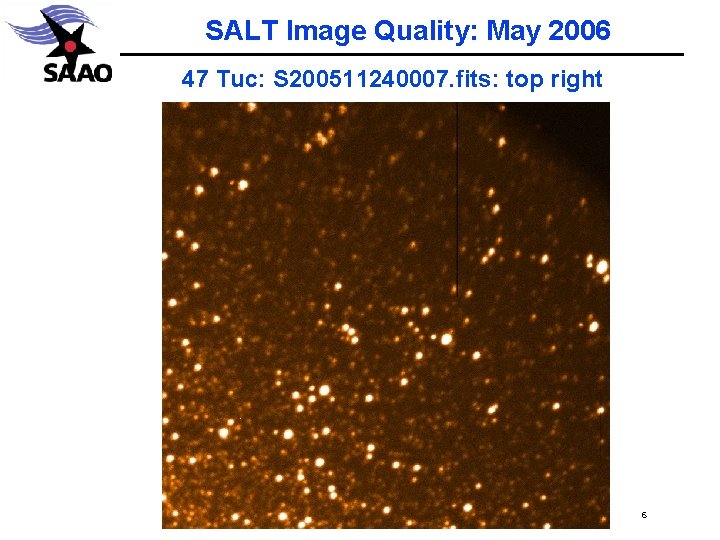
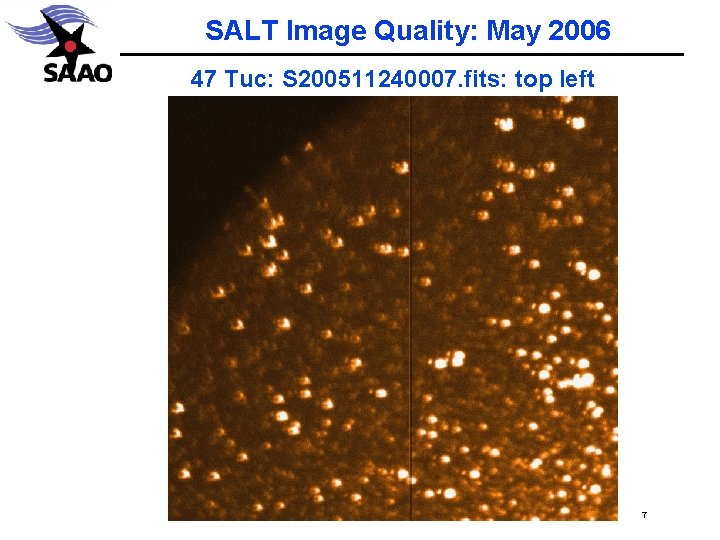
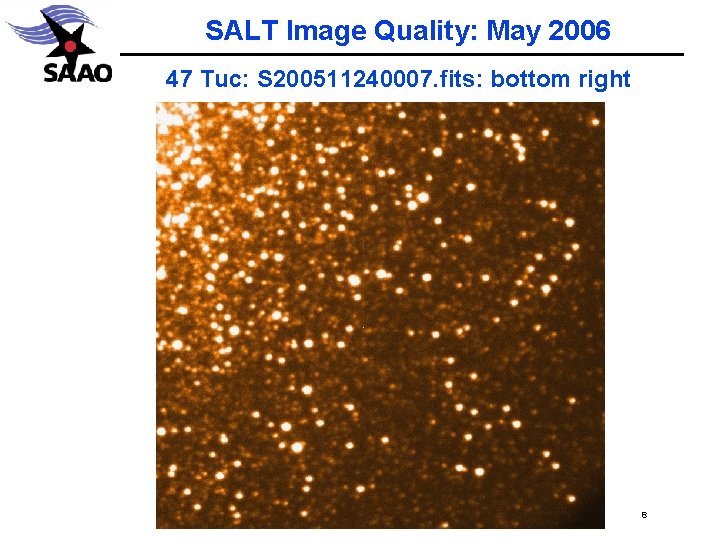
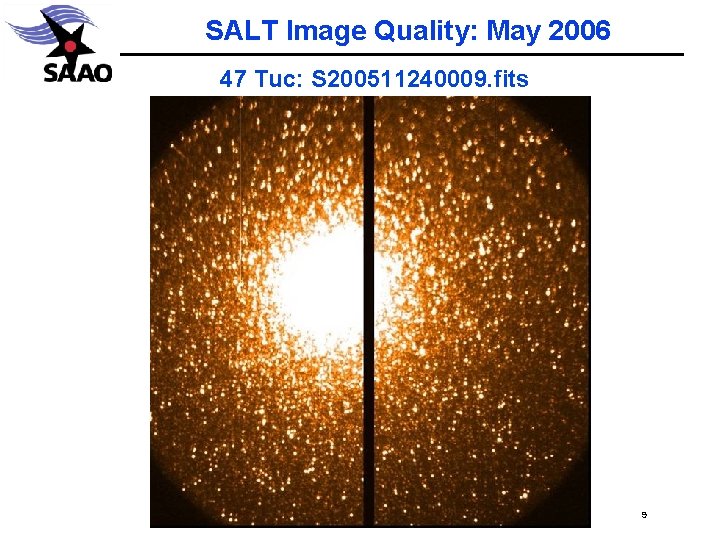
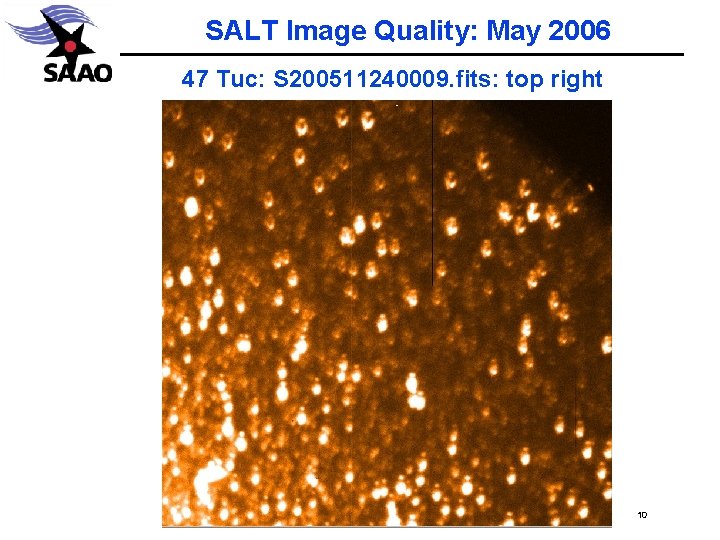
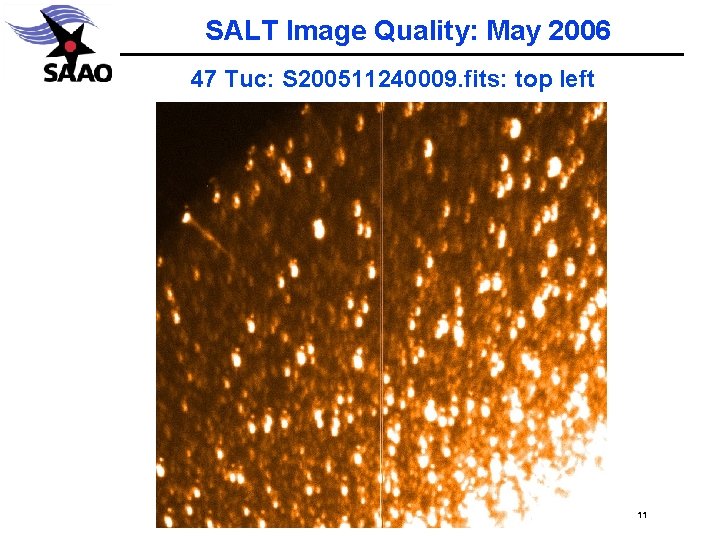
SALT Image Quality: May 2006 Slides 4 -10 show IQ in images of the globular cluster 47 Tuc. Expanded scale views are also included. The instruments, the acquisition camera SALTICAM and the imaging spectrometer RSS, are mounted in a rotating payload. Slides 4 -7 show images from SALTICAM with the payload at one rotation angle; slides 8 -10 show images with the payload rotated around the telescope optical axis by 90 degrees. These slides (along with every other time this kind of test procedure was executed) show that: 4
SALT Image Quality: May 2006 47 Tuc: S 200511240007. fits: November 2005 5
SALT Image Quality: May 2006 47 Tuc: S 200511240007. fits: top right 6
SALT Image Quality: May 2006 47 Tuc: S 200511240007. fits: top left 7
SALT Image Quality: May 2006 47 Tuc: S 200511240007. fits: bottom right 8
SALT Image Quality: May 2006 47 Tuc: S 200511240009. fits 9
SALT Image Quality: May 2006 47 Tuc: S 200511240009. fits: top right 10
SALT Image Quality: May 2006 47 Tuc: S 200511240009. fits: top left 11
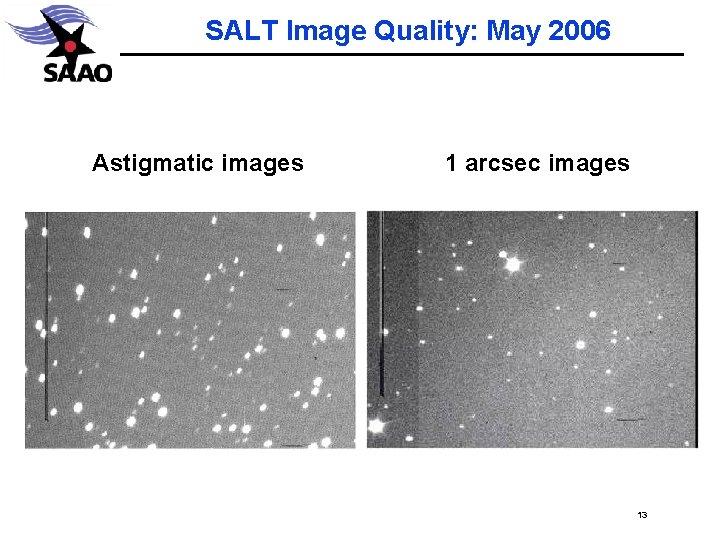
SALT Image Quality: May 2006 Another pair of images: “typical” at the edge of the field; “best” at the centre of the field and in good seeing. 12
SALT Image Quality: May 2006 Astigmatic images 1 arcsec images 13
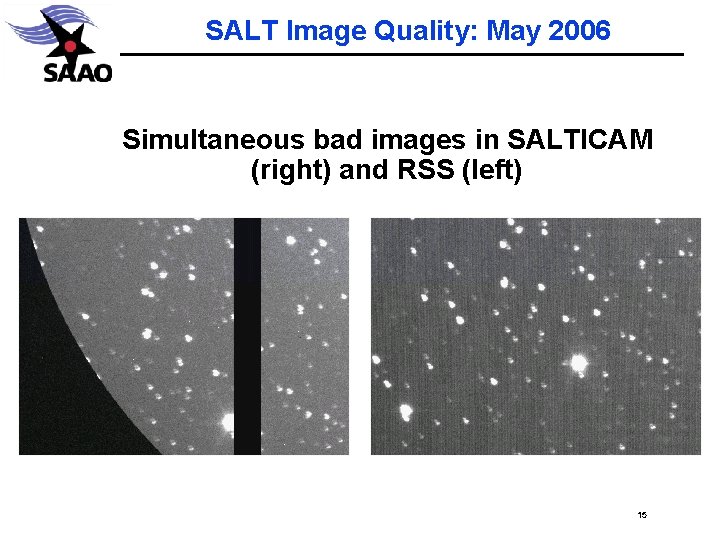
SALT Image Quality: May 2006 Slide 12 shows a “quasi-simultaneous” image taken with the two instruments, SALTICAM and RSS, in the rotating payload. An image was taken with SALTICAM and then immediately the fold flat feeding light to SALTICAM was removed, and “straight through” light from the SAC reached RSS. This slide (along with many others obtained with the same kind of procedure) show that: v Both instruments see the same poor image quality, in this case doubled star images. 14
SALT Image Quality: May 2006 Simultaneous bad images in SALTICAM (right) and RSS (left) 15
SALT Image Quality: May 2006 This leads To Two Alibis For The Instruments: • The same poor images are seen in both instruments in quasisimultaneous data. • All the aberrations “go around with the rho stage” “follow the stars” the aberrations are ‘fixed’ in the reference frame of the telescope structure These are two pretty unshakeable alibis 16
SALT Image Quality: May 2006 This leaves the other two optical sub-systems: • The Primary Mirror • The Spherical Aberration Corrector (SAC) 17
SALT Image Quality: May 2006 The Primary Mirror My number 1 suspect for a long time because: • Image quality variability (Primary is realigned every night) • Doubled images (Primary is aligned in 2 halves) • Images are astigmatic; astigmatism is easy to generate in the Primary, difficult in the SAC 18
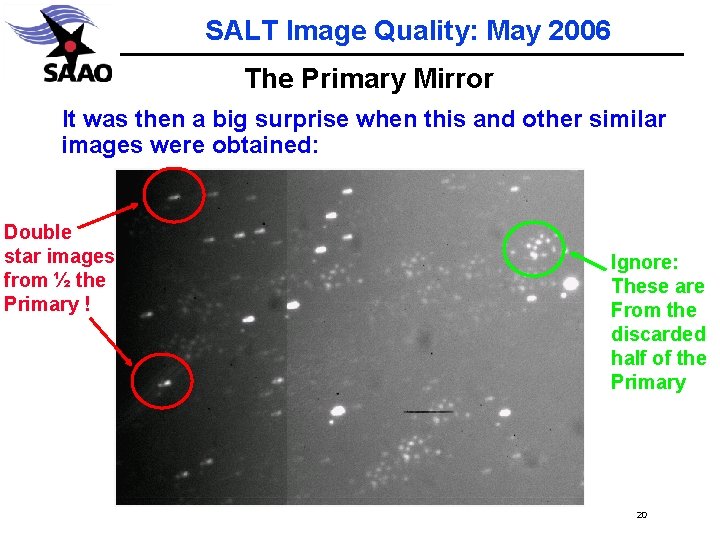
SALT Image Quality: May 2006 We felt that the doubling of star images has been a significant feature of the image quality problem which needs explanation. The SALT tracker does not allow all the primary mirror to be seen by the Shack-Hartmann alignment camera in the tower alongside the telescope. So the primary mirror is always stacked in two separate halves. An experiment was therefore conducted in which half the primary mirror was tilted away, unaligned, and the other half was used to take images. The expectation was that there would be no sign of doubled images. To our surprise this expectation was NOT fulfilled: see the next slide… 19
SALT Image Quality: May 2006 The Primary Mirror It was then a big surprise when this and other similar images were obtained: Double star images from ½ the Primary ! Ignore: These are From the discarded half of the Primary 20
SALT Image Quality: May 2006 The Primary Mirror So I analysed the Shack-Hartmann residuals after aligning the primary and found no problems large enough to explain the observed poor image quality (details can be supplied if you would like to see them). 21
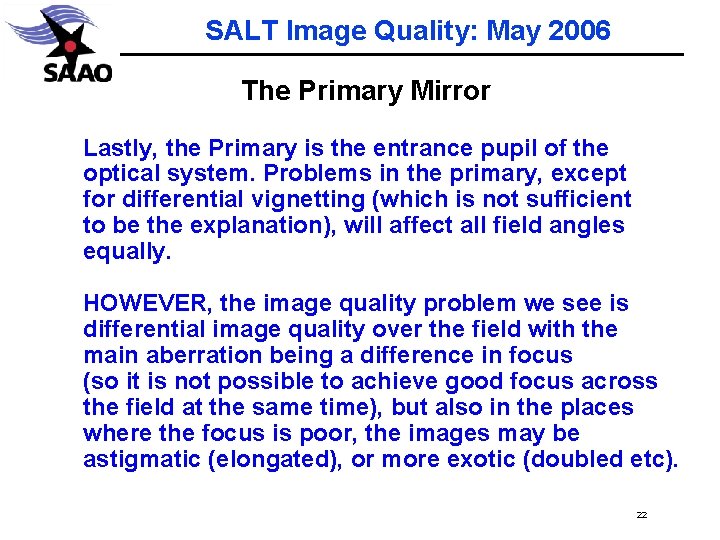
SALT Image Quality: May 2006 The Primary Mirror Lastly, the Primary is the entrance pupil of the optical system. Problems in the primary, except for differential vignetting (which is not sufficient to be the explanation), will affect all field angles equally. HOWEVER, the image quality problem we see is differential image quality over the field with the main aberration being a difference in focus (so it is not possible to achieve good focus across the field at the same time), but also in the places where the focus is poor, the images may be astigmatic (elongated), or more exotic (doubled etc). 22
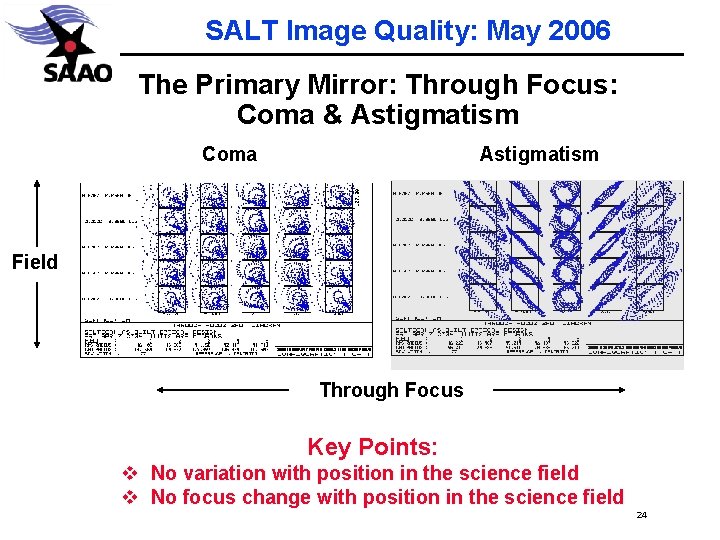
SALT Image Quality: May 2006 The Primary Mirror Just to confirm the points made in the last slide, I carried out Zemax simulations where I first induced 3 rd order coma and then astigmatism in the primary and inspected the spot diagrams for the centre and edges of the field of view, confirming that all parts of the field of view are affected similarly, and that all parts of the field of view have the same best focus. These two properties are in contradiction to what is seen with SALT. 23
SALT Image Quality: May 2006 The Primary Mirror: Through Focus: Coma & Astigmatism Coma Astigmatism Field Through Focus Key Points: v No variation with position in the science field v No focus change with position in the science field 24
SALT Image Quality: May 2006 We conclude that the Primary Mirror is not the cause of SALT’s image quality problems: v Doubled images when using either half of the Primary v Testing of the Primary at CCAS shows no evidence for problems v Primary is pupil optic: all field angles affected the same 25
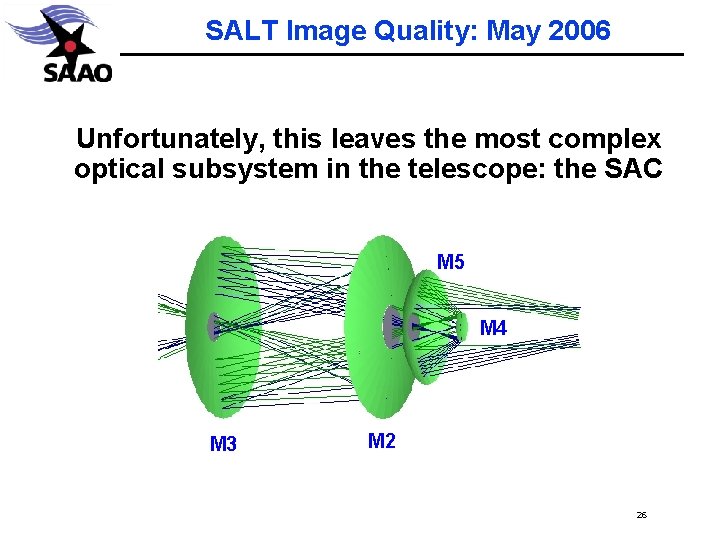
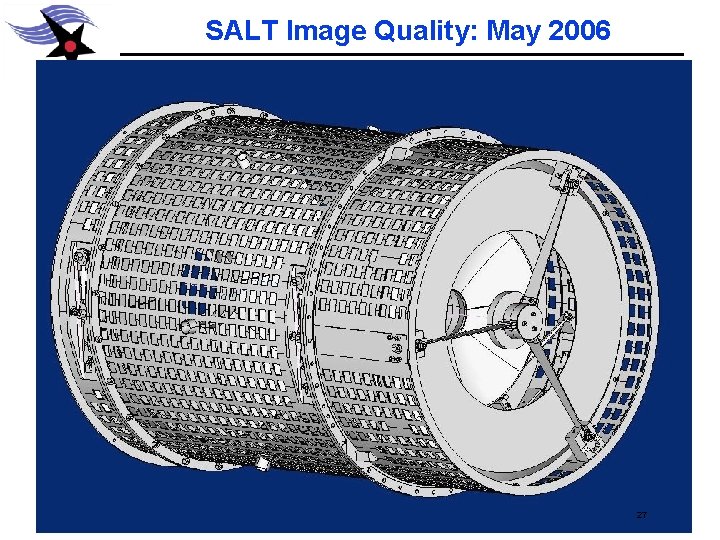
SALT Image Quality: May 2006 Unfortunately, this leaves the most complex optical subsystem in the telescope: the SAC M 5 M 4 M 3 M 2 26
SALT Image Quality: May 2006 27
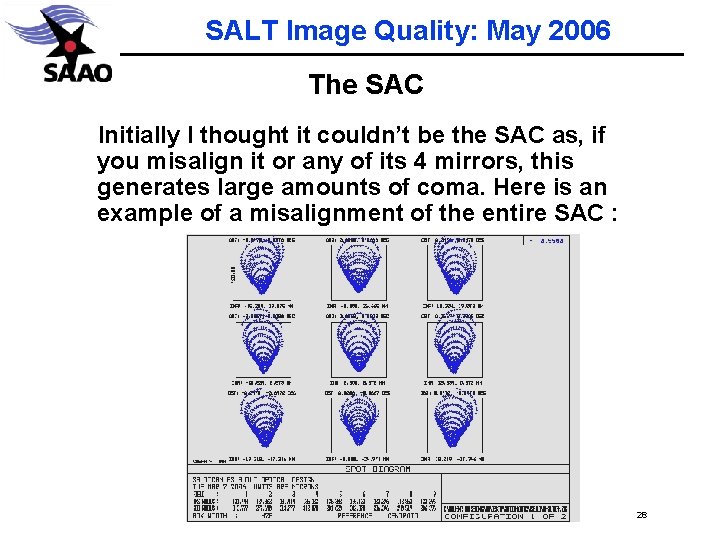
SALT Image Quality: May 2006 The SAC Initially I thought it couldn’t be the SAC as, if you misalign it or any of its 4 mirrors, this generates large amounts of coma. Here is an example of a misalignment of the entire SAC : 28
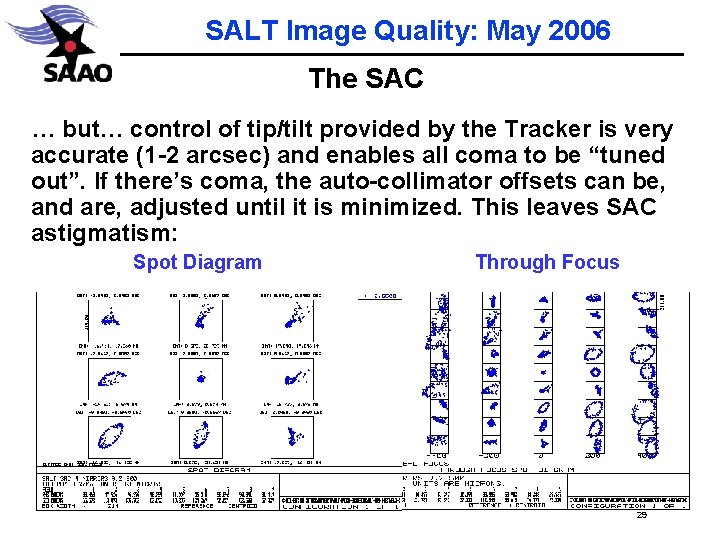
SALT Image Quality: May 2006 The SAC … but… control of tip/tilt provided by the Tracker is very accurate (1 -2 arcsec) and enables all coma to be “tuned out”. If there’s coma, the auto-collimator offsets can be, and are, adjusted until it is minimized. This leaves SAC astigmatism: Spot Diagram Through Focus 29
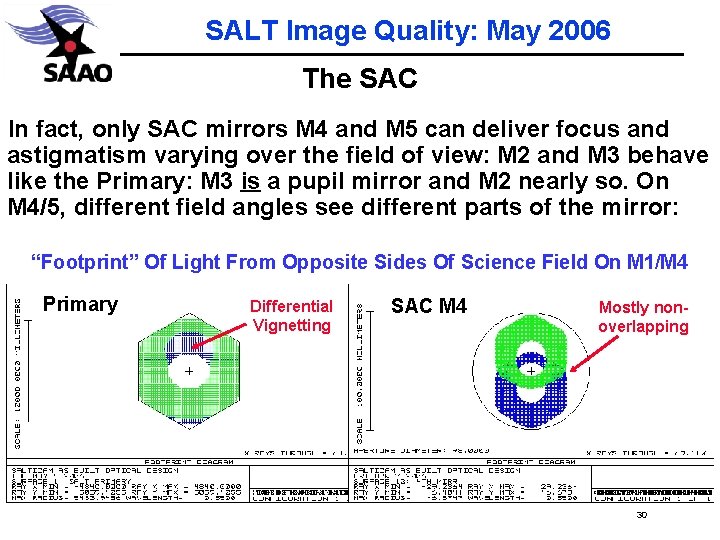
SALT Image Quality: May 2006 The SAC In fact, only SAC mirrors M 4 and M 5 can deliver focus and astigmatism varying over the field of view: M 2 and M 3 behave like the Primary: M 3 is a pupil mirror and M 2 nearly so. On M 4/5, different field angles see different parts of the mirror: “Footprint” Of Light From Opposite Sides Of Science Field On M 1/M 4 Primary Differential Vignetting SAC M 4 Mostly nonoverlapping 30
SALT Image Quality: May 2006 So Let’s Summarize The Logic So Far: • It’s not the instruments: v Aberrations go round with the rotating stage v Same poor images seen in SALTICAM and RSS • It’s not the Primary Mirror: v Doubled images seen using only ½ the mirror v CCAS testing shows no evidence for problems v Primary mirror affects all field angles ~the same • This leaves the SAC. And not only that, it must be M 4/5 v Only M 4/M 5 give differential field effects v Best current ray tracing guess gives very plausible ‘star images’ qualitatively, but not yet quantitatively. 31
SALT Image Quality: May 2006 How can we further diagnose what the problem is? 32
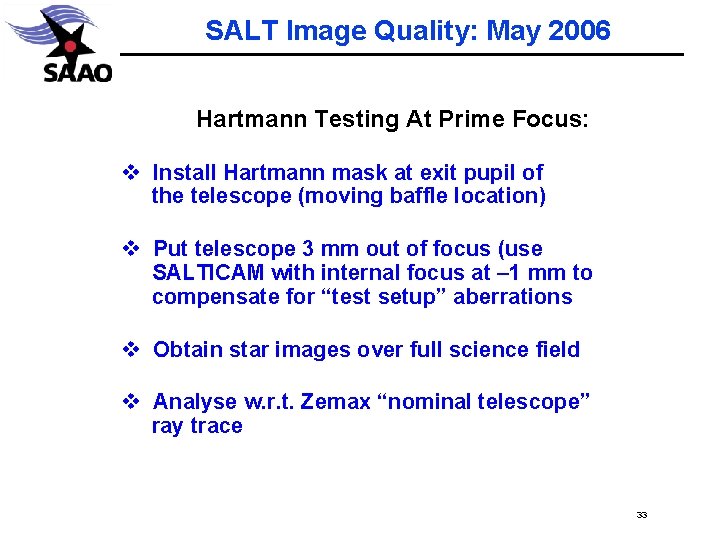
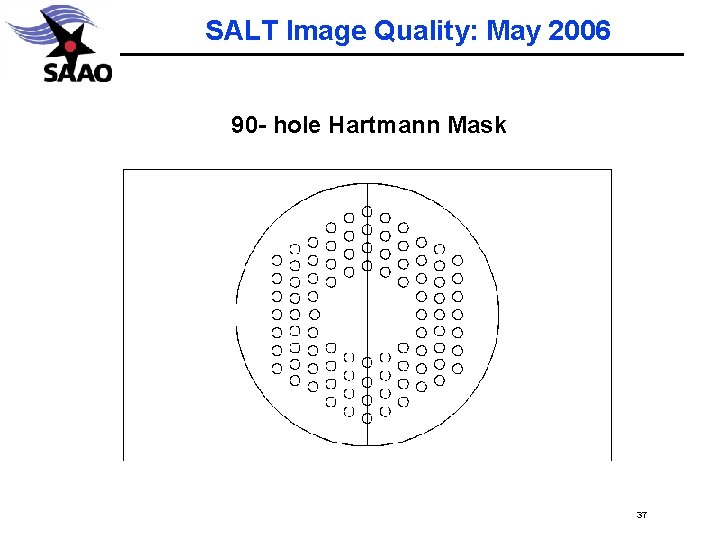
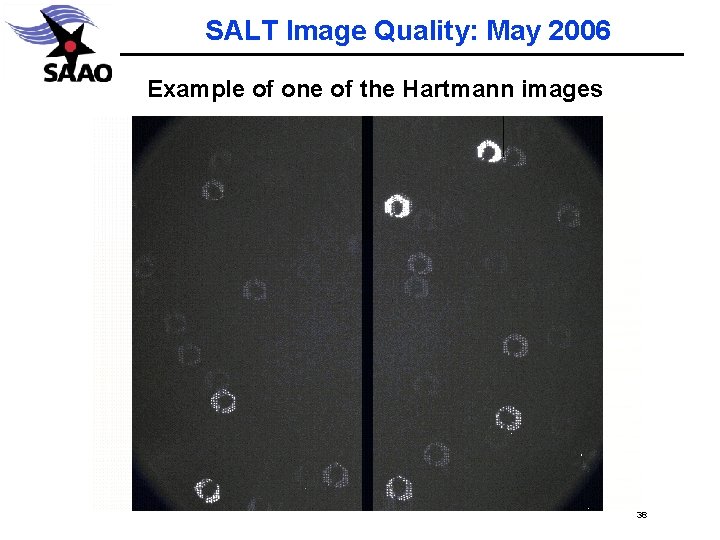
SALT Image Quality: May 2006 Hartmann Testing At Prime Focus: v Install Hartmann mask at exit pupil of the telescope (moving baffle location) v Put telescope 3 mm out of focus (use SALTICAM with internal focus at – 1 mm to compensate for “test setup” aberrations v Obtain star images over full science field v Analyse w. r. t. Zemax “nominal telescope” ray trace 33
SALT Image Quality: May 2006 Guesstimated schedule for fixing: v Diagnosis complete by end of Sep v Completion of fix by end of Qtr I, 2007 The End (if you have had enough) 34
SALT Image Quality: May 2006 35
SALT Image Quality: May 2006 36
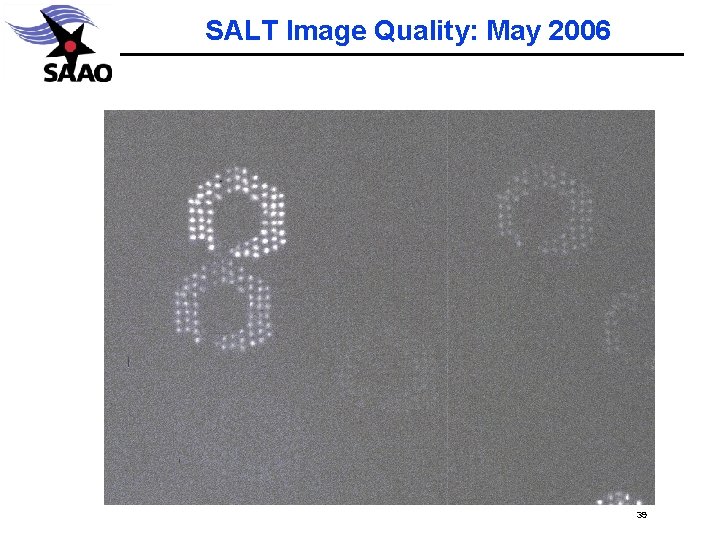
SALT Image Quality: May 2006 90 - hole Hartmann Mask 37
SALT Image Quality: May 2006 Example of one of the Hartmann images 38
SALT Image Quality: May 2006 39
SALT Image Quality: May 2006 Data Analysis: v Centroid the spots using a CCD stellar photometry program. v Compare spot positions with those of “ideal” telescope. Compare spot positions with those from telescope with (i) M 4 decentred in x/y; (ii) Tracker tip/tilted; (iii) M 4/M 5 tip/tilted; (iv) M 4 coma/astigmatism; (v) M 1 coma/astigmatism. (I made no attempt to decompose into Zernikes as what do we do then? ). v Least squares fit linear combination of the above models. 40
SALT Image Quality: May 2006 Preliminary Results Of Data Analysis: v So far, none of the models, or their linear combinations, provide a satisfactory fit to the Hartmann data, although only a small number of the 3 nights worth of images has so far been analysed. The best solution so far is the model in which M 4 is decentred but although it does provide some fit to the Hartmann data, it does not provide a fit that can be regarded as satisfactory. 41
SALT Image Quality: May 2006 The central question is how do we get the system fixed given the risks (schedule, technical, cost etc. )? Schedule: • Sending the SAC to SAGEM will bring the telescope down for weeks to months. And what if the problem disappears on taking the SAC off the telescope because it is something to do with mounting it on SALT. • Adjusting on the telescope is optimal (but probably impossible, or too risky at best). • What seems best to me is the compromise: fix at SALT if possible 42
SALT Image Quality: May 2006 Technical Risk: • Damage to optics, opto-mechanics or coatings during removal/re-installation of SAC. Mitigate this through contracting Willem Esterhuyse and Leon Nel (who installed it), to remove and re-install • Damage (as above) during transportation to Cape Town or France. Avoid if possible • Lack of experience/equipment of local personnel with complex aspherical optics. Contract SAGEM to adjust at Sutherland if at all possible • Incorrect adjustment. Very serious if done in France; not so damaging if done at SALT (but of course much better to get it right first time!) 43
SALT Image Quality: May 2006 Speculations: I How Did This Situation Arise? • It is my belief, since the exoneration of the Primary Mirror, that misalignment of some combination of M 4/M 5, either as individual mirrors, or as a pair, is the likely cause of the IQ problem. • The amount of misalignment required is HUGE: ~0. 5 mm of decentre in M 4, or a similar amount in M 5, or an appropriate tip/tilt. How on earth can such a large misalignment have arisen? • Misalignment of M 4/M 5 (or any of the other mirrors) can arise at assembly at SAGEM, during shipping, during installation, or during operation. 44
SALT Image Quality: May 2006 Speculations: II How Did This Situation Arise? • M 2, M 4 and M 5 were individually fabricated and tested interferometrically; M 4 and M 5 were assembled interferometrically. • This “rules out” simple misalignment of M 4 with respect to M 5. • The M 4/M 5 pair were positioned on M 2 by mechanical metrology. Decentre of this pair is unlikely and would have minimal impact anyway. Tip/tilt of 0. 4 degree (!) would give an error more or less of the right size. However, Zemax simulations of this possibility shows no doubling of images or cashew-shaped star images. 45
SALT Image Quality: May 2006 Speculations: III How Did This Situation Arise? • Shipping: container very sophisticated; no shock sensors were triggered on arrival in CT. • Very violent treatment needed during installation/ operation to cause a 0. 5 mm decentre or 0. 4 degree tip/tilt. Personally I think this is very unlikely. So far, there is no satisfactory detailed explanation of the problem. 46
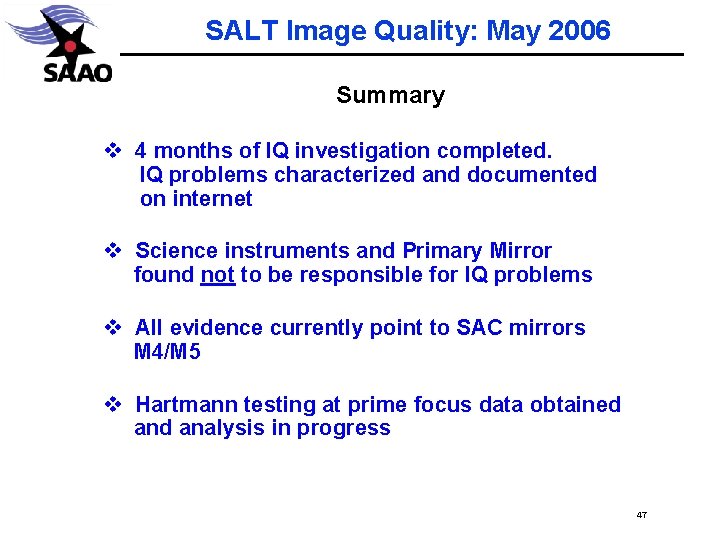
SALT Image Quality: May 2006 Summary v 4 months of IQ investigation completed. IQ problems characterized and documented on internet v Science instruments and Primary Mirror found not to be responsible for IQ problems v All evidence currently point to SAC mirrors M 4/M 5 v Hartmann testing at prime focus data obtained analysis in progress 47