
Salt Combining ACID and BASE in a Distributed

Salt: Combining ACID and BASE in a Distributed Database Authors (University of Texas Austin): Chao Xie, Chunzhi Su, Manos Kapritsos, Yang Wang, Navid Yaghmazadeh, Lorenzo Alvisi, Prince Mahajan Presented By: Sharanya Bathey
The tale of ACID… • Transaction - Basic unit of work in an RDBMS • ACID – Atomicity: all or nothing – Consistency: always leave a database in a consistent state – Isolation: every transaction is completely isolated – Durability: once committed always recorded Image Source
The tale of ACID…(Oh No!) • What needs to be done to achieve this abstraction? – 2 Phase Commit – Locks • What baggage do such abstractions come with? Image Source – Performance is sacrificed
Rise of BASE… • BASE – Basically Available - does guarantee availability, in terms of CAP theorem – Soft State - State of the system may change over time – Eventually Consistent - data will be consistent at replicas eventually Image Source
Rise of BASE… (What now? ) • Problem? – Complexity of programming – Consistency Management Image Source
Is there no middle ground? • Pareto Principle - 80 -20 Rule • Example: – Fusion Ticket (open source ticketing application) – Total of 11 different types of Transactions of which just 2 are performance critical
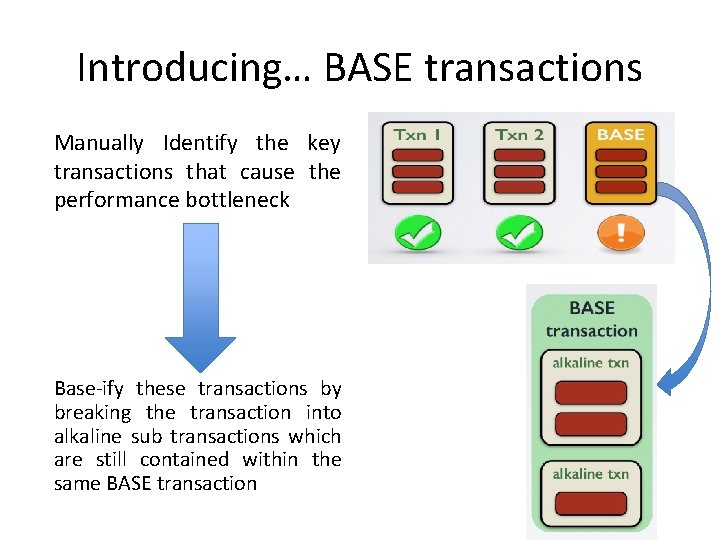
Introducing… BASE transactions Manually Identify the key transactions that cause the performance bottleneck Base-ify these transactions by breaking the transaction into alkaline sub transactions which are still contained within the same BASE transaction
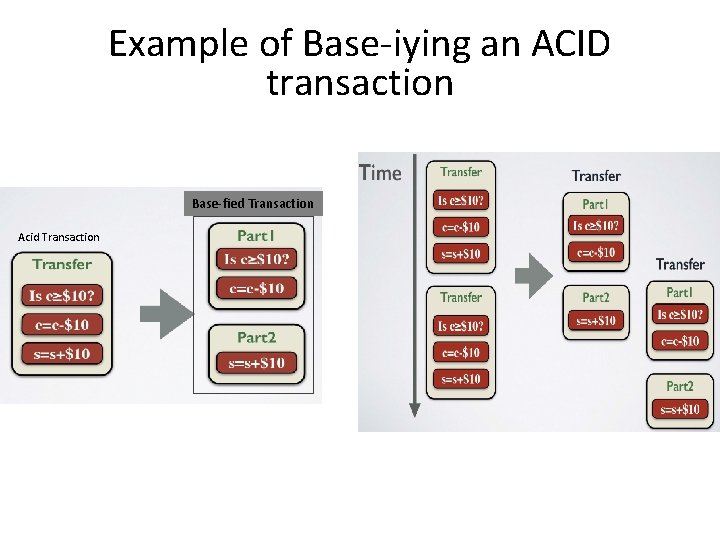
Example of Base-iying an ACID transaction Base-fied Transaction Acid Transaction
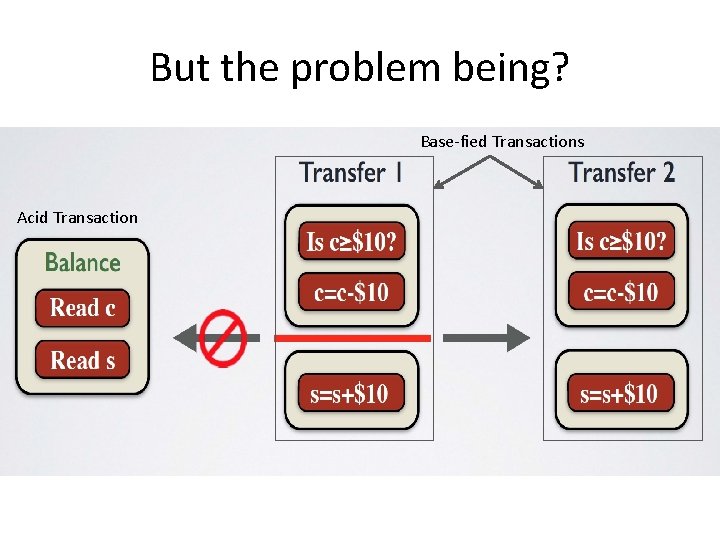
But the problem being? Base-fied Transactions Acid Transaction
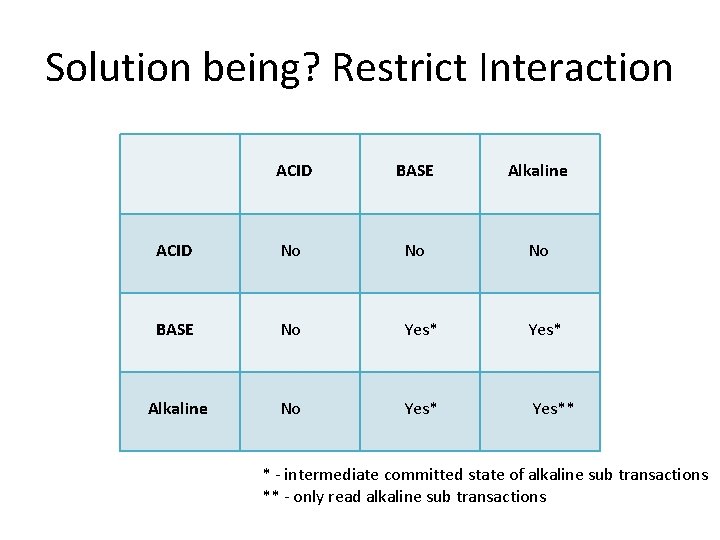
Solution being? Restrict Interaction ACID Alkaline No No BASE No Yes* Alkaline No Yes** ACID BASE * - intermediate committed state of alkaline sub transactions ** - only read alkaline sub transactions

Base Transactions (Contd…) • Major life events of BASE transactions: Accept & Commit • How does a BASE transaction provide ACID abstraction? – Atomicity - once accepted will eventually commit – Consistency - Interactions keep ACID and BASE transactions isolated – Isolation - SALT Isolation coming up next. . – Durability - Accepted BASE transactions are guaranteed to be durable through logging
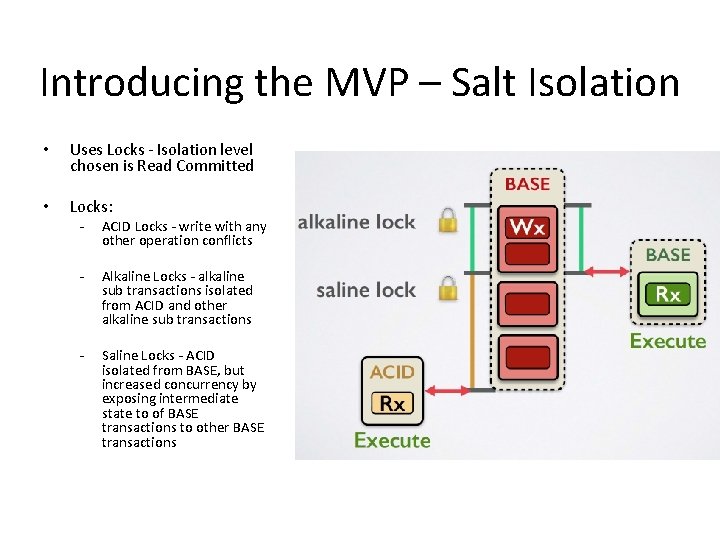
Introducing the MVP – Salt Isolation • Uses Locks - Isolation level chosen is Read Committed • Locks: - ACID Locks - write with any other operation conflicts - Alkaline Locks - alkaline sub transactions isolated from ACID and other alkaline sub transactions - Saline Locks - ACID isolated from BASE, but increased concurrency by exposing intermediate state to of BASE transactions to other BASE transactions
So does it actually work? • Implementation: – Modified My. SQL to allow BASE transactions and Alkaline Subtransactions – Allow alkaline and saline locks • Optimizations: – Early commit - A client that issues a BASE transaction sees the transaction completion when its first Alkaline sub transaction commits – Failure recovery - Logging with redo and roll forward – Transitive dependencies - Per object queue – Local Transactions • Replication of data was done across 10 partitions and each partition was three-way replicated • Evaluated: Performance Gain, Programming Effort, Contention Ratio
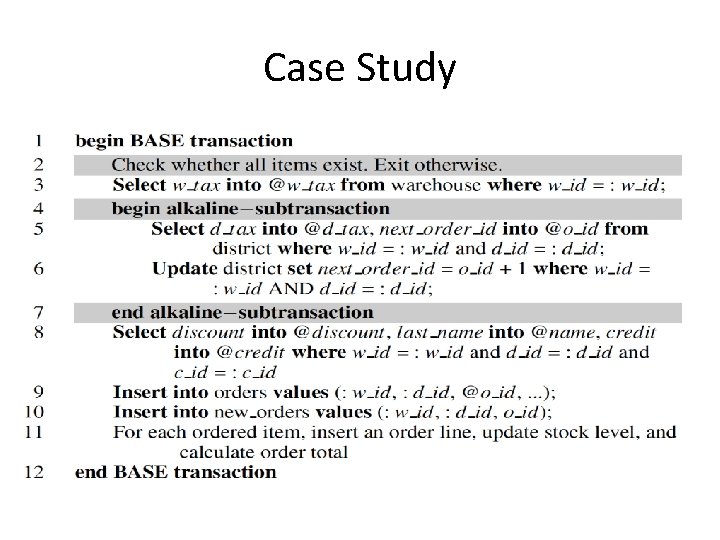
Case Study
Applications used for the experiments • TPC-C benchmark : database performance standard – 5 transactions (new-order, payment, stock-level, order-status and delivery) – New-order and payment are responsible for 43. 5% of total number of transactions • Fusion Ticket: open source ticketing application in PHP and My. SQL – Includes several transactions – Create-order and payment most frequent and performance critical • Micro benchmark: – Contention ratio – Contending transaction position – Read-Write ratio
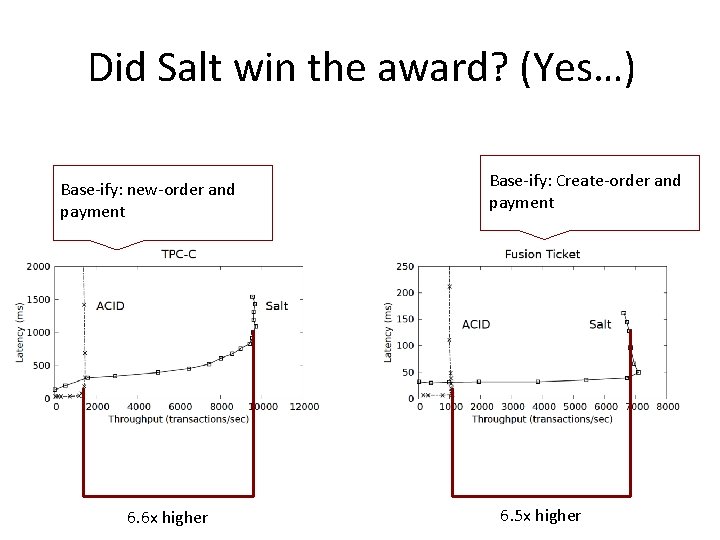
Did Salt win the award? (Yes…) Base-ify: new-order and payment 6. 6 x higher Base-ify: Create-order and payment 6. 5 x higher
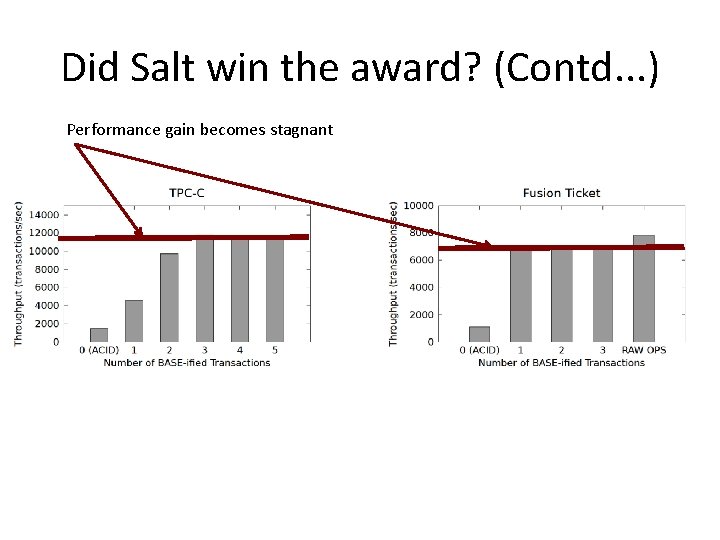
Did Salt win the award? (Contd. . . ) Performance gain becomes stagnant
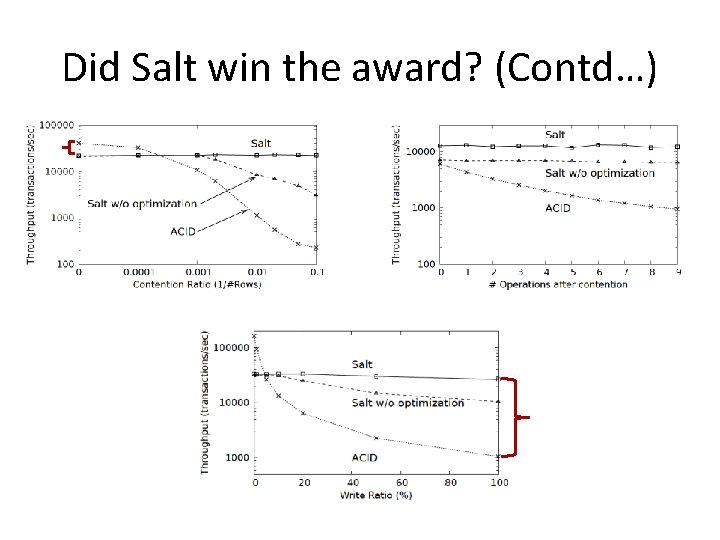
Did Salt win the award? (Contd…)
Discussion & Q-A • Pros: – Performance gain is drastic – Control in the hands of the programmer • Cons: – Cassandra allows batching of commands into groups to form transactions called atomic batches – Leverage the power of My. SQL clusters - My. SQL does not allow nested transactions and My. SQL now has several No. SQL/New. SQL like features – Programming complexity - the difficulty of identifying the transactions that need to be converted and verifying the correctness is a daunting task

Thank You!
- Slides: 20