
SALSA Scalable and Lowsynchronization NUMAaware Algorithm for ProducerConsumer
SALSA: Scalable and Lowsynchronization NUMA-aware Algorithm for Producer-Consumer Pools Elad Gidron, Idit Keidar, Dmitri Perelman, Yonathan Perez 1

New Architectures – New Software Development Challenges �Increasing number of computing elements 2 Need scalability �Memory latency more pronounced Need cache-friendliness �Asymmetric memory access in NUMA multi. CPU Need local memory accesses for reduced contention �Large systems less predictable Need robustness to unexpected thread stalls, load fluctuations
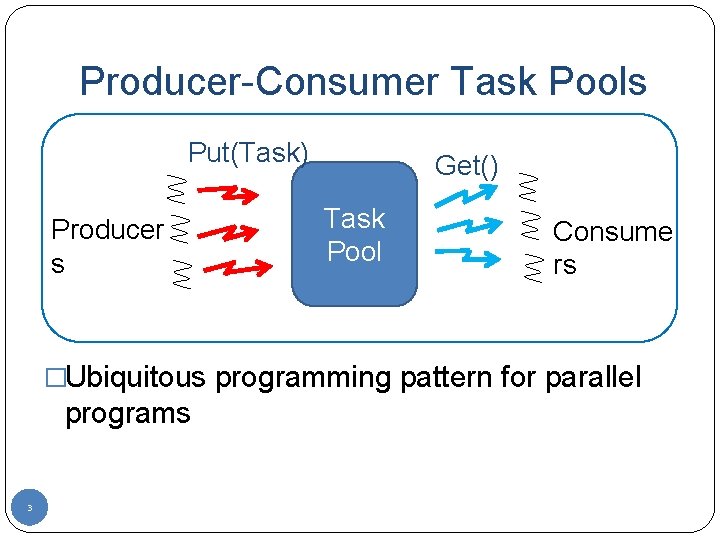
Producer-Consumer Task Pools Put(Task) Producer s Get() Task Pool Consume rs �Ubiquitous programming pattern for parallel programs 3
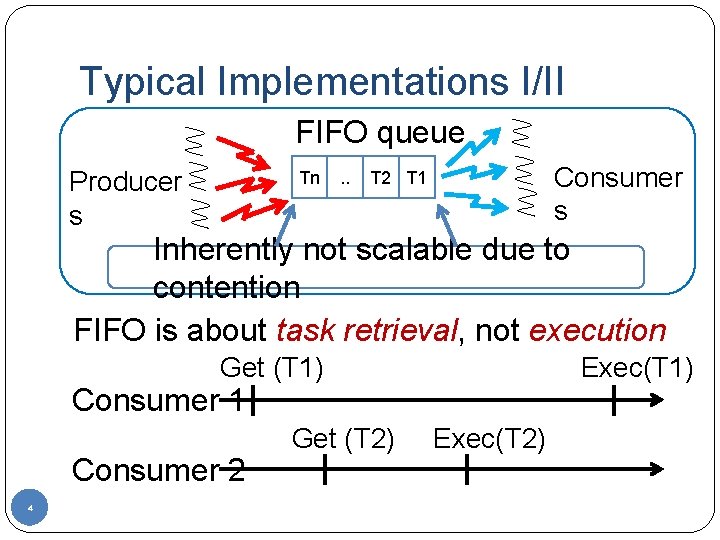
Typical Implementations I/II FIFO queue Producer s Tn . . Consumer s T 2 T 1 Inherently not scalable due to contention FIFO is about task retrieval, not execution Get (T 1) Exec(T 1) Consumer 1 Consumer 2 4 Get (T 2) Exec(T 2)
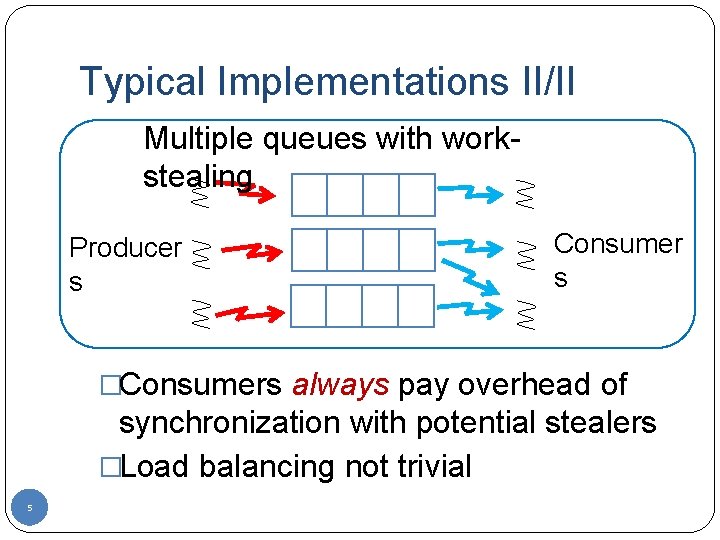
Typical Implementations II/II Multiple queues with workstealing Producer s Consumer s �Consumers always pay overhead of synchronization with potential stealers �Load balancing not trivial 5
And Now, to Our Approach �Single-consumer pools as building block �Framework for multiple pools with stealing �SALSA – novel single-consumer pool �Evaluation 6
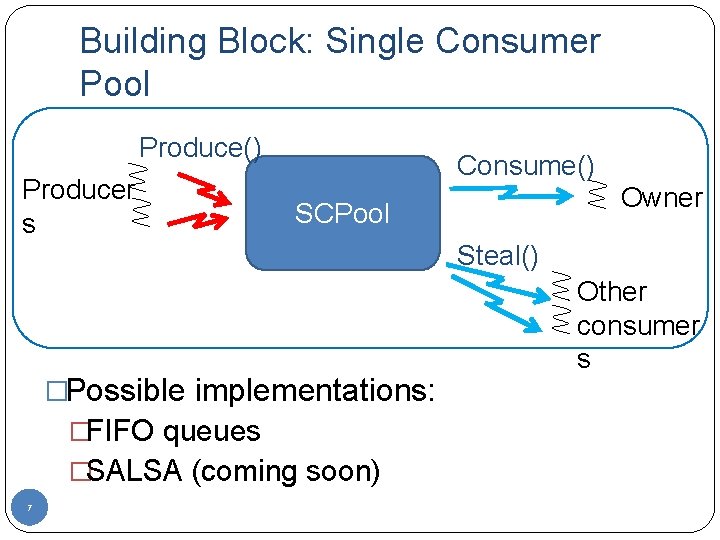
Building Block: Single Consumer Pool Produce() Producer s Consume() Owner SCPool Steal() �Possible implementations: �FIFO queues �SALSA (coming soon) 7 Other consumer s
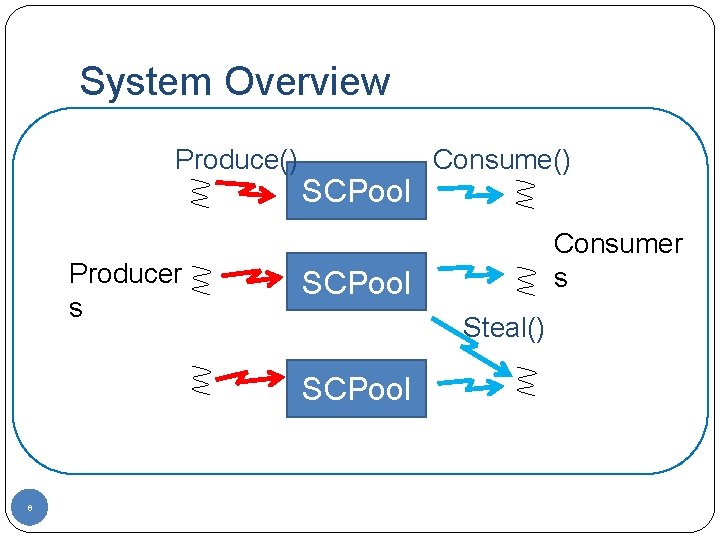
System Overview Produce() Producer s SCPool Consumer s SCPool Steal() SCPool 8 Consume()
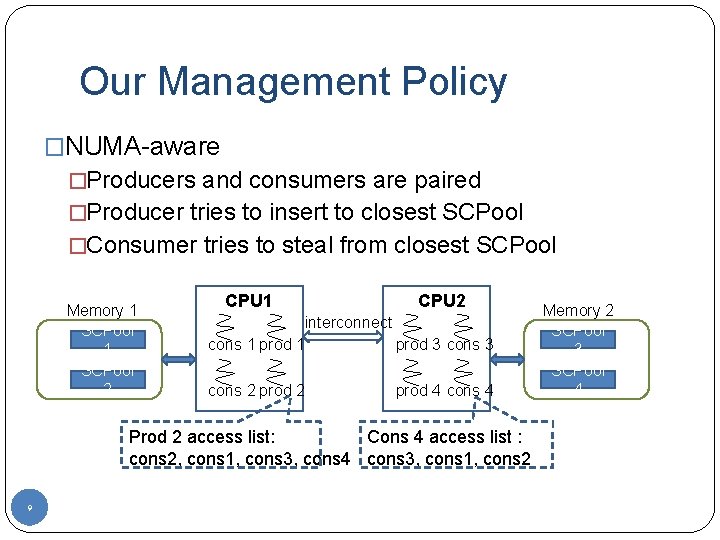
Our Management Policy �NUMA-aware �Producers and consumers are paired �Producer tries to insert to closest SCPool �Consumer tries to steal from closest SCPool Memory 1 SCPool 2 CPU 1 CPU 2 interconnect cons 1 prod 3 cons 2 prod 4 cons 4 Prod 2 access list: Cons 4 access list : cons 2, cons 1, cons 3, cons 4 cons 3, cons 1, cons 2 9 Memory 2 SCPool 3 SCPool 4
SCPool Implementation Goals �Goal 1: “Fast path” �Use synchronization, atomic operations only when stealing �Goal 2: Minimize stealing �Goal 3: Locality �Cache friendliness, low contention �Goal 4: Load balancing �Robustness to stalls, load fluctuations 10

SALSA – Scalable and Low Synchronization Algorithm �SCPool implementation �Synchronization-free when no stealing occurs Low contention �Tasks held in page-size chunks Cache-friendly �Consumers steal entire chunks of tasks Reduces number of steals �Producer-based load-balancing Robust to stalls, load fluctuations 11
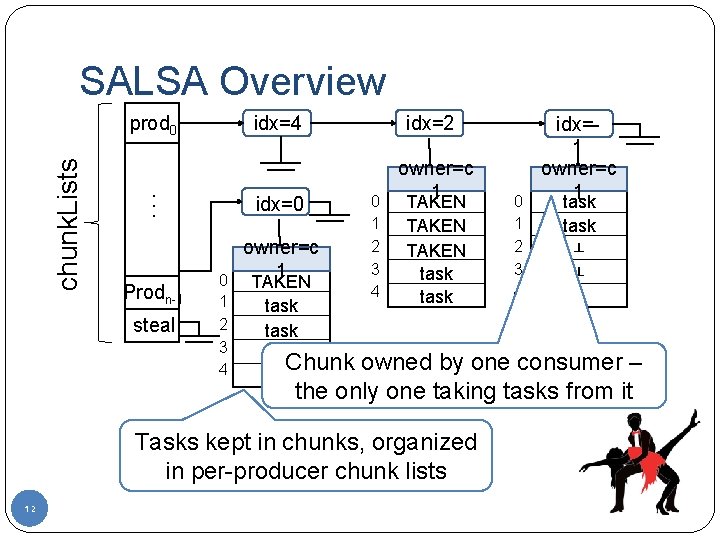
SALSA Overview. . . chunk. Lists prod 0 Prodn-1 steal 0 1 2 3 4 idx=2 idx=0 owner=c 1 TAKEN task 0 1 2 3 4 TAKEN task ┴ ┴ ┴ Chunk owned by one consumer – the only one taking tasks from it ┴ Tasks kept in chunks, organized in per-producer chunk lists 12 0 1 2 3 4 idx=1 owner=c 1 task
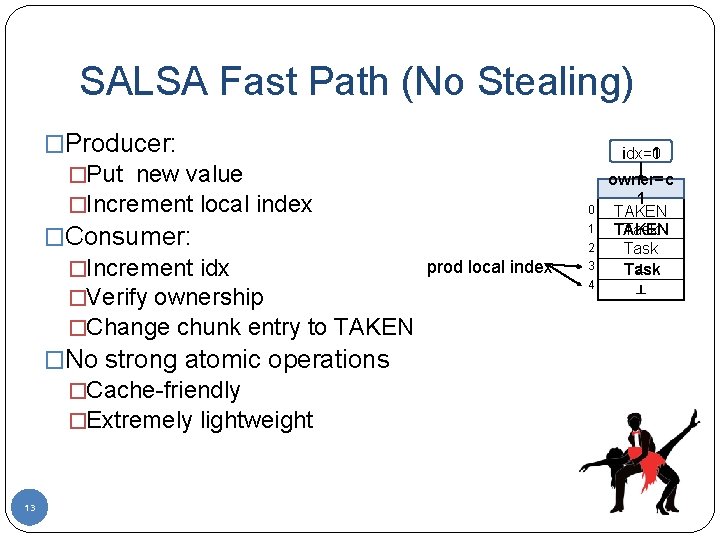
SALSA Fast Path (No Stealing) �Producer: �Put new value �Increment local index �Consumer: prod local index �Increment idx �Verify ownership �Change chunk entry to TAKEN �No strong atomic operations �Cache-friendly �Extremely lightweight 13 idx=0 idx=1 0 1 2 3 4 owner=c 1 TAKEN Task ┴ ┴
Chunk Stealing �Steal a chunk of tasks �Reduces the number of steal operations �Stealing consumer changes the owner field �When a consumer sees its chunk has been stolen �Takes one task using CAS, �Leaves the chunk 14
Stealing �Stealing is complicated �Data races �Liveness issues �Fast-path means no memory fences �See details in paper 15
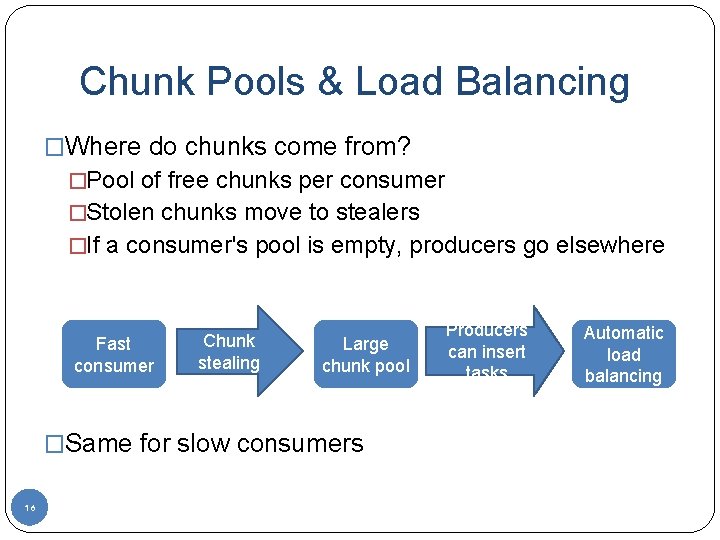
Chunk Pools & Load Balancing �Where do chunks come from? �Pool of free chunks per consumer �Stolen chunks move to stealers �If a consumer's pool is empty, producers go elsewhere Fast consumer Chunk stealing Large chunk pool �Same for slow consumers 16 Producers can insert tasks Automatic load balancing
Getting It Right �Liveness: we ensure that operations are lock- free �Ensure progress whenever operations fail due to steals �Safety: linearizability mandates that Get() return Null only if all pools were simultaneously empty �Tricky 17
Evaluation Compared Algorithms �SALSA+CAS: every consume operation uses CAS (no fast path optimization) �Conc. Bag: Concurrent Bags algorithm [Sundell et al. 2011] �Per producer chunk-list, but requires CAS for consume and stealing granularity of a single task. �WS-MSQ: work-stealing based on Michael-Scott queues [M. M. Michael M. L. Scott 1996] �WS-LIFO: work-stealing based on Michael’s LIFO stacks 18 [M. M. Michael 2004]
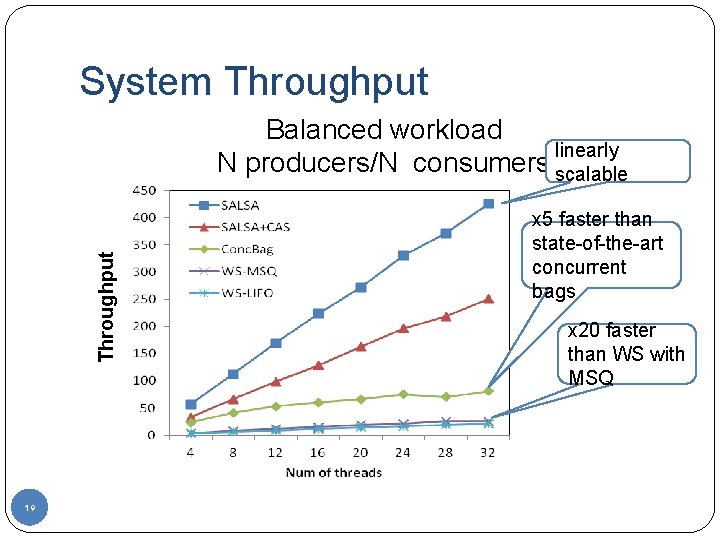
System Throughput Balanced workload linearly N producers/N consumers scalable 19 x 5 faster than state-of-the-art concurrent bags x 20 faster than WS with MSQ
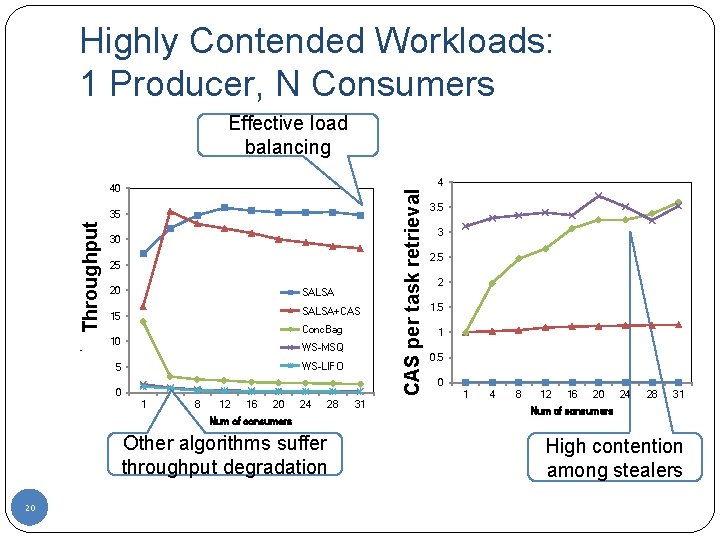
Highly Contended Workloads: 1 Producer, N Consumers Effective load balancing Throughput (1000 tasks/msec) 35 30 25 20 SALSA+CAS 15 Conc. Bag 10 WS-MSQ WS-LIFO 5 0 1 4 8 12 16 20 24 28 Num of consumers Other algorithms suffer throughput degradation 20 31 operations per retrieval task retrieval CASCAS per task 4 40 3. 5 3 2. 5 2 1. 5 1 0. 5 0 1 4 8 12 16 20 24 28 31 Num of consumers High contention among stealers
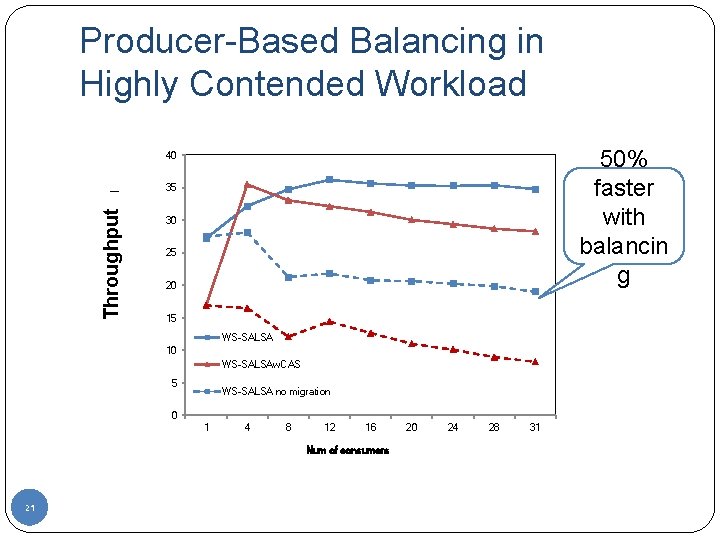
Producer-Based Balancing in Highly Contended Workload 50% faster with balancin g Throughput (1000 tasks/msec) 40 35 30 25 20 15 WS-SALSA 10 WS-SALSAw. CAS 5 WS-SALSA no migration 0 1 4 8 12 16 Num of consumers 21 20 24 28 31
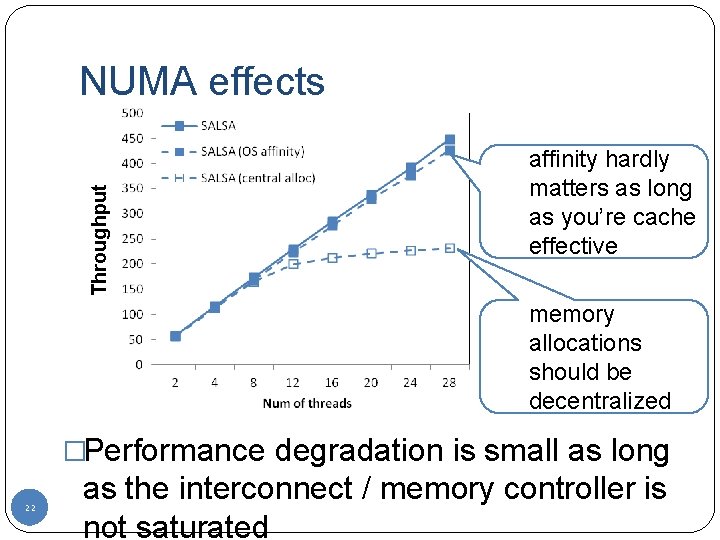
Throughput NUMA effects affinity hardly matters as long as you’re cache effective memory allocations should be decentralized �Performance degradation is small as long 22 as the interconnect / memory controller is not saturated
Conclusions �Techniques for improving performance: �Lightweight, synchronization-free fast path �NUMA-aware memory management (most data accesses are inside NUMA nodes) �Chunk-based stealing amortizes stealing costs �Elegant load-balancing using per-consumer chunk pools �Great performance �Linear scalability �x 20 faster than other work stealing techniques, x 5 faster than state-of-the art non-FIFO pools �Highly robust to imbalances and unexpected thread stalls 23
Backup 24
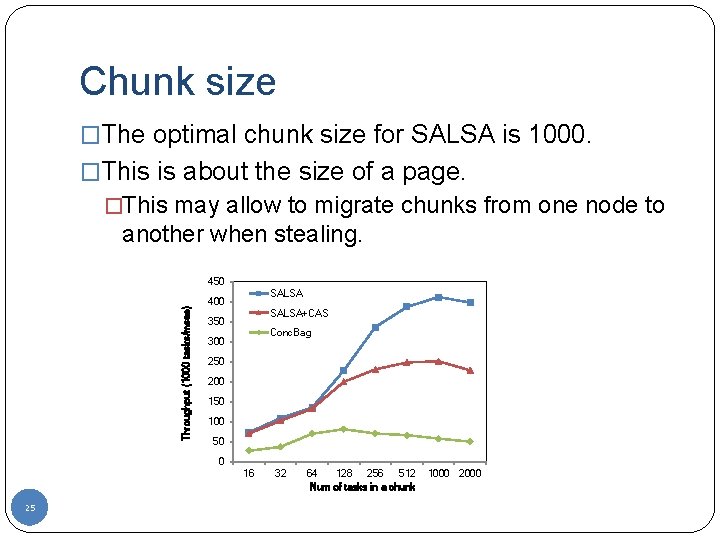
Chunk size �The optimal chunk size for SALSA is 1000. �This is about the size of a page. �This may allow to migrate chunks from one node to another when stealing. Throughput (1000 tasks/msec) 450 SALSA 400 SALSA+CAS 350 Conc. Bag 300 250 200 150 100 50 0 16 25 32 64 128 256 512 Num of tasks in a chunk 1000 2000
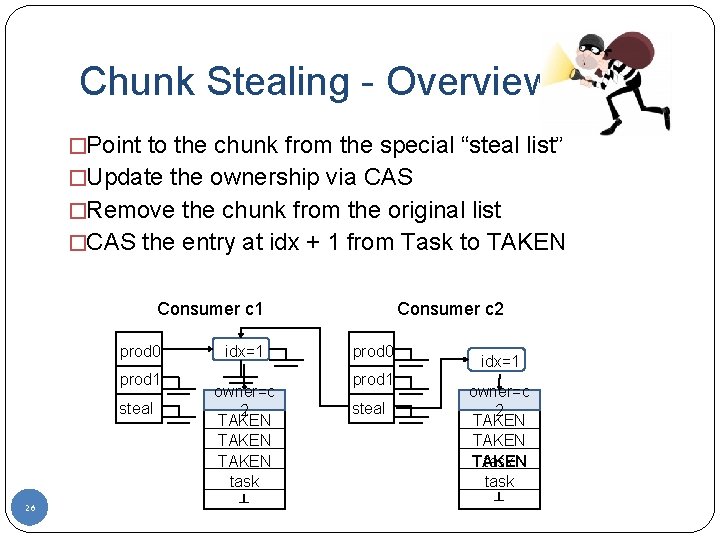
Chunk Stealing - Overview �Point to the chunk from the special “steal list” �Update the ownership via CAS �Remove the chunk from the original list �CAS the entry at idx + 1 from Task to TAKEN Consumer c 1 prod 0 prod 1 steal 26 idx=1 owner=c 1 2 TAKEN task ┴ Consumer c 2 prod 0 prod 1 steal idx=1 owner=c 2 TAKEN task ┴
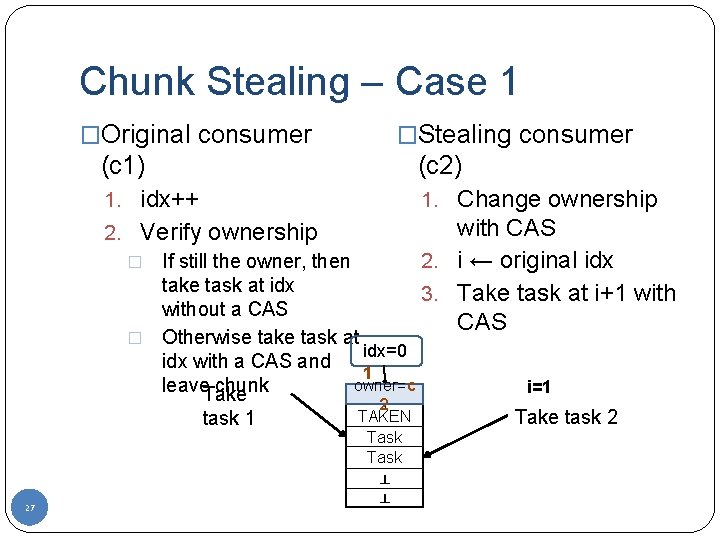
Chunk Stealing – Case 1 �Original consumer �Stealing consumer (c 1) (c 2) 1. idx++ 1. Change ownership 2. Verify ownership � If still the owner, then 2. take task at idx 3. without a CAS � Otherwise take task at idx=0 idx with a CAS and 1 owner=c leave. Take chunk task 1 27 1 2 TAKEN Task ┴ ┴ with CAS i ← original idx Take task at i+1 with CAS i=1 Take task 2
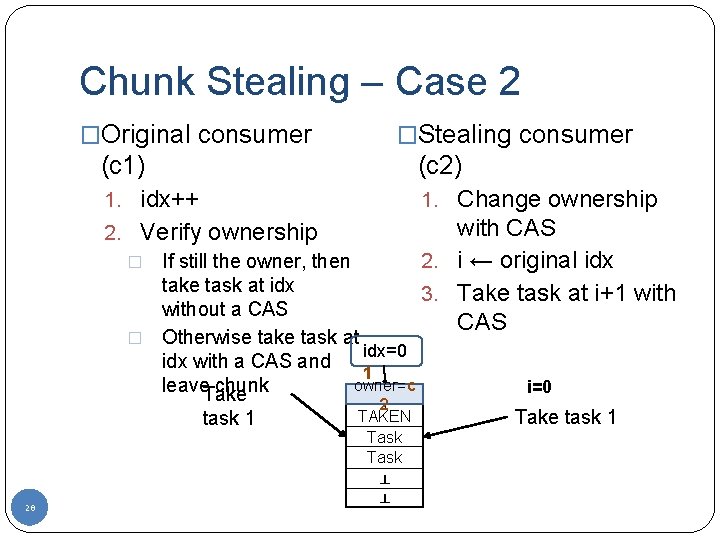
Chunk Stealing – Case 2 �Original consumer �Stealing consumer (c 1) (c 2) 1. idx++ 1. Change ownership 2. Verify ownership � If still the owner, then 2. take task at idx 3. without a CAS � Otherwise take task at idx=0 idx with a CAS and 1 owner=c leave. Take chunk task 1 28 1 2 TAKEN Task ┴ ┴ with CAS i ← original idx Take task at i+1 with CAS i=0 Take task 1
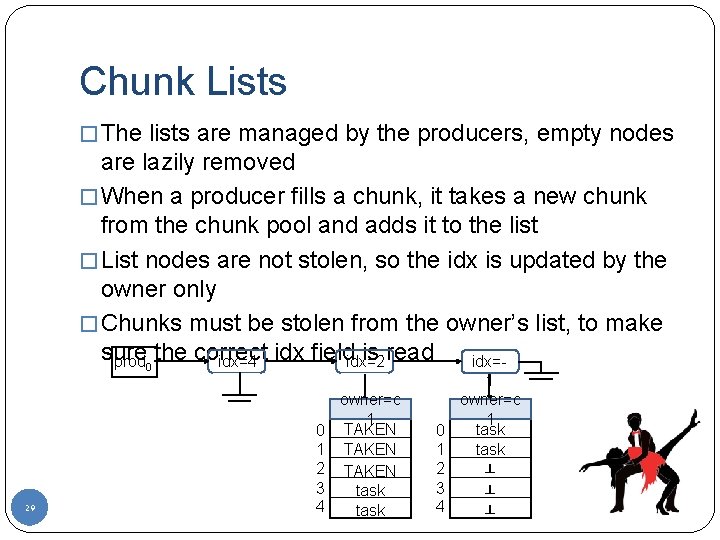
Chunk Lists � The lists are managed by the producers, empty nodes are lazily removed � When a producer fills a chunk, it takes a new chunk from the chunk pool and adds it to the list � List nodes are not stolen, so the idx is updated by the owner only � Chunks must be stolen from the owner’s list, to make sure is read idx=4 idx field idx=2 prod 0 the correct idx=- 29 0 1 2 3 4 owner=c 1 TAKEN task 1 owner=c 1 task 0 1 task 2 ┴ 3 ┴ 4 ┴
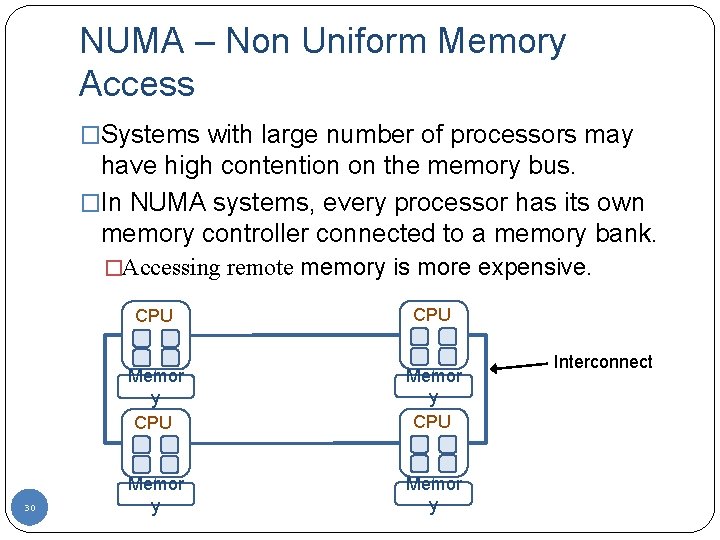
NUMA – Non Uniform Memory Access �Systems with large number of processors may have high contention on the memory bus. �In NUMA systems, every processor has its own memory controller connected to a memory bank. �Accessing remote memory is more expensive. CPU 1 30 CPU 2 Memor y CPU 3 Memor y CPU 4 Memor y Interconnect
- Slides: 30