
SALIVARY GLANDS Objectives Describe the microscopic structure of
SALIVARY GLANDS Objectives: Describe the microscopic structure of the major salivary glands in correlation with function. ◧ ◧ ◧ Editing file Important Doctor notes / Extra 438 Histology Team GNT Block

❏ Types Salivary Glands ❏ General Structure Major Salivary Glands: 1. Parotid. 2. Submandibular. 3. Sublingual. Minor Salivary Glands: 1. Labial (lips) 2. Lingual (tongue) 3. Buccal (cheek) 4. Palatine (Palate) Produce 5% of salivary output. Most of them are pure mucous or seromucous glands. Stroma: • C. T. capsule. • C. T. septa dividing the glands into lobes and lobules. • Reticular C. T. Parenchyma: Acini. (secretory unite) Duct system. 438 Histology Team – GNT Block 2

Types of Salivary Acini Serous Acini: • Contain only serous cells. • Small, spherical, and with a narrow lumen. • Secrete serous secretion thin fluid rich in enzymes, such as amylase and lysozyme. Mucous Acini: Mucoserous (Mixed) Acini: • Contain only mucous • Mucous acini with a cap cells. of serous cells (serous • Larger, more tubular, and demilunes). Half moon shape with a wider lumen. • Secrete mucous secretion. thick viscid secretion and rich in mucin 438 Histology Team – GNT Block 3
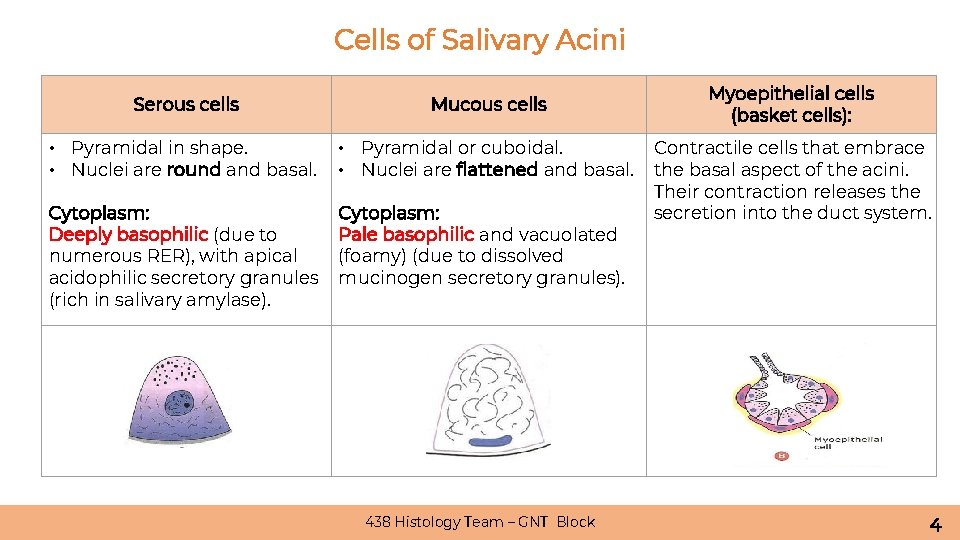
Cells of Salivary Acini Serous cells Mucous cells • Pyramidal in shape. • Nuclei are round and basal. • Pyramidal or cuboidal. • Nuclei are flattened and basal. Cytoplasm: Deeply basophilic (due to numerous RER), with apical acidophilic secretory granules (rich in salivary amylase). Cytoplasm: Pale basophilic and vacuolated (foamy) (due to dissolved mucinogen secretory granules). 438 Histology Team – GNT Block Myoepithelial cells (basket cells): Contractile cells that embrace the basal aspect of the acini. Their contraction releases the secretion into the duct system. 4

Duct System of Salivary Glands 1. Intralobular ducts (prominent): • Intercalated ducts: lined by small cuboidal cells. • Striated ducts: lined by low columnar cells. 2. Interlobular ducts: lined by simple columnar epithelium. 3. Main duct: lined by stratified columnar epithelium which becomes stratified squamous (nonkeratinized) in the distal end. 438 Histology Team – GNT Block 5
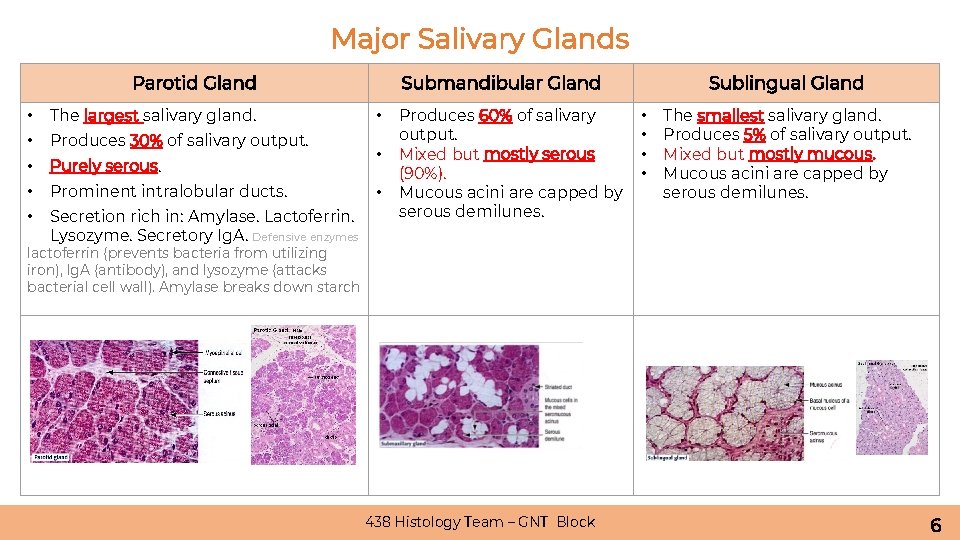
Major Salivary Glands Parotid Gland • The largest salivary gland. • Produces 30% of salivary output. • Purely serous. • Prominent intralobular ducts. • Secretion rich in: Amylase. Lactoferrin. Lysozyme. Secretory Ig. A. Defensive enzymes Submandibular Gland • • • Produces 60% of salivary output. Mixed but mostly serous (90%). Mucous acini are capped by serous demilunes. Sublingual Gland • • The smallest salivary gland. Produces 5% of salivary output. Mixed but mostly mucous. Mucous acini are capped by serous demilunes. lactoferrin (prevents bacteria from utilizing iron), Ig. A (antibody), and lysozyme (attacks bacterial cell wall). Amylase breaks down starch 438 Histology Team – GNT Block 6
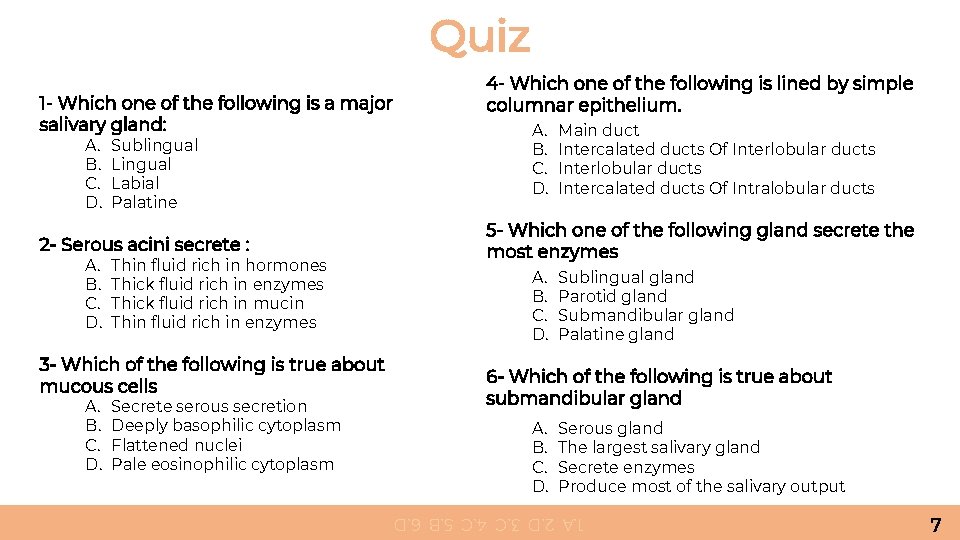
Quiz A. B. C. D. Sublingual Labial Palatine 2 - Serous acini secrete : A. B. C. D. Thin fluid rich in hormones Thick fluid rich in enzymes Thick fluid rich in mucin Thin fluid rich in enzymes 3 - Which of the following is true about mucous cells A. B. C. D. Secrete serous secretion Deeply basophilic cytoplasm Flattened nuclei Pale eosinophilic cytoplasm A. B. C. D. Main duct Intercalated ducts Of Interlobular ducts Intercalated ducts Of Intralobular ducts 5 - Which one of the following gland secrete the most enzymes A. B. C. D. Sublingual gland Parotid gland Submandibular gland Palatine gland 6 - Which of the following is true about submandibular gland A. B. C. D. Serous gland The largest salivary gland Secrete enzymes Produce most of the salivary output 1. A 2. D 3. C 4. C 5. B 6. D 1 - Which one of the following is a major salivary gland: 4 - Which one of the following is lined by simple columnar epithelium. 7

Team Leaders ◧ Abdullah shadid ◧ Sarah alflaij Good luck
- Slides: 8