
Salient Contour Extraction Using Contour Tee BongSoo Sohn

Salient Contour Extraction Using Contour Tee Bong-Soo Sohn Assistant Professor School of Computer Engineering Chung-Ang University 1
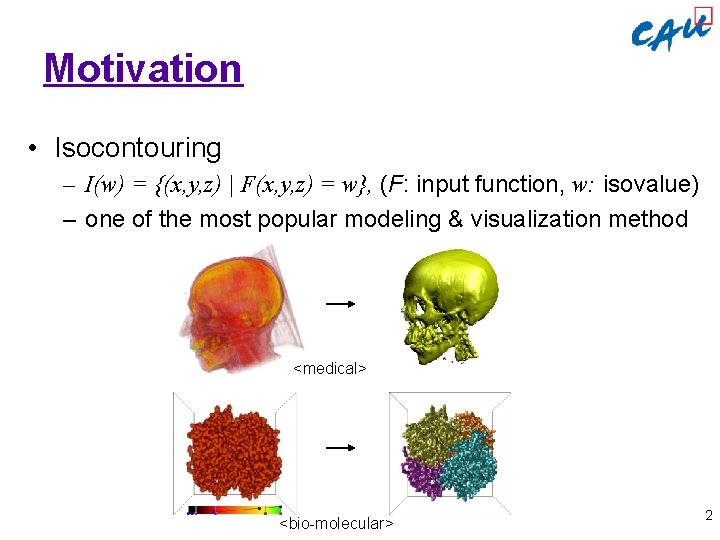
Motivation • Isocontouring – I(w) = {(x, y, z) | F(x, y, z) = w}, (F: input function, w: isovalue) – one of the most popular modeling & visualization method <medical> <bio-molecular> 2
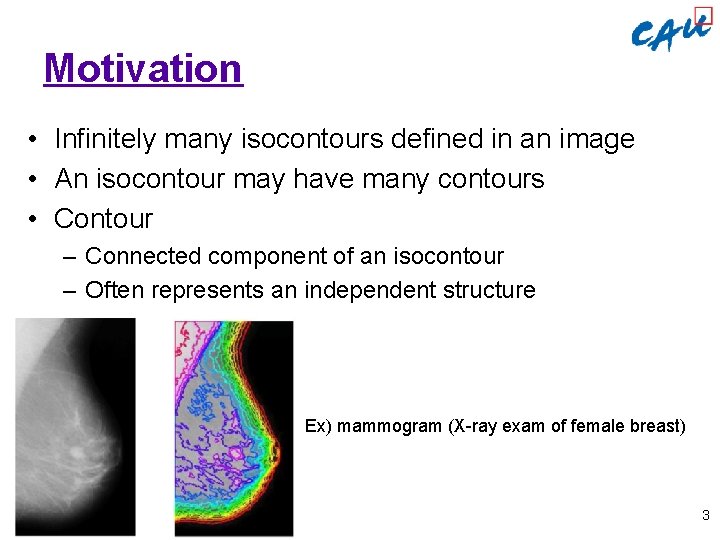
Motivation • Infinitely many isocontours defined in an image • An isocontour may have many contours • Contour – Connected component of an isocontour – Often represents an independent structure Ex) mammogram (X-ray exam of female breast) 3
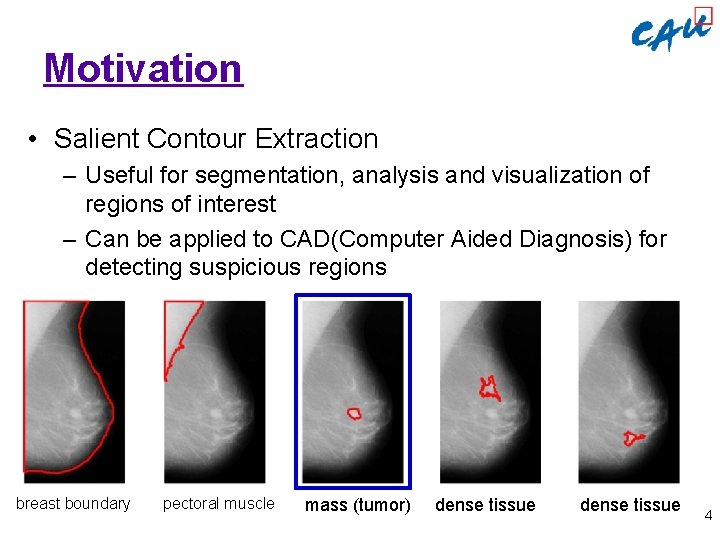
Motivation • Salient Contour Extraction – Useful for segmentation, analysis and visualization of regions of interest – Can be applied to CAD(Computer Aided Diagnosis) for detecting suspicious regions breast boundary pectoral muscle mass (tumor) dense tissue 4
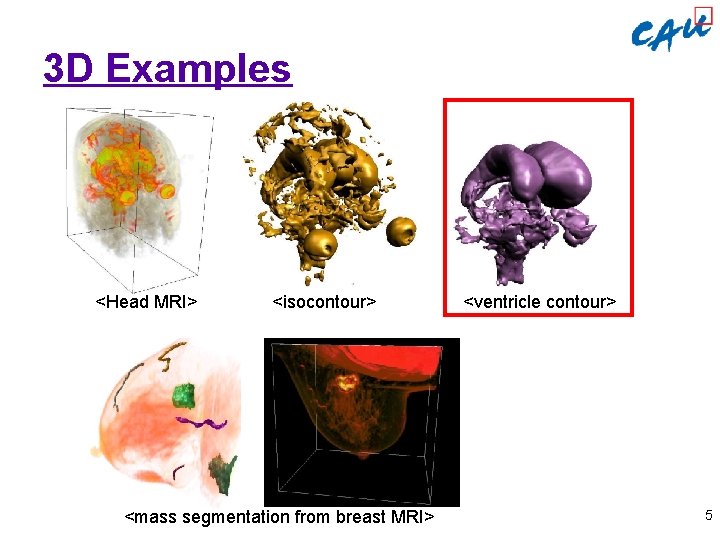
3 D Examples <Head MRI> <isocontour> <mass segmentation from breast MRI> <ventricle contour> 5

Past Contour Tree Approach • Contour Tree – Represents topological changes of contours according to isovalue change. – Property • structure (topology) of level sets • contour extraction • seed set generation for fast extraction 6
Our Approach • Interactive Contour Tree Interface – Performance Improvement of Extraction Process – Utilizing Quantitative Information • Development of Saliency Metric – MND(Minimum Nesting Depth) – Apply to medical images 7

Hybrid Parallel Contour Extraction • Different from isocontour extraction • Divide contour extraction process into – Propagation • Iterative algorithm -> hard to optimize using GPU • multi-threaded algorithm executed in multi-core CPU – Triangulation • CUDA implementation executed in many-core GPU < propagation > < performance of our hybrid parallel algorithm > 8
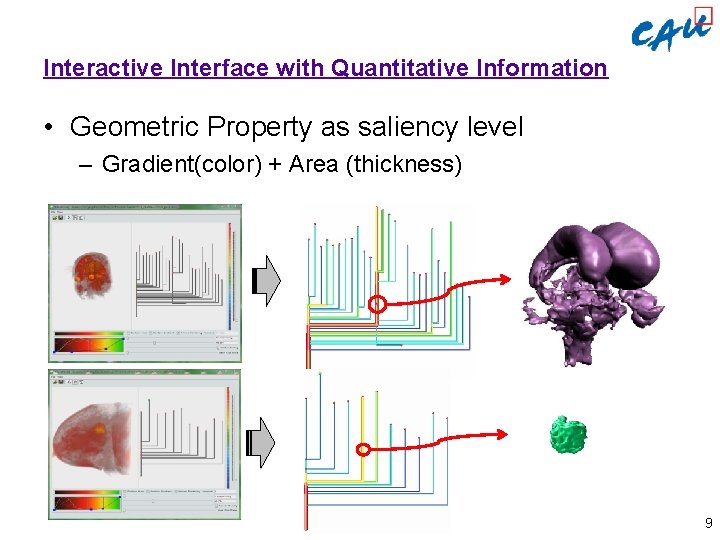
Interactive Interface with Quantitative Information • Geometric Property as saliency level – Gradient(color) + Area (thickness) 9
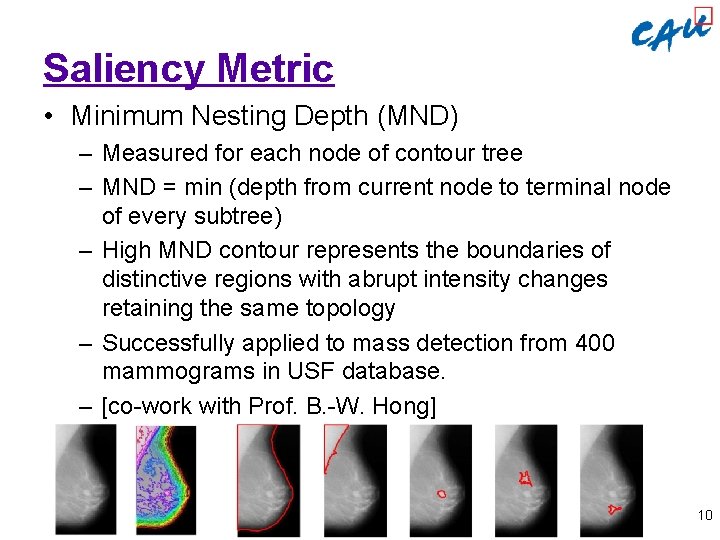
Saliency Metric • Minimum Nesting Depth (MND) – Measured for each node of contour tree – MND = min (depth from current node to terminal node of every subtree) – High MND contour represents the boundaries of distinctive regions with abrupt intensity changes retaining the same topology – Successfully applied to mass detection from 400 mammograms in USF database. – [co-work with Prof. B. -W. Hong] 10
- Slides: 10