
SALES AND MARKETING LECTURE 11 Introduction What is
- Slides: 32
SALES AND MARKETING LECTURE 11
Introduction What is sales? A sale is the important activity involved in selling products or services in return for money or other compensation. What is marketing? The process of planning and executing the conception pricing, promotion, and distribution of ideas, goods and services to create exchanges that satisfy individual and organisational goals. Churchill and Peter, (1998)
Why business fail? (3 Ms) Money – insufficient operating capital and cash flow Management – lack of skills and experience Marketing – lack of research (knowing and assessing your customer)
Marketing Definition Introduce entrepreneur, business or company of the products or services that can be offered to the society. Increase the sales or services Brings satisfaction, excitement to the customer to continuously repeat the order. Enhance the offer, sales methods, pricing, market area and communication method to client.
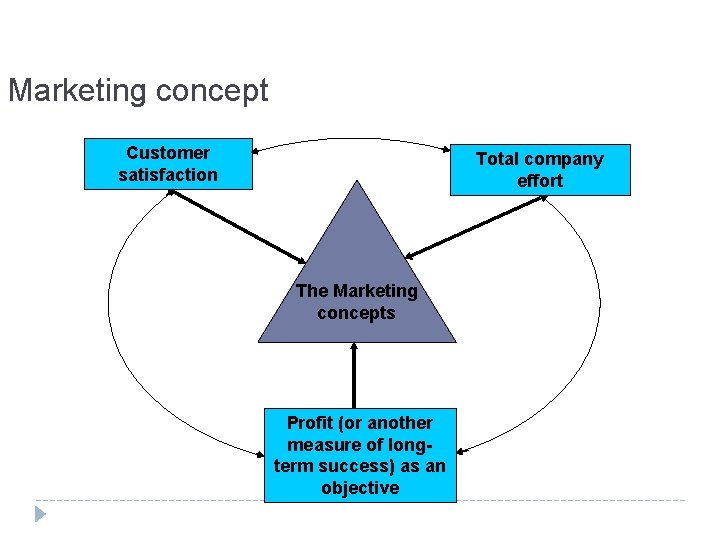
Marketing concept Customer satisfaction Total company effort The Marketing concepts Profit (or another measure of longterm success) as an objective
Cont… The marketing concept suggests how organisations should behave in terms of customers and competition. Stress the belief that an organisation should aim all its efforts at anticipating and satisfying its customers at a profit
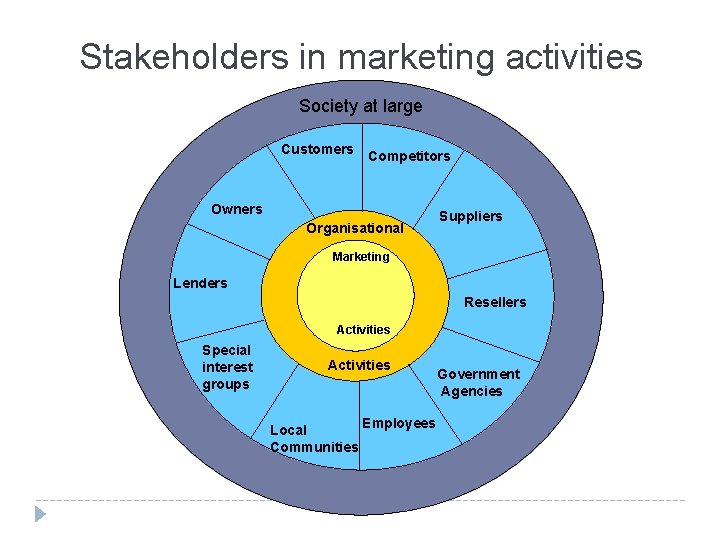
Stakeholders in marketing activities Society at large Customers Competitors Owners Organisational Suppliers Marketing Lenders Resellers Activities Special interest groups Activities Employees Local Communities Government Agencies
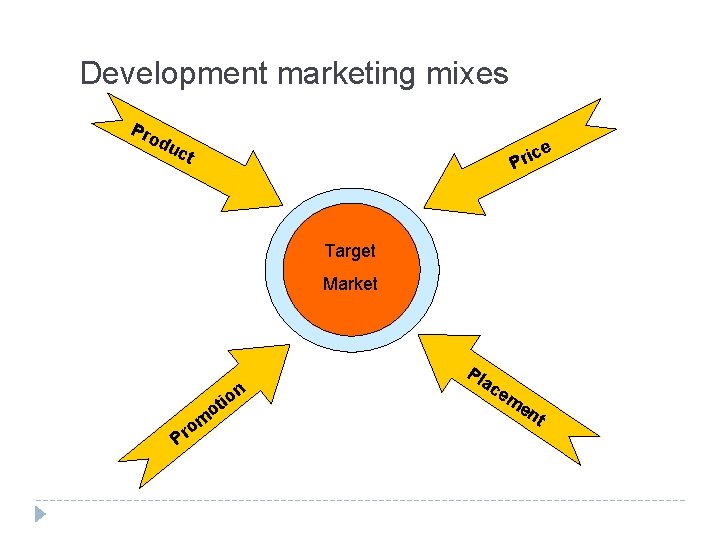
Development marketing mixes Pro d uc e c Pri t Target Market on i ot Pr om Pl ac em e nt
Product The product element is concerned with what marketers offer to customers. The management of existing products The management of new products The management of services
Price Concerns the amount of money or other resources marketers ask for their offerings Pricing fundamentals Management of pricing
Placement Channels of distribution Concerns how products and services are delivered to markets to make them available for exchanges Managing channels of distribution Wholesaling Physical distribution retailing
Promotion Communications Concerns how marketers inform, persuade, and remind customers about products and services Integrated marketing communication Advertising Sales promotion Publicity Personal selling Sales management
Entrepreneur roles towards marketing 1. Choose the right and potential target market. 2. Conduct market survey on customer’s needs and desire. 3. Offer products and services with variety of types, characteristics, continuous enhancement and quality.
4. Offer reasonable and competitive pricing or cheapest among the competitors. 5. Made available of the product and services to the customer. 6. Distribute widely the promotion information and able to convince the potential customers.
MARKETING ENVIRONMENT
What is Marketing Environment? Factors and general surrounding that effect business marketing planning and the implementation. 2 categories: i. ii. Internal Business Environment External Business Environment
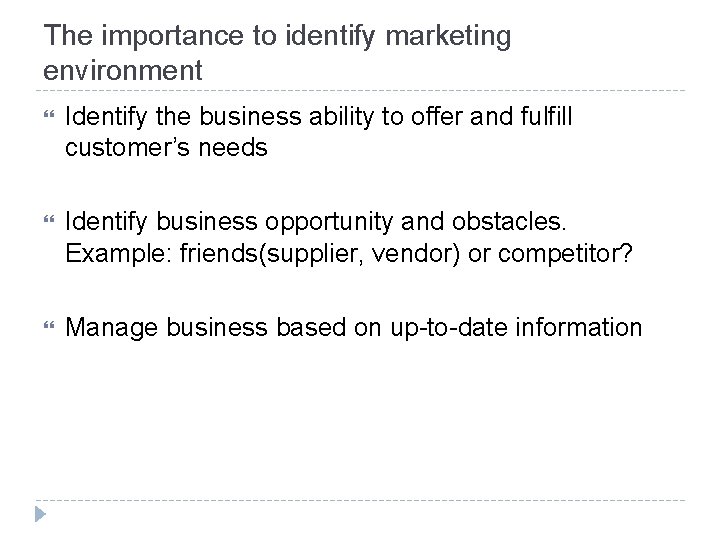
The importance to identify marketing environment Identify the business ability to offer and fulfill customer’s needs Identify business opportunity and obstacles. Example: friends(supplier, vendor) or competitor? Manage business based on up-to-date information
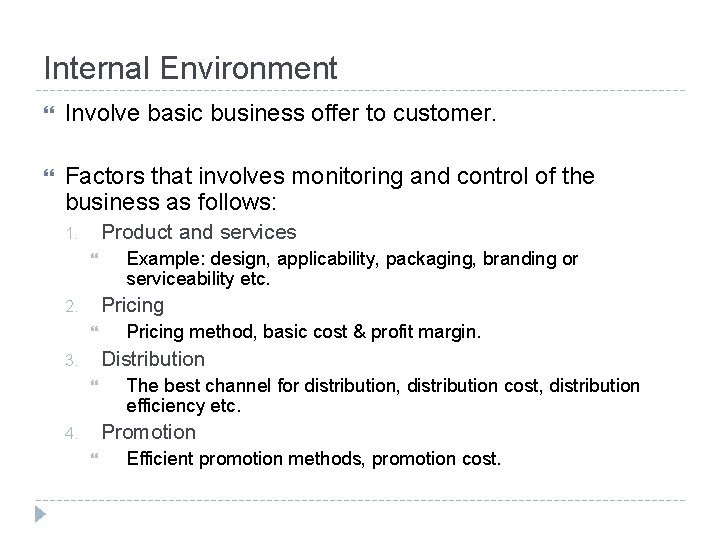
Internal Environment Involve basic business offer to customer. Factors that involves monitoring and control of the business as follows: Product and services 1. Example: design, applicability, packaging, branding or serviceability etc. Pricing 2. Pricing method, basic cost & profit margin. Distribution 3. The best channel for distribution, distribution cost, distribution efficiency etc. Promotion 4. Efficient promotion methods, promotion cost.
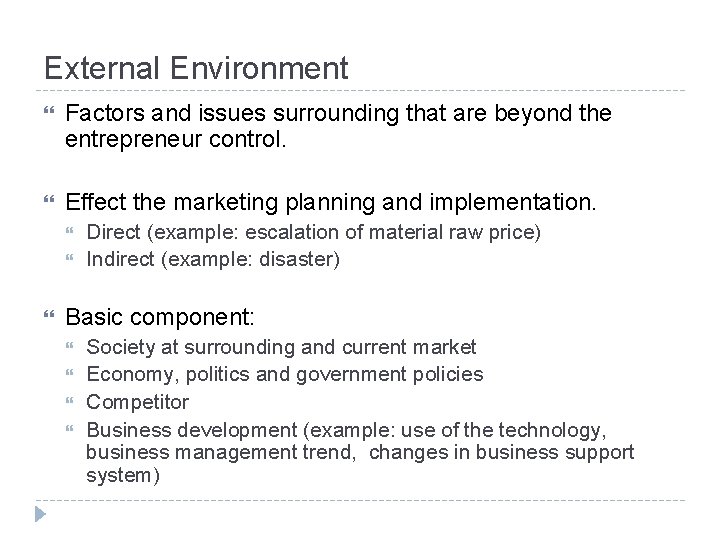
External Environment Factors and issues surrounding that are beyond the entrepreneur control. Effect the marketing planning and implementation. Direct (example: escalation of material raw price) Indirect (example: disaster) Basic component: Society at surrounding and current market Economy, politics and government policies Competitor Business development (example: use of the technology, business management trend, changes in business support system)
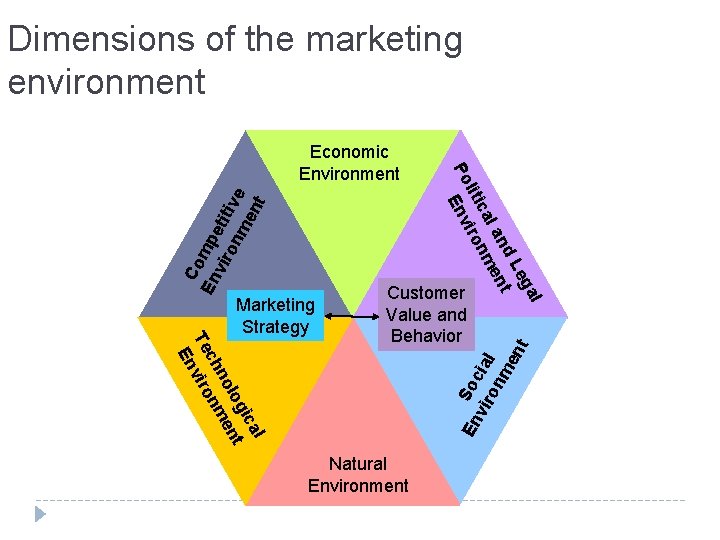
Dimensions of the marketing environment Co En mpe vir on titive me nt Customer Value and Behavior En Soc vir ia on l me nt l ica log nt no nme ch Te viro En Marketing Strategy l ga Le nd ent la ca nm liti iro Po Env Economic Environment Natural Environment
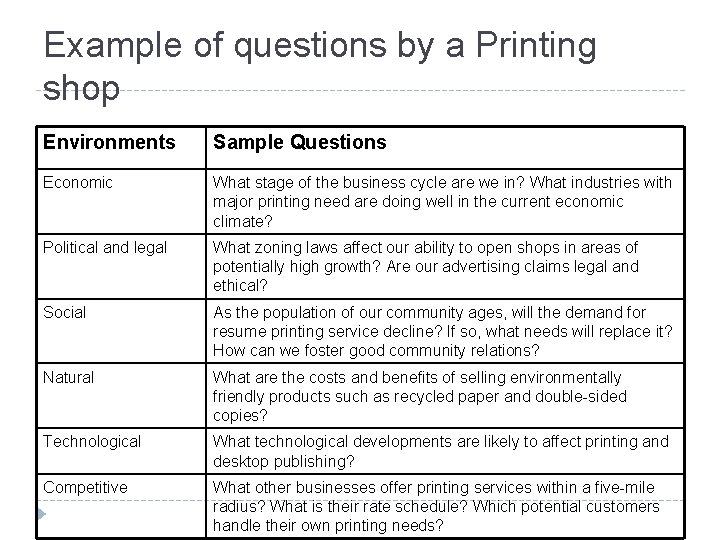
Example of questions by a Printing shop Environments Sample Questions Economic What stage of the business cycle are we in? What industries with major printing need are doing well in the current economic climate? Political and legal What zoning laws affect our ability to open shops in areas of potentially high growth? Are our advertising claims legal and ethical? Social As the population of our community ages, will the demand for resume printing service decline? If so, what needs will replace it? How can we foster good community relations? Natural What are the costs and benefits of selling environmentally friendly products such as recycled paper and double-sided copies? Technological What technological developments are likely to affect printing and desktop publishing? Competitive What other businesses offer printing services within a five-mile radius? What is their rate schedule? Which potential customers handle their own printing needs?
Sales Method
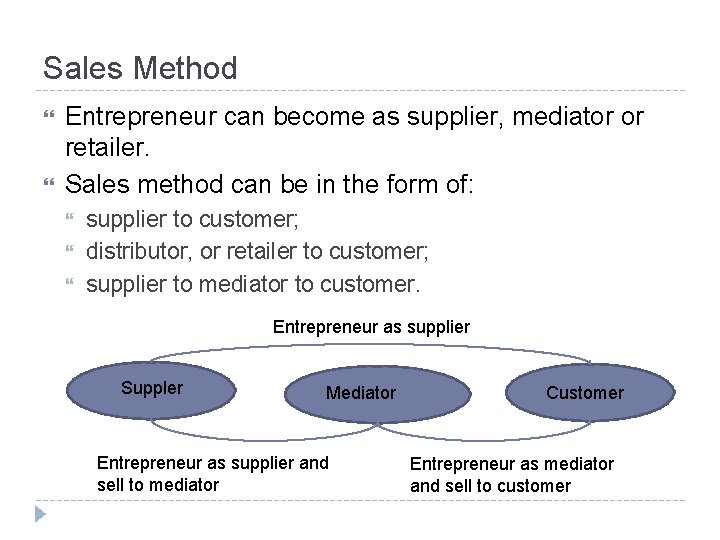
Sales Method Entrepreneur can become as supplier, mediator or retailer. Sales method can be in the form of: supplier to customer; distributor, or retailer to customer; supplier to mediator to customer. Entrepreneur as supplier Suppler Mediator Entrepreneur as supplier and sell to mediator Customer Entrepreneur as mediator and sell to customer
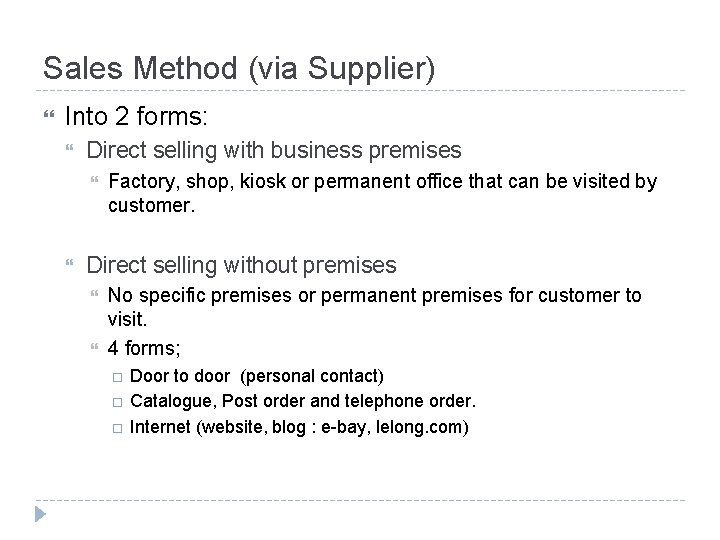
Sales Method (via Supplier) Into 2 forms: Direct selling with business premises Factory, shop, kiosk or permanent office that can be visited by customer. Direct selling without premises No specific premises or permanent premises for customer to visit. 4 forms; Door to door (personal contact) Catalogue, Post order and telephone order. Internet (website, blog : e-bay, lelong. com)
Sales Method (via Mediator) Most favorable method for supplier to sell their product to other parties. Most usual channel via mediator: Sell via supplier Sell via retailer Sell via sales prepresentatives/agent/stockist.
Sales Forecasting
What is Sales Forecasting? Estimation of identified customer purchasing. Projection for future business term. Sales forecasting can be produced in Unit (product sold) or RM (sales) for certain period of time (weekly/monthly/annually/specified term)
The needs to forecast sales As a sales projection for business Actual sales vs. forecasted sales will indicate: Less manpower during high sales or: Miscalculation in purchasing raw material. Forecasting can be used to estimate the needs and usage of the resources. (example: purchasing of high quantity of raw material when it is forecasted to have high sales)
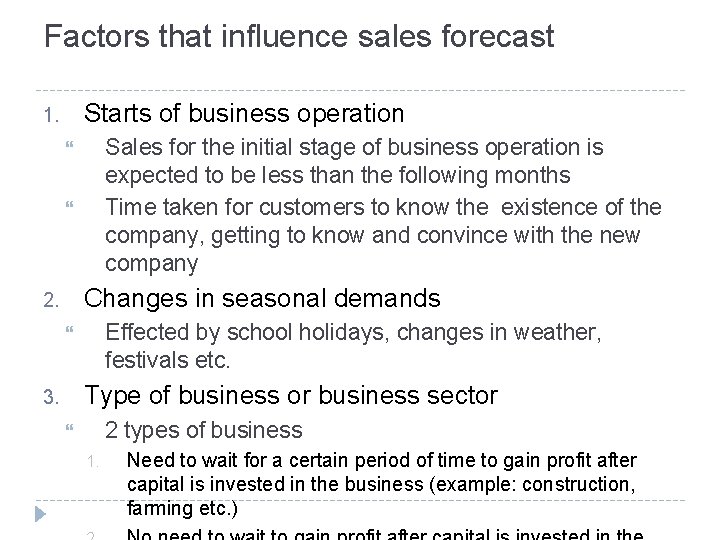
Factors that influence sales forecast Starts of business operation 1. Sales for the initial stage of business operation is expected to be less than the following months Time taken for customers to know the existence of the company, getting to know and convince with the new company Changes in seasonal demands 2. Effected by school holidays, changes in weather, festivals etc. Type of business or business sector 3. 2 types of business 1. Need to wait for a certain period of time to gain profit after capital is invested in the business (example: construction, farming etc. )
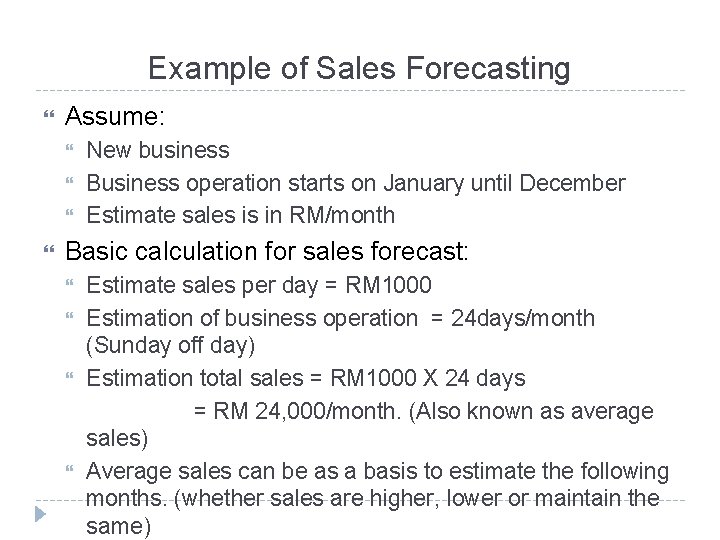
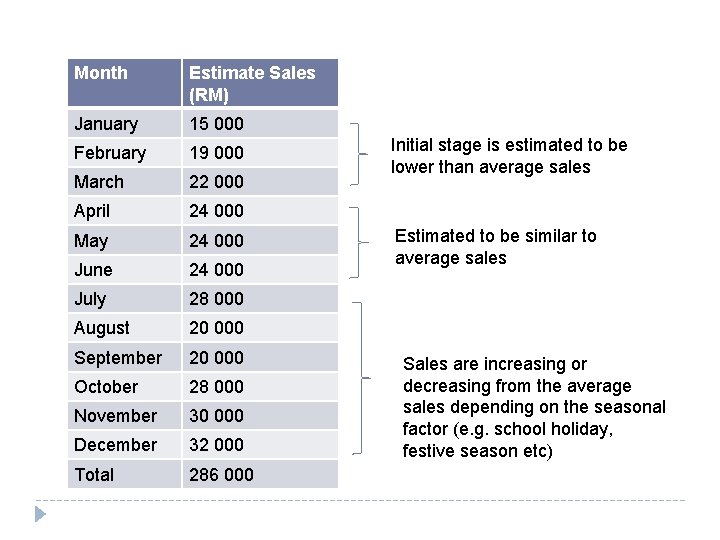
Example of Sales Forecasting Assume: New business Business operation starts on January until December Estimate sales is in RM/month Basic calculation for sales forecast: Estimate sales per day = RM 1000 Estimation of business operation = 24 days/month (Sunday off day) Estimation total sales = RM 1000 X 24 days = RM 24, 000/month. (Also known as average sales) Average sales can be as a basis to estimate the following months. (whether sales are higher, lower or maintain the same)
Month Estimate Sales (RM) January 15 000 February 19 000 March 22 000 April 24 000 May 24 000 June 24 000 July 28 000 August 20 000 September 20 000 October 28 000 November 30 000 December 32 000 Total 286 000 Initial stage is estimated to be lower than average sales Estimated to be similar to average sales Sales are increasing or decreasing from the average sales depending on the seasonal factor (e. g. school holiday, festive season etc)
References Ismail, B. , Pawan, F. , Abdul Kadir, MAB. , Alipiah, N. , Raya, R. , Abdul rahman, R. and Abdul Karim, S. 2009. “Asas Pengurusan Pemasaran”. UPENA, Ui. TM Shah Alam