
Salem Massachusetts 1692 Why Salem Still Haunts Us




- Slides: 44
Salem, Massachusetts 1692
Why Salem Still Haunts Us l Fascination l. A with Witches Stain on American History l How Could an Entire Community Engage in Such Horrific Acts?
Witches and Europe l Many people in early European society relied on the local wise people to give an explanation for good and bad fortune. l It was believed that some people possessed special powers that could cause good or harm.
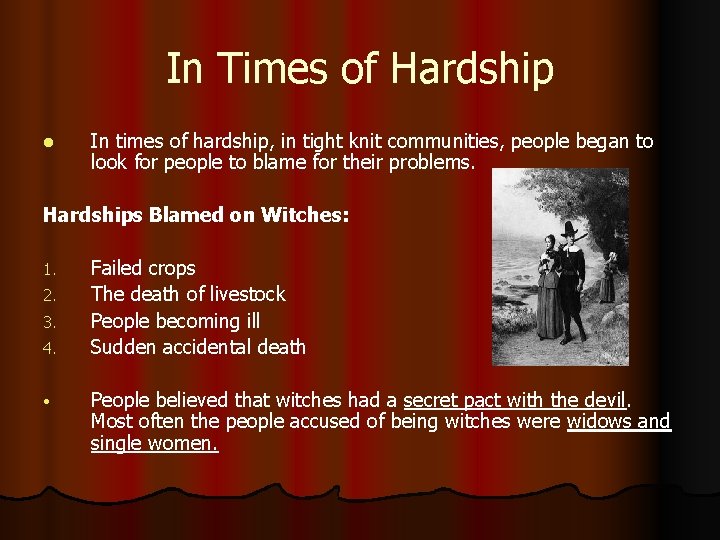
In Times of Hardship l In times of hardship, in tight knit communities, people began to look for people to blame for their problems. Hardships Blamed on Witches: 1. 2. 3. 4. • Failed crops The death of livestock People becoming ill Sudden accidental death People believed that witches had a secret pact with the devil. Most often the people accused of being witches were widows and single women.
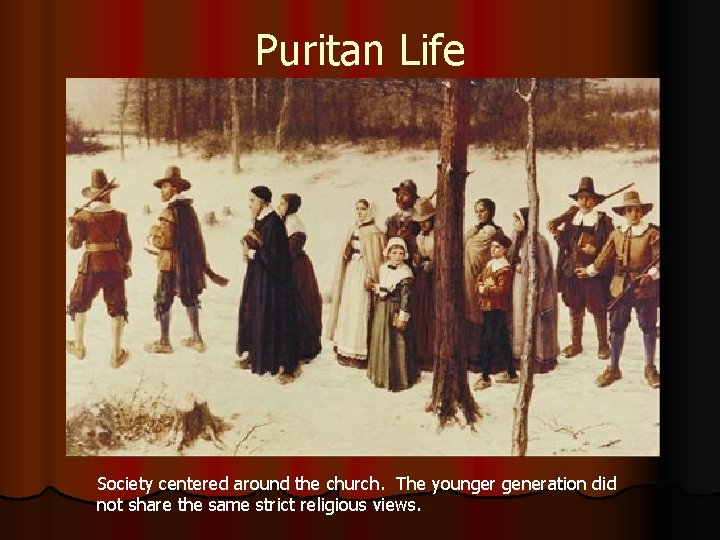
Puritan Life Society centered around the church. The younger generation did not share the same strict religious views.
Salem—the Village History l 1630: John Winthrop is elected the first governor. l 1641: English law makes witchcraft a capital crime. l November, 1689: Samuel Parris is named the new minister of Salem, and Salem Village Church is formed.
The Accused Tituba is a foreigner, given to storytelling, confessed, perhaps because of fear for her life and the enjoyment of being the center of attention. l Sarah Good was homeless, a social misfit who would mumble incoherently when someone failed to be charitable, and the death of livestock was attributed to her curses. l Sarah Osborne was an elderly woman who hadn’t been to church in year and may have been considered rather crotchety. l
Strange Behavior l In January of 1692, a group of girls in Salem Village, MA began to exhibit strange behavior, such as blasphemous screaming, convulsive seizures, trance-like states and mysterious spells. l Physicians concluded that only the influence of Satan could be responsible for the girls’ afflictions. l Pressured to identify the source of their affliction, the girls named three women as witches: Tituba (the pastor’s Caribbean-Indian slave), Sarah Good & Sarah Osborne.
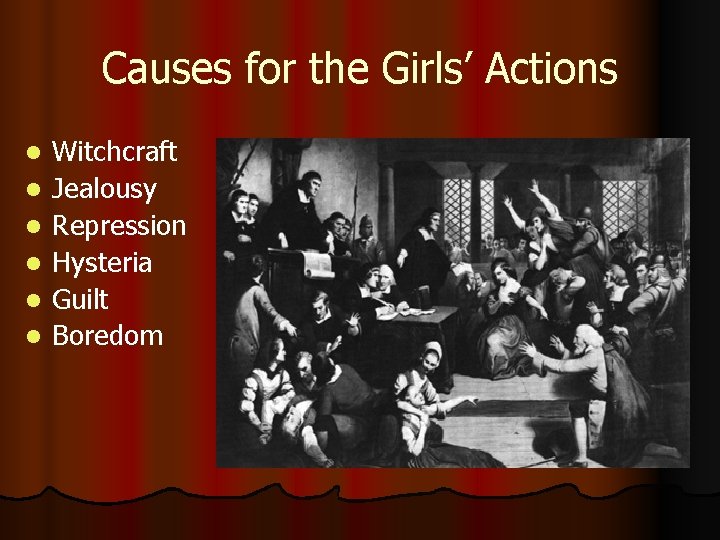
Causes for the Girls’ Actions l l l Witchcraft Jealousy Repression Hysteria Guilt Boredom
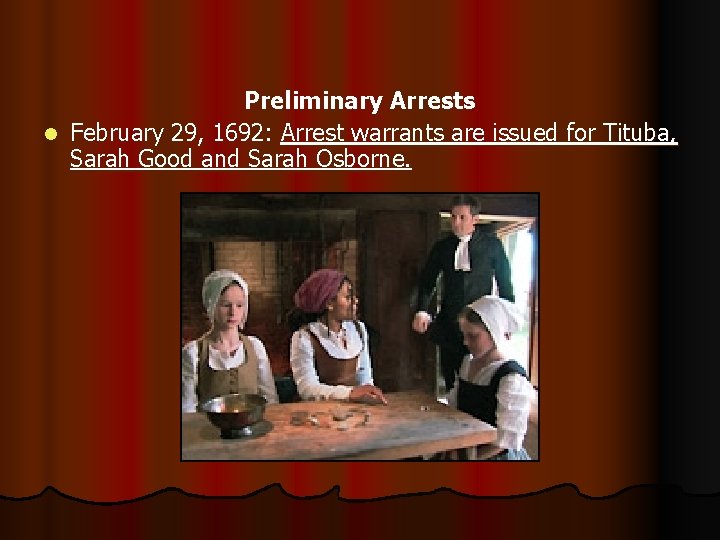
Preliminary Arrests l February 29, 1692: Arrest warrants are issued for Tituba, Sarah Good and Sarah Osborne.
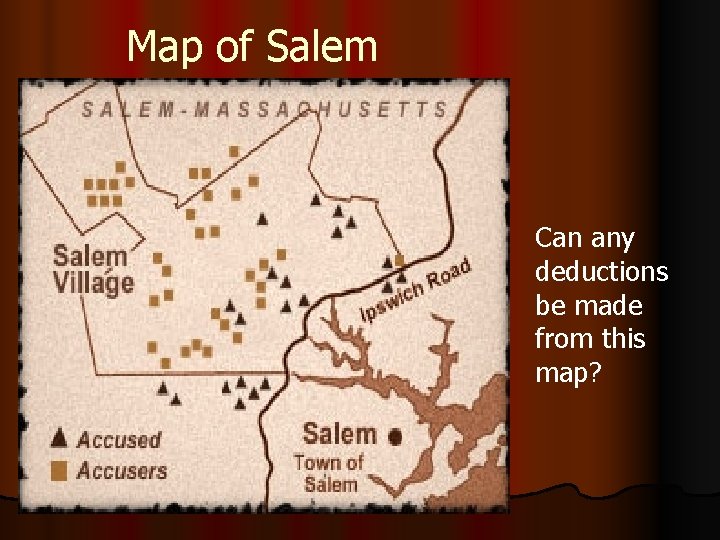
Map of Salem Can any deductions be made from this map?
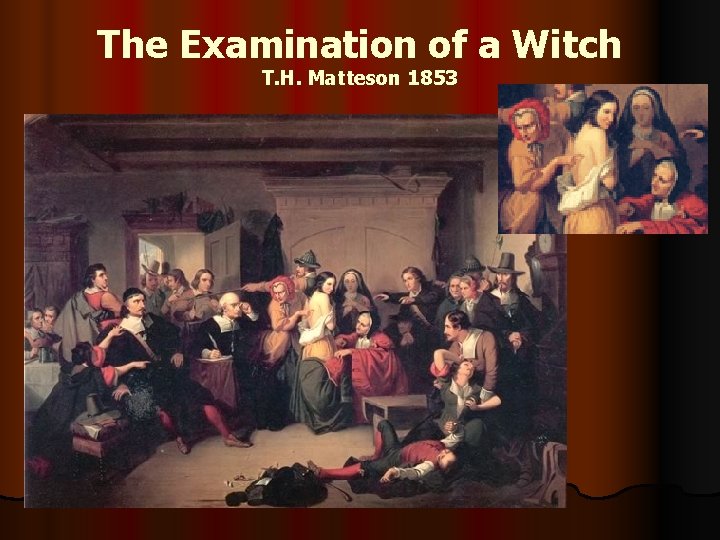
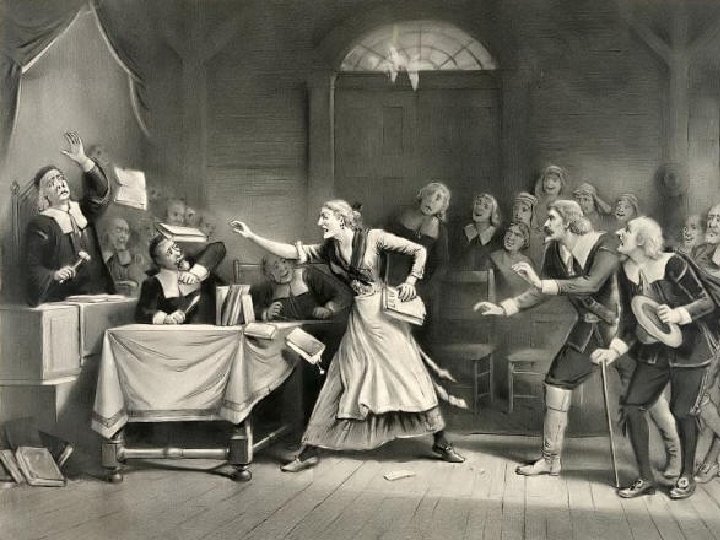
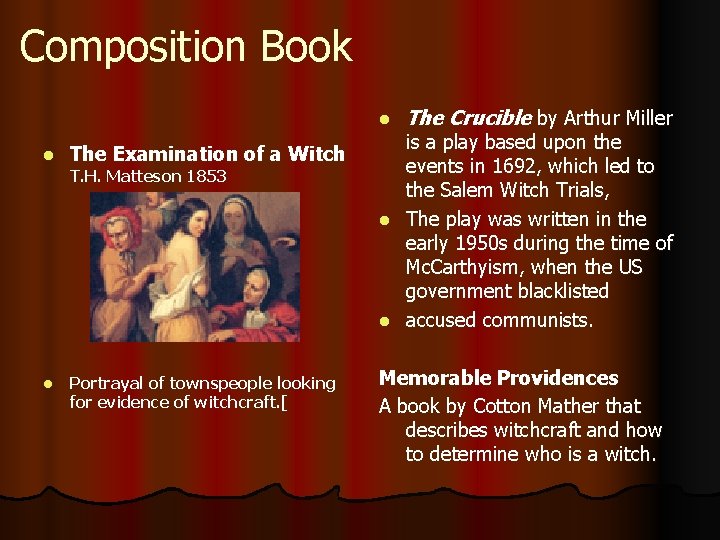
The Examination of a Witch T. H. Matteson 1853
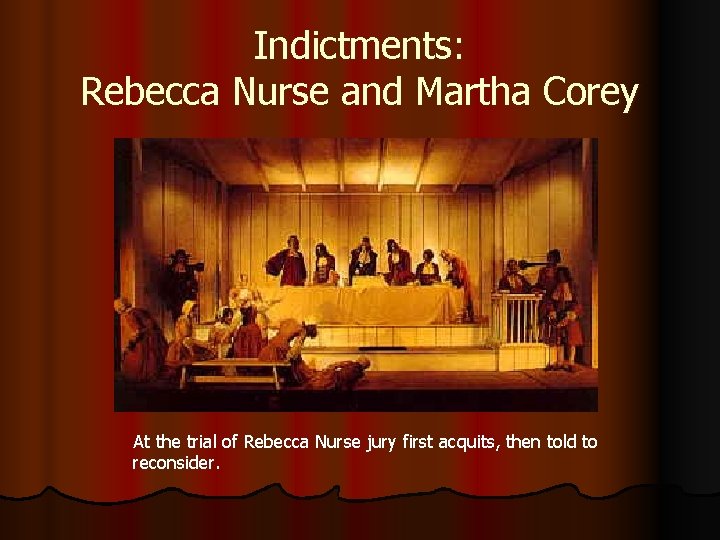
Indictments: Rebecca Nurse and Martha Corey At the trial of Rebecca Nurse jury first acquits, then told to reconsider.
Characteristics of “Witch” Trials 1. 2. 3. 4. 5. 6. 7. 8. 9. 10. Pressure of Social Forces Stigmatization of the Accused Climate of Fear Resemblance to a Fair Trial Use of Simulated Evidence Simulated Expert Testimony Non-falsifiabile Evidence Reversal of Polarity Non-Openness Use of Loaded Questions
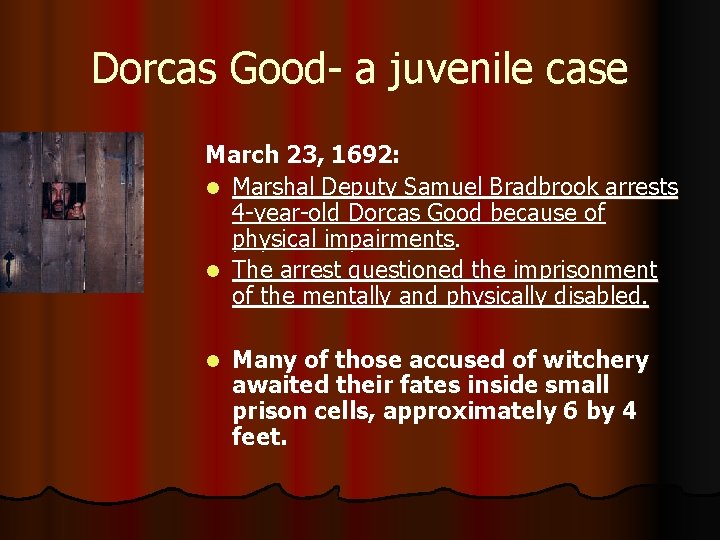
Dorcas Good- a juvenile case March 23, 1692: l Marshal Deputy Samuel Bradbrook arrests 4 -year-old Dorcas Good because of physical impairments. l The arrest questioned the imprisonment of the mentally and physically disabled. l Many of those accused of witchery awaited their fates inside small prison cells, approximately 6 by 4 feet.
The sentences are carried out. l August 19: George Burroughs, John Proctor, John Willard, George Jacobs, and Martha Carrier are hanged. Elizabeth Proctor is spared because she is pregnant. l September 9: Six more tried and sentenced to death, including Martha Corey.
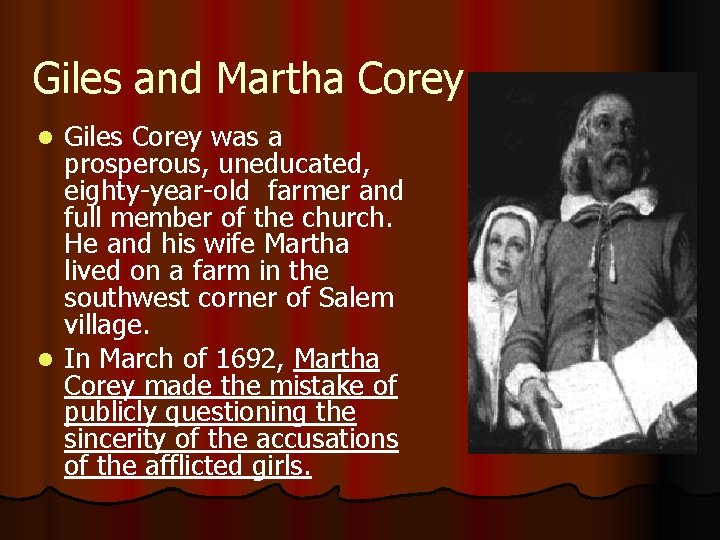
Giles and Martha Corey Giles Corey was a prosperous, uneducated, eighty-year-old farmer and full member of the church. He and his wife Martha lived on a farm in the southwest corner of Salem village. l In March of 1692, Martha Corey made the mistake of publicly questioning the sincerity of the accusations of the afflicted girls. l
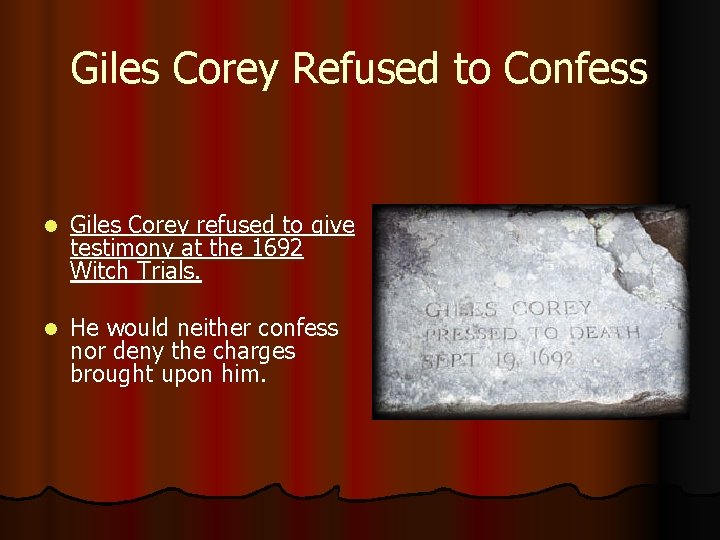
Giles Corey Refused to Confess l Giles Corey refused to give testimony at the 1692 Witch Trials. l He would neither confess nor deny the charges brought upon him.
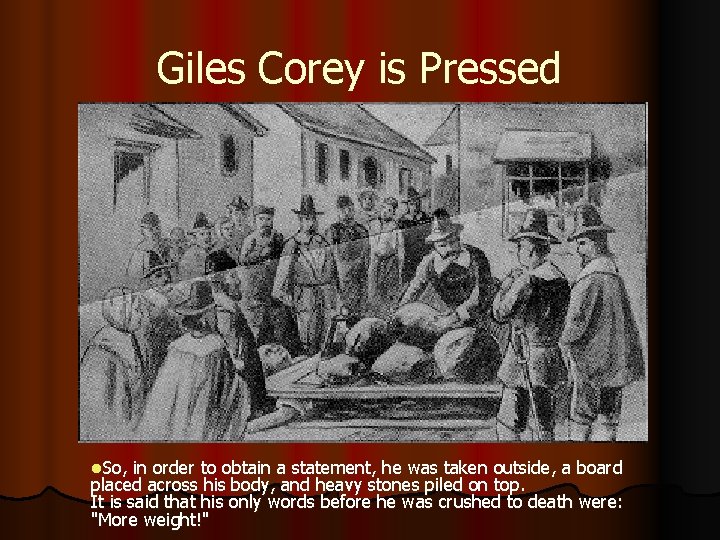
Giles Corey is Pressed l. So, in order to obtain a statement, he was taken outside, a board placed across his body, and heavy stones piled on top. It is said that his only words before he was crushed to death were: "More weight!"
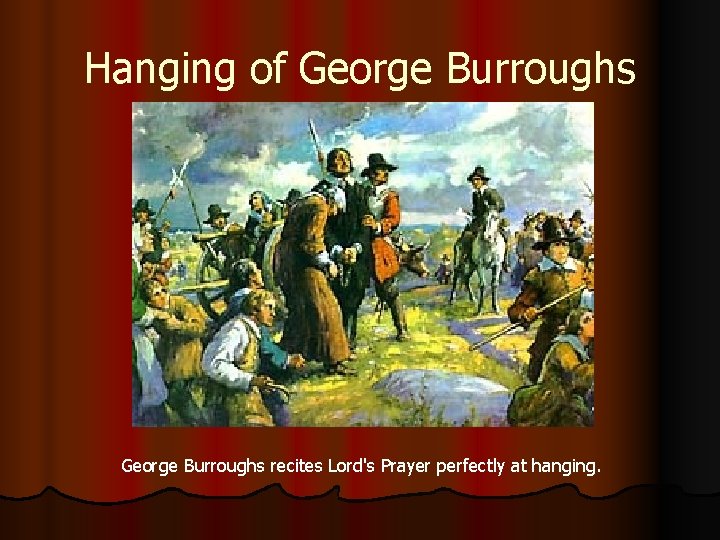
Hanging of George Burroughs recites Lord's Prayer perfectly at hanging.
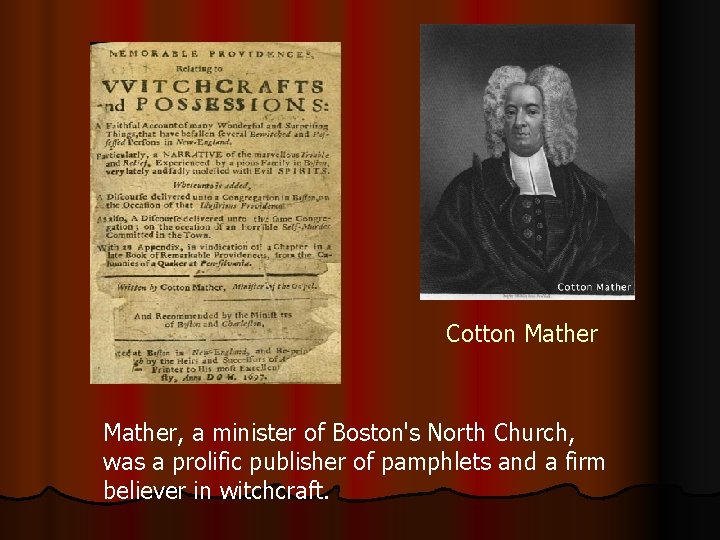
Cotton Mather, a minister of Boston's North Church, was a prolific publisher of pamphlets and a firm believer in witchcraft.
Results of the Hysteria l 140 people had been accused of practicing witchcraft in Salem, including a 4 year old girl and a man in his 80 s. l Twenty accused witches were executed, fifteen women and five men. l Nineteen were hung following conviction. l One was pressed to death for refusing to enter a plea. l At least 4 and as many as 13 prisoners may have died in jail.
Why the hysteria ended l 1. Doubts grow when respected citizens are convicted and executed. l 2. Accusations of witchcraft include the powerful and well-connected. l 3. The educated elite of Boston pressure Gov. Phips to exclude spectral l Increase Mather points out the Devil could take the shape of an innocent person: "It were better that 10 suspected witches should escape than one innocent person should be condemned. "
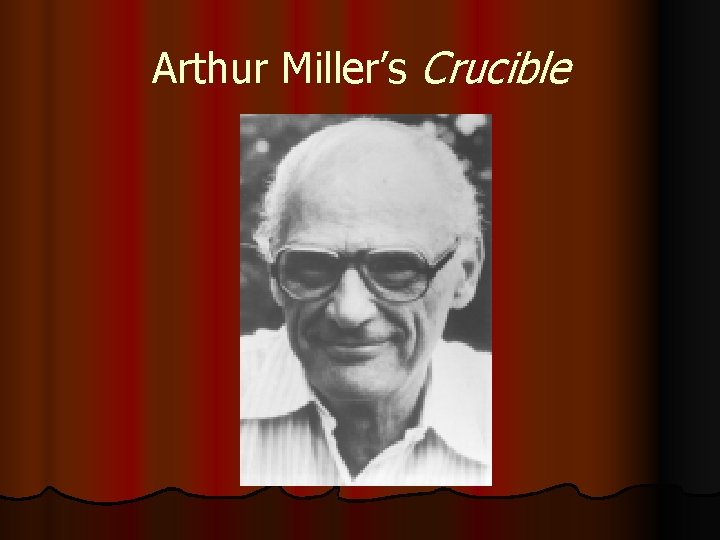
Arthur Miller’s Crucible
Composition Book l l The Examination of a Witch l Portrayal of townspeople looking for evidence of witchcraft. [ T. H. Matteson 1853 The Crucible by Arthur Miller is a play based upon the events in 1692, which led to the Salem Witch Trials, l The play was written in the early 1950 s during the time of Mc. Carthyism, when the US government blacklisted l accused communists. Memorable Providences A book by Cotton Mather that describes witchcraft and how to determine who is a witch.
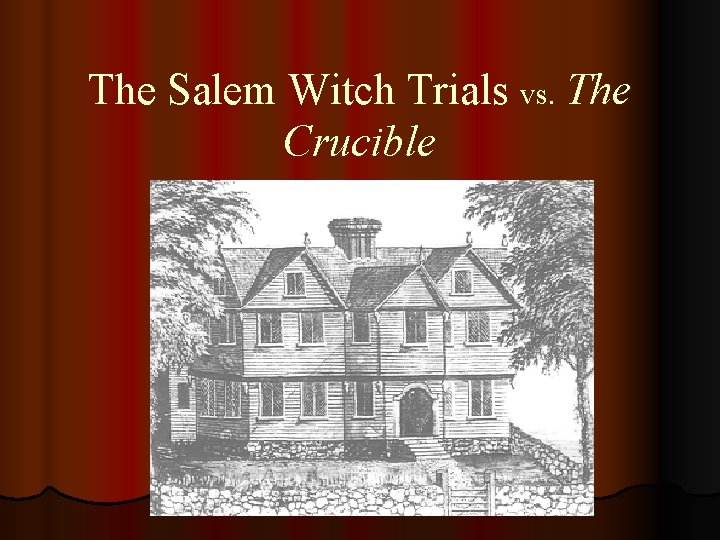
The Salem Witch Trials vs. The Crucible
So, What’s the Truth? THIS IS FICTION: 1. Tituba led six girls into a nearby forest to cast charms and 2. 3. 4. spells, followed by a wild dancing ritual. Ruth Putnam was the first girl to become afflicted. The only symptom of bewitchment was that the victim could not be woken from a deep slumber. John Proctor, Rebecca Nurse, and Martha Corey were all hung on the same day.
The Parris Family THIS IS FICTION: 1. Mrs. Parris had been dead for years and the family consisted of Betty (daughter), Mr. Parris, Abigail (niece), and Tituba (slave). 2. Betty was present for the trials. 3. Mr. Parris claimed to be a graduate of Harvard. 4. Tituba was single and didn’t have family as a slave. Tituba confessed quickly.
The Putnams, Nurses, & Giles Corey THIS IS FICTION: 1. Daughter is named Ruth Putnam. 2. Ruth was the only child of 8 to survive. 3. Both of the Nurses were deeply respected and revered. 4. Giles Corey was executed for refusing to reveal the name of a witness.
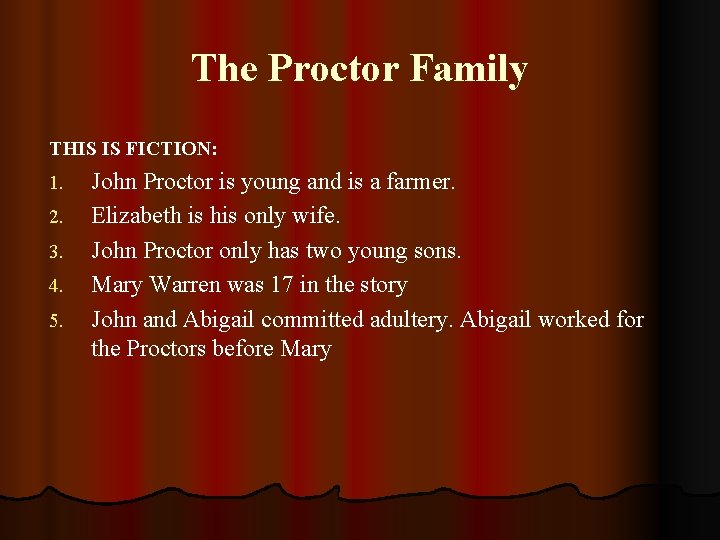
The Proctor Family THIS IS FICTION: 1. 2. 3. 4. 5. John Proctor is young and is a farmer. Elizabeth is his only wife. John Proctor only has two young sons. Mary Warren was 17 in the story John and Abigail committed adultery. Abigail worked for the Proctors before Mary
Salem Witch Trials Memorial
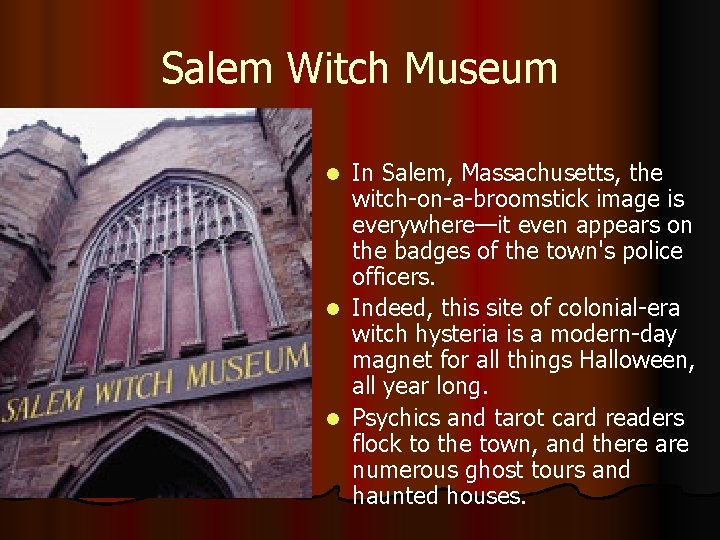
Salem Witch Museum In Salem, Massachusetts, the witch-on-a-broomstick image is everywhere—it even appears on the badges of the town's police officers. l Indeed, this site of colonial-era witch hysteria is a modern-day magnet for all things Halloween, all year long. l Psychics and tarot card readers flock to the town, and there are numerous ghost tours and haunted houses. l
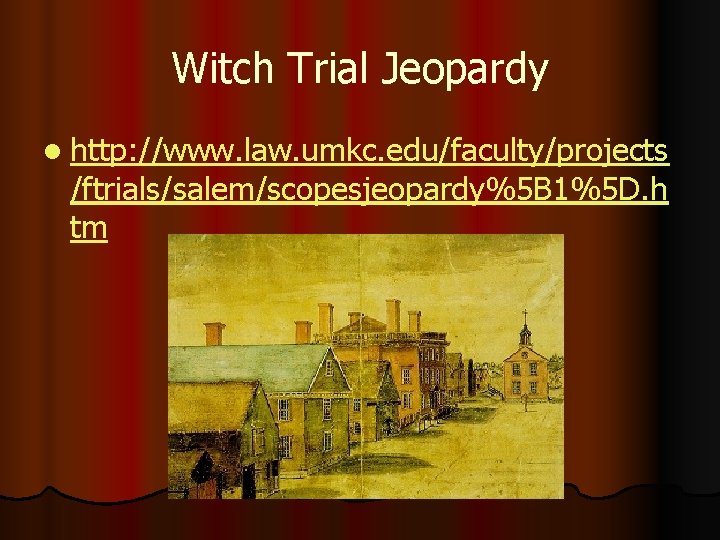
Witch Trial Jeopardy l http: //www. law. umkc. edu/faculty/projects /ftrials/salem/scopesjeopardy%5 B 1%5 D. h tm
What would you do? l It's the spring of 1692 in Salem, Massachusetts. You've just been accused by "an afflicted girl" of being a witch. The reason for the accusation against you might have been any from a long list of possibilities. Perhaps you're reclusive, talk to yourself, or exhibit some other form of eccentric behavior. Perhaps you were involved in a previous dispute with the family of the afflicted girl. Perhaps you don't go to church, or go to the wrong church, or sided with the wrong faction in recent congregational strife within the Salem Village Church. Perhaps you speak French or are suspected with having aided the Wabanakis in the recent Indian wars. Or perhaps you expressed support for a recently accused witch or--worse yet--accused the accusers of lying. Whatever the reason, you're in big trouble now. What do you do? (Pick an option below).
Choose One Option 1. Flee Salem 2. Accuse someone else. 3. Quick! Get pregnant! 4. Confess, even though you are innocent. 5. Plead innocent and stand for trial. 6. Refuse to stand trial and face the consequences.
Flee Salem l Good idea, if you can swing it. Several accused witches did escape from jail and survive the 1692 hysteria. They included Philip and Mary English, John Alden, Hezekiah Usher, and Mrs. Nathaniel Cary. However, all these accused persons had either money or influence that made their escape possible. You don't have either. Try your next option.
Accuse Someone Else l The theory here is that if you're afflicted by witchcraft, you can't be a witch yourself. This theory even convinced some daughters to testify against their own mothers. It's not a bad idea (if you have no conscience), but--sorry--it's too late now. You should have thought of this idea a few days ago. Now, your accusation will look like an obvious attempt to distract attention from your own guilt. The accusation of witchcraft has been made against you and you're still going to have to deal with it. Pick another option.
Quick Get Pregnant This isn't as silly an idea as it sounds. Pregnant women, even if convicted of witchcraft, would not be executed so long as they remained pregnant. The theory is that even if you deserve death, the baby inside you does not--so the officials will put off your execution. This was called "reprieve for the belly. " l Of course, you still might be executed eventually, but the hope is that the hysteria won't last another nine months. l One slight problem, however. Who will you find in jail to impregnate you? Sorry, this option is not available: Try another! l
Confess Even Though Your Are Innocent. This route, pioneered by accused witches Tituba and Deliverance Hobbs, turned out to be a life saver. Confessing witches weren't executed. Instead, they were kept apart from other prisoners, to be called upon in trials when their testimony might be helpful to the prosecution. The Puritans believed that once a person made a full confession, his or her fate should be left in God's hands, not man's. Fifty-five persons in the Salem area confessed to witchcraft in 1692, adding substantial credibility to the initial charges of witchcraft made by the afflicted girls. l Do you really want to admit to being a witch? Is this something you want on your resume? If not, try another option. . l
Plead Innocent and Stand Trial This is the approach that led to nineteen innocent persons being carted off to Gallows Hill during the summer of 1692. If you plead innocent, you'll have to face trial without a lawyer and without the ability to call witnesses on your own behalf, answer unanswerable questions ("If you're not a witch, how do explain the fact that these afflicted girls fall into fits the minute you enter the room? ")--all before a court that unanimously believes in witchcraft and believes that you're guilty. (Even in the one case that the jury came back with an acquittal, the trial of Rebecca Nurse, the court sent the jury back to reconsider the verdict. The second time around, the jury found Nurse guilty. ) You'll face spectral evidence--and how do you propose to convince the court that your apparition was not doing all this work on the part of the Devil? Just exactly what was your apparition doing on the night of April 23 anyway? l This approach looks hopeless. You better try another option. l
Refuse to Stand Trial Octogenarian Giles Corey gave this option a try. Knowing the fate that awaited him if he stood for trial, Giles refused to answer the ritual question, "Will you be tried by your God and your country (that is, a jury)? " The penalty for refusing to answer was peine forte et dure, an especially unpleasant way of going that involves piling heavy stones on your body until you either agree to stand trial or are crushed to death. l I don't think you want to go through with this. Better try another option. l