
Salads and Dressings 19 Objective Recognize the different


Salads and Dressings 19

Objective • Recognize the different purposes salads serve on a menu. © Goodheart-Willcox Co. , Inc. Permission granted to reproduce for educational use only.
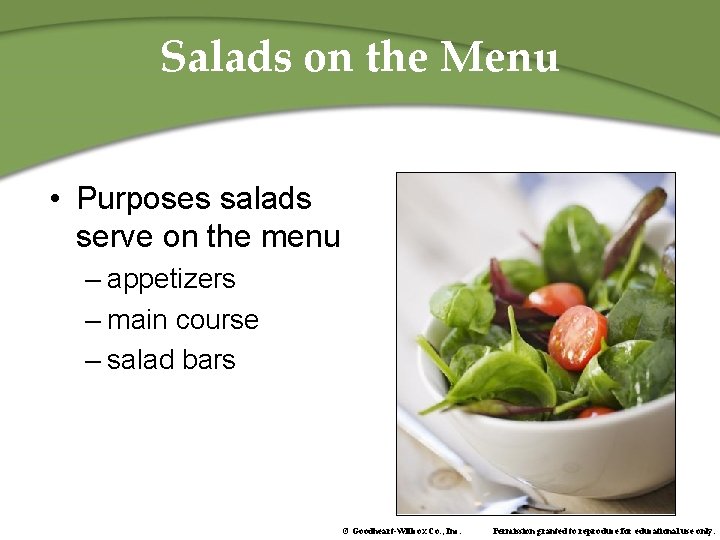
Salads on the Menu • Purposes salads serve on the menu – appetizers – main course – salad bars © Goodheart-Willcox Co. , Inc. Permission granted to reproduce for educational use only.
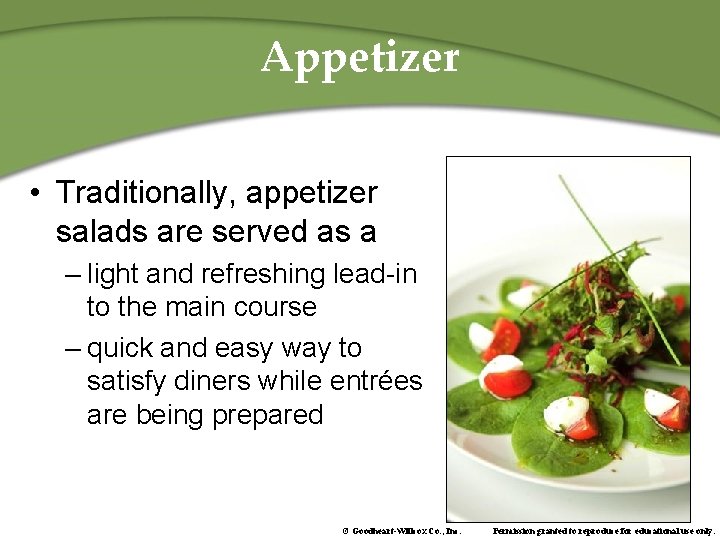
Appetizer • Traditionally, appetizer salads are served as a – light and refreshing lead-in to the main course – quick and easy way to satisfy diners while entrées are being prepared © Goodheart-Willcox Co. , Inc. Permission granted to reproduce for educational use only.
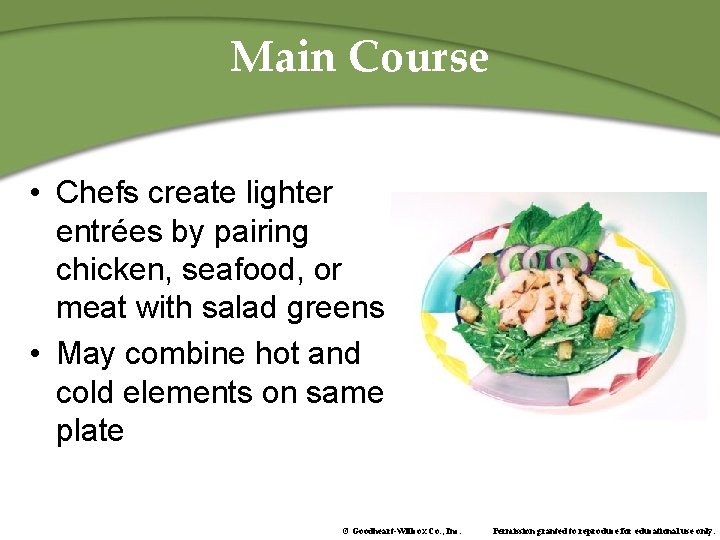
Main Course • Chefs create lighter entrées by pairing chicken, seafood, or meat with salad greens • May combine hot and cold elements on same plate © Goodheart-Willcox Co. , Inc. Permission granted to reproduce for educational use only.
Salad Bars • Common in American casual dining and fast -food restaurants • Diners enjoy the variety, choice, and ability to create custom salads • The use of low-cost ingredients and minimal labor costs are appealing to restaurant operators continued © Goodheart-Willcox Co. , Inc. Permission granted to reproduce for educational use only.
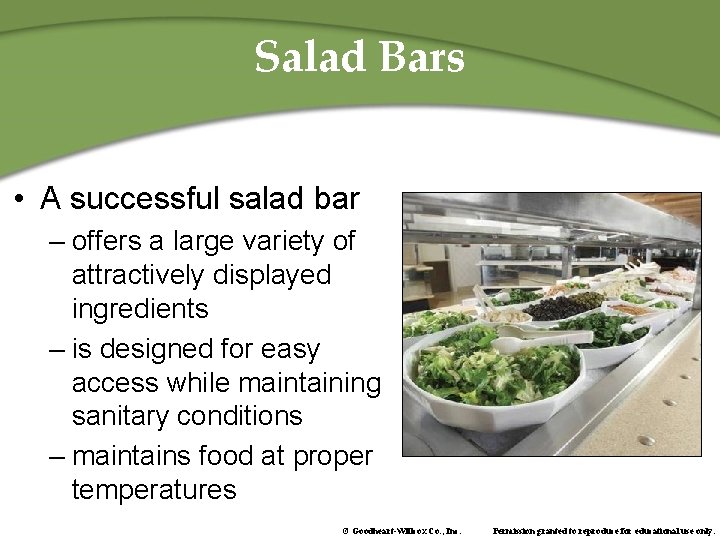
Salad Bars • A successful salad bar – offers a large variety of attractively displayed ingredients – is designed for easy access while maintaining sanitary conditions – maintains food at proper temperatures © Goodheart-Willcox Co. , Inc. Permission granted to reproduce for educational use only.
Objective • Classify the different types of salads. © Goodheart-Willcox Co. , Inc. Permission granted to reproduce for educational use only.
Types of Salads • Three main types of salads are – simple – composed – bound © Goodheart-Willcox Co. , Inc. Permission granted to reproduce for educational use only.
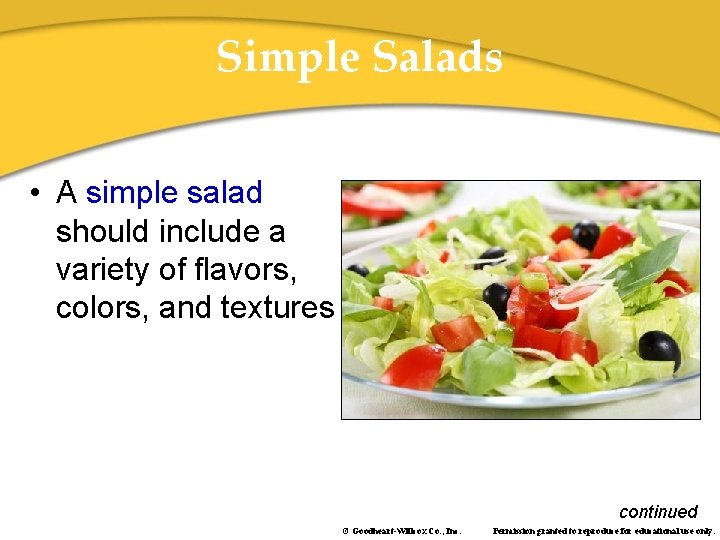
Simple Salads • A simple salad should include a variety of flavors, colors, and textures continued © Goodheart-Willcox Co. , Inc. Permission granted to reproduce for educational use only.
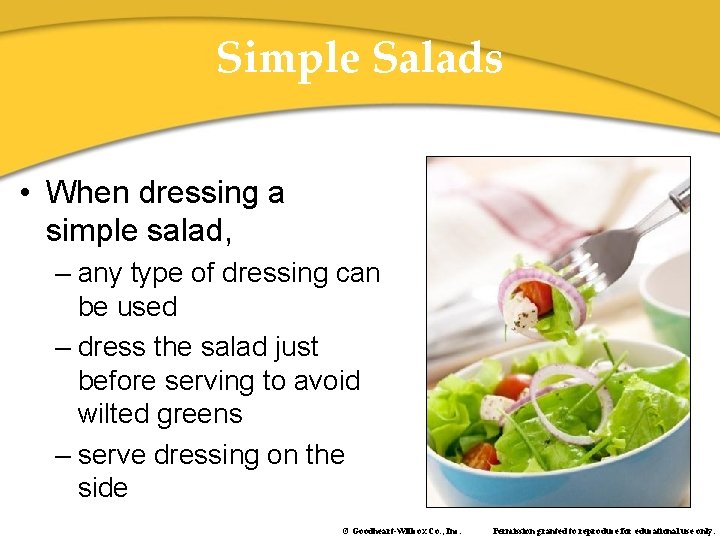
Simple Salads • When dressing a simple salad, – any type of dressing can be used – dress the salad just before serving to avoid wilted greens – serve dressing on the side © Goodheart-Willcox Co. , Inc. Permission granted to reproduce for educational use only.
Composed • Composed salads, also called plated salads, are popular main course menu items • The four parts of a composed salad include – – base body dressing garnish continued © Goodheart-Willcox Co. , Inc. Permission granted to reproduce for educational use only.
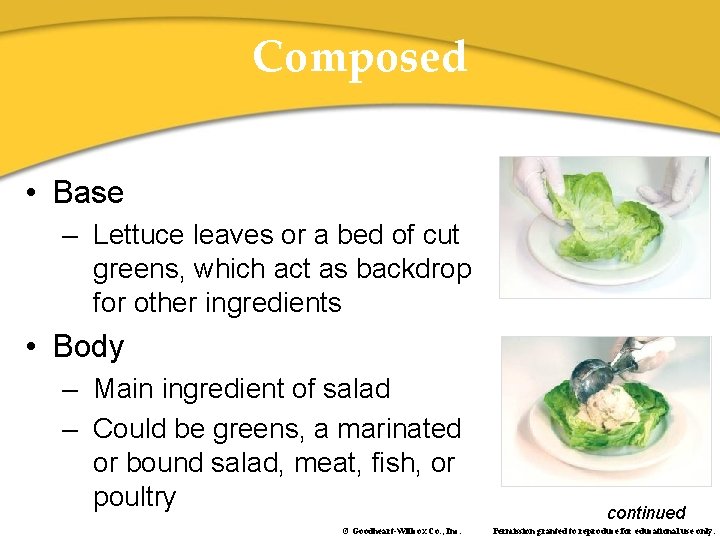
Composed • Base – Lettuce leaves or a bed of cut greens, which act as backdrop for other ingredients • Body – Main ingredient of salad – Could be greens, a marinated or bound salad, meat, fish, or poultry © Goodheart-Willcox Co. , Inc. continued Permission granted to reproduce for educational use only.
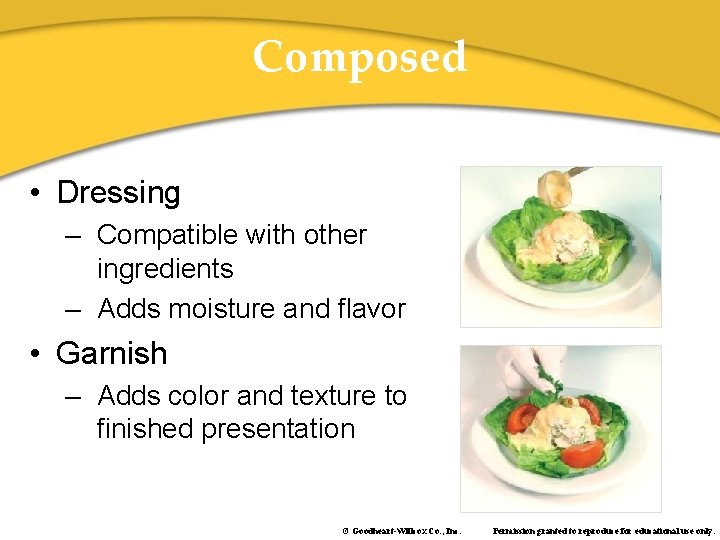
Composed • Dressing – Compatible with other ingredients – Adds moisture and flavor • Garnish – Adds color and texture to finished presentation © Goodheart-Willcox Co. , Inc. Permission granted to reproduce for educational use only.
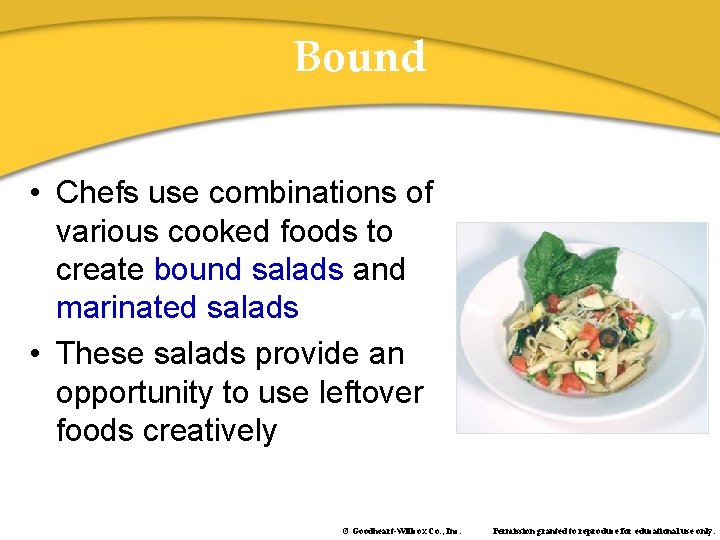
Bound • Chefs use combinations of various cooked foods to create bound salads and marinated salads • These salads provide an opportunity to use leftover foods creatively © Goodheart-Willcox Co. , Inc. Permission granted to reproduce for educational use only.
Objective • Recognize common salad greens. © Goodheart-Willcox Co. , Inc. Permission granted to reproduce for educational use only.
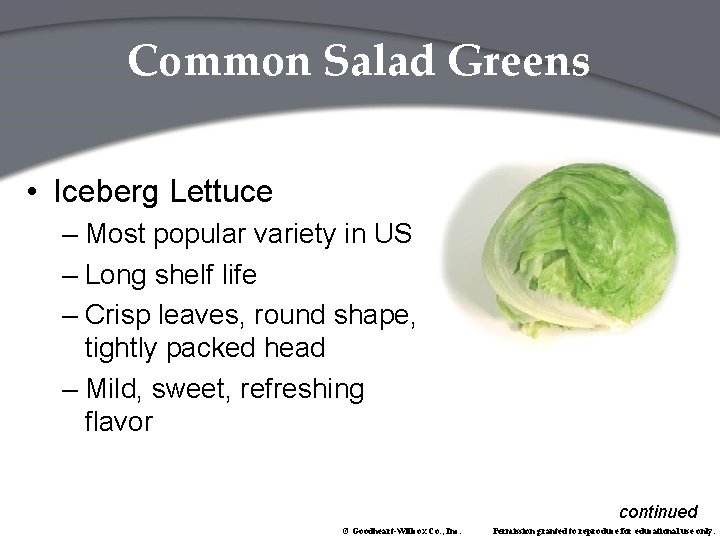
Common Salad Greens • Iceberg Lettuce – Most popular variety in US – Long shelf life – Crisp leaves, round shape, tightly packed head – Mild, sweet, refreshing flavor continued © Goodheart-Willcox Co. , Inc. Permission granted to reproduce for educational use only.
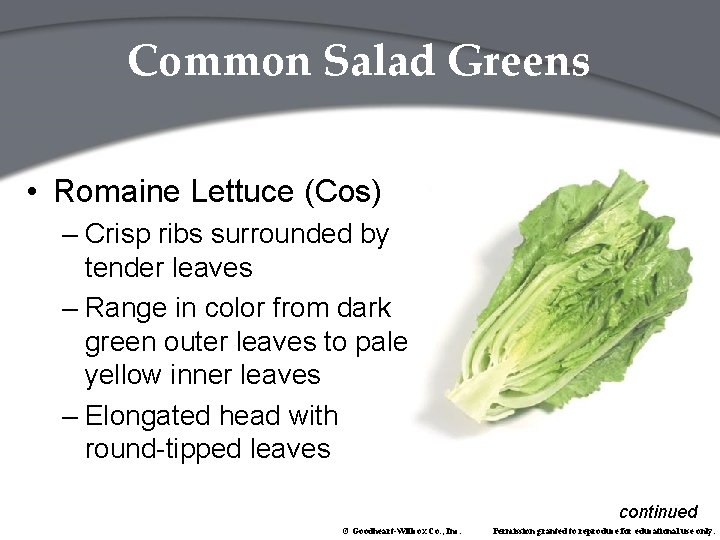
Common Salad Greens • Romaine Lettuce (Cos) – Crisp ribs surrounded by tender leaves – Range in color from dark green outer leaves to pale yellow inner leaves – Elongated head with round-tipped leaves continued © Goodheart-Willcox Co. , Inc. Permission granted to reproduce for educational use only.
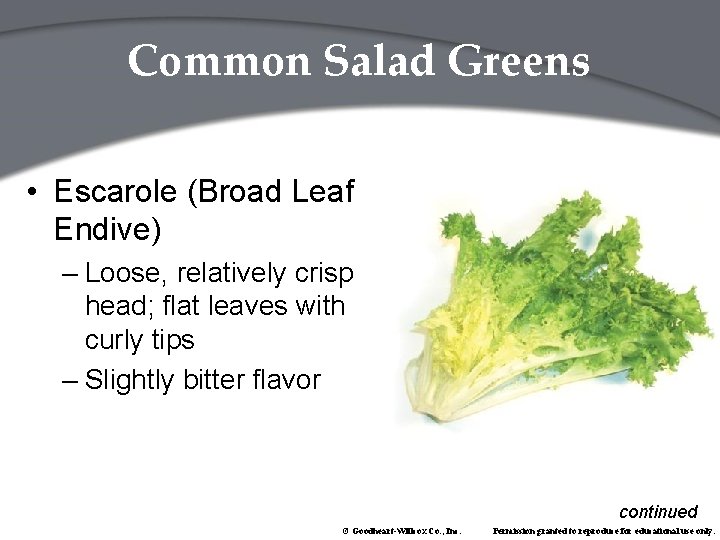
Common Salad Greens • Escarole (Broad Leaf Endive) – Loose, relatively crisp head; flat leaves with curly tips – Slightly bitter flavor continued © Goodheart-Willcox Co. , Inc. Permission granted to reproduce for educational use only.
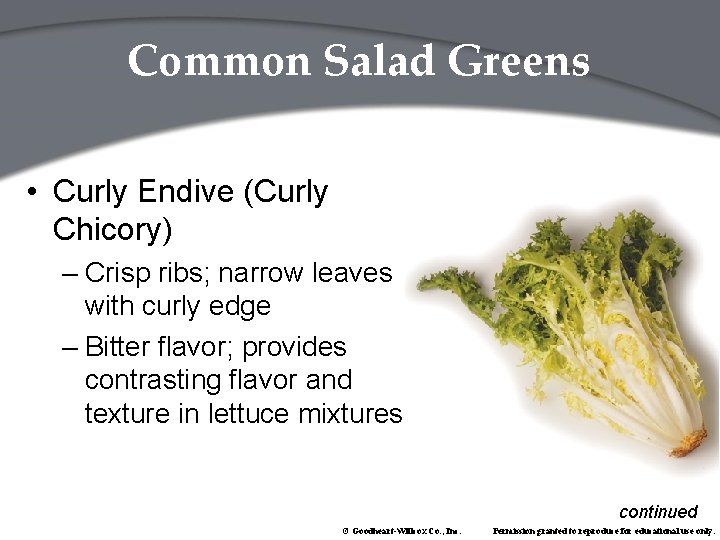
Common Salad Greens • Curly Endive (Curly Chicory) – Crisp ribs; narrow leaves with curly edge – Bitter flavor; provides contrasting flavor and texture in lettuce mixtures continued © Goodheart-Willcox Co. , Inc. Permission granted to reproduce for educational use only.
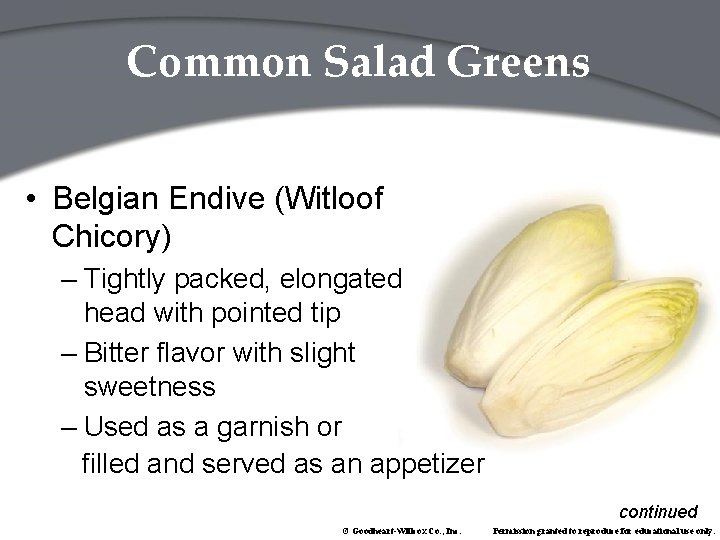
Common Salad Greens • Belgian Endive (Witloof Chicory) – Tightly packed, elongated head with pointed tip – Bitter flavor with slight sweetness – Used as a garnish or filled and served as an appetizer continued © Goodheart-Willcox Co. , Inc. Permission granted to reproduce for educational use only.
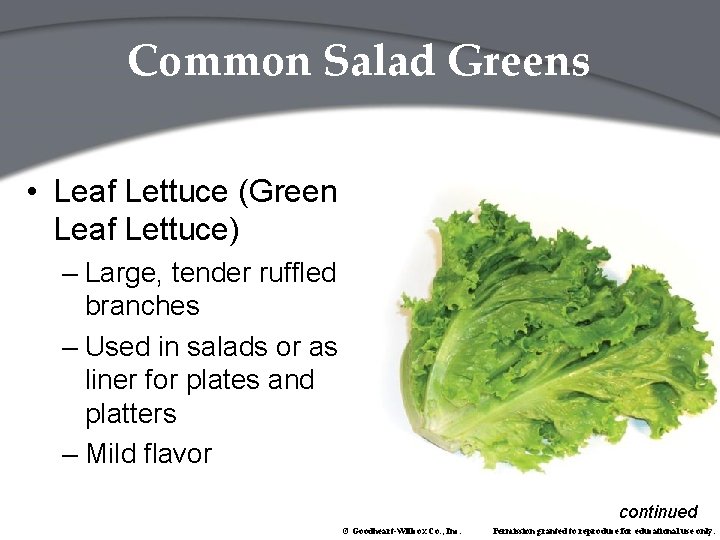
Common Salad Greens • Leaf Lettuce (Green Leaf Lettuce) – Large, tender ruffled branches – Used in salads or as liner for plates and platters – Mild flavor continued © Goodheart-Willcox Co. , Inc. Permission granted to reproduce for educational use only.
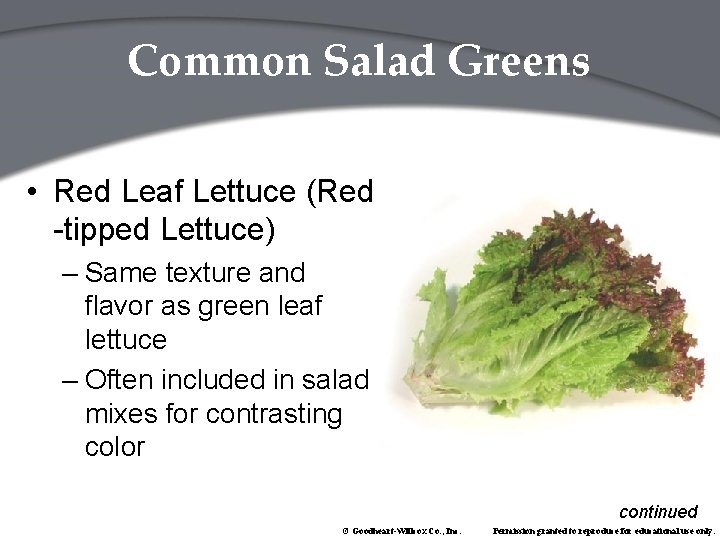
Common Salad Greens • Red Leaf Lettuce (Red -tipped Lettuce) – Same texture and flavor as green leaf lettuce – Often included in salad mixes for contrasting color continued © Goodheart-Willcox Co. , Inc. Permission granted to reproduce for educational use only.
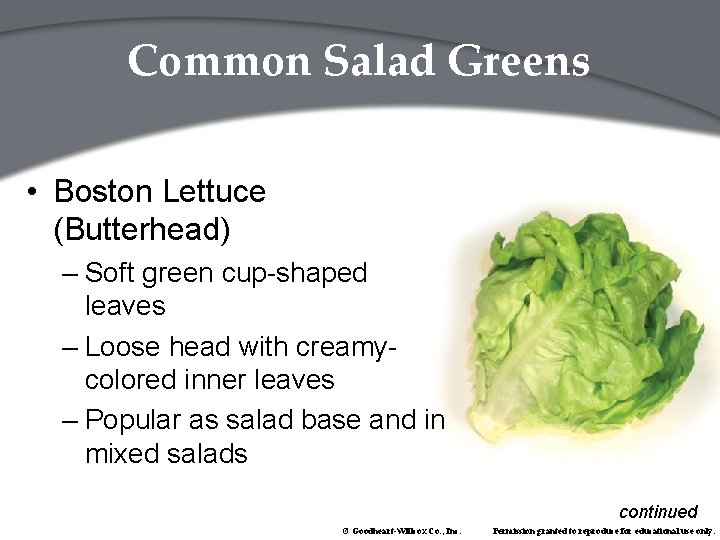
Common Salad Greens • Boston Lettuce (Butterhead) – Soft green cup-shaped leaves – Loose head with creamycolored inner leaves – Popular as salad base and in mixed salads continued © Goodheart-Willcox Co. , Inc. Permission granted to reproduce for educational use only.
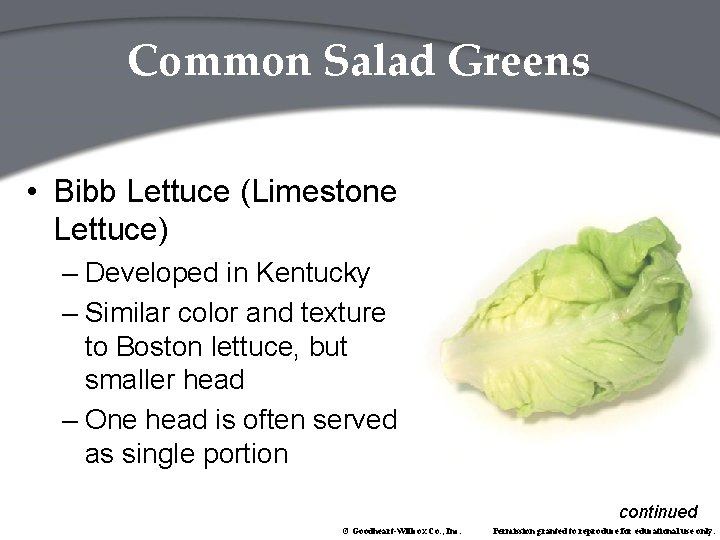
Common Salad Greens • Bibb Lettuce (Limestone Lettuce) – Developed in Kentucky – Similar color and texture to Boston lettuce, but smaller head – One head is often served as single portion continued © Goodheart-Willcox Co. , Inc. Permission granted to reproduce for educational use only.
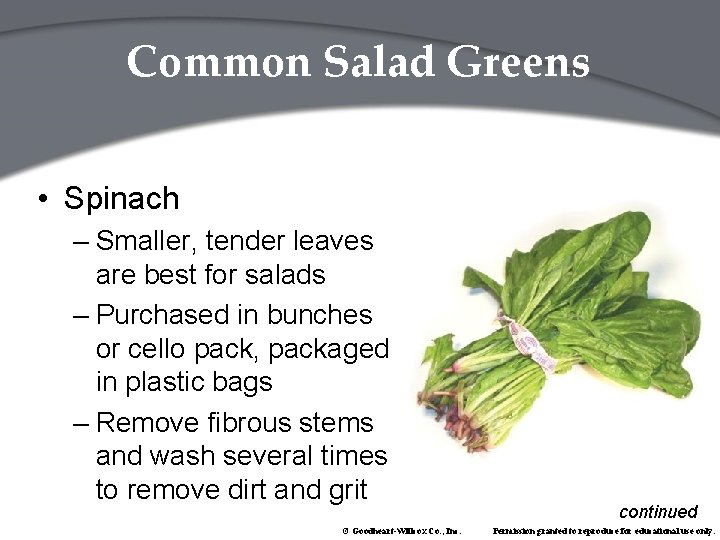
Common Salad Greens • Spinach – Smaller, tender leaves are best for salads – Purchased in bunches or cello pack, packaged in plastic bags – Remove fibrous stems and wash several times to remove dirt and grit © Goodheart-Willcox Co. , Inc. continued Permission granted to reproduce for educational use only.
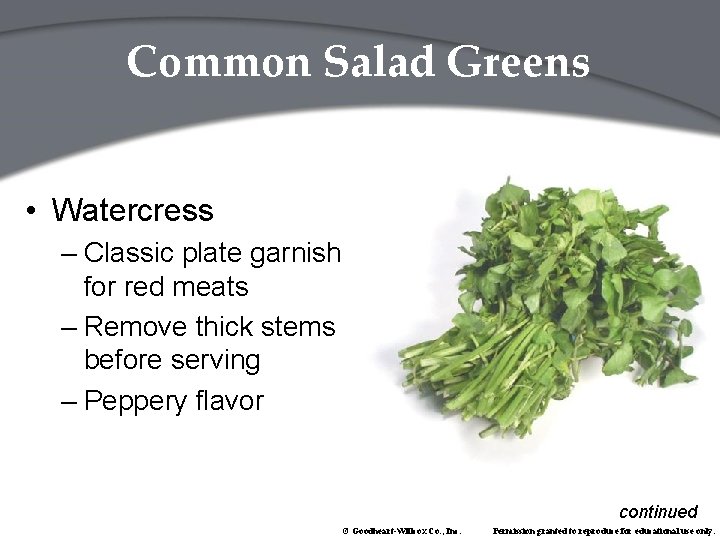
Common Salad Greens • Watercress – Classic plate garnish for red meats – Remove thick stems before serving – Peppery flavor continued © Goodheart-Willcox Co. , Inc. Permission granted to reproduce for educational use only.
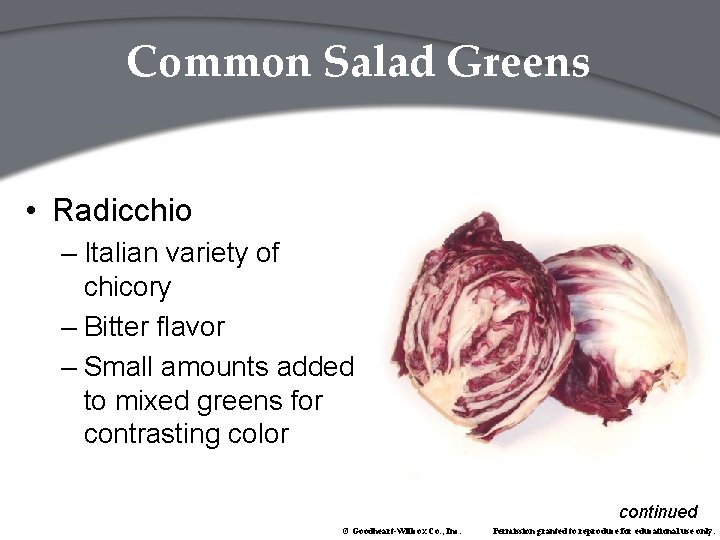
Common Salad Greens • Radicchio – Italian variety of chicory – Bitter flavor – Small amounts added to mixed greens for contrasting color continued © Goodheart-Willcox Co. , Inc. Permission granted to reproduce for educational use only.
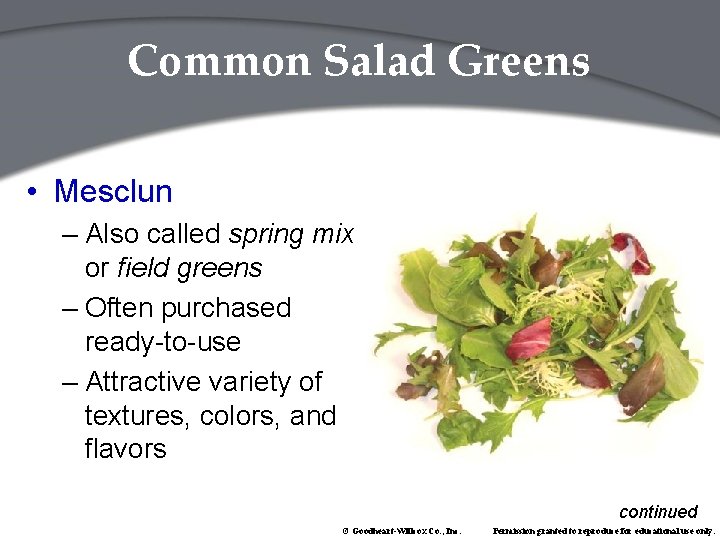
Common Salad Greens • Mesclun – Also called spring mix or field greens – Often purchased ready-to-use – Attractive variety of textures, colors, and flavors continued © Goodheart-Willcox Co. , Inc. Permission granted to reproduce for educational use only.
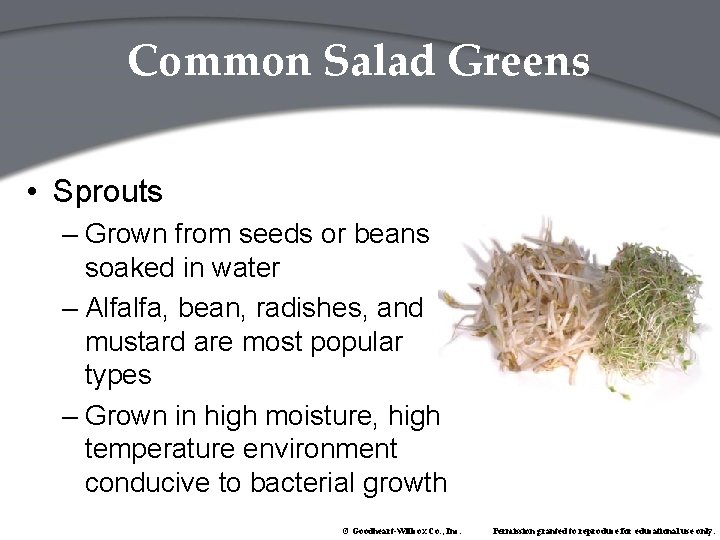
Common Salad Greens • Sprouts – Grown from seeds or beans soaked in water – Alfalfa, bean, radishes, and mustard are most popular types – Grown in high moisture, high temperature environment conducive to bacterial growth © Goodheart-Willcox Co. , Inc. Permission granted to reproduce for educational use only.
Objective • Explain various factors involved when buying lettuce. © Goodheart-Willcox Co. , Inc. Permission granted to reproduce for educational use only.
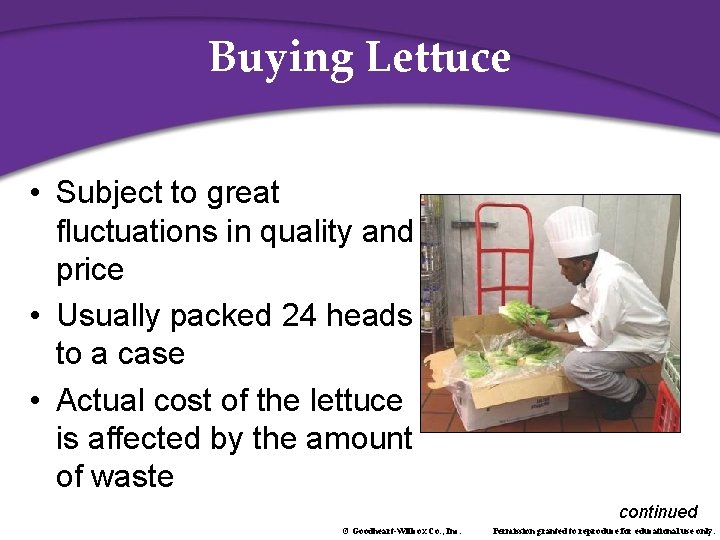
Buying Lettuce • Subject to great fluctuations in quality and price • Usually packed 24 heads to a case • Actual cost of the lettuce is affected by the amount of waste continued © Goodheart-Willcox Co. , Inc. Permission granted to reproduce for educational use only.
Buying Lettuce • Ready-to-eat greens – Greens are prewashed and precut – More expensive than other greens – No prep time and little or no waste for the operation – Must be rotated and used quickly © Goodheart-Willcox Co. , Inc. Permission granted to reproduce for educational use only.
Objective • Execute the preparation of salad greens. © Goodheart-Willcox Co. , Inc. Permission granted to reproduce for educational use only.
Preparing Salad Greens • Greens that are not ready-to-eat must be prepared before use • Steps for preparing salad greens include – cutting – washing – drying © Goodheart-Willcox Co. , Inc. Permission granted to reproduce for educational use only.
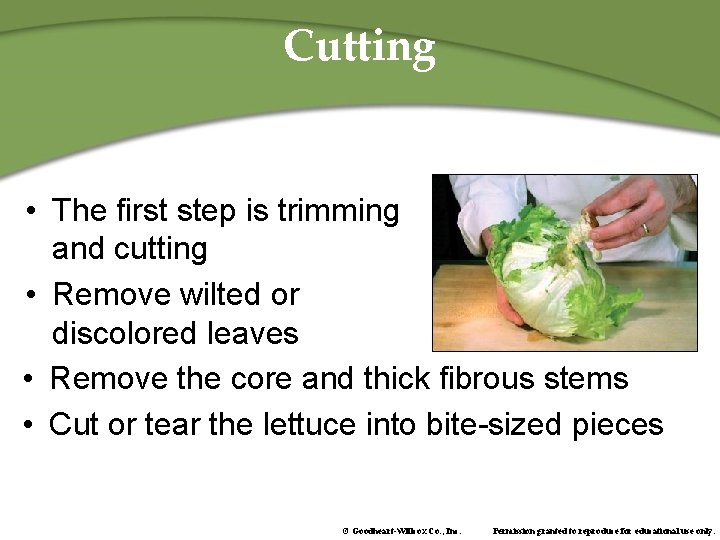
Cutting • The first step is trimming and cutting • Remove wilted or discolored leaves • Remove the core and thick fibrous stems • Cut or tear the lettuce into bite-sized pieces © Goodheart-Willcox Co. , Inc. Permission granted to reproduce for educational use only.
Washing • In a commercial kitchen, lettuce and other greens are washed by submersion • Place cut greens in a sink or container of cold water • Greens should float freely • Stir to help loosen dirt or sand • Lift and drain the greens © Goodheart-Willcox Co. , Inc. Permission granted to reproduce for educational use only.
Drying • Drain excess water to avoid soggy greens and diluting the dressing • Drain leaves in a colander or perforated hotel pan • A salad spinner is the best option, because it dries greens without crushing the product © Goodheart-Willcox Co. , Inc. Permission granted to reproduce for educational use only.
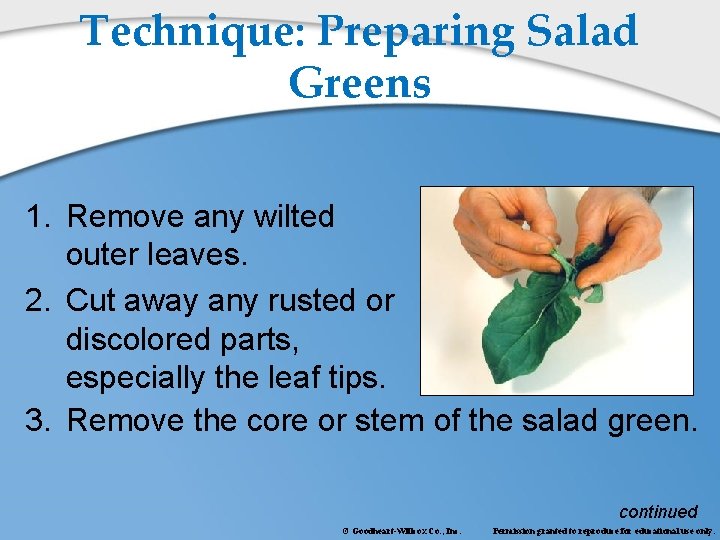
Technique: Preparing Salad Greens 1. Remove any wilted outer leaves. 2. Cut away any rusted or discolored parts, especially the leaf tips. 3. Remove the core or stem of the salad green. continued © Goodheart-Willcox Co. , Inc. Permission granted to reproduce for educational use only.
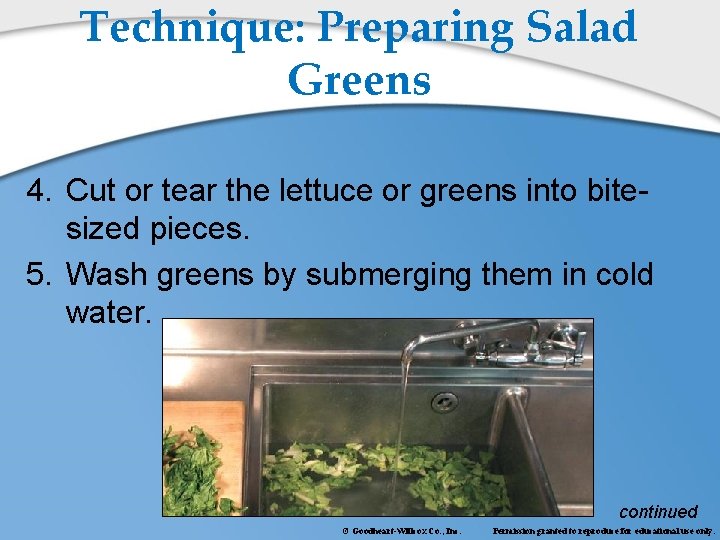
Technique: Preparing Salad Greens 4. Cut or tear the lettuce or greens into bitesized pieces. 5. Wash greens by submerging them in cold water. continued © Goodheart-Willcox Co. , Inc. Permission granted to reproduce for educational use only.

Technique: Preparing Salad Greens 6. Remove the greens by lifting them from the water with a spider. continued © Goodheart-Willcox Co. , Inc. Permission granted to reproduce for educational use only.
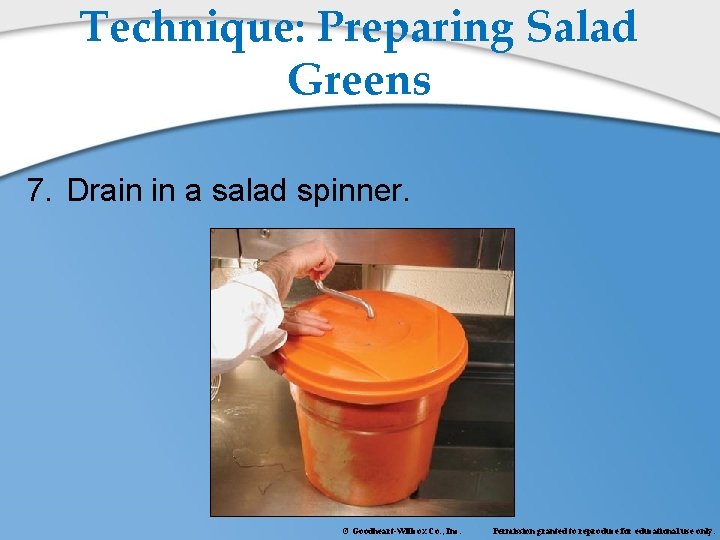
Technique: Preparing Salad Greens 7. Drain in a salad spinner. © Goodheart-Willcox Co. , Inc. Permission granted to reproduce for educational use only.
Objective • Compare and contrast the three salad dressings—simple vinaigrette, mayonnaise, and emulsified dressing. © Goodheart-Willcox Co. , Inc. Permission granted to reproduce for educational use only.
Salad Dressings • Salad dressing should enhance the flavor of the salad • Three basic types of salad dressing include – simple vinaigrette – mayonnaise – emulsified dressing © Goodheart-Willcox Co. , Inc. Permission granted to reproduce for educational use only.
Simple Vinaigrettes • The secret to a good vinaigrette is balancing the fat, acid, and seasonings • Oil provides the palate with a supple mouthfeel and acts as flavor carrier • Vinegar “cuts” the fat, adds another taste sensation, and prevents the oil from coating the palate continued © Goodheart-Willcox Co. , Inc. Permission granted to reproduce for educational use only.
Simple Vinaigrettes • To achieve the desired balance, a 3: 1 ratio of oil to vinegar is often used • When working with a stronger vinegar, most chefs change the ratio to 4 or 5: 1 • Because vinegar and oil separate, simple vinaigrette must be stirred immediately before service © Goodheart-Willcox Co. , Inc. Permission granted to reproduce for educational use only.
Mayonnaise and Emulsified Dressings • Simple vinaigrette separates because it is a temporary emulsion • An emulsion can be stabilized with pasteurized egg or egg yolks • Raw egg or egg yolks present a food safety concern continued © Goodheart-Willcox Co. , Inc. Permission granted to reproduce for educational use only.
Mayonnaise and Emulsified Dressings • When making mayonnaise, the tiny drops of oil become suspended in the water from the vinegar and egg during the whipping process • Proteins from the egg yolk keep the oil and water from separating • Mayonnaise is often used as a base for dressings and cold sauces continued © Goodheart-Willcox Co. , Inc. Permission granted to reproduce for educational use only.
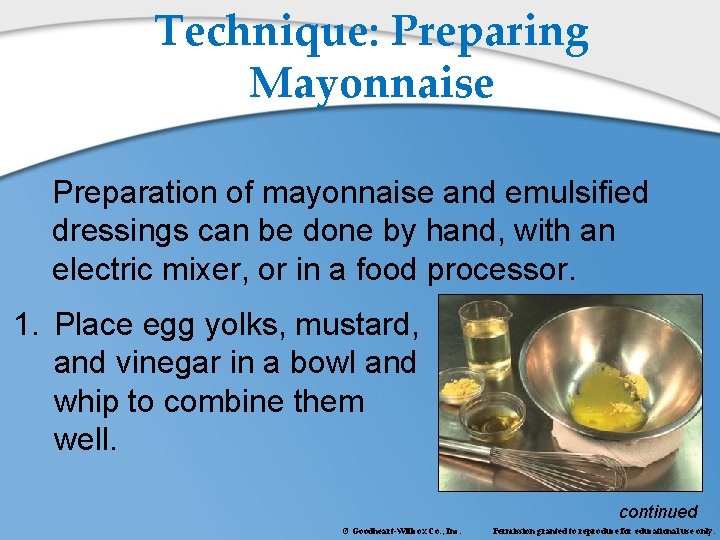
Technique: Preparing Mayonnaise Preparation of mayonnaise and emulsified dressings can be done by hand, with an electric mixer, or in a food processor. 1. Place egg yolks, mustard, and vinegar in a bowl and whip to combine them well. continued © Goodheart-Willcox Co. , Inc. Permission granted to reproduce for educational use only.
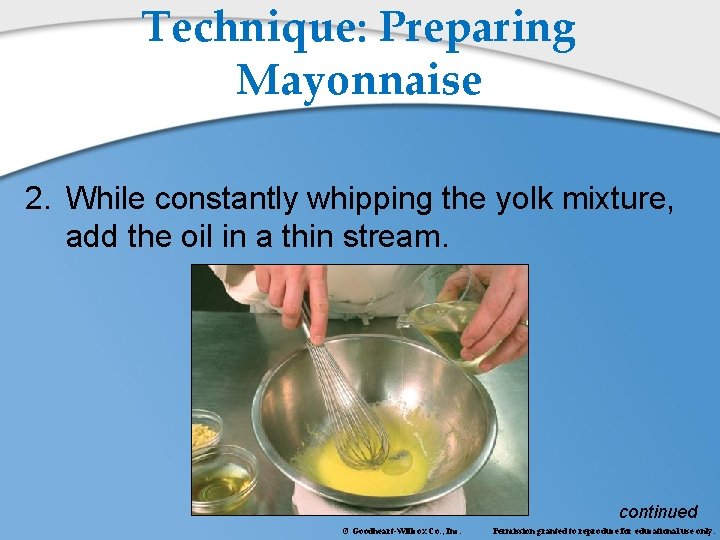
Technique: Preparing Mayonnaise 2. While constantly whipping the yolk mixture, add the oil in a thin stream. continued © Goodheart-Willcox Co. , Inc. Permission granted to reproduce for educational use only.
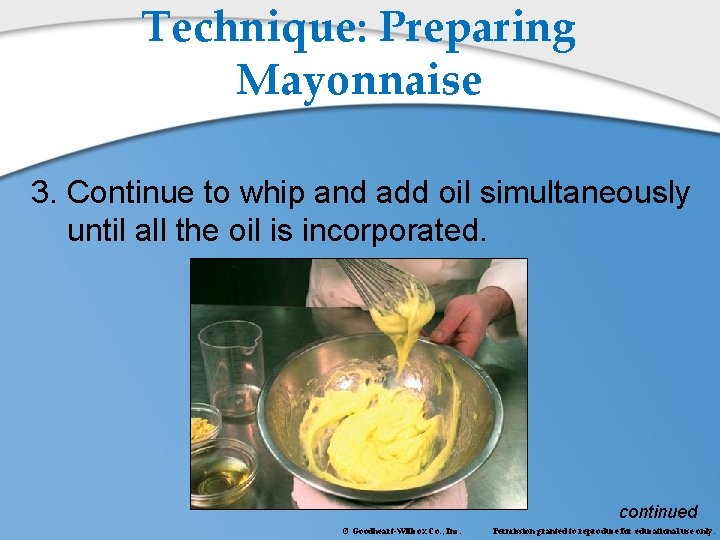
Technique: Preparing Mayonnaise 3. Continue to whip and add oil simultaneously until all the oil is incorporated. continued © Goodheart-Willcox Co. , Inc. Permission granted to reproduce for educational use only.
Technique: Preparing Mayonnaise 4. Adjust consistency by thinning with a small amount of water or lemon juice if needed. 5. Season with salt and pepper. Adjust acidity with additional vinegar or lemon juice if needed. 6. Refrigerate immediately. © Goodheart-Willcox Co. , Inc. Permission granted to reproduce for educational use only.
Mayonnaise and Emulsified Dressings • One egg yolk to one cup of oil is the standard proportion for making mayonnaise • Mustard and vinegar are often added to taste continued © Goodheart-Willcox Co. , Inc. Permission granted to reproduce for educational use only.
Mayonnaise and Emulsified Dressings • Emulsified dressings are made with the same technique used for creating mayonnaise • Herbs, spices, and cheese are common ingredients in emulsified dressings • Emulsified dressings are usually thinner than mayonnaise because of added liquid or the use of whole eggs © Goodheart-Willcox Co. , Inc. Permission granted to reproduce for educational use only.
Ingredients for Dressings • Ingredients commonly used in dressings include – oil – vinegar – mustard • There is a range of choices for each of these ingredients, which allows chefs to customize dressings continued © Goodheart-Willcox Co. , Inc. Permission granted to reproduce for educational use only.
Ingredients for Dressings • Oils – High quality oil is essential for making a good vinaigrette, mayonnaise, or dressing – Oils are classified as neutral or flavored – Neutral oils are “flavorless” and interchangeable in recipes – Flavored oils are extracted from ingredients that contribute their unique flavor continued © Goodheart-Willcox Co. , Inc. Permission granted to reproduce for educational use only.
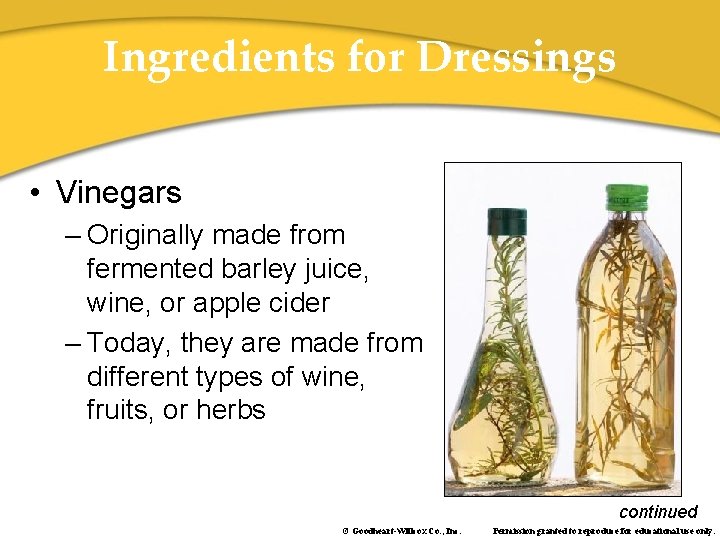
Ingredients for Dressings • Vinegars – Originally made from fermented barley juice, wine, or apple cider – Today, they are made from different types of wine, fruits, or herbs continued © Goodheart-Willcox Co. , Inc. Permission granted to reproduce for educational use only.
Ingredients for Dressings • Vinegars – Most vinegars are diluted to five percent acid – Naturally fermented wine vinegars usually contain six to seven percent acid – Citrus juice can also be used as an acid in vinaigrettes continued © Goodheart-Willcox Co. , Inc. Permission granted to reproduce for educational use only.
Ingredients for Dressings • Mustard – Its sharp flavor counters the richness of the oil – Helps to emulsify mayonnaise and emulsified dressings – Dry or prepared mustards can be used – Used in small amounts because of its strong flavor © Goodheart-Willcox Co. , Inc. Permission granted to reproduce for educational use only.
Objective • Recall standard procedures that will ensure both sanitation and quality in salad preparation. © Goodheart-Willcox Co. , Inc. Permission granted to reproduce for educational use only.
Sanitation and Quality in Salad Preparation • Thoroughly wash all salad ingredients • Keep salad ingredients well chilled • Refrigerate dressings containing egg or dairy products at or below 41°F (5°C) • Chill salad plates before plating continued © Goodheart-Willcox Co. , Inc. Permission granted to reproduce for educational use only.
Sanitation and Quality in Salad Preparation • Use gloves or utensils to handle salad ingredients • Mix tossed salads with dressing as close to service as possible • Do not overdress salads © Goodheart-Willcox Co. , Inc. Permission granted to reproduce for educational use only.

Review • Name the different purposes salads serve on a menu. – appetizer – main course – salad bar continued © Goodheart-Willcox Co. , Inc. Permission granted to reproduce for educational use only.
Review • What are three main types of salad? – simple salads – composed salads – bound salads continued © Goodheart-Willcox Co. , Inc. Permission granted to reproduce for educational use only.

Review • Name the steps used to prepare salad greens. – cutting – washing – drying continued © Goodheart-Willcox Co. , Inc. Permission granted to reproduce for educational use only.
Review • What are three types of salad dressings? – simple vinaigrette – mayonnaise – emulsified dressing continued © Goodheart-Willcox Co. , Inc. Permission granted to reproduce for educational use only.

Review • What is the standard proportion of oil to vinegar chefs use when making a simple vinaigrette? – Three parts oil to one part vinegar continued © Goodheart-Willcox Co. , Inc. Permission granted to reproduce for educational use only.
Review • What is the proportion of egg yolk to oil chefs use when preparing mayonnaise? – One egg yolk to one cup oil continued © Goodheart-Willcox Co. , Inc. Permission granted to reproduce for educational use only.
Review • Name three ingredients generally used in all dressings. – oil – vinegar – mustard © Goodheart-Willcox Co. , Inc. Permission granted to reproduce for educational use only.
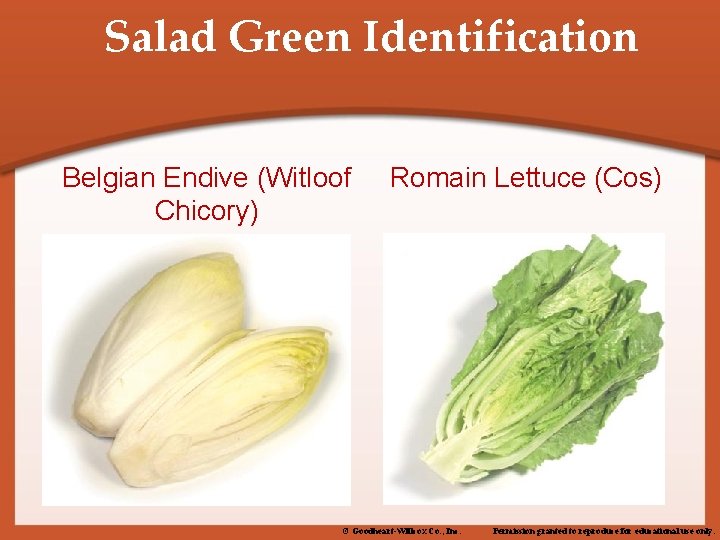
Salad Green Identification Belgian Endive (Witloof Chicory) Romain Lettuce (Cos) © Goodheart-Willcox Co. , Inc. Permission granted to reproduce for educational use only.
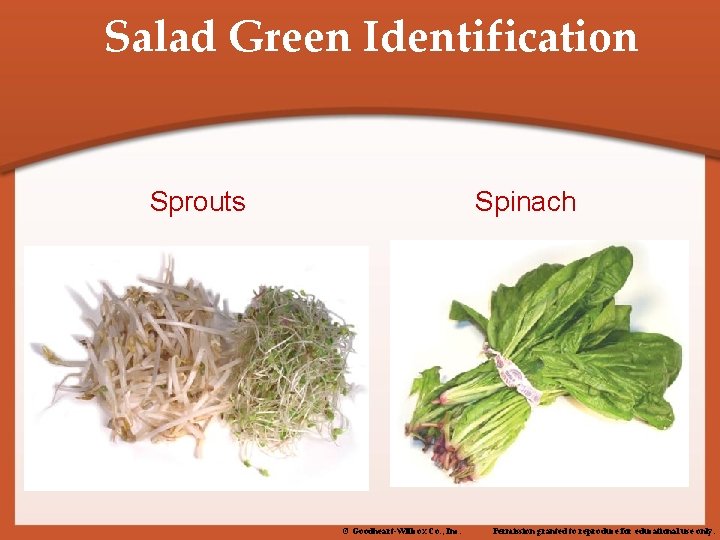
Salad Green Identification Sprouts Spinach © Goodheart-Willcox Co. , Inc. Permission granted to reproduce for educational use only.
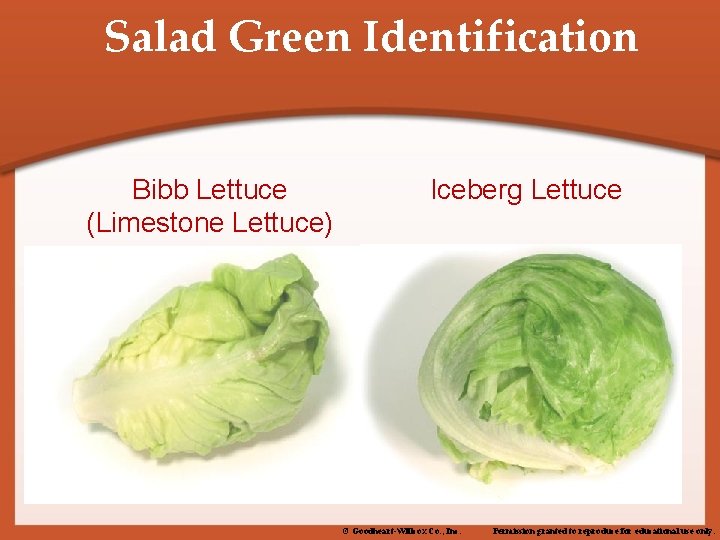
Salad Green Identification Bibb Lettuce (Limestone Lettuce) Iceberg Lettuce © Goodheart-Willcox Co. , Inc. Permission granted to reproduce for educational use only.
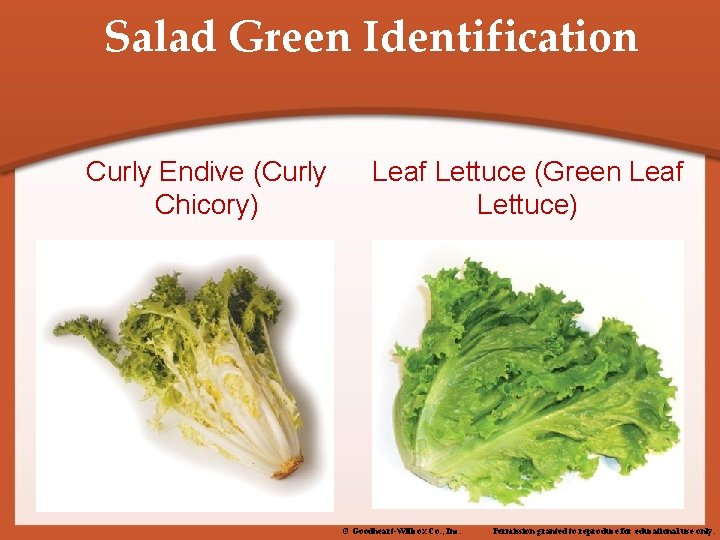
Salad Green Identification Curly Endive (Curly Chicory) Leaf Lettuce (Green Leaf Lettuce) © Goodheart-Willcox Co. , Inc. Permission granted to reproduce for educational use only.
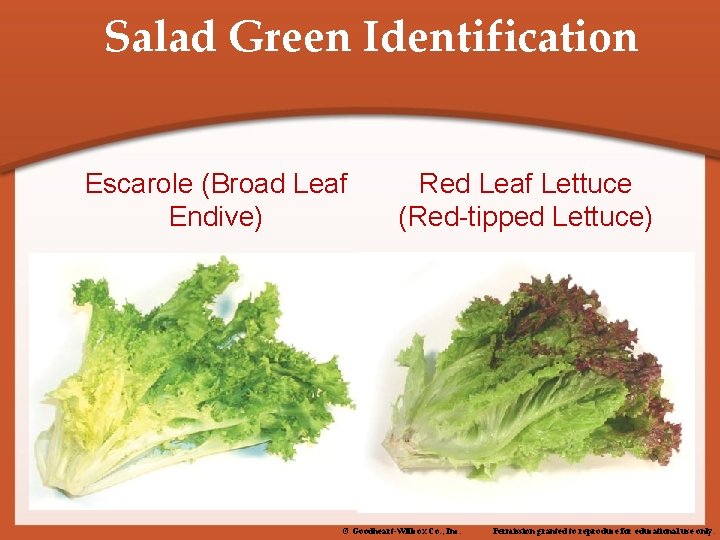
Salad Green Identification Escarole (Broad Leaf Endive) Red Leaf Lettuce (Red-tipped Lettuce) © Goodheart-Willcox Co. , Inc. Permission granted to reproduce for educational use only.
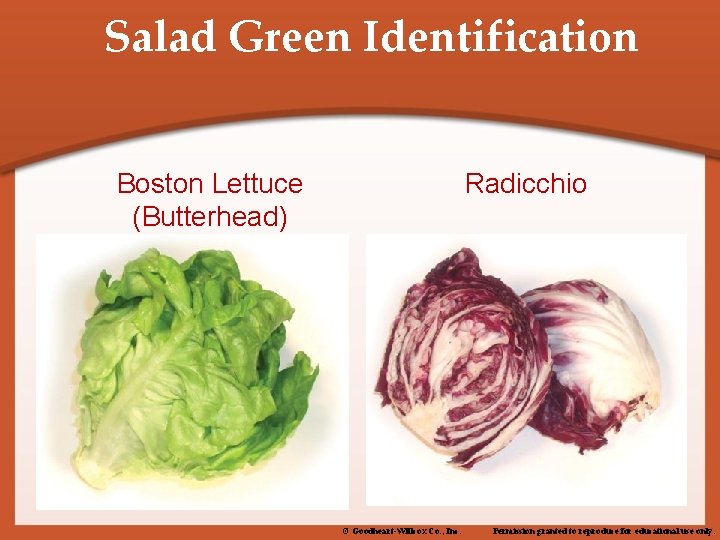
Salad Green Identification Boston Lettuce (Butterhead) Radicchio © Goodheart-Willcox Co. , Inc. Permission granted to reproduce for educational use only.
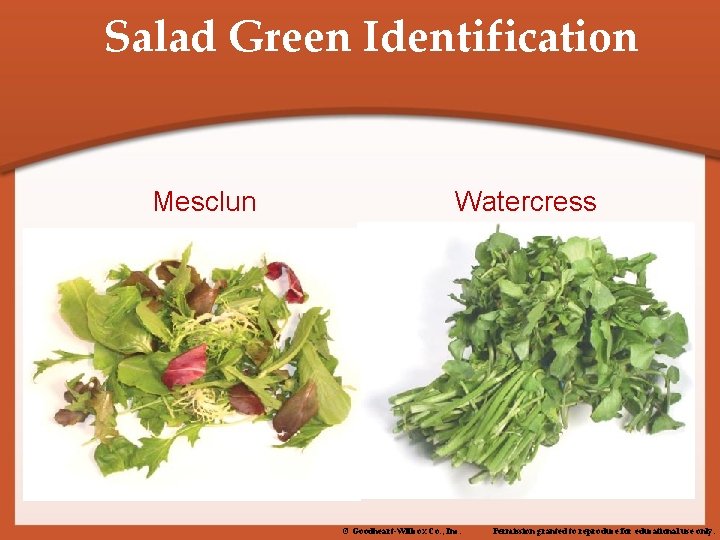
Salad Green Identification Mesclun Watercress © Goodheart-Willcox Co. , Inc. Permission granted to reproduce for educational use only.
- Slides: 77