
Saint Pauls House of Formation The Anglican Way
- Slides: 33
Saint Paul’s House of Formation The Anglican Way: Both/And
Themes I. III. IV. V. Unity in diversity A different kind of Reformation “Both/and” vs. “either/or” Application to current challenges Three currents, one stream 2
Part I Unity in diversity 3
Anglicanism is “messy” A. Different styles B. No single towering theological figure as point of reference C. Special openness to other Christian traditions 4
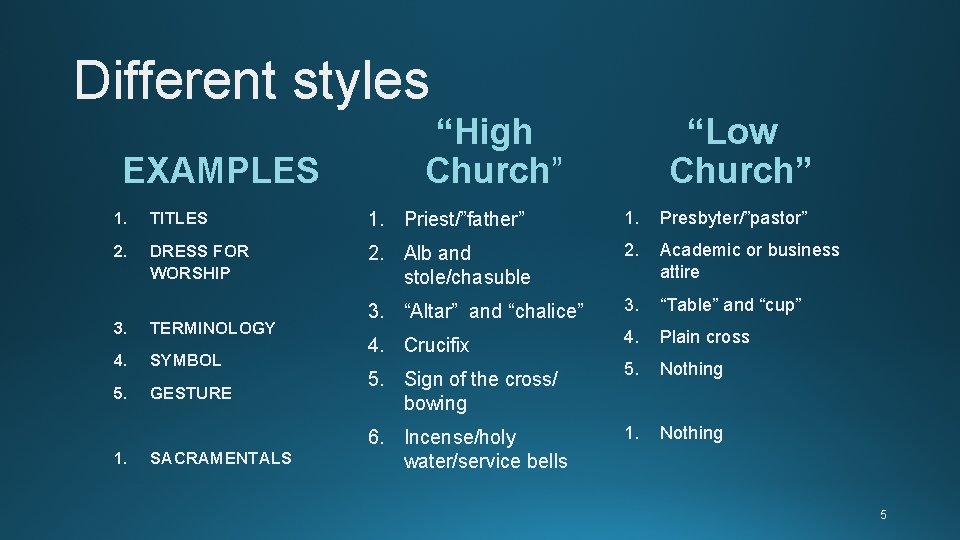
Different styles EXAMPLES “High Church” “Low Church” 1. TITLES 1. Priest/”father” 1. Presbyter/”pastor” 2. DRESS FOR WORSHIP 2. Alb and stole/chasuble 2. Academic or business attire 3. “Altar” and “chalice” 3. “Table” and “cup” 4. Crucifix 4. Plain cross 5. Sign of the cross/ bowing 5. Nothing 6. Incense/holy water/service bells 1. Nothing 3. TERMINOLOGY 4. SYMBOL 5. GESTURE 1. SACRAMENTALS 5
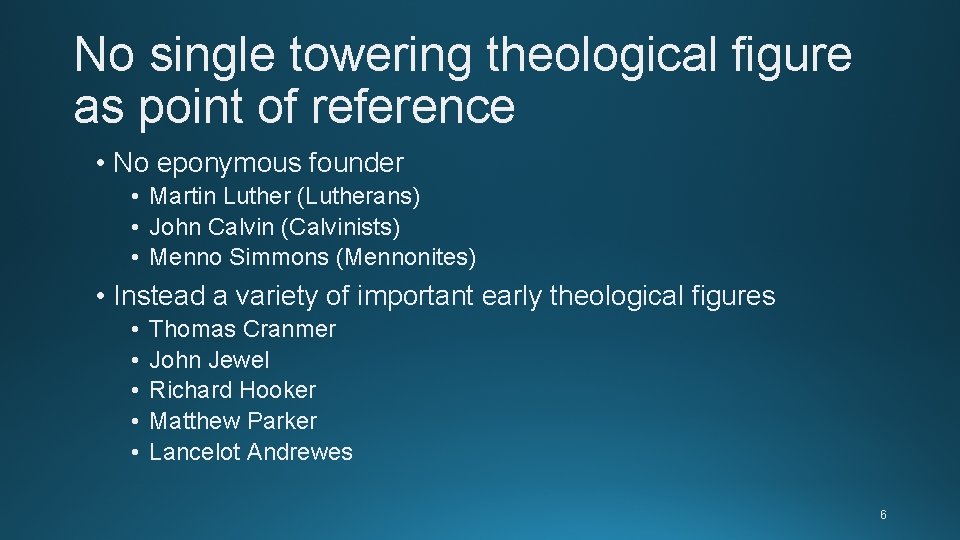
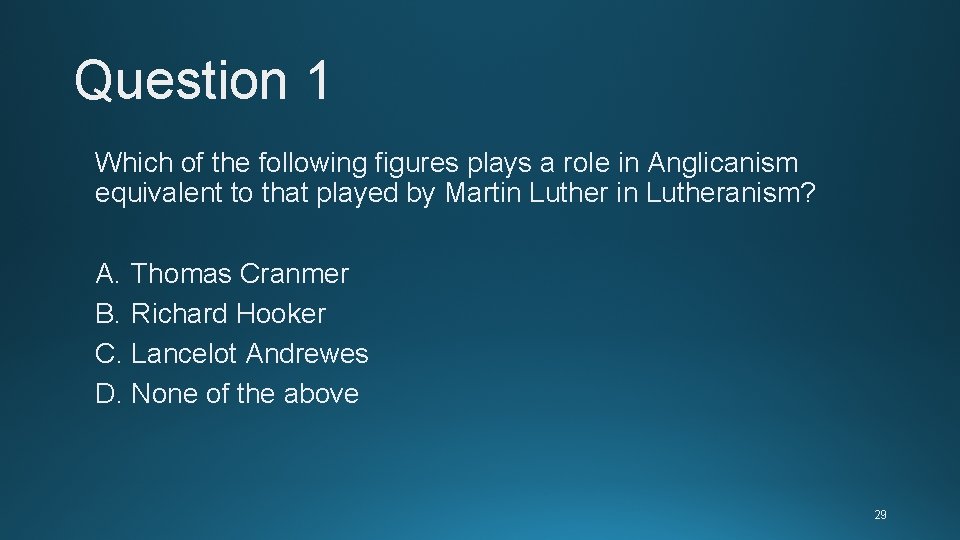
No single towering theological figure as point of reference • No eponymous founder • Martin Luther (Lutherans) • John Calvin (Calvinists) • Menno Simmons (Mennonites) • Instead a variety of important early theological figures • • • Thomas Cranmer John Jewel Richard Hooker Matthew Parker Lancelot Andrewes 6
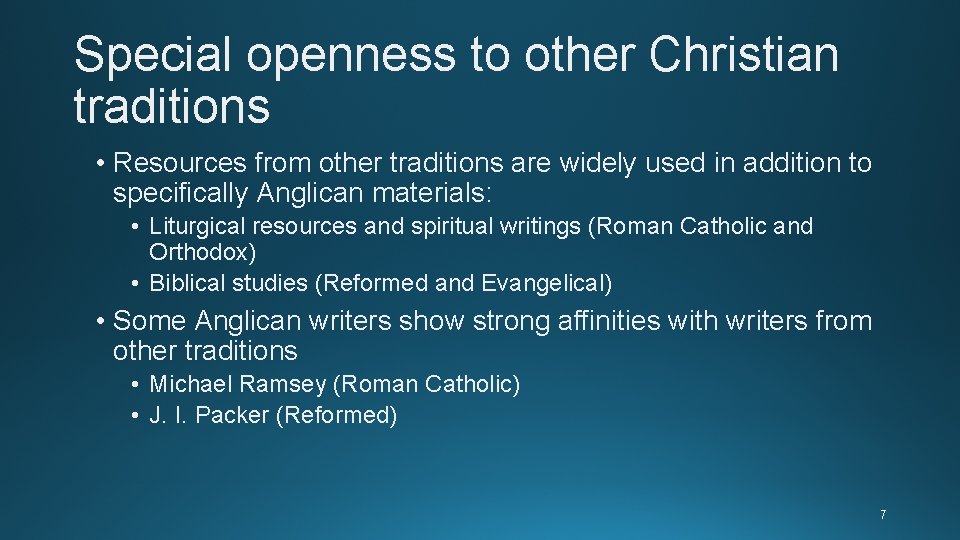
Special openness to other Christian traditions • Resources from other traditions are widely used in addition to specifically Anglican materials: • Liturgical resources and spiritual writings (Roman Catholic and Orthodox) • Biblical studies (Reformed and Evangelical) • Some Anglican writers show strong affinities with writers from other traditions • Michael Ramsey (Roman Catholic) • J. I. Packer (Reformed) 7
Part II A different kind of Reformation 8
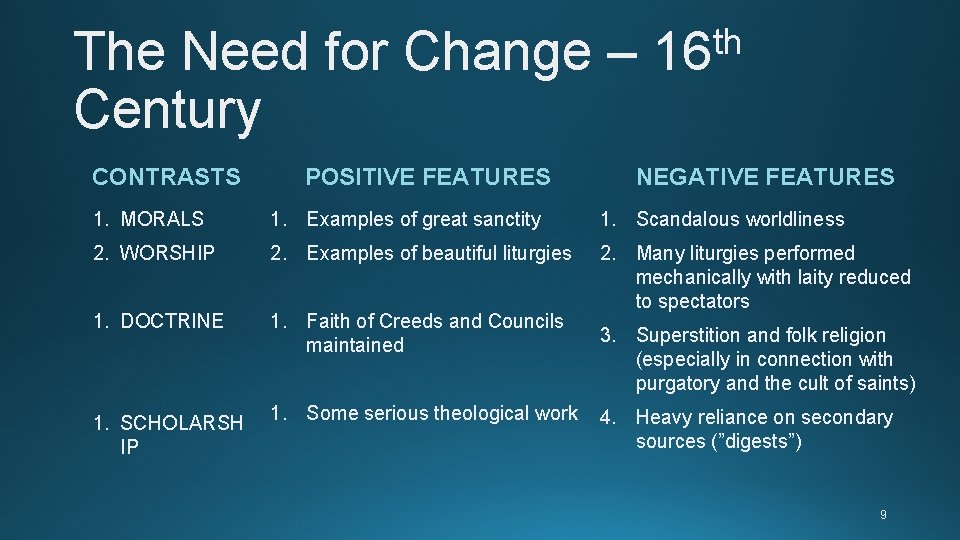
The Need for Change – Century CONTRASTS POSITIVE FEATURES th 16 NEGATIVE FEATURES 1. MORALS 1. Examples of great sanctity 1. Scandalous worldliness 2. WORSHIP 2. Examples of beautiful liturgies 1. DOCTRINE 1. Faith of Creeds and Councils maintained 2. Many liturgies performed mechanically with laity reduced to spectators 1. SCHOLARSH IP 1. Some serious theological work 3. Superstition and folk religion (especially in connection with purgatory and the cult of saints) 4. Heavy reliance on secondary sources (”digests”) 9
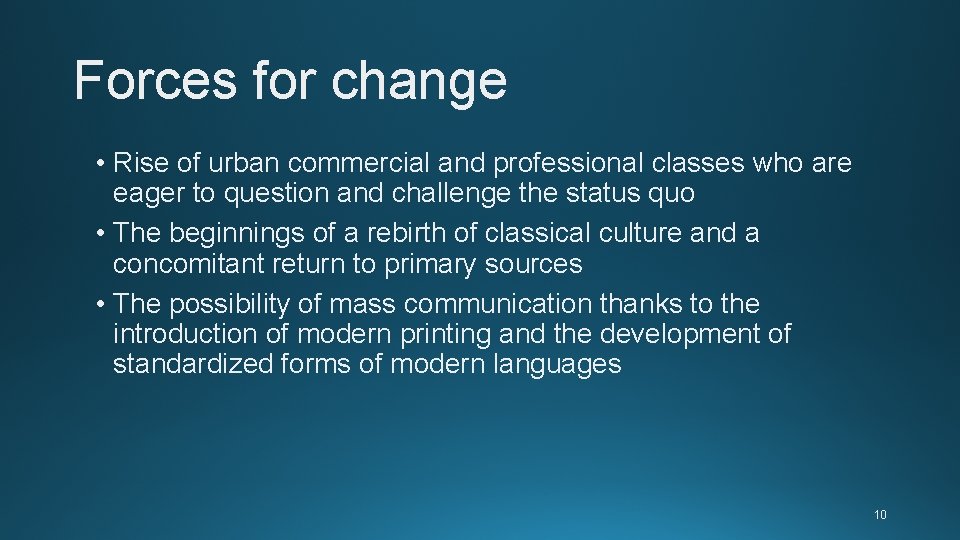
Forces for change • Rise of urban commercial and professional classes who are eager to question and challenge the status quo • The beginnings of a rebirth of classical culture and a concomitant return to primary sources • The possibility of mass communication thanks to the introduction of modern printing and the development of standardized forms of modern languages 10
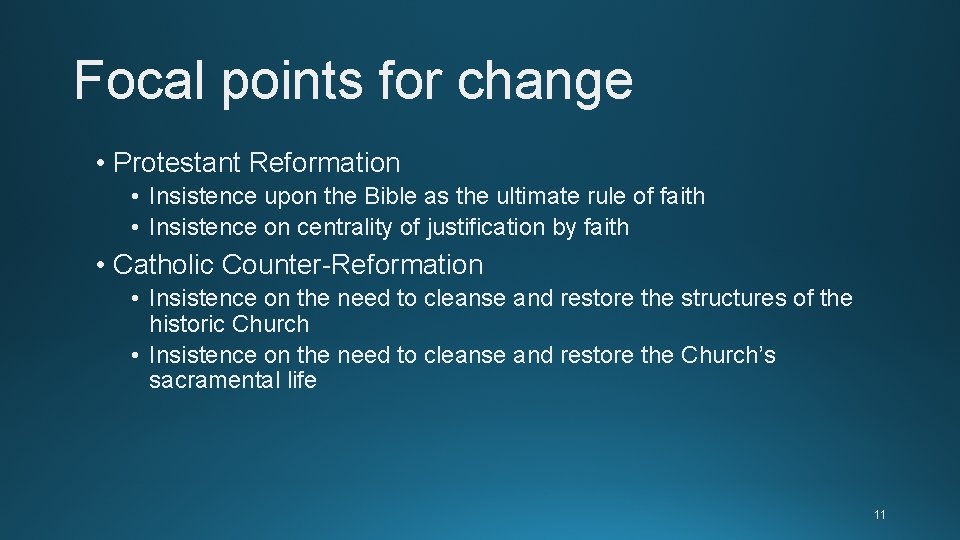
Focal points for change • Protestant Reformation • Insistence upon the Bible as the ultimate rule of faith • Insistence on centrality of justification by faith • Catholic Counter-Reformation • Insistence on the need to cleanse and restore the structures of the historic Church • Insistence on the need to cleanse and restore the Church’s sacramental life 11
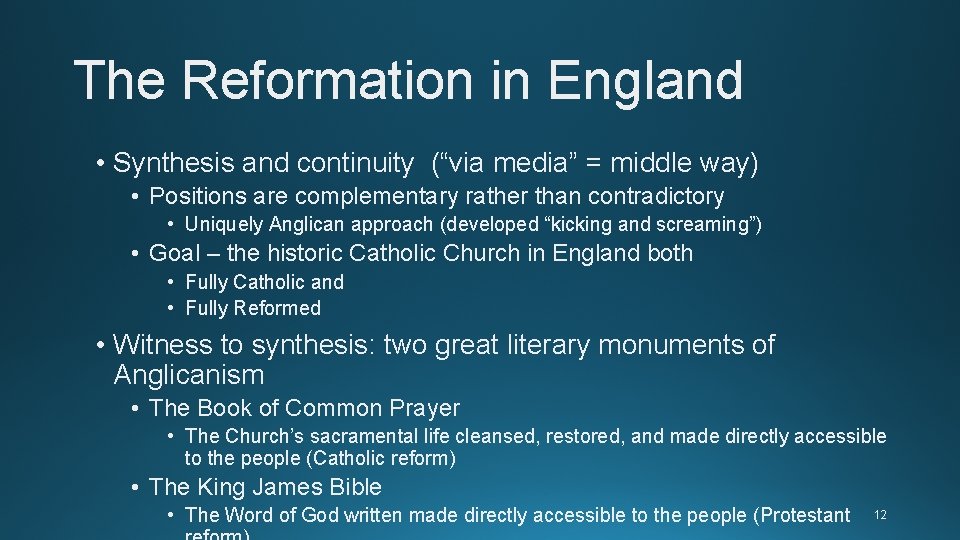
The Reformation in England • Synthesis and continuity (“via media” = middle way) • Positions are complementary rather than contradictory • Uniquely Anglican approach (developed “kicking and screaming”) • Goal – the historic Catholic Church in England both • Fully Catholic and • Fully Reformed • Witness to synthesis: two great literary monuments of Anglicanism • The Book of Common Prayer • The Church’s sacramental life cleansed, restored, and made directly accessible to the people (Catholic reform) • The King James Bible • The Word of God written made directly accessible to the people (Protestant 12
Ongoing challenge • Dynamic tension • Fully Catholic • Fully Reformed • Via media not lowest common denominator • “Something to offend everyone!” • Separation has come when people have been unwilling to embrace both • Puritans (reject Catholic continuity and sacramental life) • Oxford Movement converts to Roman Catholicism (reject Reformed principles) 13
Source of common misunderstandings • Failure to appreciate the unique character of the Anglican synthesis and to instead treat either element as the sole point of reference • Anglicans compared to Roman Catholics • “Junior varsity Catholics” • Anglicans compared to Reformed • ”Calvinists with Candles” • Akin to treating instances of uniquely “English” orthography (labour, centre) as spelling mistakes • Anglicanism must be judged by what it is, rather than by what it is not 14
Pattern found in Old Testament • The reform of King Josiah (2 Kings 22 -23) • • Book of the Law recovered Book of the Law made known to all the people Abuses corrected (uprooting) Passover restored (replanting) 15
Anglican Reformation • Recovery and dissemination of the Word of God • The English Bible • Direct action on that word • Uproot abuse and error • Restore full participation in the sacramental life for all • Sacraments administered in ”a language understanded of the people” • Restoration of the common cup 16
Part III “Both/and” vs. “either/or” 17
A special gift to the broader Church • To those from a principally sacramental background • Direct and vital contact with the word of God • To those from a principally evangelical background • Connection with the historic church, and with it • Participation in the sacramental life 18
Special openness to other Christian traditions • Anglicans have never viewed themselves as the “one true church” • We identify with both ends of the spectrum • We always find plenty that we recognize as “our own” • Archbishop Ramsey – comparison to children of divorce • Our goal is reunion (”we want our parents back together”) 19
Mere Christianity • Like the oath taken in court • The truth • The whole truth • And nothing but the truth • The faith of the undivided Church • What the has always been believed everywhere by everyone (Vincent of Lérins) 20
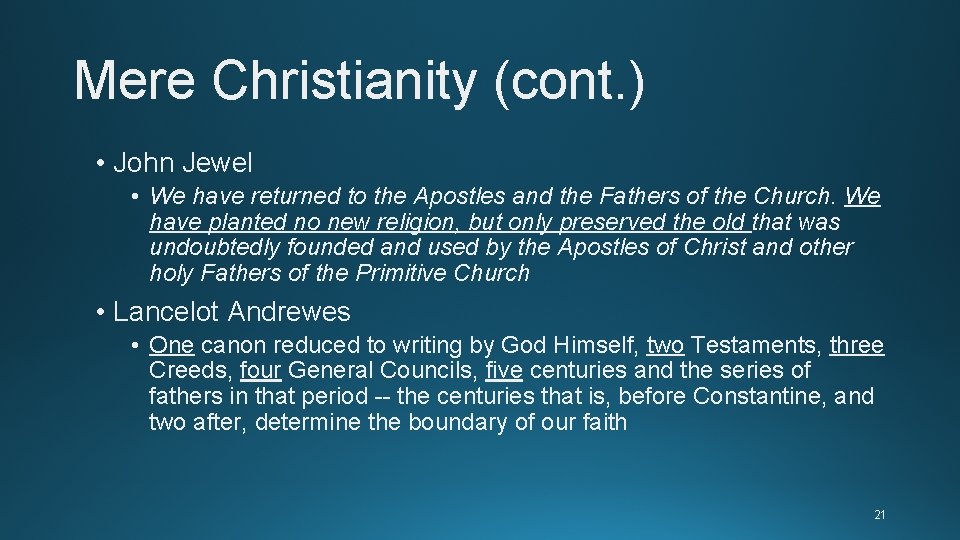
Mere Christianity (cont. ) • John Jewel • We have returned to the Apostles and the Fathers of the Church. We have planted no new religion, but only preserved the old that was undoubtedly founded and used by the Apostles of Christ and other holy Fathers of the Primitive Church • Lancelot Andrewes • One canon reduced to writing by God Himself, two Testaments, three Creeds, four General Councils, five centuries and the series of fathers in that period -- the centuries that is, before Constantine, and two after, determine the boundary of our faith 21
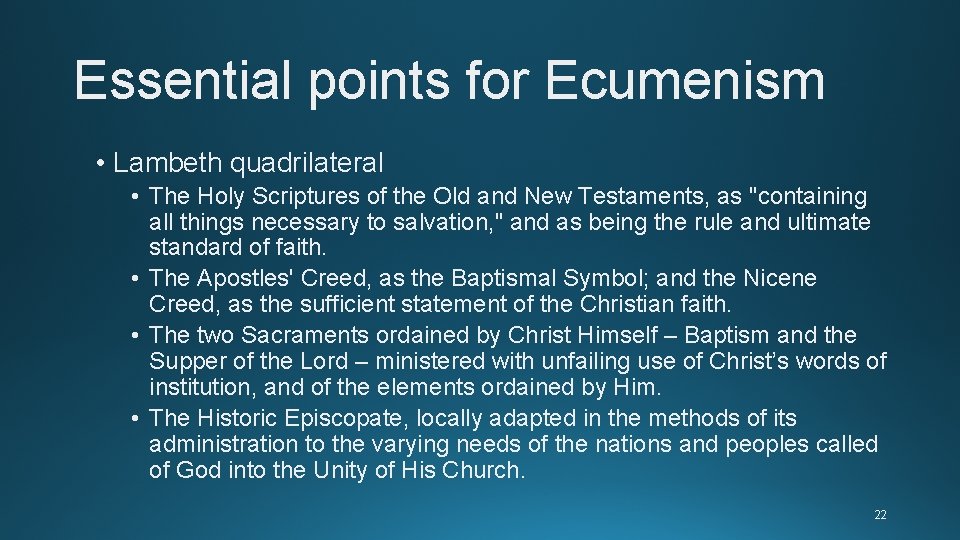
Essential points for Ecumenism • Lambeth quadrilateral • The Holy Scriptures of the Old and New Testaments, as "containing all things necessary to salvation, " and as being the rule and ultimate standard of faith. • The Apostles' Creed, as the Baptismal Symbol; and the Nicene Creed, as the sufficient statement of the Christian faith. • The two Sacraments ordained by Christ Himself – Baptism and the Supper of the Lord – ministered with unfailing use of Christ’s words of institution, and of the elements ordained by Him. • The Historic Episcopate, locally adapted in the methods of its administration to the varying needs of the nations and peoples called of God into the Unity of His Church. 22
Part IV Application to current challenges 23
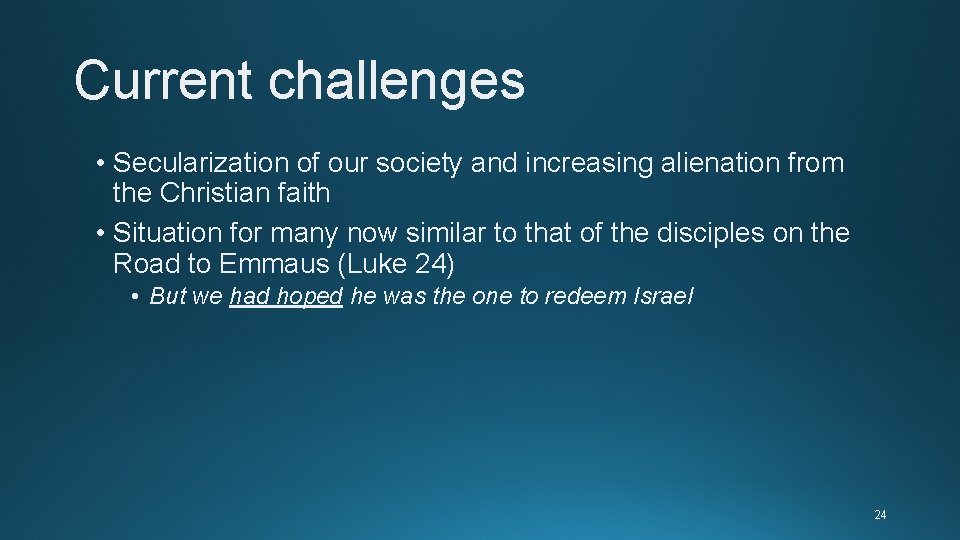
Current challenges • Secularization of our society and increasing alienation from the Christian faith • Situation for many now similar to that of the disciples on the Road to Emmaus (Luke 24) • But we had hoped he was the one to redeem Israel 24
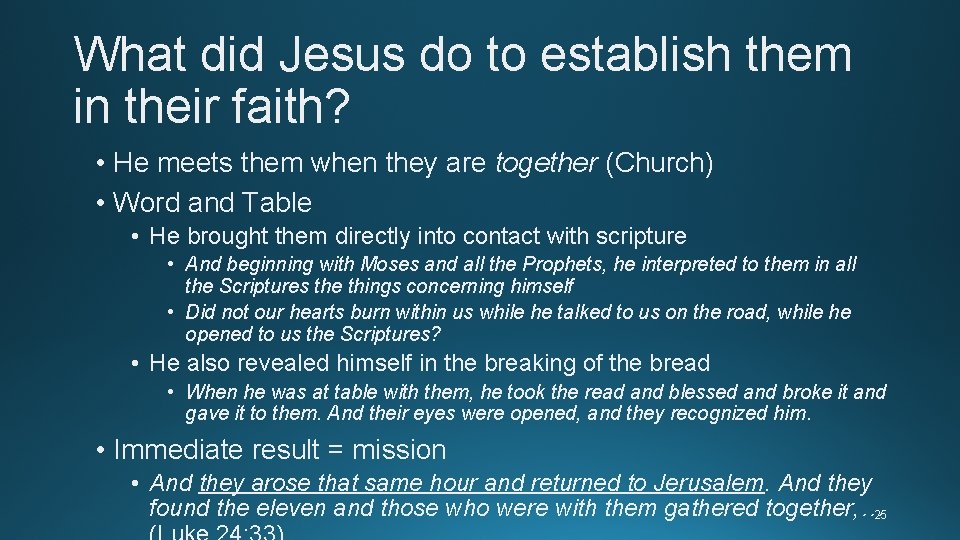
What did Jesus do to establish them in their faith? • He meets them when they are together (Church) • Word and Table • He brought them directly into contact with scripture • And beginning with Moses and all the Prophets, he interpreted to them in all the Scriptures the things concerning himself • Did not our hearts burn within us while he talked to us on the road, while he opened to us the Scriptures? • He also revealed himself in the breaking of the bread • When he was at table with them, he took the read and blessed and broke it and gave it to them. And their eyes were opened, and they recognized him. • Immediate result = mission • And they arose that same hour and returned to Jerusalem. And they found the eleven and those who were with them gathered together, … 25
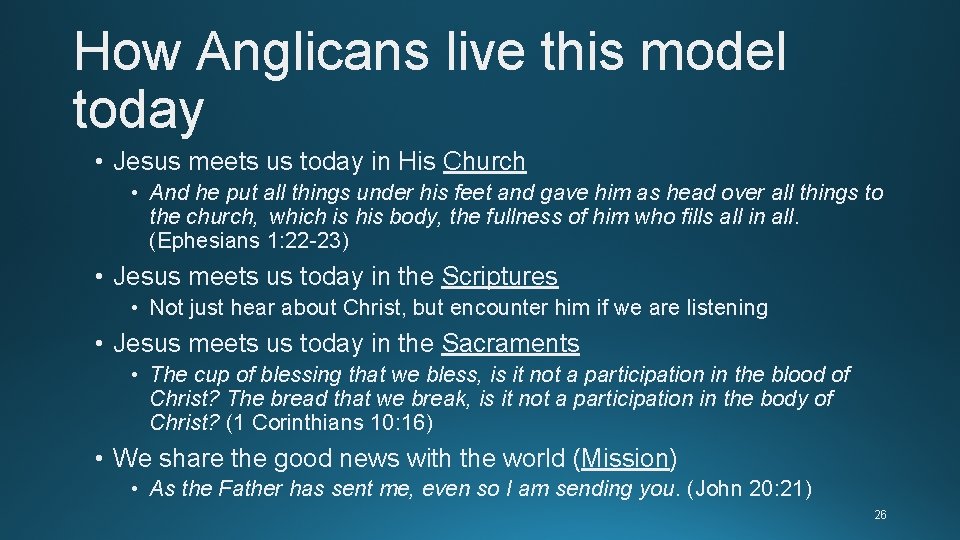
How Anglicans live this model today • Jesus meets us today in His Church • And he put all things under his feet and gave him as head over all things to the church, which is his body, the fullness of him who fills all in all. (Ephesians 1: 22 -23) • Jesus meets us today in the Scriptures • Not just hear about Christ, but encounter him if we are listening • Jesus meets us today in the Sacraments • The cup of blessing that we bless, is it not a participation in the blood of Christ? The bread that we break, is it not a participation in the body of Christ? (1 Corinthians 10: 16) • We share the good news with the world (Mission) • As the Father has sent me, even so I am sending you. (John 20: 21) 26
Part V Three streams 27
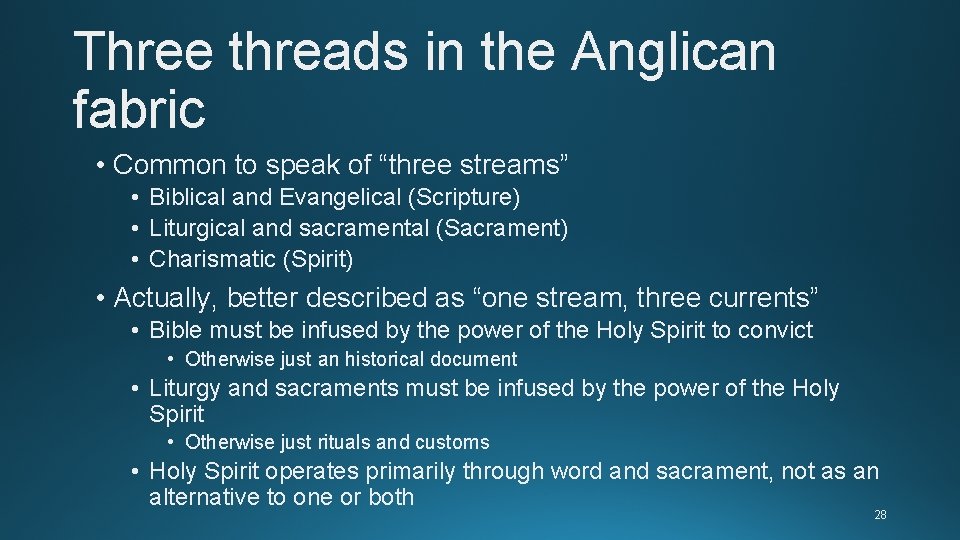
Three threads in the Anglican fabric • Common to speak of “three streams” • Biblical and Evangelical (Scripture) • Liturgical and sacramental (Sacrament) • Charismatic (Spirit) • Actually, better described as “one stream, three currents” • Bible must be infused by the power of the Holy Spirit to convict • Otherwise just an historical document • Liturgy and sacraments must be infused by the power of the Holy Spirit • Otherwise just rituals and customs • Holy Spirit operates primarily through word and sacrament, not as an alternative to one or both 28
Question 1 Which of the following figures plays a role in Anglicanism equivalent to that played by Martin Lutheranism? A. Thomas Cranmer B. Richard Hooker C. Lancelot Andrewes D. None of the above 29
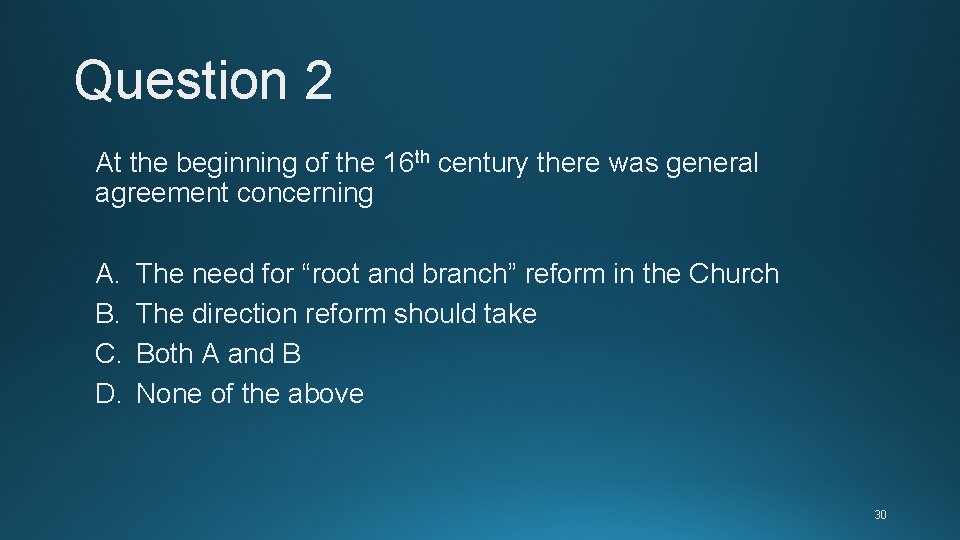
Question 2 At the beginning of the 16 th century there was general agreement concerning A. B. C. D. The need for “root and branch” reform in the Church The direction reform should take Both A and B None of the above 30
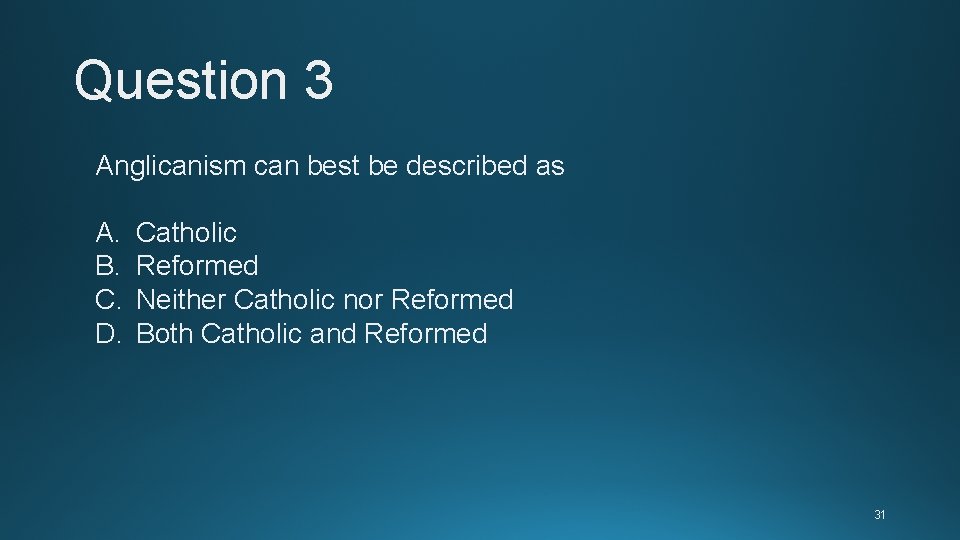
Question 3 Anglicanism can best be described as A. B. C. D. Catholic Reformed Neither Catholic nor Reformed Both Catholic and Reformed 31
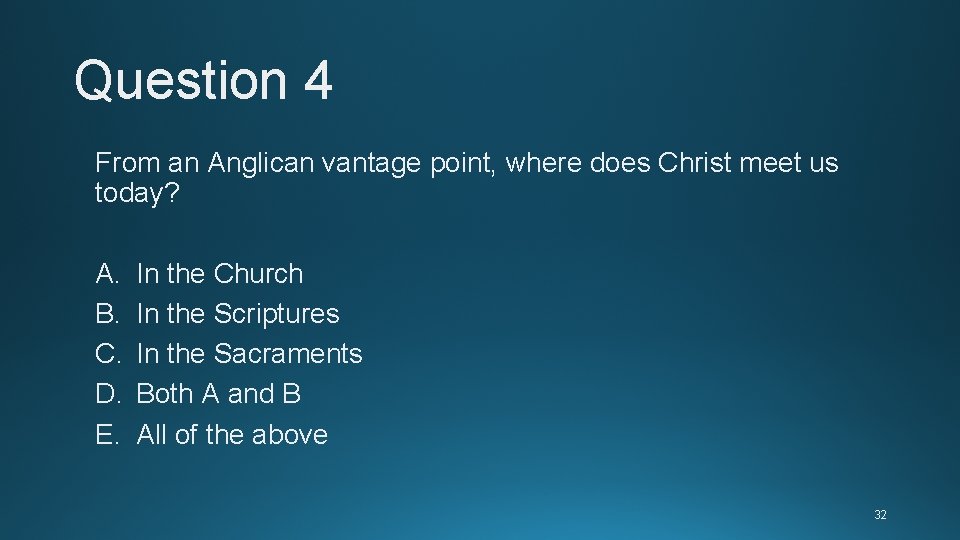
Question 4 From an Anglican vantage point, where does Christ meet us today? A. B. C. D. E. In the Church In the Scriptures In the Sacraments Both A and B All of the above 32
Question 5 Which of the following are expressions of the concept of “mere Christianity”? A. Lambeth Quadrilateral B. Vincentian Canon (“what has been accepted everywhere, always, by everyone”) C. Faith of the undivided Church D. One canon, two testaments, three creeds, four councils, five centuries (Lancelot Andrewes) E. All of the above 33