
Saint Patrick The history of St Patrick the
- Slides: 24
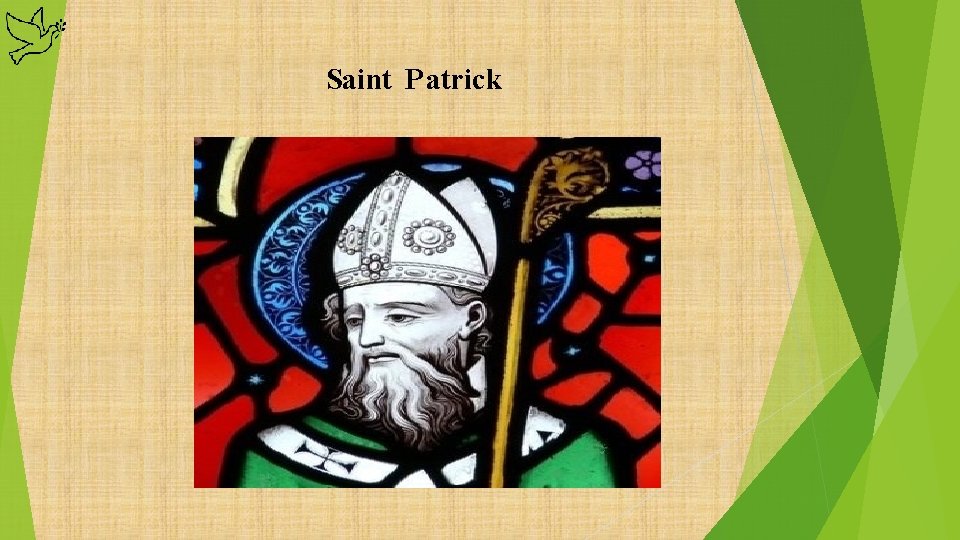
Saint Patrick
The history of St Patrick, the patron saint of Ireland who was born in the second half of the 4 th century, is inevitably sketchy. Even his year of birth is uncertain, with some scholars hitting on 373 while others calculate 390.
Similarly, the place where St Patrick was born cannot be confirmed. It is known that he was raised near a village called Banna Vemta Burniae but its location cannot be identified. It may have been lowland Scotland but is equally likely to have been Wales, which was under Roman control at the time. Patrick's real name was probably Maewyn Succat. His father, Calpornius, was a Roman-British army officer and a deacon.
Despite this family involvement in the church, the young Patrick was not a believer. His life was ordinary, and completely unexceptional, until the age of 16. But dramatic events then occurred which set the history of St Patrick, and the history of Ireland, on a new course.
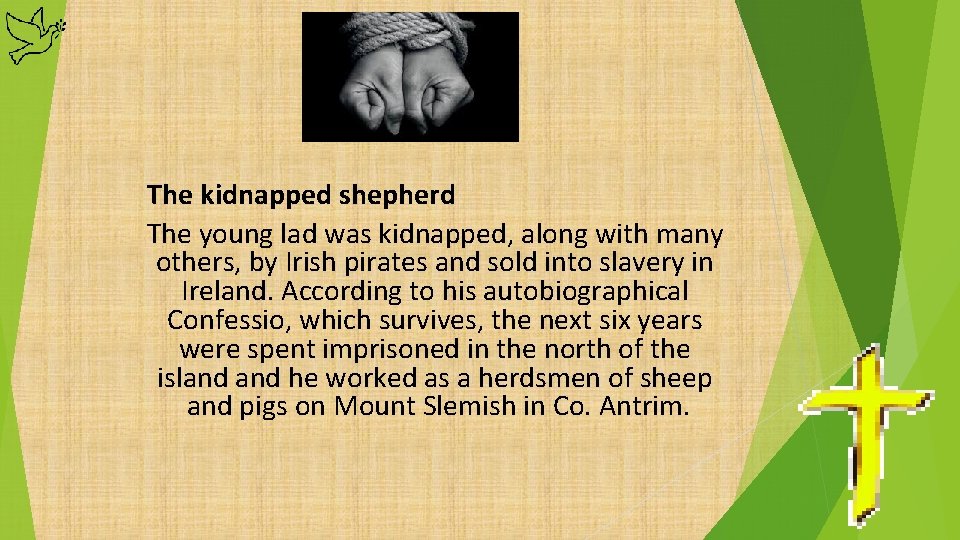
The kidnapped shepherd The young lad was kidnapped, along with many others, by Irish pirates and sold into slavery in Ireland. According to his autobiographical Confessio, which survives, the next six years were spent imprisoned in the north of the island he worked as a herdsmen of sheep and pigs on Mount Slemish in Co. Antrim.
The kidnapped shepherd During this period, he became increasingly religious. He considered his kidnapping and imprisonment as a punishment for his lack of faith and spent a lot of time in prayer. After a vision led him to stow away on a boat bound for Britain, Patrick escaped back to his family.
There he had a dream that the Irish were calling him back to Ireland to tell them about God. This inspired him to return to Ireland as a priest but not immediately. At this point he didn't feel adequately prepared for a life as a missionary. His studies took him to France where he was trained in a monastery, possibly under St. Germain, the bishop of Auxerre, and he dedicated this period of his life to learning. It was some 12 years before he returned to Irish shores as a bishop sent with the Pope's blessing.
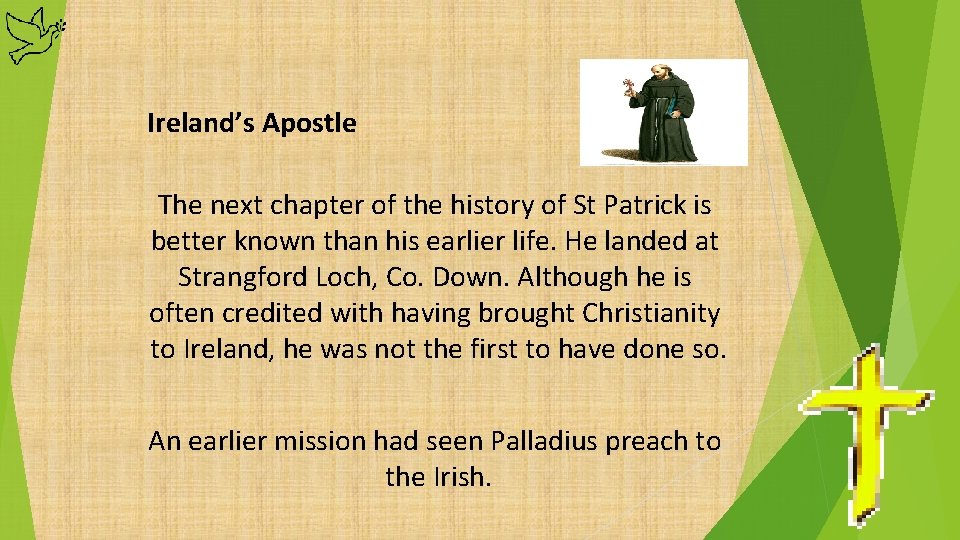
Ireland’s Apostle The next chapter of the history of St Patrick is better known than his earlier life. He landed at Strangford Loch, Co. Down. Although he is often credited with having brought Christianity to Ireland, he was not the first to have done so. An earlier mission had seen Palladius preach to the Irish.
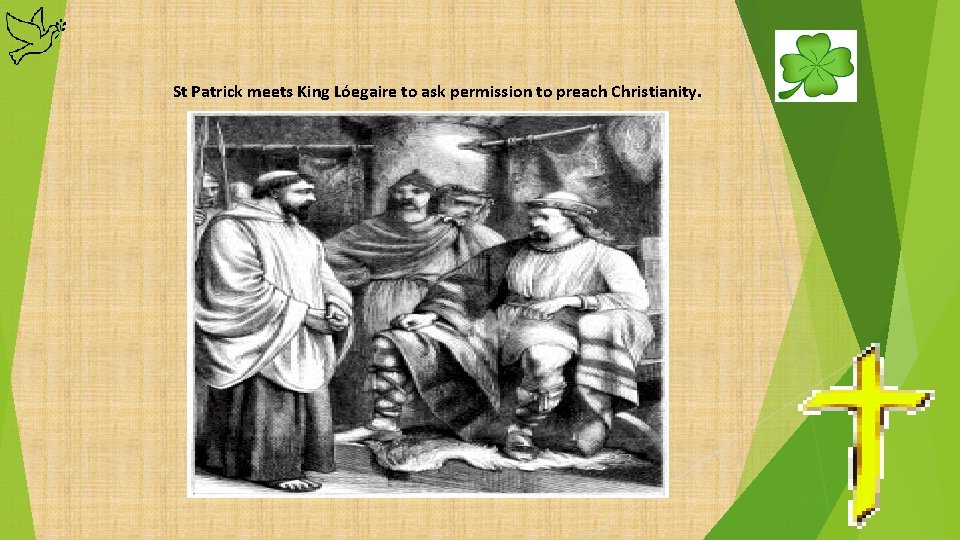
St Patrick meets King Lóegaire to ask permission to preach Christianity.
Of course, it wasn't all plain sailing. The history of St Patrick is littered with periods of imprisonment when his teachings had upset local chieftains or Celtic Druids but he always escaped or gained freedom by presenting his captors with gifts. For twenty years he travelled the length and breadth of the island, baptising people and establishing monasteries, schools and churches as he went.
By the time he died, on 17 March 461 (or 493, depending on which date you started your calculation), he left behind an organised church, the see of Armagh, and an island of Christians. This date – 17 th March – has been commemorated as St Patrick's Day ever since. He was buried either in Downpatrick, Co Down, or in Armagh.
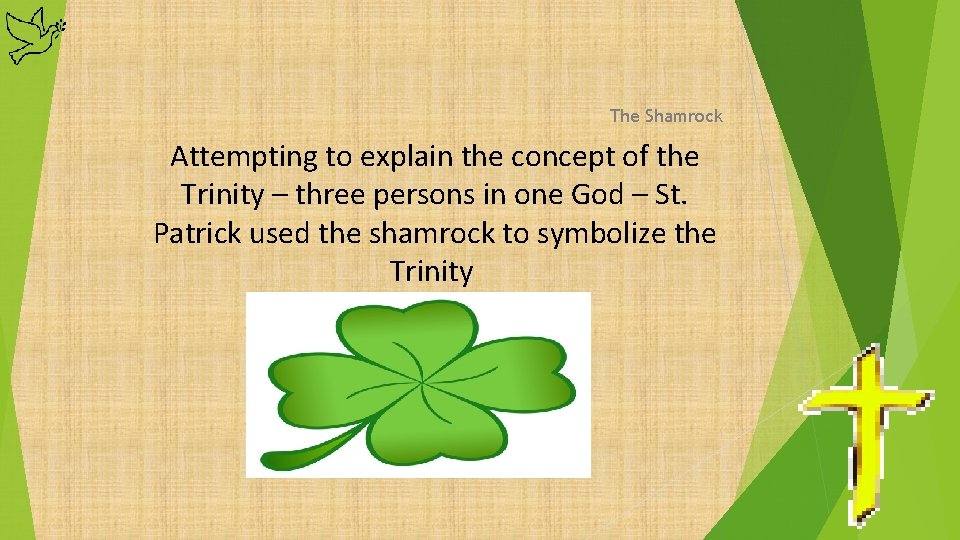
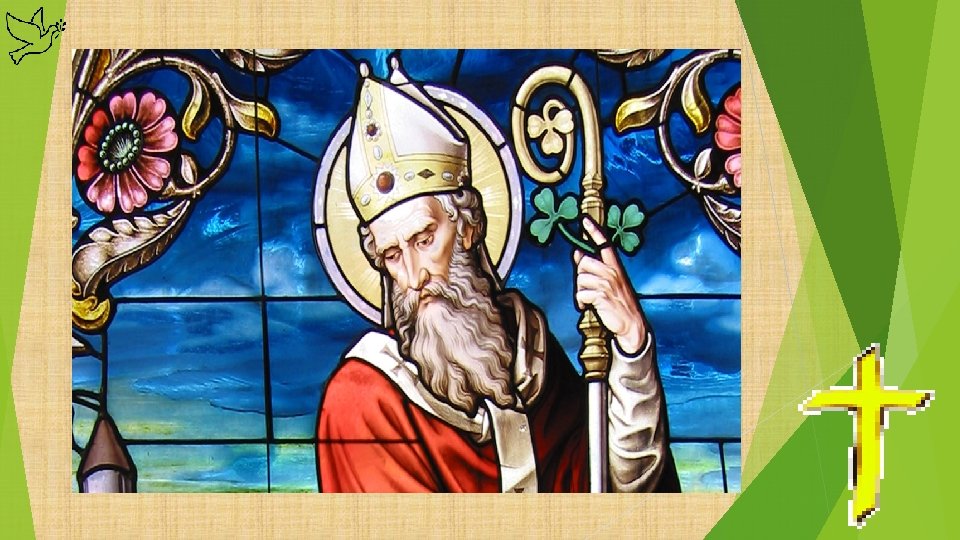
The Shamrock Attempting to explain the concept of the Trinity – three persons in one God – St. Patrick used the shamrock to symbolize the Trinity
Some Myths Did St Patrick drive the snakes out of Ireland? Probably not! No, he didn't, because it's unlikely there ever were any snakes in Ireland. The snake may be a reference to serpent, a symbol of evil, and the driving out a reference to Patrick's mission to rid Ireland of pagan influence.
Some Myths Did St Patrick bring Christianity to Ireland? Probably not. There's good evidence that there were believers in Ireland before Patrick arrived. Pope Celestine had sent Palladius to that part of the world years before. Anyway, it would be unlikely that a country with such strong trading links with the Roman Empire would have remained untouched by Christianity.
Patrick's writings In Ireland, probably towards the end of his life, Bishop Patrick wrote about his life and work in the Confessio. ‘I am the sinner, Patrick. I am the most unsophisticated of people, the least of Christians and for many people I am the most comtemptible… I was taken into captivity in Ireland – at that time I was ignorant of the true God – along with many thousands of others. This was our punishment for departing from God, abandoning his commandments and ignoring our priests who kept on warning us about our salvation…’
St. Patrick's Breastplate is a popular prayer attributed to one of Ireland’s most beloved patron saints. According to tradition, St. Patrick wrote it in 433 A. D. for divine protection before successfully converting the Irish King Leoghaire and his subjects from paganism to Christianity. The term breastplate refers to a piece of armour worn in battle. This prayer has also been called The Cry of the Deer. I arise today Through a mighty strength, the invocation of the Trinity, Through belief in the Threeness, Through confession of the Oneness of the Creator of creation.
I arise today Through the strength of Christ's birth with His baptism, Through the strength of His crucifixion with His burial, Through the strength of His resurrection with His ascension, Through the strength of His descent for the judgment of doom.
I arise today Through the strength of the love of cherubim, In the obedience of angels, In the service of archangels, In the hope of resurrection to meet with reward, In the prayers of patriarchs, In the predictions of prophets, In the preaching of apostles, In the faith of confessors, In the innocence of holy virgins, In the deeds of righteous men.
I arise today, through The strength of heaven, The light of the sun, The radiance of the moon, The splendor of fire, The speed of lightning, The swiftness of wind, The depth of the sea, The stability of the earth, The firmness of rock.
I arise today, through God's strength to pilot me, God's might to uphold me, God's wisdom to guide me, God's eye to look before me, God's ear to hear me, God's word to speak for me, God's hand to guard me, God's shield to protect me, God's host to save me From snares of devils, From temptation of vices, From everyone who shall wish me ill, afar and near.
I summon today All these powers between me and those evils, Against every cruel and merciless power that may oppose my body and soul, Against incantations of false prophets, Against black laws of pagandom, Against false laws of heretics, Against craft of idolatry, Against spells of witches and smiths and wizards, Against every knowledge that corrupts man's body and soul; Christ to shield me today Against poison, against burning, Against drowning, against wounding, So that there may come to me an abundance of reward.
Christ with me, Christ before me, Christ behind me, Christ in me, Christ beneath me, Christ above me, Christ on my right, Christ on my left, Christ when I lie down, Christ when I sit down, Christ when I arise, Christ in the heart of every man who thinks of me, Christ in the mouth of everyone who speaks of me, Christ in every eye that sees me, Christ in every ear that hears me.
I arise today Through a mighty strength, the invocation of the Trinity, Through belief in the Threeness, Through confession of the Oneness of the Creator of creation.