
Saint John Chrysostom Biblical Series The Pentateuch Overview

Saint John Chrysostom Biblical Series The Pentateuch
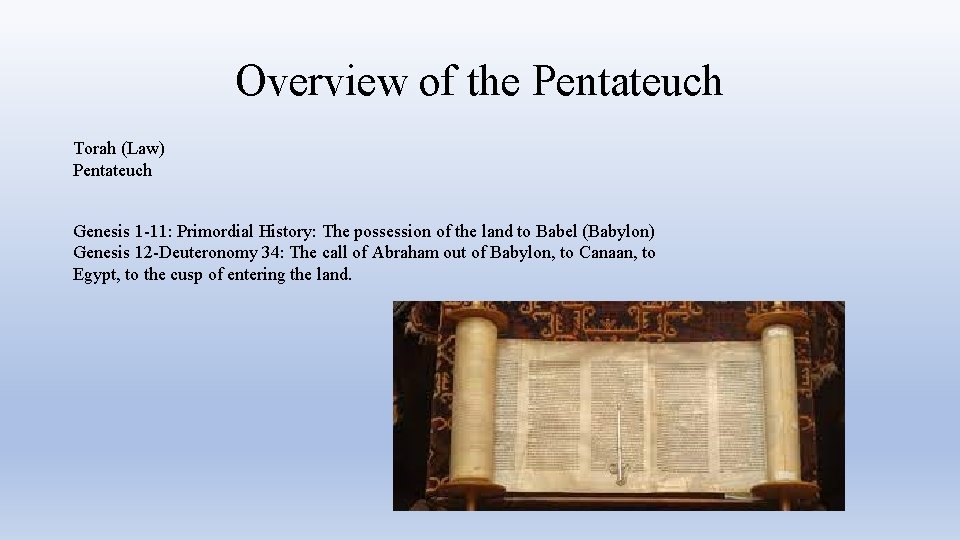
Overview of the Pentateuch Torah (Law) Pentateuch Genesis 1 -11: Primordial History: The possession of the land to Babel (Babylon) Genesis 12 -Deuteronomy 34: The call of Abraham out of Babylon, to Canaan, to Egypt, to the cusp of entering the land.
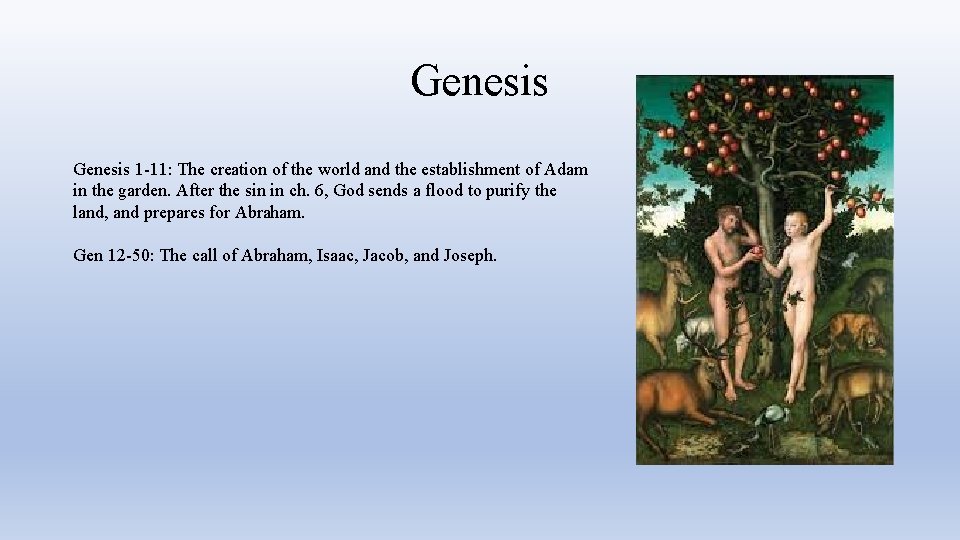
Genesis 1 -11: The creation of the world and the establishment of Adam in the garden. After the sin in ch. 6, God sends a flood to purify the land, and prepares for Abraham. Gen 12 -50: The call of Abraham, Isaac, Jacob, and Joseph.
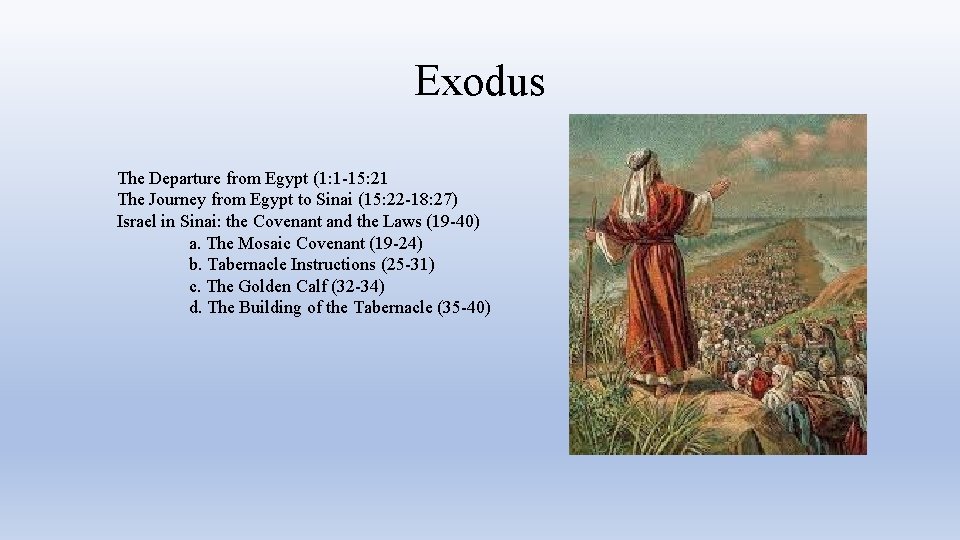
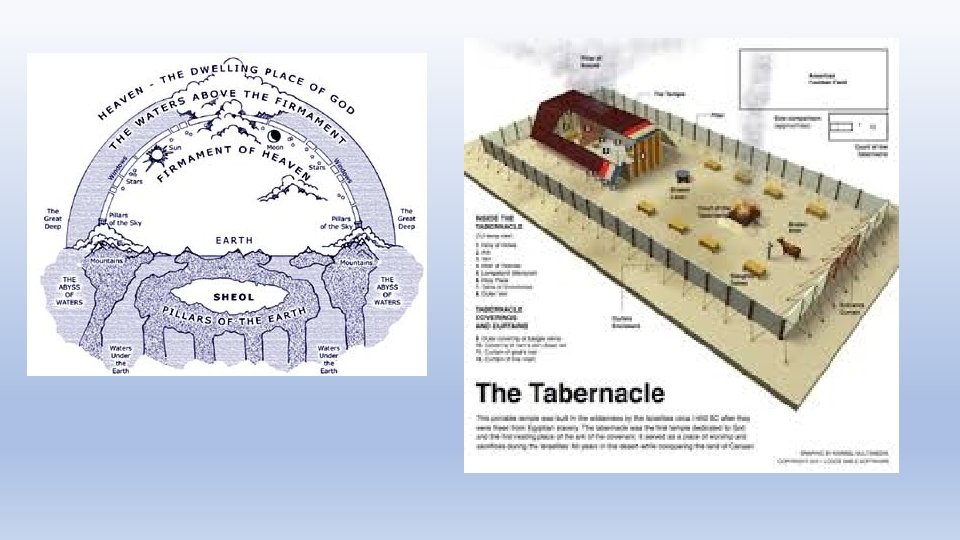
Exodus The Departure from Egypt (1: 1 -15: 21 The Journey from Egypt to Sinai (15: 22 -18: 27) Israel in Sinai: the Covenant and the Laws (19 -40) a. The Mosaic Covenant (19 -24) b. Tabernacle Instructions (25 -31) c. The Golden Calf (32 -34) d. The Building of the Tabernacle (35 -40)
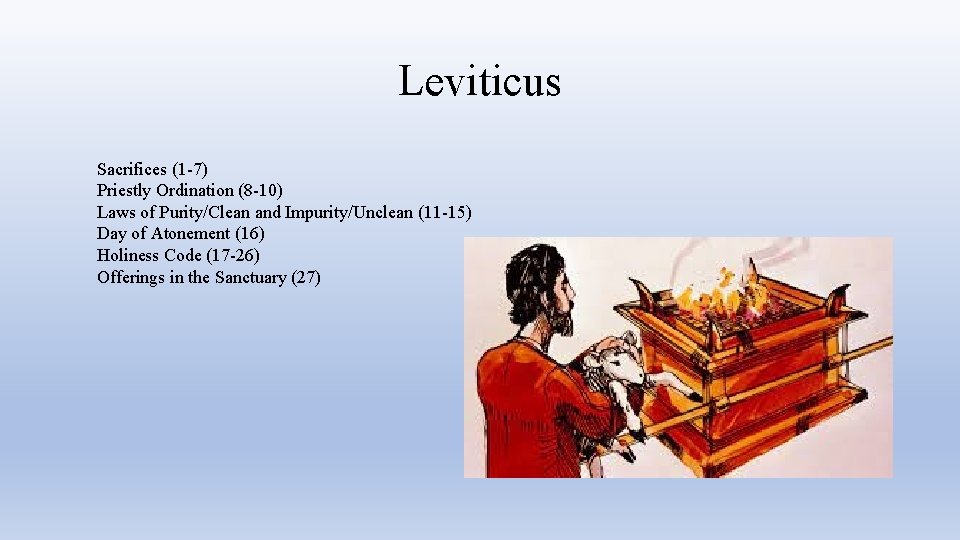
Leviticus Sacrifices (1 -7) Priestly Ordination (8 -10) Laws of Purity/Clean and Impurity/Unclean (11 -15) Day of Atonement (16) Holiness Code (17 -26) Offerings in the Sanctuary (27)
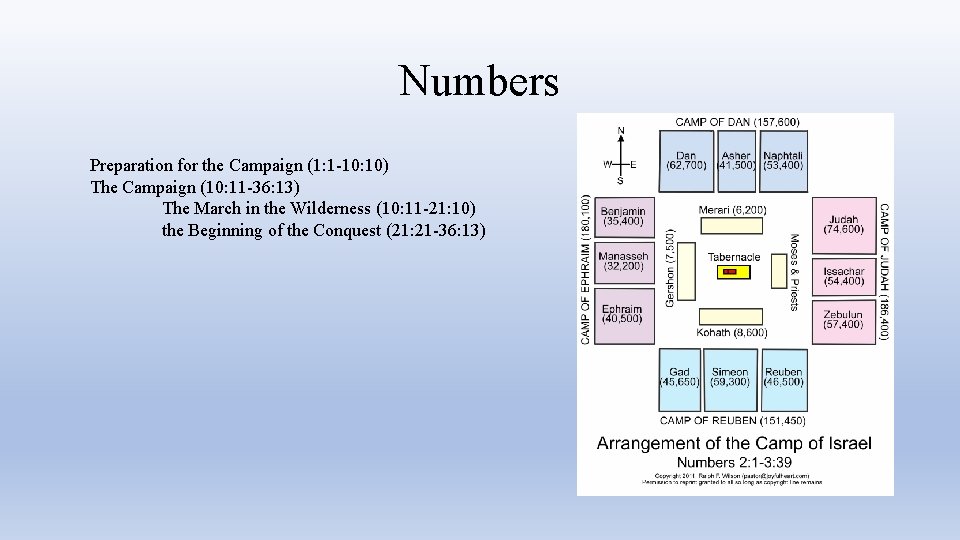
Numbers Preparation for the Campaign (1: 1 -10: 10) The Campaign (10: 11 -36: 13) The March in the Wilderness (10: 11 -21: 10) the Beginning of the Conquest (21: 21 -36: 13)
Deuteronomy “These are the words that Moses spoke to all Israel beyond the Jordan…” (1: 1) “This the law that Moses set before the Israelites…” (4: 44) “These are the words of the covenant that Yhwh commanded Moses to make with the Israelites…” (28: 69) “This is the blessing with which Moses, the man of God, blessed the Israelites before his death…” (33: 1)
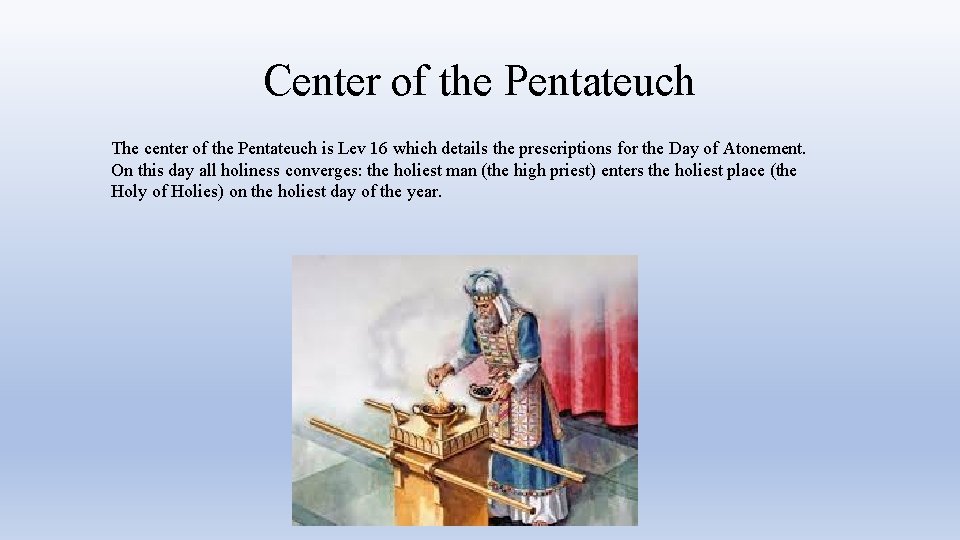
Center of the Pentateuch The center of the Pentateuch is Lev 16 which details the prescriptions for the Day of Atonement. On this day all holiness converges: the holiest man (the high priest) enters the holiest place (the Holy of Holies) on the holiest day of the year.
Mosaic Authorship Deuteronomy 31: 9: So Moses wrote down this law and gave it to the priests Numbers 12: 3: Now Moses was a very humble man, more humble than anyone else on the face of the earth. Deuteronomy 34: 5: So there, in the land of Moab, Moses, the servant of the LORD, died Number 21: 13 -15: Setting out from there, they encamped on the other side of the Arnon, in the desert that extends from the territory of the Amorites; for the Arnon forms Moab's boundary with the Amorites. Hence it is said in the "Book of the Wars of the LORD": "Waheb in Suphah and the wadies, Arnon and the wadi gorges That reach back toward the site of Ar and slant to the border of Moab. "
Questions of Mosaic Authorship 1. Doublets a. Two creation accounts (1: 1 -2: 4 a/2: 4 b-2: 25) b. Triple Narrative about the Wife/Sister (Gen 12: 10 -20; 20: 1 -18; 26: 1 -11) c. Double Narrative of the Lack of Water at Meribah (Exod 17: 1 -7; Numbers 20: 1 -13) 2. Different names of places (Horeb [Exod 17: 6]/Sinai [Exod 19: 1]))
Questions of Mosaic Authorship 3. Development: Some Law texts seem to show some development: a. Leviticus 21: 5 The priests shall not make bare the crown of the head, nor shave the edges of the beard, nor lacerate the body. To their God they shall be sacred, and not profane his name Deuteronomy 14: 1 -2: You are children of the LORD, your God. You shall not gash yourselves nor shave the hair above your foreheads for the dead. For you are a people sacred to the LORD. b. Leviticus 4: 20 Thus the priest shall make atonement for them, and they will be forgiven. Numbers 15: 25 -26 Then the priest shall make atonement for the whole Israelite community; thus they will be forgiven the inadvertence for which they have brought their holocaust as an oblation to the LORD. 26 Not only the whole Israelite community, but also the aliens residing among you, shall be forgiven, since the fault of inadvertence affects all the people. c. Exodus 22: 30 You shall be men sacred to me. Flesh torn to pieces in the field you shall not eat; throw it to the dogs. Deuteronony 14: 21 You must not eat any animal that has died of itself, for you are a people sacred to the LORD, your God. But you may give it to an alien who belongs to your community, and he may eat it, or you may sell it to a foreigner.
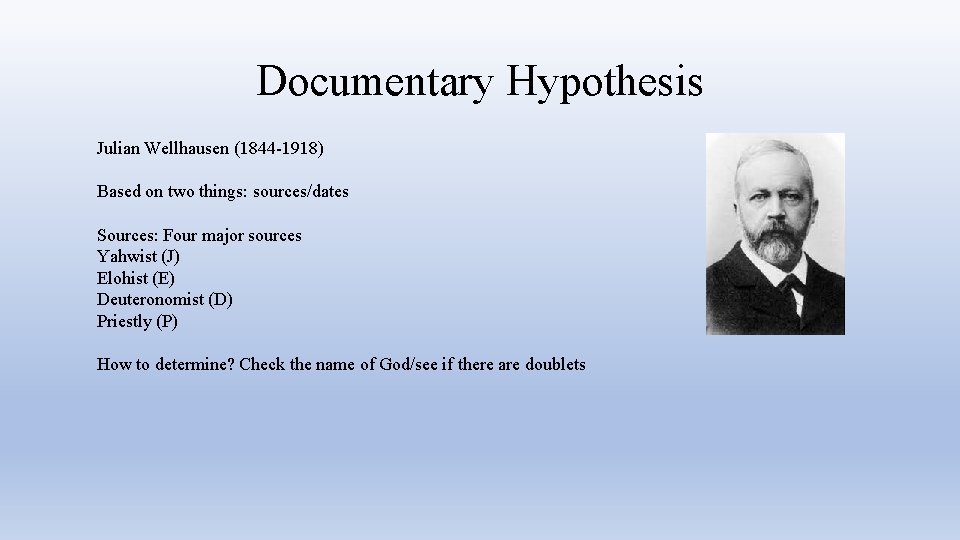
Documentary Hypothesis Julian Wellhausen (1844 -1918) Based on two things: sources/dates Sources: Four major sources Yahwist (J) Elohist (E) Deuteronomist (D) Priestly (P) How to determine? Check the name of God/see if there are doublets
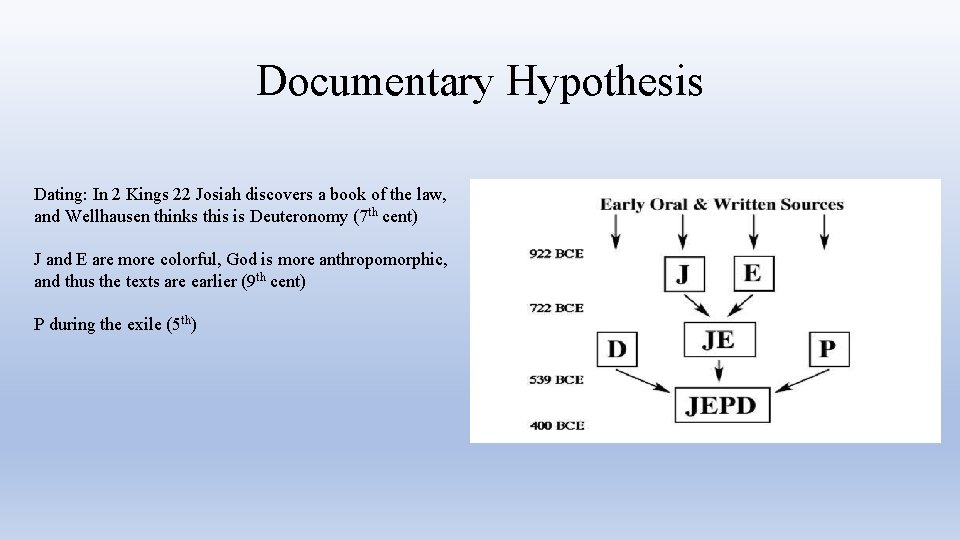
Documentary Hypothesis Dating: In 2 Kings 22 Josiah discovers a book of the law, and Wellhausen thinks this is Deuteronomy (7 th cent) J and E are more colorful, God is more anthropomorphic, and thus the texts are earlier (9 th cent) P during the exile (5 th)
Model until about 70’s Questions regarding sources and dating: Do narrative doublets mean different sources? Where is Adam? What if developed system of priests was early? Why doesn’t D mention Jerusalem (Josiah’s centralized mention of worship in Jerusalem)? Ezekiel seems to know the Pentateuch (6 th cent) Tabernacle texts seem to reflect Egypt during the time of Ramses II.
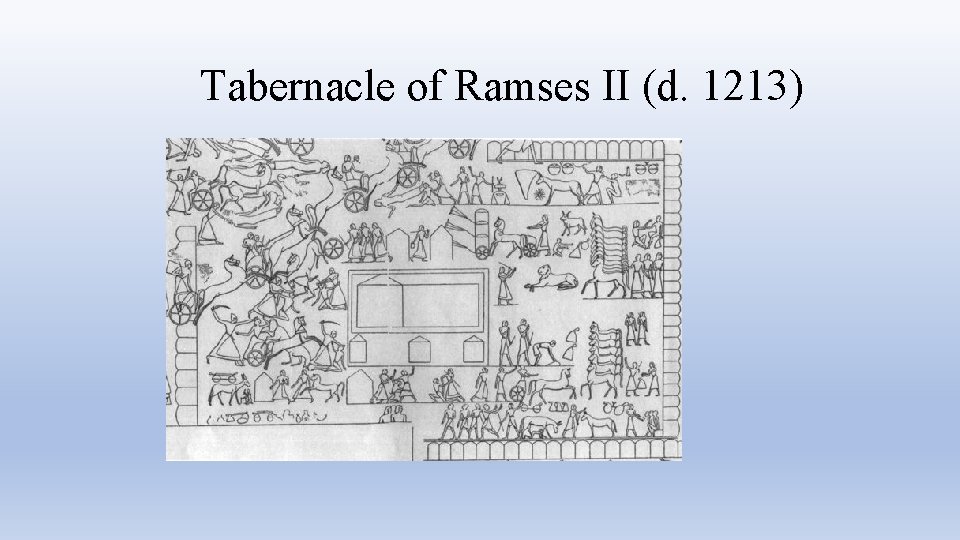
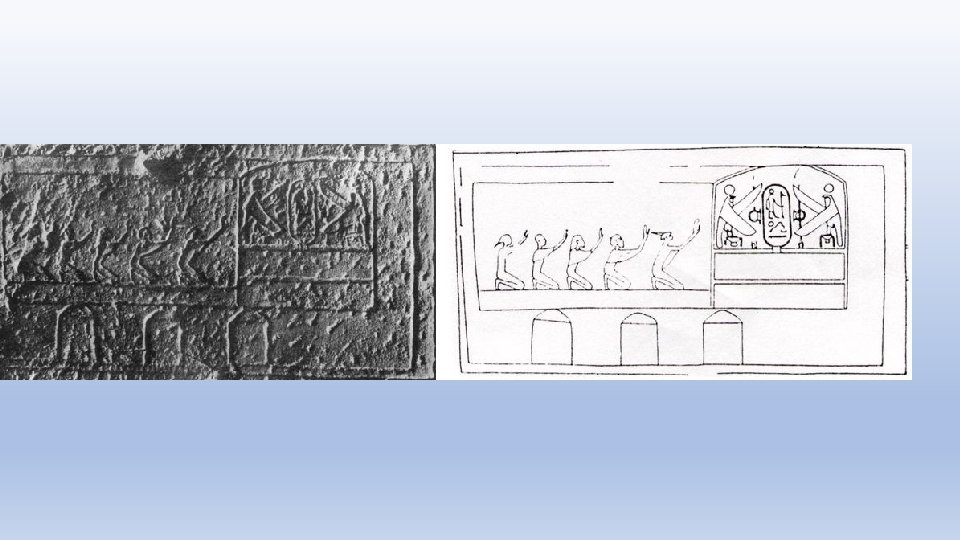
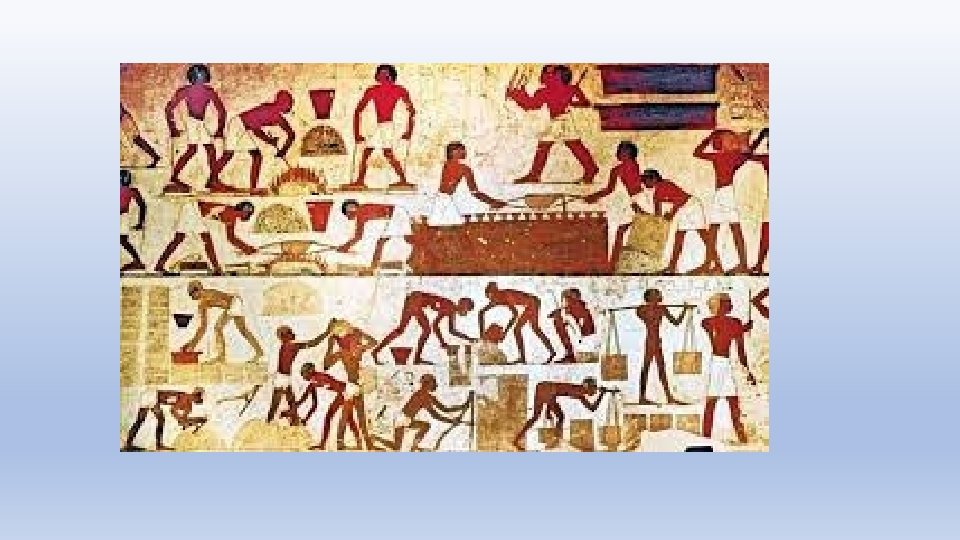
Tabernacle of Ramses II (d. 1213)
Current State Priestly and Deuteronomistic source exists. The dating and inner workings of these sources remains debated. The other source/sources remains deeply complicated and unclear. There is somewhat generally agreement that the Pentateuch may have reached its final form in the exile (6 th cent)
Implications and Considerations The Pentateuch seems to be a mixture of different writings from a variety of people over a long period of time. This Pentateuch is a work of a community, a pilgrim people. They let difficulties stand (light, development of the texts) They considered different strands or types of writing as worthy of being included. The authors are self-effacing, but Moses is clearly an important figure. They draw from a wide milieu around them and seek to learn and perfect the literature around them (flood stories, Law of Hammurabi [d. 1750], creation accounts). God revealed himself to the Israelites, and they strained to understand God by examining history and creation, and this work is the result of centuries of searching and praying.
- Slides: 21