
Sagittal Balance In Hyperkyphotic Patients With Growing Rods
Sagittal Balance In Hyperkyphotic Patients With Growing Rods and the Effect of Preoperative Halo Gravity Traction Cynthia V. Nguyen, MD 2 Henry Ofori Duah, RN MPH 1 Mabel Owiredu 1 Henry Osei Tutu, BS 1 Kwadwo Poku Yankey, MD 1 Irene Wulff, MD 1 Henry Akoto, MB Ch. B 1 Oheneba Boachie-Adjei, MD 1 FOCOS Spine Research Group 1 2 Shriners for Children Medical Center – Pasadena
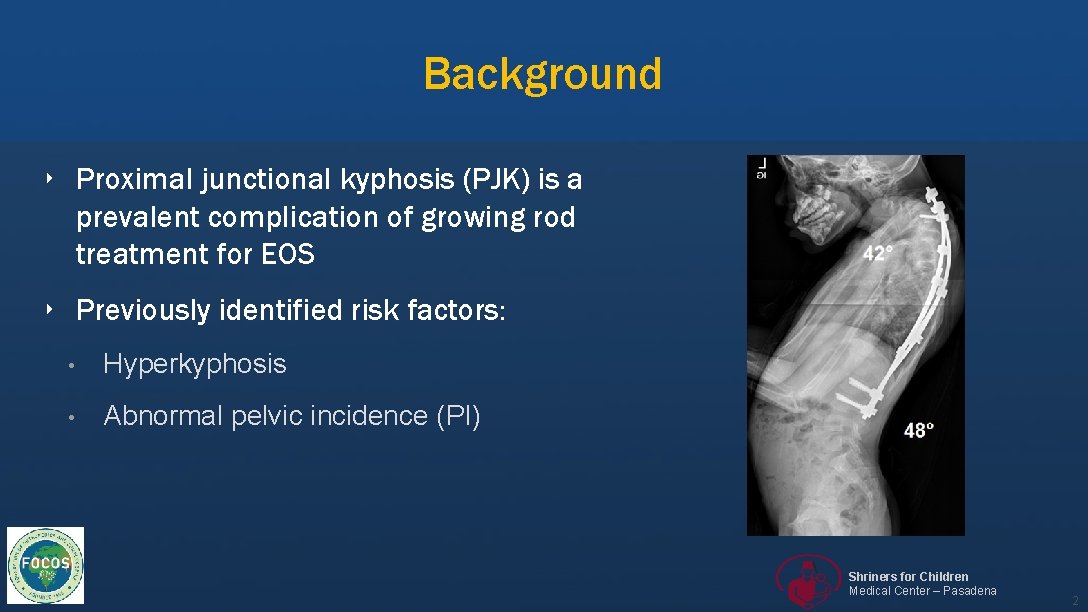
Background ‣ Proximal junctional kyphosis (PJK) is a prevalent complication of growing rod treatment for EOS ‣ Previously identified risk factors: • Hyperkyphosis • Abnormal pelvic incidence (PI) Shriners for Children Medical Center – Pasadena 2

Background 1. In population of patients who all have hyperkyphosis, what are the risks of PJK? 2. Would halo gravity traction (HGT) have a protective effect on the risks of PJK? Shriners for Children Medical Center – Pasadena 3

Materials and Methods ‣ Retrospective review, single center ‣ Inclusion criteria: • EOS treated with growing rods • Preoperative kyphosis > 40 degrees • ≥ 2 years of followup Shriners for Children Medical Center – Pasadena 4

Materials and Methods ‣ Clinical data collection • Demographics • Surgical details • Clinical course ‣ Radiographic data collection • X-rays were taken at regular follow-up visits • Sagittal parameters measured Shriners for Children Medical Center – Pasadena 5
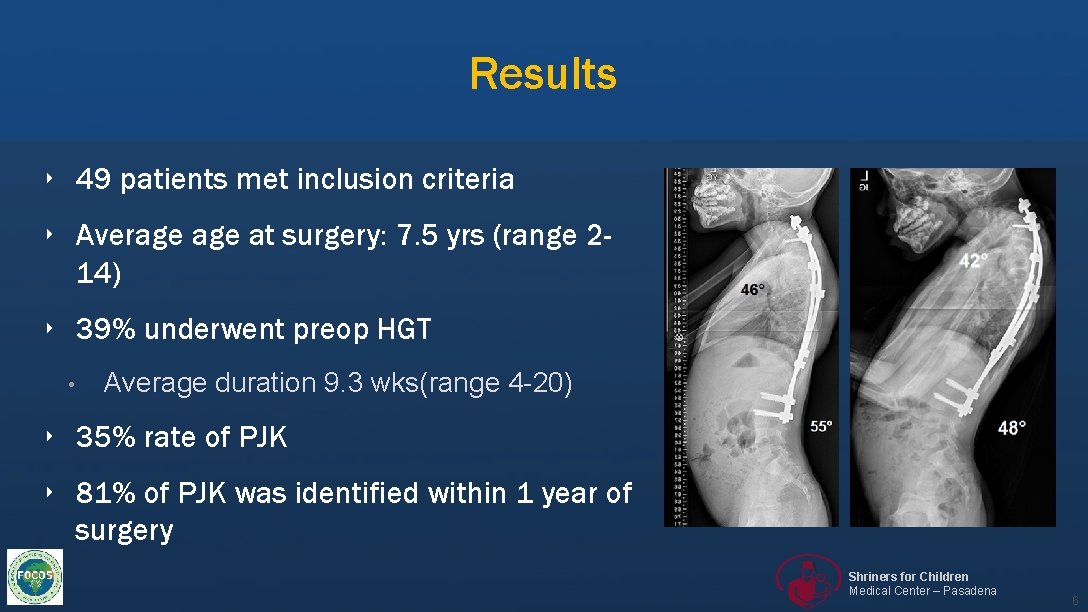
Results ‣ 49 patients met inclusion criteria ‣ Average at surgery: 7. 5 yrs (range 214) ‣ 39% underwent preop HGT • Average duration 9. 3 wks(range 4 -20) ‣ 35% rate of PJK ‣ 81% of PJK was identified within 1 year of surgery Shriners for Children Medical Center – Pasadena 6
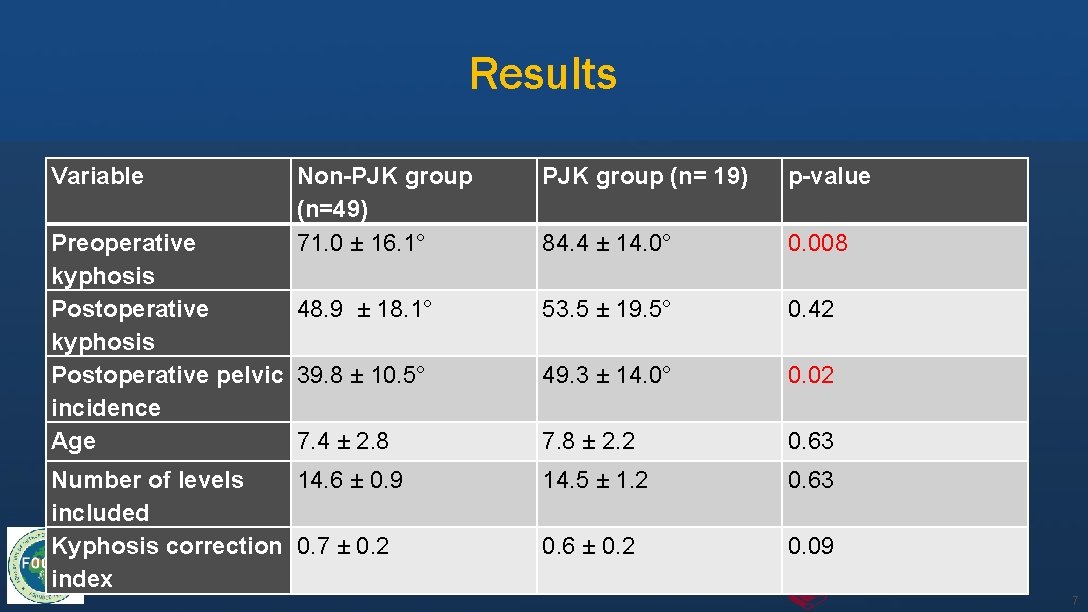
Results Variable Non-PJK group (n=49) 71. 0 ± 16. 1° PJK group (n= 19) p-value Preoperative kyphosis Postoperative 48. 9 ± 18. 1° kyphosis Postoperative pelvic 39. 8 ± 10. 5° incidence Age 7. 4 ± 2. 8 84. 4 ± 14. 0° 0. 008 53. 5 ± 19. 5° 0. 42 49. 3 ± 14. 0° 0. 02 7. 8 ± 2. 2 0. 63 Number of levels 14. 6 ± 0. 9 included Kyphosis correction 0. 7 ± 0. 2 index 14. 5 ± 1. 2 0. 63 0. 6 ± 0. 2 0. 09 Shriners for Children Medical Center – Pasadena 7

Results Variable No HGT (n=30) HGT (n= 19) p-value Kyphosis at presentation 72. 5 ± 16. 8° 106. 5 ± 11. 7° 0. 00 Preoperative kyphosis 72. 5 ± 16. 8° 81. 2 ± 15. 2° 0. 09 Postoperative kyphosis 41. 7 ± 14. 3° 64. 0 ± 16. 3° 0. 00 Rate of PJK 8/30 (27%) 9/19 (47%) 0. 14 Shriners for Children Medical Center – Pasadena 8

Conclusions ‣ Hyperkyphotic patients with growing rods have high risk of PJK • Early identification Shriners for Children Medical Center – Pasadena 9
Conclusions ‣ Hyperkyphotic patients with growing rods have high risk of PJK • Early identification ‣ Significant factors for PJK in growing rods: • Amount of preoperative kyphosis • Amount of pelvic incidence Shriners for Children Medical Center – Pasadena 10
Conclusions ‣ Hyperkyphotic patients with growing rods have high risk of PJK • Early identification ‣ Significant factors for PJK in growing rods: • Amount of preoperative kyphosis • Amount of pelvic incidence ‣ Despite starting out with more kyphosis, HGT patients did not have more PJK • Suggests that HGT has a protective effect against PJK Shriners for Children Medical Center – Pasadena 11
Thank You! Shriners for Children Medical Center – Pasadena 12
- Slides: 12