
Sagging and weakness of the bladder neck Funneling
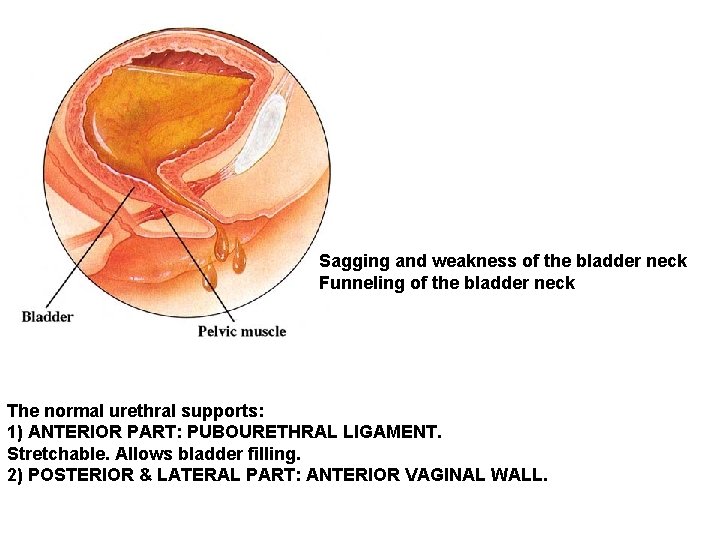
Sagging and weakness of the bladder neck Funneling of the bladder neck The normal urethral supports: 1) ANTERIOR PART: PUBOURETHRAL LIGAMENT. Stretchable. Allows bladder filling. 2) POSTERIOR & LATERAL PART: ANTERIOR VAGINAL WALL.

ANATOMICAL CONSIDERATIONS Arrangement of the muscle fibers of the detrusor muscle: 1 - Allows distension without increasing the inside pressure. 2 - Allows also evacuation of most of bladder contents.
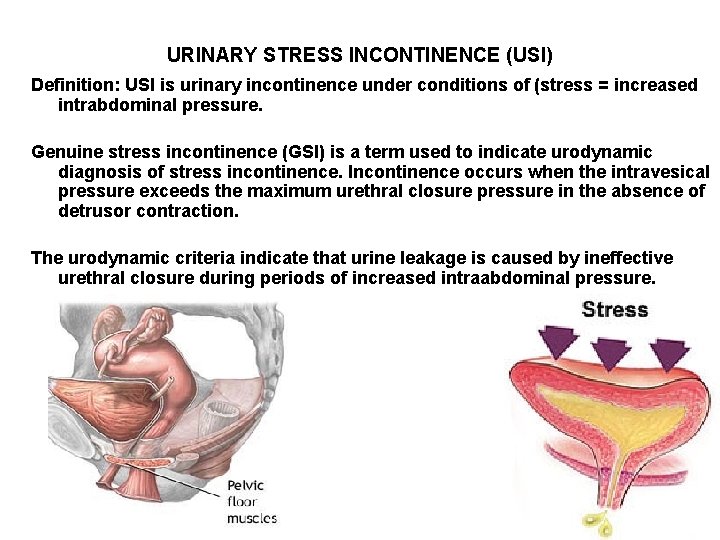
URINARY STRESS INCONTINENCE (USI) Definition: USI is urinary incontinence under conditions of (stress = increased intrabdominal pressure. Genuine stress incontinence (GSI) is a term used to indicate urodynamic diagnosis of stress incontinence. Incontinence occurs when the intravesical pressure exceeds the maximum urethral closure pressure in the absence of detrusor contraction. The urodynamic criteria indicate that urine leakage is caused by ineffective urethral closure during periods of increased intraabdominal pressure.
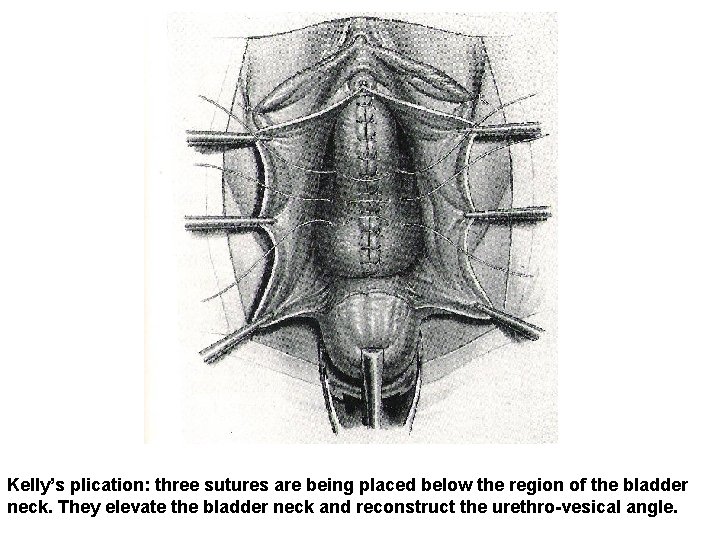
Kelly’s plication: three sutures are being placed below the region of the bladder neck. They elevate the bladder neck and reconstruct the urethro-vesical angle.
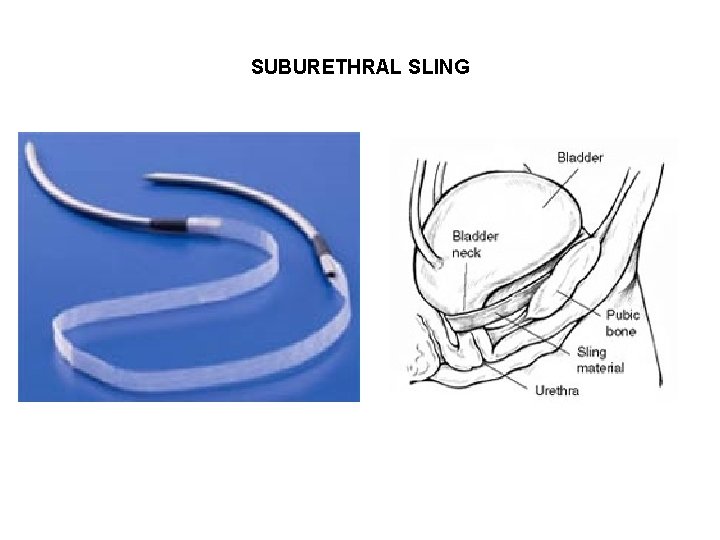
SUBURETHRAL SLING
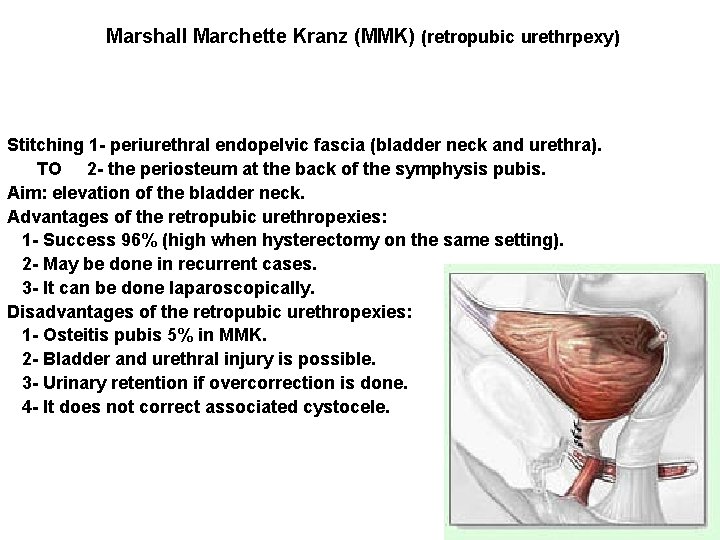
Marshall Marchette Kranz (MMK) (retropubic urethrpexy) Stitching 1 - periurethral endopelvic fascia (bladder neck and urethra). TO 2 - the periosteum at the back of the symphysis pubis. Aim: elevation of the bladder neck. Advantages of the retropubic urethropexies: 1 - Success 96% (high when hysterectomy on the same setting). 2 - May be done in recurrent cases. 3 - It can be done laparoscopically. Disadvantages of the retropubic urethropexies: 1 - Osteitis pubis 5% in MMK. 2 - Bladder and urethral injury is possible. 3 - Urinary retention if overcorrection is done. 4 - It does not correct associated cystocele.

URODYNAMIC EQUIPMENT

Set up used for cystometry recording

URODYNAMIC CATHETER SETS Used for cystometry and urethral pressure profilometry. Dual lumen construction allows the bladder to be filled while cystometry is performed. One lumen is pressure-measuring called a cystometer. The clear, non-radiopaque catheter design enhances visualization during video urodynamic studies. Double lumen cystometry catheter, 6 Fr. For simultaneous bladder filling and pressure measurement

• Triple lumen cystometry/UPP catheter 9 Fr. Graduated in 1 cm intervals from tip. Ports at 8 mm, 70 mm and 75 mm. Allows simultanious measuremenmt of bladder pressure and urethral Pressure Profile (UPP).
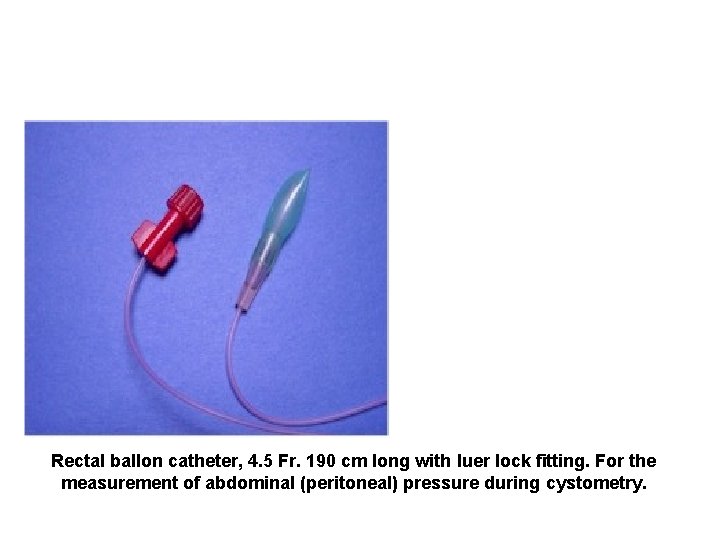
Rectal ballon catheter, 4. 5 Fr. 190 cm long with luer lock fitting. For the measurement of abdominal (peritoneal) pressure during cystometry.
- Slides: 12