
Safewards Talk Down Refresher Explanationinformation Role modelling Patient
- Slides: 22
Safewards Talk Down Refresher
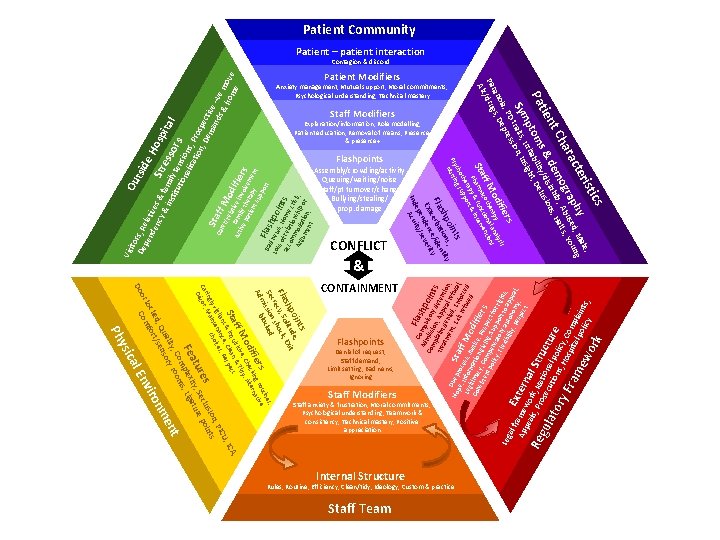
Explanation/information, Role modelling, Patient education, Removal of means, Presence & presence+ Staff Modifiers Denial of request, Staff demand, Limit setting, Bad news, Ignoring Flashpoints Staff anxiety & frustration, Moral commitments, Psychological understanding, Teamwork & consistency, Technical mastery, Positive appreciation Staff Modifiers A, , IC Rules, Routine, Efficiency, Clean/tidy, Ideology, Custom & practice Internal Structure Staff Team ics s s, ne c ti blo rs g rou tive ifie ckin erna od e, Che dy, Alt ff M isitiv & Ti Sta & inqu, Clean spect t oin de, shp litu Exit Fla ecy, Soshock, r Sec ission ked m Ad CONTAINMENT ork Anxiety management, Mutual support, Moral commitments, Psychological understanding, Technical mastery rist hy , Male, g cte p ed un ara ogra. , Abusall. s, Yo Ch em nhib s, H nt & d y/disi lusion tie Pa ptomsritabiliitght, De , Ir ns Symtraits sion, I s rs , PD re oia s, Dep an Par /drug Alc Patient Modifiers al f E r Ap ame xter pe wo n Re als, Prork, Natal Stru gul io s ato ecutionnal polcture ic s, ry Fra Hospitya, Comp la lp me w olicy ints, & sis ifie od erapy al analyns ff M coth ction entio Sta. Pharmya & fun& interv rap ort the upp cho g s ts Psy ursin N or al E sic t U Re ce ilan enan ices, PIC vig t n, cho gly Main sio nts rin Ca cor, es eclu poi Dé tur ity, S ture Fea plex , Liga om ooms , C t lity ory r en ua s , Q sen nm ked rt/ iro loc omfo nv C Do y Ph Leg Flashpoints Assembly/crowding/activity Queuing/waiting/noise Staff/pt turnover/change Bullying/stealing/ prop. damage oin s; y shp tion ntit Fla rba ide e c ce/ ty Exa nden everi s e ep ity/ Ind Acu CONFLICT C Fla Ad omp shp uls m o Co mp ission ory d ints l a tre int , App eten atm de ti e en nied al ref on, D t, E , En usa Ho ue p S t x pe l a it r f f , roc efu orce , Leg Infor ess, J f M sed d m o u Co itima atio stice dif nsi cy, n g , R ier ste e i nt Comp ving, spec s po licy ensa Supp t for , Fl tor ort righ exi y a bili uto to ap ts, p ty, n Re omy eal, spe , ct ie ctiv mil in e p y th volv rs ati era em en en t su py t pp F o l r Ba a t d n sh Los ew po s o s, H in acc f rela ome ts om tio cri Arg mod nship sis, um atio or en n, t Ou ito tsid De rs, Re pe e. H nd lative en osp cy s & f Str & i am ita e s nst i l itu ly ten sors tio na sions lisa tio , Pros n, De pecti ma ve Sta nd –ve Ca s& rer ff M /re ho move lat od me i F ve if a A Vis Patient Community Patient – patient interaction Contagion & discord
Background • When people become agitated, fearful, angry, ashamed, depressed or suicidal, it should be possible to lessen people’s distress by talking to them • Most of us have had instruction in de-escalation in aggression management training but this may be limited • Safewards pulls together ‘Talk Down’ techniques into a meaningful picture
Aims • Build patient’s emotional self-management skills, self-monitoring, self-awareness and psychological understanding • Using crisis as an opportunity for therapeutic learning for everyone • Improve team cohesion, skill sharing, mutual support • Expand staff skill set • Avoid conflict and containment - or minimise the impact in the event of conflict and/or containment
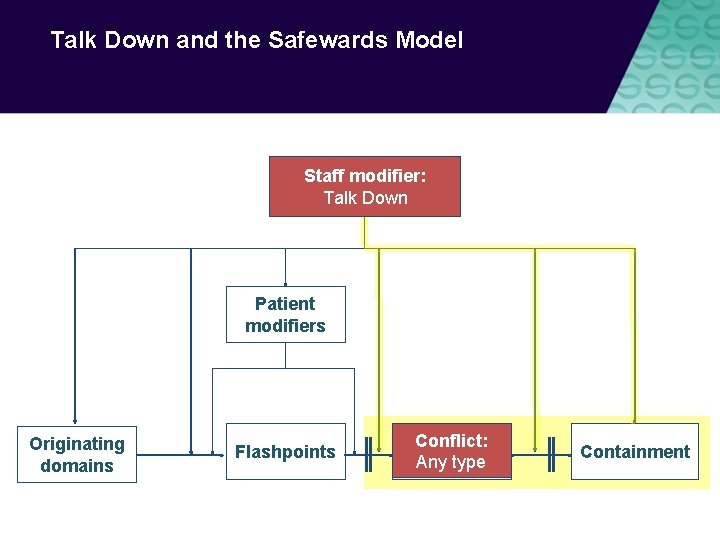
Talk Down and the Safewards Model Staff modifier: Staff modifiers Talk Down Patient modifiers Originating domains Flashpoints Conflict: Conflict Any type Containment
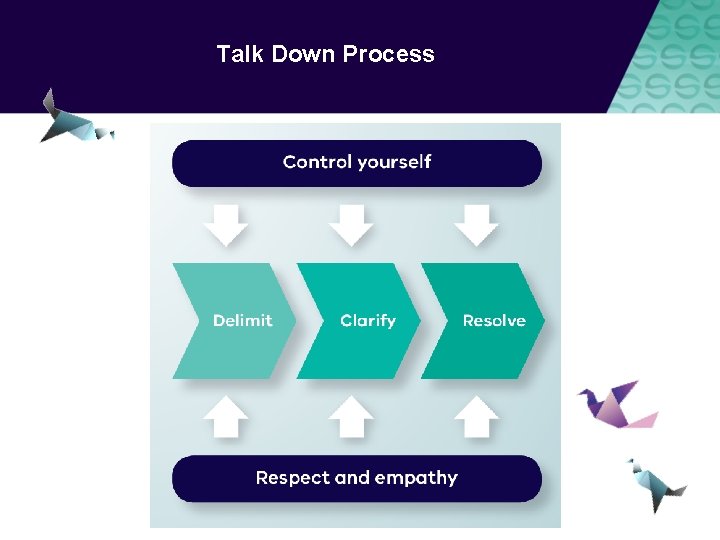
Talk Down Process
De-escalation model Depicts de-escalation as a process: • Starts with delimiting the situation • Moves onto clarification of the problem with the patient • Reaches a resolution The model indicates that de-escalation is only likely to succeed if, at every stage, the de-escalator: • Controls their own emotions, and • Expresses respect and empathy for the patient
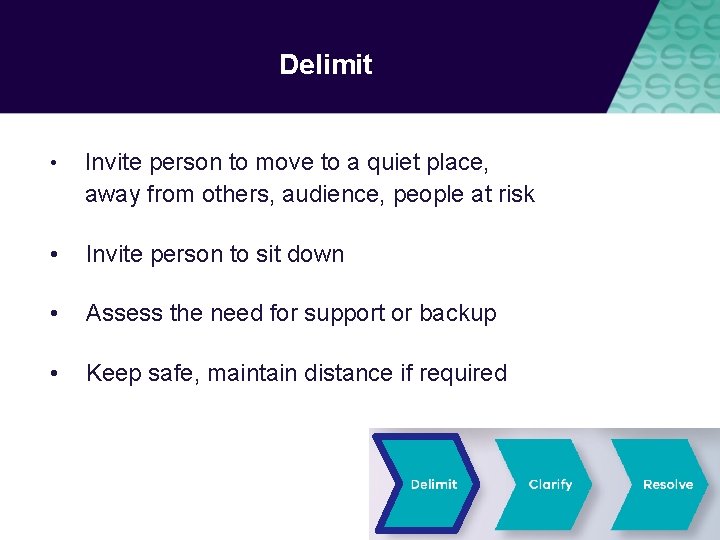
Delimit • Invite person to move to a quiet place, away from others, audience, people at risk • Invite person to sit down • Assess the need for support or backup • Keep safe, maintain distance if required
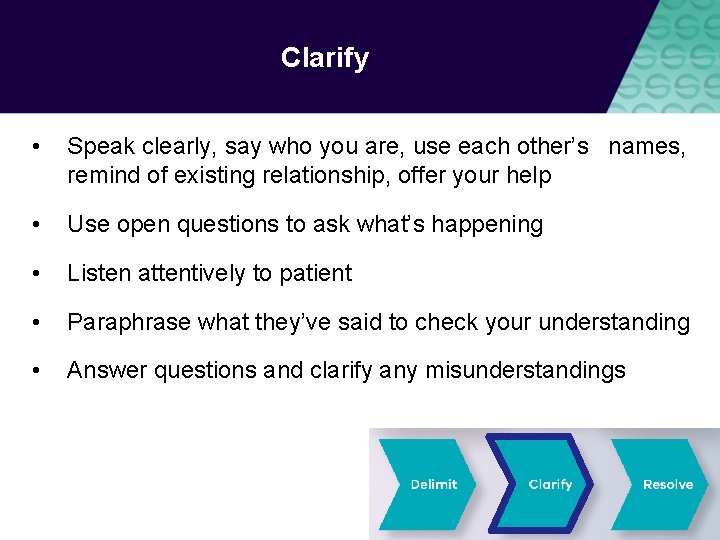
Clarify • Speak clearly, say who you are, use each other’s names, remind of existing relationship, offer your help • Use open questions to ask what’s happening • Listen attentively to patient • Paraphrase what they’ve said to check your understanding • Answer questions and clarify any misunderstandings
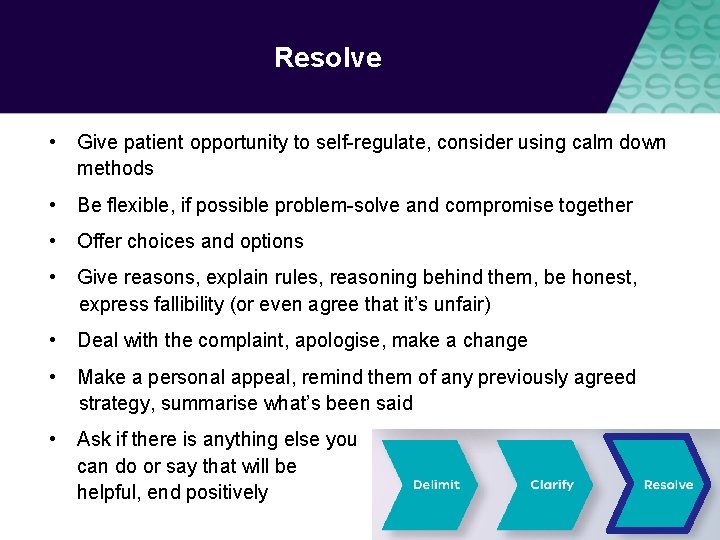
Resolve • Give patient opportunity to self-regulate, consider using calm down methods • Be flexible, if possible problem-solve and compromise together • Offer choices and options • Give reasons, explain rules, reasoning behind them, be honest, express fallibility (or even agree that it’s unfair) • Deal with the complaint, apologise, make a change • Make a personal appeal, remind them of any previously agreed strategy, summarise what’s been said • Ask if there is anything else you can do or say that will be helpful, end positively
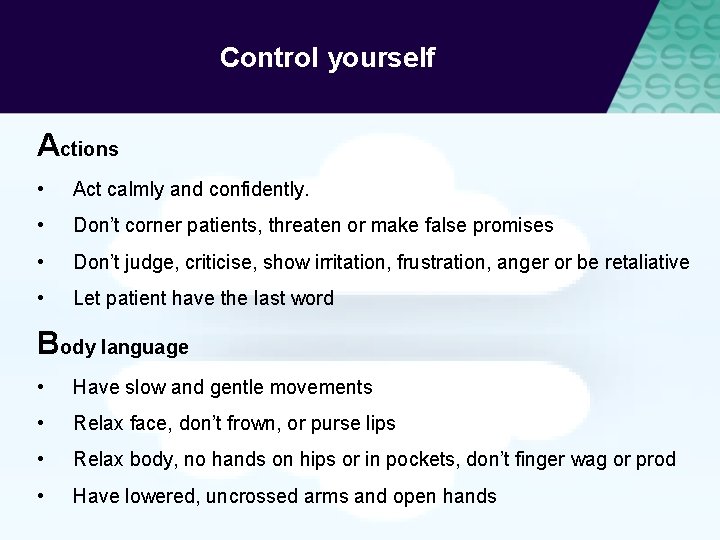
Control yourself Actions • Act calmly and confidently. • Don’t corner patients, threaten or make false promises • Don’t judge, criticise, show irritation, frustration, anger or be retaliative • Let patient have the last word Body language • Have slow and gentle movements • Relax face, don’t frown, or purse lips • Relax body, no hands on hips or in pockets, don’t finger wag or prod • Have lowered, uncrossed arms and open hands
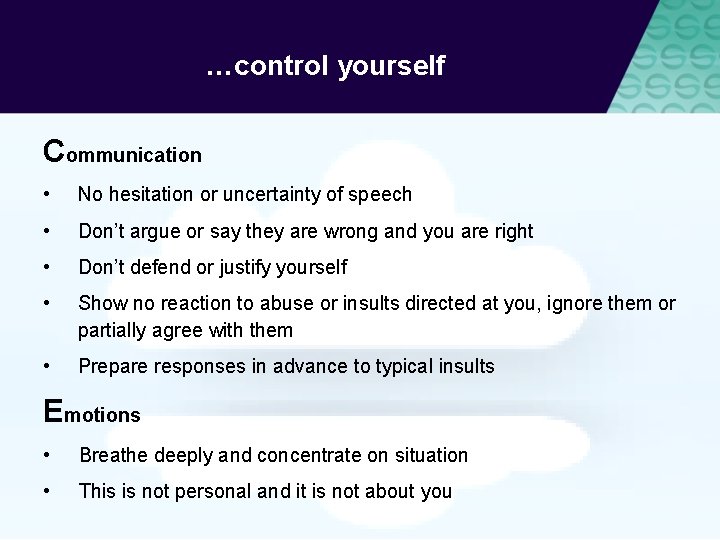
…control yourself Communication • No hesitation or uncertainty of speech • Don’t argue or say they are wrong and you are right • Don’t defend or justify yourself • Show no reaction to abuse or insults directed at you, ignore them or partially agree with them • Prepare responses in advance to typical insults Emotions • Breathe deeply and concentrate on situation • This is not personal and it is not about you
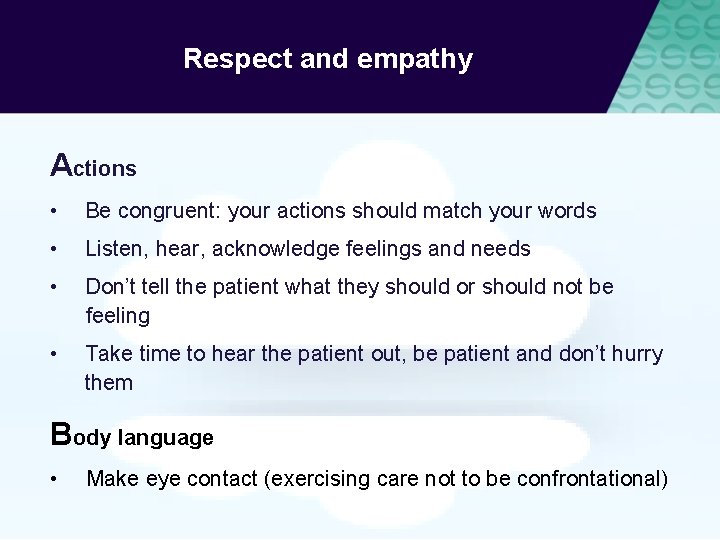
Respect and empathy Actions • Be congruent: your actions should match your words • Listen, hear, acknowledge feelings and needs • Don’t tell the patient what they should or should not be feeling • Take time to hear the patient out, be patient and don’t hurry them Body language • Make eye contact (exercising care not to be confrontational)
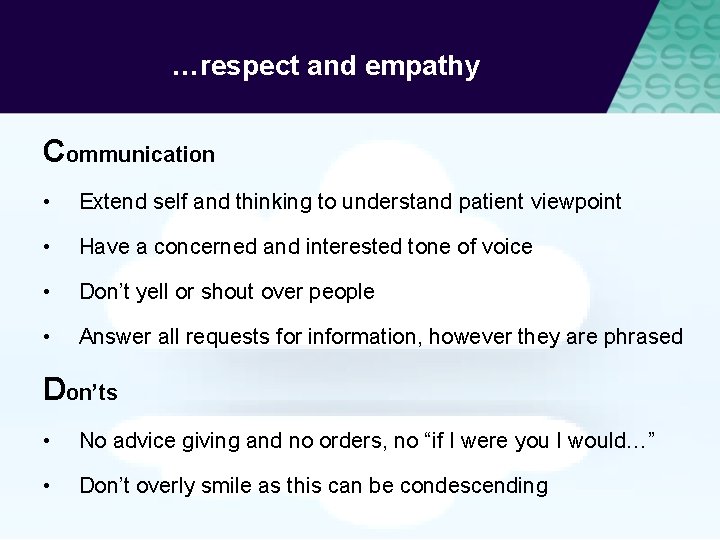
…respect and empathy Communication • Extend self and thinking to understand patient viewpoint • Have a concerned and interested tone of voice • Don’t yell or shout over people • Answer all requests for information, however they are phrased Don’ts • No advice giving and no orders, no “if I were you I would…” • Don’t overly smile as this can be condescending
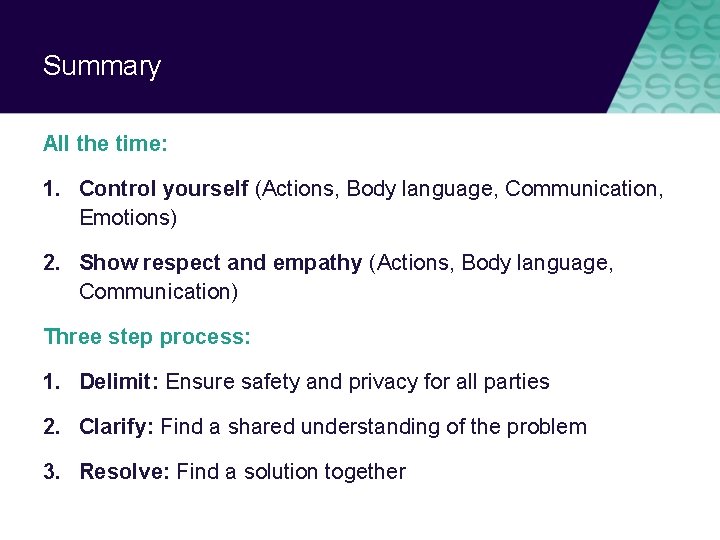
Summary All the time: 1. Control yourself (Actions, Body language, Communication, Emotions) 2. Show respect and empathy (Actions, Body language, Communication) Three step process: 1. Delimit: Ensure safety and privacy for all parties 2. Clarify: Find a shared understanding of the problem 3. Resolve: Find a solution together
Talk Down in practice Video by Chris Hart, Youtube https: //youtu. be/Q 4 T-x 1 za 6 lg
Talk down in practice • A poster summarising de-escalation techniques is placed in an area frequented by staff • The unit decides on the ‘talk down’ lead • The lead spends 10 -15 minutes with other members of the team explaining the poster and giving examples from their experience • The lead gives each staff member a copy of Talk Down ‘Staying open, friendly and positive handout’ • The lead invites staff to read the poster, ask questions and use it to reflect after the process is used
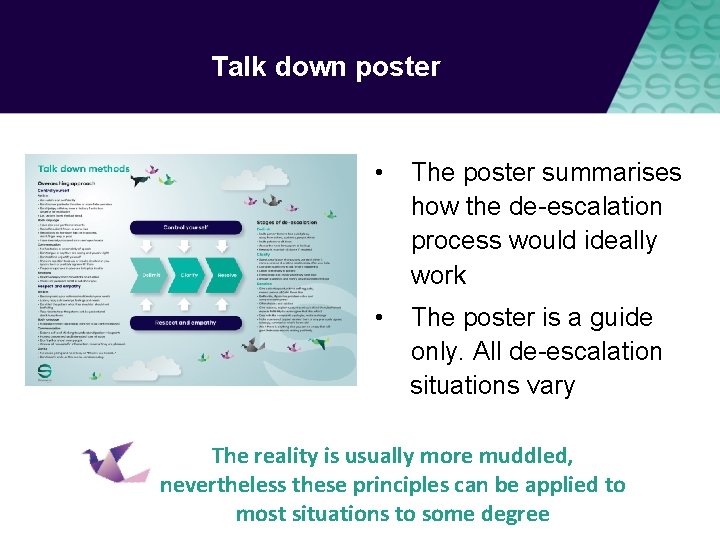
Talk down poster • The poster summarises how the de-escalation process would ideally work • The poster is a guide only. All de-escalation situations vary The reality is usually more muddled, nevertheless these principles can be applied to most situations to some degree
Role of the intervention lead – promote talk down • Highlight to the team when talk down methods are used effectively • Mention talk down in handovers or other team meetings • Express respect for use of talk down methods • Acknowledge the growing skill of the team • Consider using the poster when debriefing following an incident - not only recognising the skills that were used but also those that were not and discussing opportunities for improvement
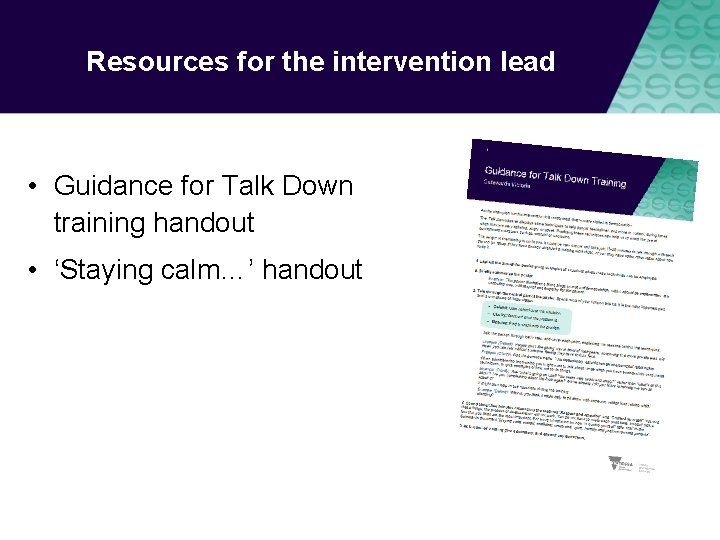
Resources for the intervention lead • Guidance for Talk Down training handout • ‘Staying calm…’ handout
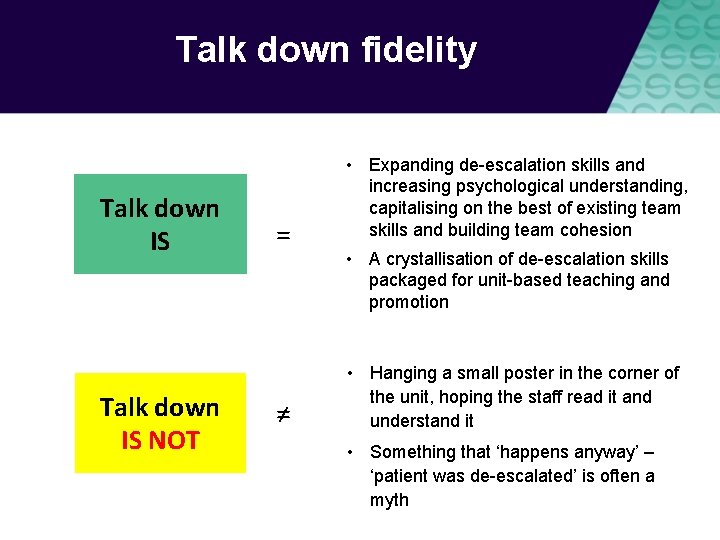
Talk down fidelity Talk down IS NOT = ≠ • Expanding de-escalation skills and increasing psychological understanding, capitalising on the best of existing team skills and building team cohesion • A crystallisation of de-escalation skills packaged for unit-based teaching and promotion • Hanging a small poster in the corner of the unit, hoping the staff read it and understand it • Something that ‘happens anyway’ – ‘patient was de-escalated’ is often a myth
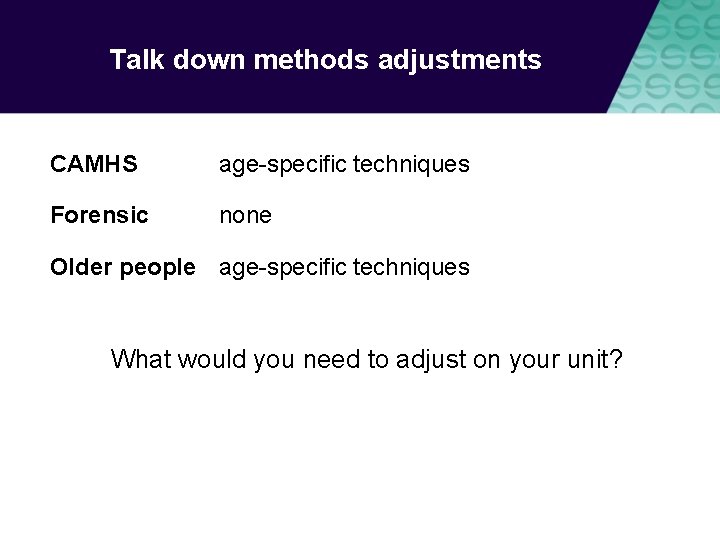
Talk down methods adjustments CAMHS age-specific techniques Forensic none Older people age-specific techniques What would you need to adjust on your unit?