
Safewards Reassurance Refresher Explanationinformation Role modelling Patient education
- Slides: 20
Safewards Reassurance Refresher
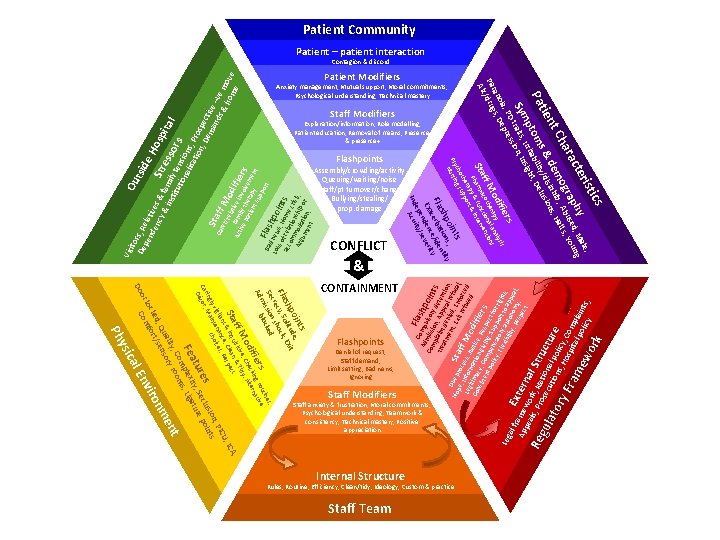
Explanation/information, Role modelling, Patient education, Removal of means, Presence & presence+ Staff Modifiers Denial of request, Staff demand, Limit setting, Bad news, Ignoring Flashpoints Staff anxiety & frustration, Moral commitments, Psychological understanding, Teamwork & consistency, Technical mastery, Positive appreciation Staff Modifiers A, , IC Rules, Routine, Efficiency, Clean/tidy, Ideology, Custom & practice Internal Structure Staff Team ics s s, ne c ti blo rs g rou tive ifie ckin erna od e, Che dy, Alt ff M isitiv & Ti Sta & inqu, Clean spect t oin de, shp litu Exit Fla ecy, Soshock, r Sec ission ked m Ad CONTAINMENT ork Anxiety management, Mutual support, Moral commitments, Psychological understanding, Technical mastery rist hy , Male, g cte p ed un ara ogra. , Abusall. s, Yo Ch em nhib s, H nt & d y/disi lusion tie Pa ptomsritabiliitght, De , Ir ns Symtraits sion, I s rs , PD re oia s, Dep an Par /drug Alc Patient Modifiers al f E r Ap ame xter pe wo n Re als, Prork, Natal Stru gul io s ato ecutionnal polcture ic s, ry Fra Hospitya, Comp la lp me w olicy ints, & sis ifie od erapy al analyns ff M coth ction entio Sta. Pharmya & fun& interv rap ort the upp cho g s ts Psy ursin N or al E sic t U Re ce ilan enan ices, PIC vig t n, cho gly Main sio nts rin Ca cor, es eclu poi Dé tur ity, S ture Fea plex , Liga om ooms , C t lity ory r en ua s , Q sen nm ked rt/ iro loc omfo nv C Do y Ph Leg Flashpoints Assembly/crowding/activity Queuing/waiting/noise Staff/pt turnover/change Bullying/stealing/ prop. damage oin s; y shp tion ntit Fla rba ide e c ce/ ty Exa nden everi s e ep ity/ Ind Acu CONFLICT C Fla Ad omp shp uls m o Co mp ission ory d ints l a tre int , App eten atm de ti e en nied al ref on, D t, E , En usa Ho ue p S t x pe l a it r f f , roc efu orce , Leg Infor ess, J f M sed d m o u Co itima atio stice dif nsi cy, n g , R ier ste e i nt Comp ving, spec s po licy ensa Supp t for , Fl tor ort righ exi y a bili uto to ap ts, p ty, n Re omy eal, spe , ct ie ctiv mil in e p y th volv rs ati era em en en t su py t pp F o l r Ba a t d n sh Los ew po s o s, H in acc f rela ome ts om tio cri Arg mod nship sis, um atio or en n, t Ou ito tsid De rs, Re pe e. H nd lative en osp cy s & f Str & i am ita e s nst i l itu ly ten sors tio na sions lisa tio , Pros n, De pecti ma ve Sta nd –ve Ca s& rer ff M /re ho move lat od me i F ve if a A Vis Patient Community Patient – patient interaction Contagion & discord
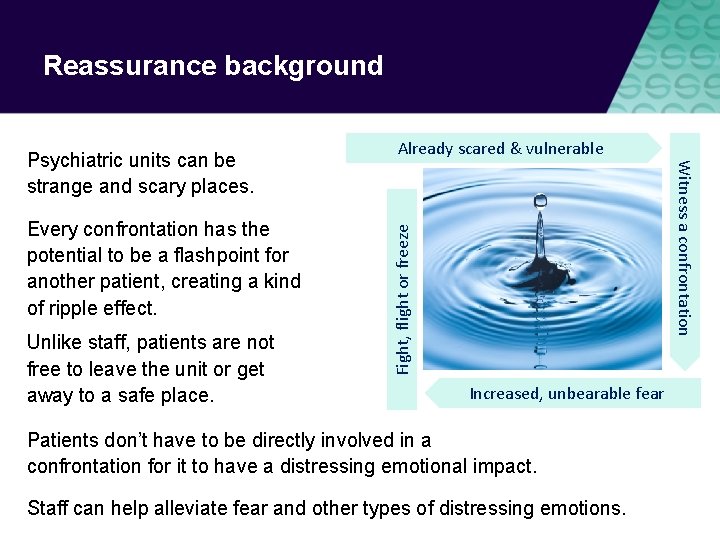
Reassurance background Unlike staff, patients are not free to leave the unit or get away to a safe place. Fight, flight or freeze Every confrontation has the potential to be a flashpoint for another patient, creating a kind of ripple effect. Already scared & vulnerable Witness a confrontation Psychiatric units can be strange and scary places. Increased, unbearable fear Patients don’t have to be directly involved in a confrontation for it to have a distressing emotional impact. Staff can help alleviate fear and other types of distressing emotions.
Reassurance aims To proactively reassure every patient after every confrontation, incident or conflict on the unit To reduce the potential ripple effect of conflict on the unit To prevent or reduce the impact of flashpoints To ensure patients feel safe and supported Reassuranc e for patients is a bit like debriefing fo r staff
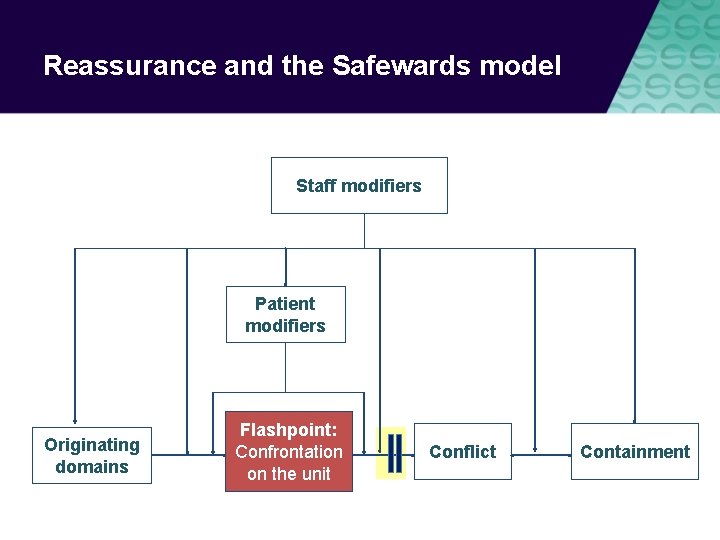
Reassurance and the Safewards model Staff modifiers Patient modifiers Originating domains Flashpoint: Flashpoints Confrontation on the unit Conflict Containment
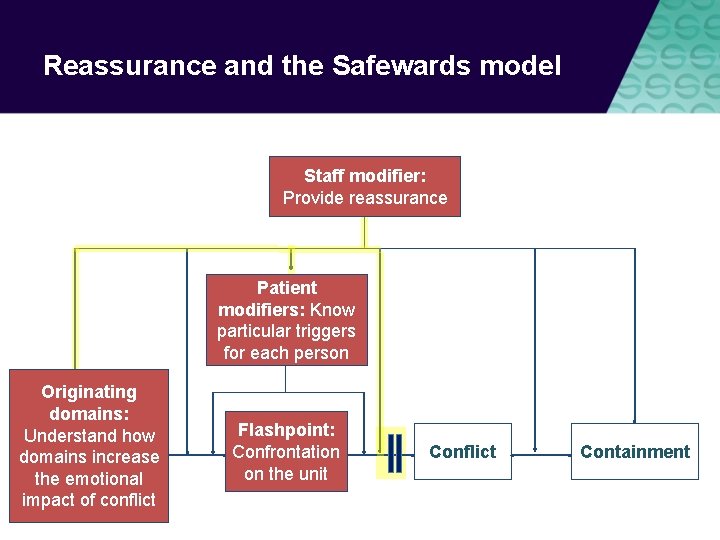
Reassurance and the Safewards model Staff modifier: Staff modifiers Provide reassurance Patient. Know modifiers: modifiers particular triggers for each person Originating domains: Understand how Originating domains increase domains the emotional impact of conflict Flashpoint: Flashpoints Confrontation on the unit Conflict Containment
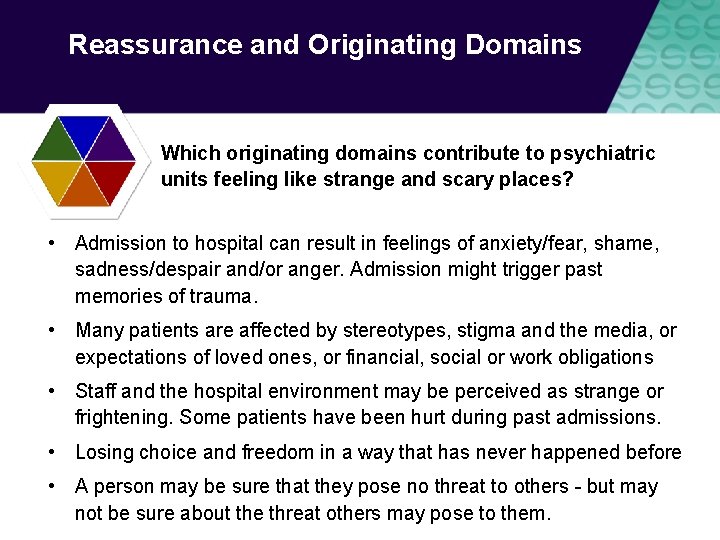
Reassurance and Originating Domains Which originating domains contribute to psychiatric units feeling like strange and scary places? • Admission to hospital can result in feelings of anxiety/fear, shame, sadness/despair and/or anger. Admission might trigger past memories of trauma. • Many patients are affected by stereotypes, stigma and the media, or expectations of loved ones, or financial, social or work obligations • Staff and the hospital environment may be perceived as strange or frightening. Some patients have been hurt during past admissions. • Losing choice and freedom in a way that has never happened before • A person may be sure that they pose no threat to others - but may not be sure about the threat others may pose to them.
What other common occurrences on a mental health unit might increase patient fear?
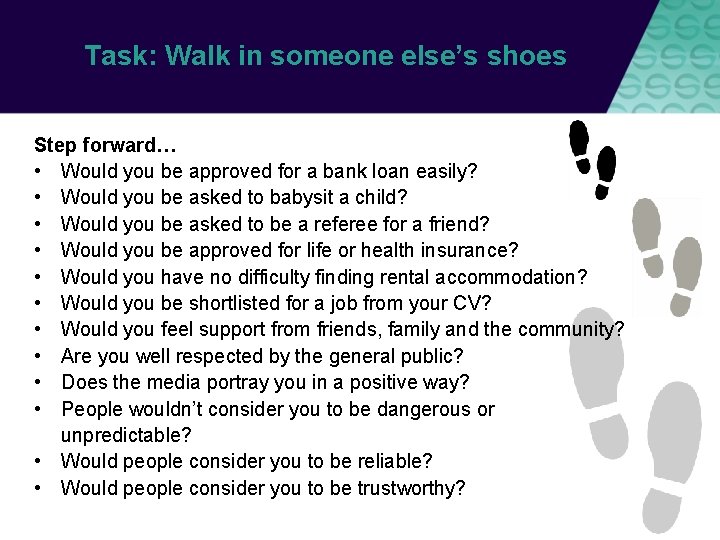
Task: Walk in someone else’s shoes Step forward… • Would you be approved for a bank loan easily? • Would you be asked to babysit a child? • Would you be asked to be a referee for a friend? • Would you be approved for life or health insurance? • Would you have no difficulty finding rental accommodation? • Would you be shortlisted for a job from your CV? • Would you feel support from friends, family and the community? • Are you well respected by the general public? • Does the media portray you in a positive way? • People wouldn’t consider you to be dangerous or unpredictable? • Would people consider you to be reliable? • Would people consider you to be trustworthy?
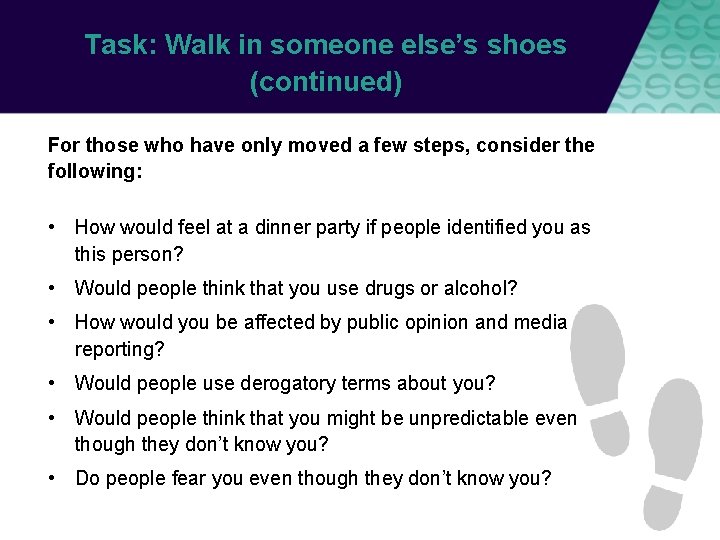
Task: Walk in someone else’s shoes (continued) For those who have only moved a few steps, consider the following: • How would feel at a dinner party if people identified you as this person? • Would people think that you use drugs or alcohol? • How would you be affected by public opinion and media reporting? • Would people use derogatory terms about you? • Would people think that you might be unpredictable even though they don’t know you? • Do people fear you even though they don’t know you?
Task discussion This activity was a chance to think more deeply about stigma as an ‘outside hospital’ originating domain. • How could stigma impact patients’ emotions during an admission? • Why do you think we included this activity in the reassurance intervention?
Reassurance in practice Common situations requiring reassurance Loud shouting/property damage/aggression: May provoke fear that could lead to defensive aggression, absconding, withdrawal and disengagement, suicidality Self-harm - May provoke similar acts, can be distressing, provoke anger, shame or fear of one’s own internal impulses Intoxication – May provoke fear about unpredictable behavior and personal safety Show of staff force – (such as transferring a patient to high dependency area) Can undermine patient confidence in staff, make people feel vulnerable or bullied, provoke anger, fear or other distressing emotions, may trigger re-traumatization / flashbacks, panic, self-harm, suicidality
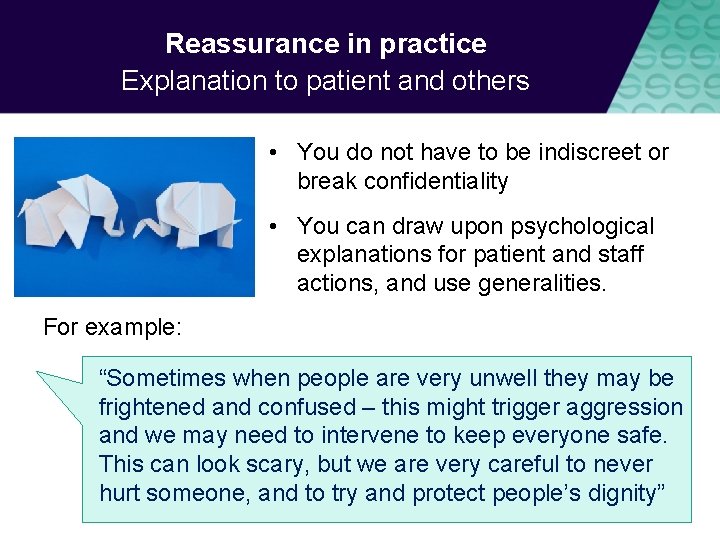
Reassurance in practice Explanation to patient and others • You do not have to be indiscreet or break confidentiality • You can draw upon psychological explanations for patient and staff actions, and use generalities. For example: “Sometimes when people are very unwell they may be frightened and confused – this might trigger aggression and we may need to intervene to keep everyone safe. This can look scary, but we are very careful to never hurt someone, and to try and protect people’s dignity”
Reassurance in practice: Empathy is a critical staff skill Brené Brown on Empathy (Youtube video) https: //youtube/1 Evwgu 369 Jw
Reassurance in practice: Empathy is a critical staff skill Empathy fuels connection, sympathy drives disconnection. Key qualities of empathy: • • Perspective taking Staying out of judgement Recognising emotion in other people Communicating that Empathy is feeling ‘with’ people. Brené Brown on Empathy (Youtube video) https: //youtube/1 Evwgu 369 Jw • Empathy can make us feel vulnerable because it means having to connect with something in yourself that knows that feeling. Empathy means not trying to make things better. • Responses rarely make something better. • Connection with others can help people feel better
Intervention strategies Intervention lead • Consider speaking to the nurse in charge of the shift (or as a group, such as at staff meetings) and request a method is identified for ensuring the following two points are identified: – Ensure reassurance action takes place following any incident. – When an incident is mentioned at handover, ask if 'reassurance' took place.
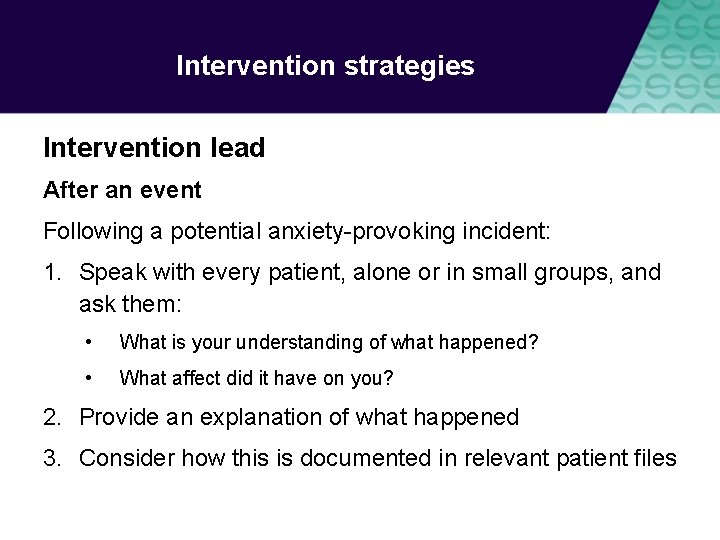
Intervention strategies Intervention lead After an event Following a potential anxiety-provoking incident: 1. Speak with every patient, alone or in small groups, and ask them: • What is your understanding of what happened? • What affect did it have on you? 2. Provide an explanation of what happened 3. Consider how this is documented in relevant patient files
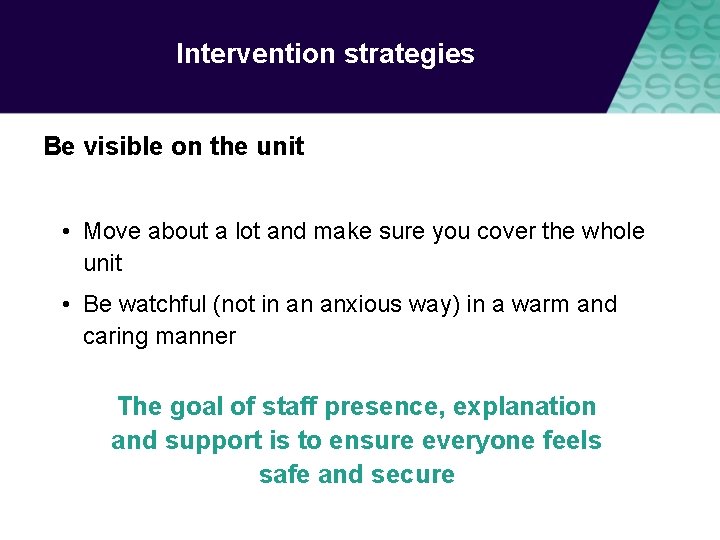
Intervention strategies Be visible on the unit • Move about a lot and make sure you cover the whole unit • Be watchful (not in an anxious way) in a warm and caring manner The goal of staff presence, explanation and support is to ensure everyone feels safe and secure
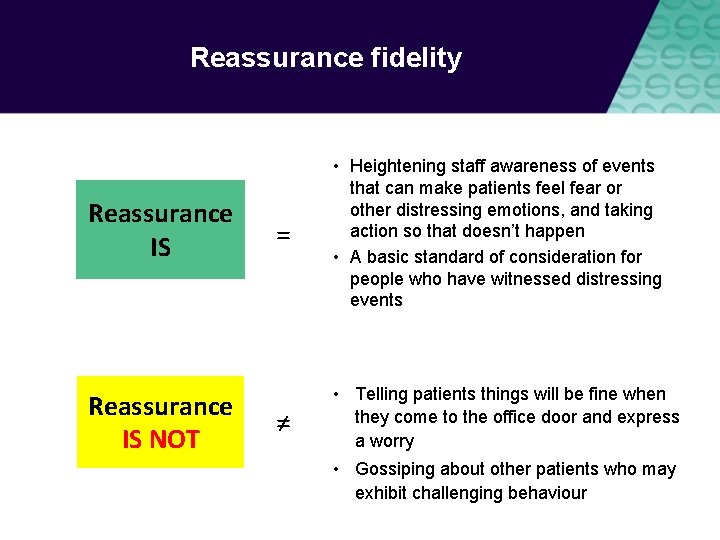
Reassurance fidelity Reassurance IS NOT = • Heightening staff awareness of events that can make patients feel fear or other distressing emotions, and taking action so that doesn’t happen • A basic standard of consideration for people who have witnessed distressing events ≠ • Telling patients things will be fine when they come to the office door and express a worry • Gossiping about other patients who may exhibit challenging behaviour
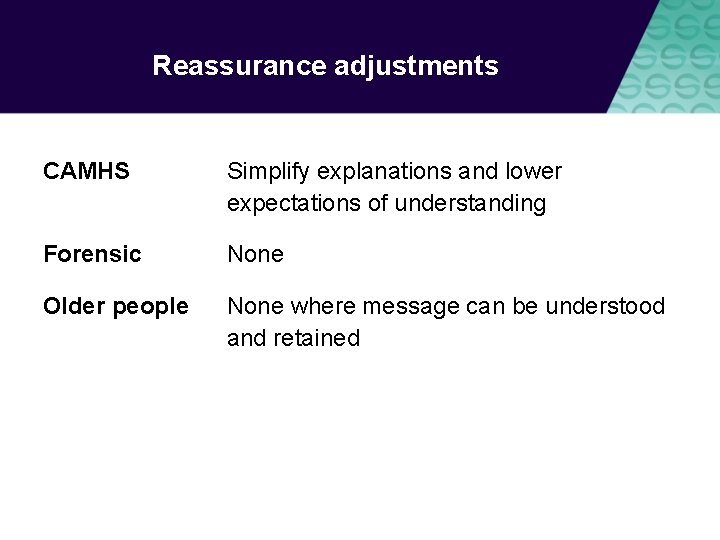
Reassurance adjustments CAMHS Simplify explanations and lower expectations of understanding Forensic None Older people None where message can be understood and retained