
Safewards Mutual Help Meeting Refresher Explanationinformation Role modelling
- Slides: 14
Safewards Mutual Help Meeting Refresher
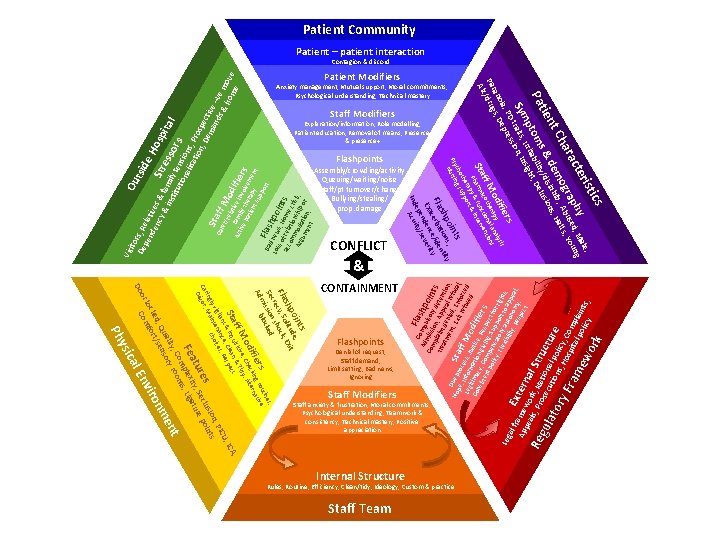
Explanation/information, Role modelling, Patient education, Removal of means, Presence & presence+ Staff Modifiers Denial of request, Staff demand, Limit setting, Bad news, Ignoring Flashpoints Staff anxiety & frustration, Moral commitments, Psychological understanding, Teamwork & consistency, Technical mastery, Positive appreciation Staff Modifiers A, , IC Rules, Routine, Efficiency, Clean/tidy, Ideology, Custom & practice Internal Structure Staff Team ics s s, ne c ti blo rs g rou tive ifie ckin erna od e, Che dy, Alt ff M isitiv & Ti Sta & inqu, Clean spect t oin de, shp litu Exit Fla ecy, Soshock, r Sec ission ked m Ad CONTAINMENT ork Anxiety management, Mutual support, Moral commitments, Psychological understanding, Technical mastery rist hy , Male, g cte p ed un ara ogra. , Abusall. s, Yo Ch em nhib s, H nt & d y/disi lusion tie Pa ptomsritabiliitght, De , Ir ns Symtraits sion, I s rs , PD re oia s, Dep an Par /drug Alc Patient Modifiers al f E r Ap ame xter pe wo n Re als, Prork, Natal Stru gul io s ato ecutionnal polcture ic s, ry Fra Hospitya, Comp la lp me w olicy ints, & sis ifie od erapy al analyns ff M coth ction entio Sta. Pharmya & fun& interv rap ort the upp cho g s ts Psy ursin N or al E sic t U Re ce ilan enan ices, PIC vig t n, cho gly Main sio nts rin Ca cor, es eclu poi Dé tur ity, S ture Fea plex , Liga om ooms , C t lity ory r en ua s , Q sen nm ked rt/ iro loc omfo nv C Do y Ph Leg Flashpoints Assembly/crowding/activity Queuing/waiting/noise Staff/pt turnover/change Bullying/stealing/ prop. damage oin s; y shp tion ntit Fla rba ide e c ce/ ty Exa nden everi s e ep ity/ Ind Acu CONFLICT C Fla Ad omp shp uls m o Co mp ission ory d ints l a tre int , App eten atm de ti e en nied al ref on, D t, E , En usa Ho ue p S t x pe l a it r f f , roc efu orce , Leg Infor ess, J f M sed d m o u Co itima atio stice dif nsi cy, n g , R ier ste e i nt Comp ving, spec s po licy ensa Supp t for , Fl tor ort righ exi y a bili uto to ap ts, p ty, n Re omy eal, spe , ct ie ctiv mil in e p y th volv rs ati era em en en t su py t pp F o l r Ba a t d n sh Los ew po s o s, H in acc f rela ome ts om tio cri Arg mod nship sis, um atio or en n, t Ou ito tsid De rs, Re pe e. H nd lative en osp cy s & f Str & i am ita e s nst i l itu ly ten sors tio na sions lisa tio , Pros n, De pecti ma ve Sta nd –ve Ca s& rer ff M /re ho move lat od me i F ve if a A Vis Patient Community Patient – patient interaction Contagion & discord
Background • The unit is a social community and potentially a powerful engine to help patients, have a positive influence, and progress towards discharge. • The help that patients give each other can be highly valued and effective. • The giving of help and support between patients offers the giver: ‒ a socially valued role ‒ the chance to make a meaningful contribution ‒ the potential to improve their self-esteem
Aims • Strengthen an existing mechanism that is highly valued by patients and staff • Create opportunities for patients to find valued roles and public recognition • Build patient self-esteem • Increase mutual support and promote recovery • Establish values, understanding and social connection
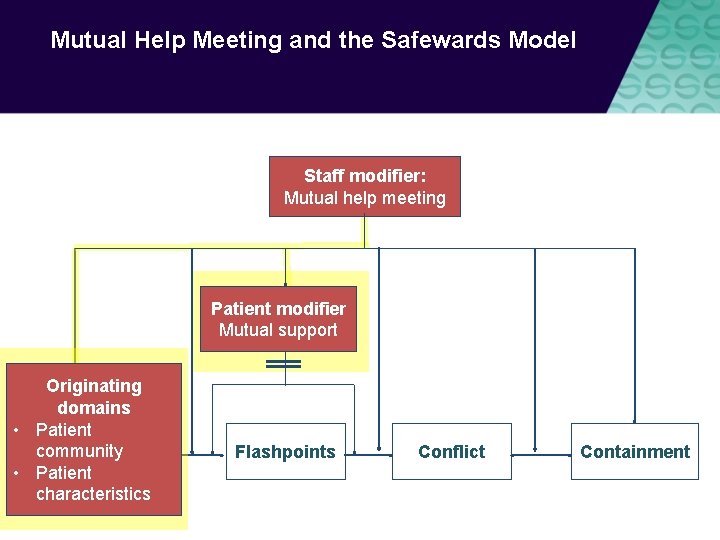
Mutual Help Meeting and the Safewards Model Staff modifier: Staff modifiers Mutual help meeting Patient modifiers Mutual support Originating domains • Patient Originating community domains • Patient characteristics Flashpoints Conflict Containment
Task: Invaluable mutual support Think of an example where patient-to-patient mutual support has been invaluable on your unit…
Conflict Inpatient aggression can arise from many different factors. This intervention focuses on preventing conflict that may arise from patient-to-patient interactions, or from being in a strange and/or frightening environment. Conflict can be reduced if patients: • Positively appreciate each other • Practice/learn ways regulate their own emotional reactions • Support each other to uphold shared expectations • Feel heard and valued • Have access to mutual support
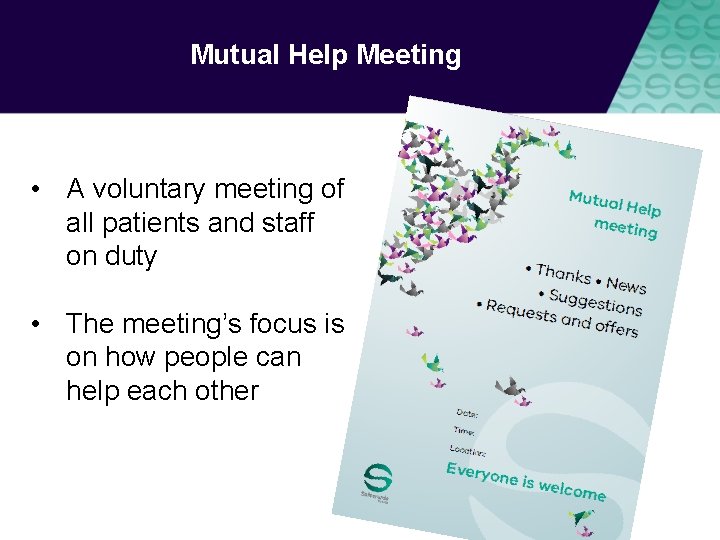
Mutual Help Meeting • A voluntary meeting of all patients and staff on duty • The meeting’s focus is on how people can help each other
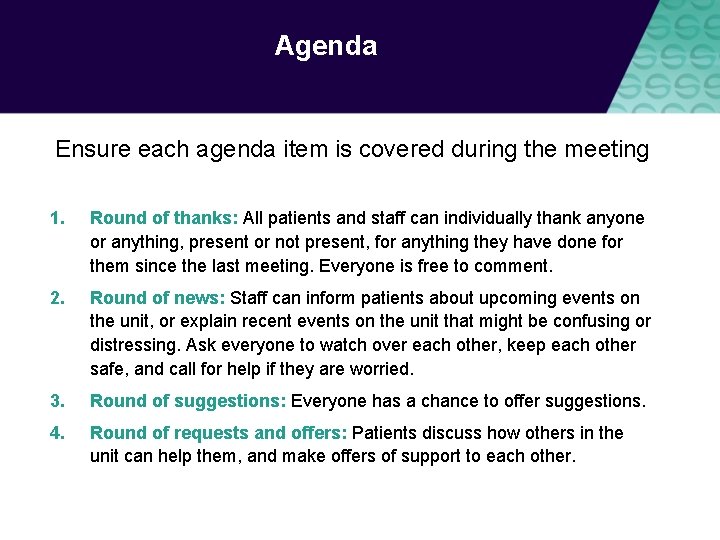
Agenda Ensure each agenda item is covered during the meeting 1. Round of thanks: All patients and staff can individually thank anyone or anything, present or not present, for anything they have done for them since the last meeting. Everyone is free to comment. 2. Round of news: Staff can inform patients about upcoming events on the unit, or explain recent events on the unit that might be confusing or distressing. Ask everyone to watch over each other, keep each other safe, and call for help if they are worried. 3. Round of suggestions: Everyone has a chance to offer suggestions. 4. Round of requests and offers: Patients discuss how others in the unit can help them, and make offers of support to each other.
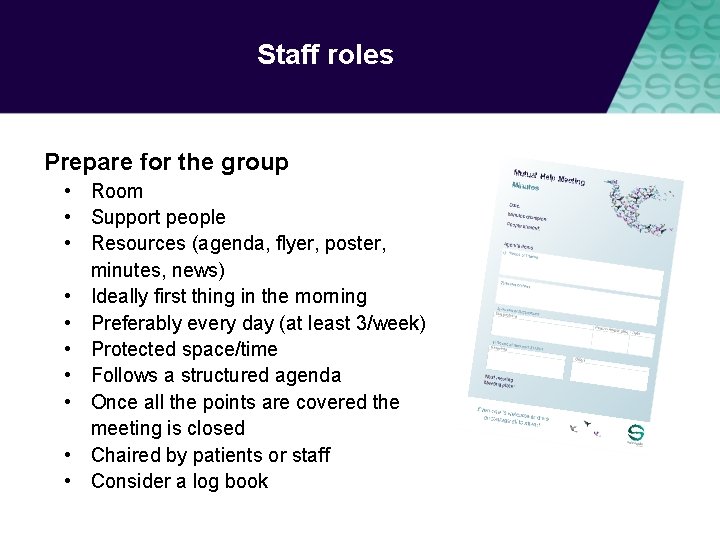
Staff roles Prepare for the group • Room • Support people • Resources (agenda, flyer, poster, minutes, news) • Ideally first thing in the morning • Preferably every day (at least 3/week) • Protected space/time • Follows a structured agenda • Once all the points are covered the meeting is closed • Chaired by patients or staff • Consider a log book
Staff roles Maintaining the meeting • • Encourage good contributions through positive feedback. Model mutual respect. Enable everyone to contribute. Seek information and opinions and provide information. Clarify and summarise for others. Suggest compromises and settlements. Offer advice on expression of mutual respect and positive appreciation • Accurately describe any recent potentially distressing events on the unit (reassurance).
What to expect • Attendance will grow if the meeting is held regularly and is talked about. • Even with only a few people the meeting can be productive. • Attendees can consider how they can help others who aren't attending. • Small things can be important to people.
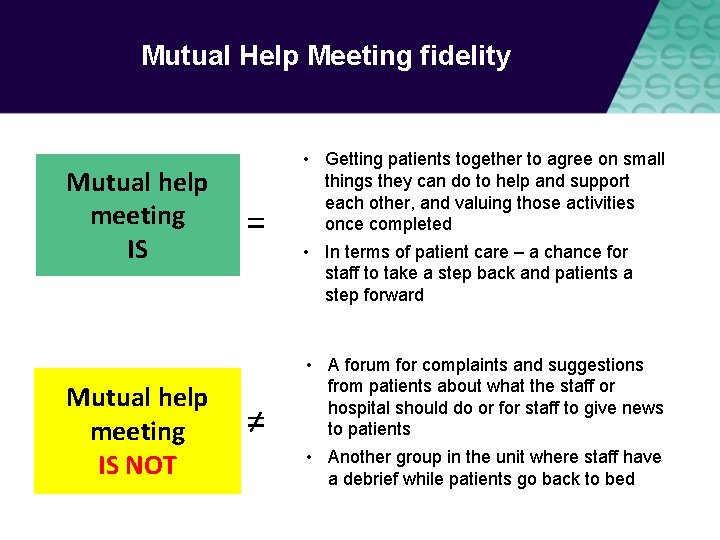
Mutual Help Meeting fidelity Mutual help meeting IS NOT = • Getting patients together to agree on small things they can do to help and support each other, and valuing those activities once completed • In terms of patient care – a chance for staff to take a step back and patients a step forward ≠ • A forum for complaints and suggestions from patients about what the staff or hospital should do or for staff to give news to patients • Another group in the unit where staff have a debrief while patients go back to bed
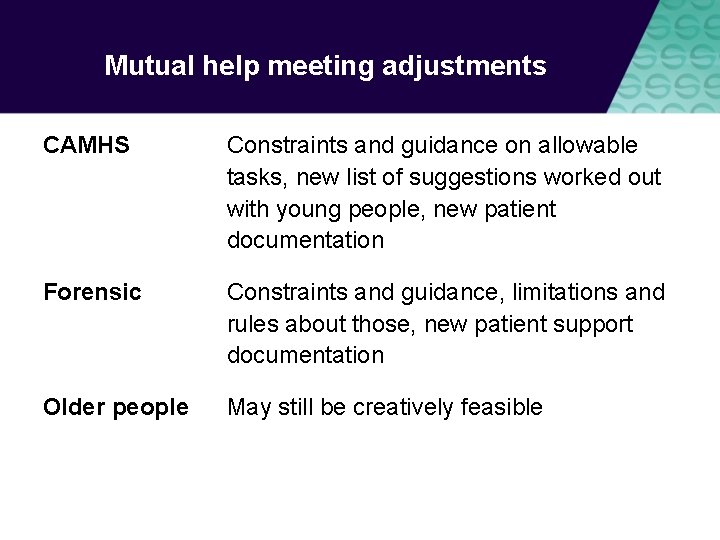
Mutual help meeting adjustments CAMHS Constraints and guidance on allowable tasks, new list of suggestions worked out with young people, new patient documentation Forensic Constraints and guidance, limitations and rules about those, new patient support documentation Older people May still be creatively feasible