
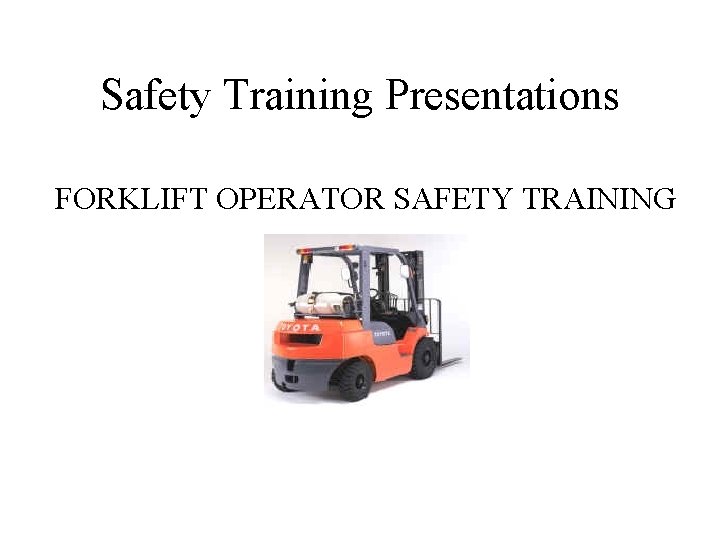
Safety Training Presentations FORKLIFT OPERATOR SAFETY TRAINING 2
- Slides: 31
Safety Training Presentations FORKLIFT OPERATOR SAFETY TRAINING
2
Forklift Operator Training • Who needs forklift training? – Anyone who operates a forklift • Who must conduct the training? – A knowledgeable trainer • Why is training necessary? – Forklifts pose many hazards • Approx. 100 deaths and 38, 000 injuries/year • Most Common accidents: – Tip over – Struck by lift or struck by load 3
Forklift Safety Hazards • Forklifts are very heavy – Average automobile - 1, 000 - 2, 000 lbs. – Average forklift - 4, 000 - 8, 000 lbs. • Loads can be heavy – Too heavy to lift by hand • Forklifts or their loads can be unstable – Forklifts can roll over easily – Loads can fall off forks or cause roll over 4
Pre-Use Inspections • Inspect forklift before each use – Don’t know condition left in by last user – Not inspecting the forklift prior to use could lead to a hazardous situation or cause serious damage to the forklift and/or the load 5
Pre-Use Checklist • • Brakes Steering Horn Lights Oil Coolant Battery/LP Tank Hoist • • Forks Engine/Drive Motor Tires Misc. – Cage – Seat belt – General overall condition of the forklift 6
Pre-Use Inspection - Lift Mechanisms • Inspect mast for damage – Broken or cracked weld point • Make sure roller tracks are greased and free to travel • Inspect forks – Cracks on ends, along blades or at heels – Make sure not bent • Check hydraulic lines and fluid levels 7
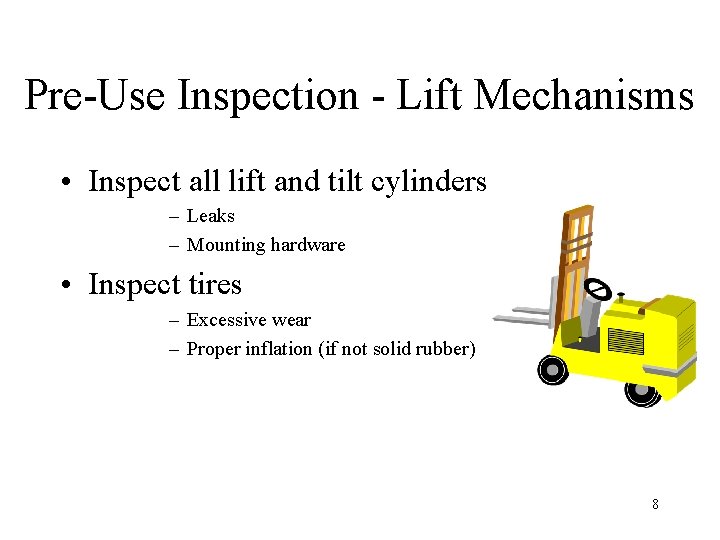
Pre-Use Inspection - Lift Mechanisms • Inspect all lift and tilt cylinders – Leaks – Mounting hardware • Inspect tires – Excessive wear – Proper inflation (if not solid rubber) 8
Propane Tank Inspection • Inspect cylinder for damage • Cracks and broken weld points • Inspect • Valves, nozzles and hoses • Be aware of flammability • Three ways to detect leaks • listen for gas escaping • smell odor • look for frost on the coupling 9
Changing Propane Tanks • No smoking! • Shut off cylinder valve before turning off forklift to reduce pressure in the fuel line – Liquid propane is approx. -40 degrees • Wear heavy duty rubber gloves • Wear safety glasses • Make sure pressure relief valve points straight up when replacing the tank 10
Battery Charging • Inspect batteries for worn parts and cables • Beware of acid – No smoking – Wear faceshield, goggles, apron, rubber gloves – Only add water after charging • Make sure charger is off before disconnecting the battery • Remove all jewelry • Use hoist or roller system when replacing 11
Capacity Plates • Must be on all forklifts – If missing or illegible, replace • Information found on capacity plates – Model # – Max load weight – Max lift height – Serial # – Manufacturer information 12
Starting the Forklift • • • Apply the foot brake Shift gears to neutral Turn the key Check gauges and indicators Check controls, steering and brakes for smooth operation 13
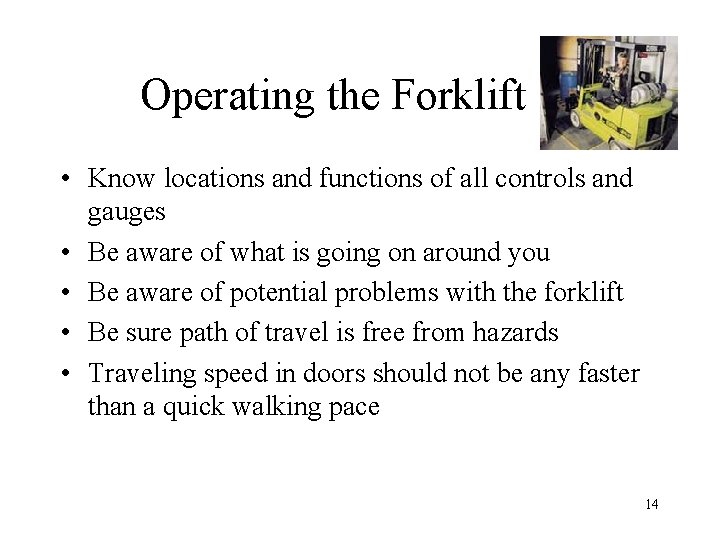
Operating the Forklift • Know locations and functions of all controls and gauges • Be aware of what is going on around you • Be aware of potential problems with the forklift • Be sure path of travel is free from hazards • Traveling speed in doors should not be any faster than a quick walking pace 14
Handling and Moving Loads • Check the Capacity Plate to be sure the forklift can handle the load • Check the load for weight and stability – If load is not marked • Contact distributor/shipper of the load • Lift the load 1 -2 inches to test the stability of the rear wheels and the forklift • If the forklift struggles, set the load down and if possible break load into smaller, more manageable loads 15
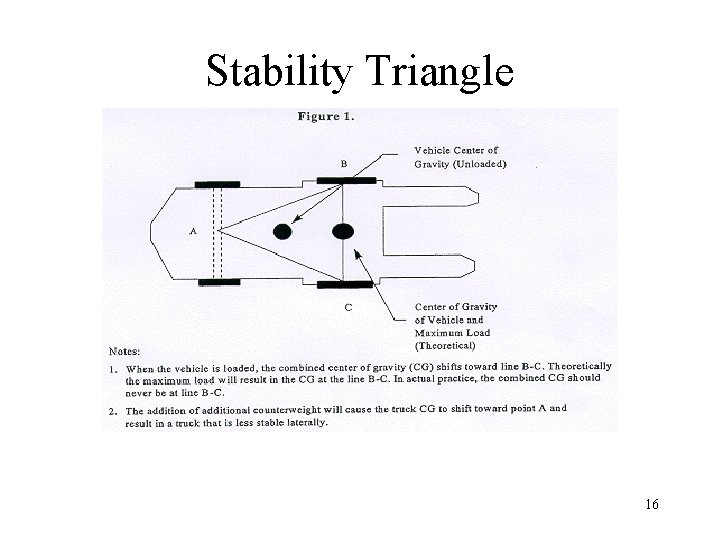
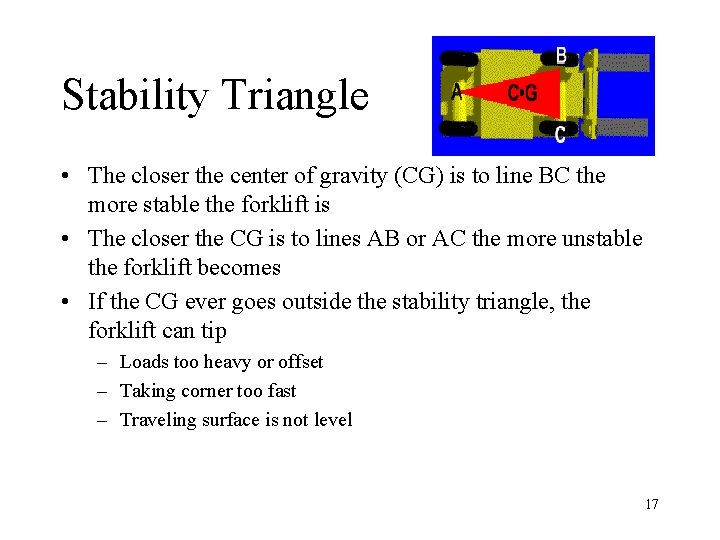
Stability Triangle 16
Stability Triangle • The closer the center of gravity (CG) is to line BC the more stable the forklift is • The closer the CG is to lines AB or AC the more unstable the forklift becomes • If the CG ever goes outside the stability triangle, the forklift can tip – Loads too heavy or offset – Taking corner too fast – Traveling surface is not level 17
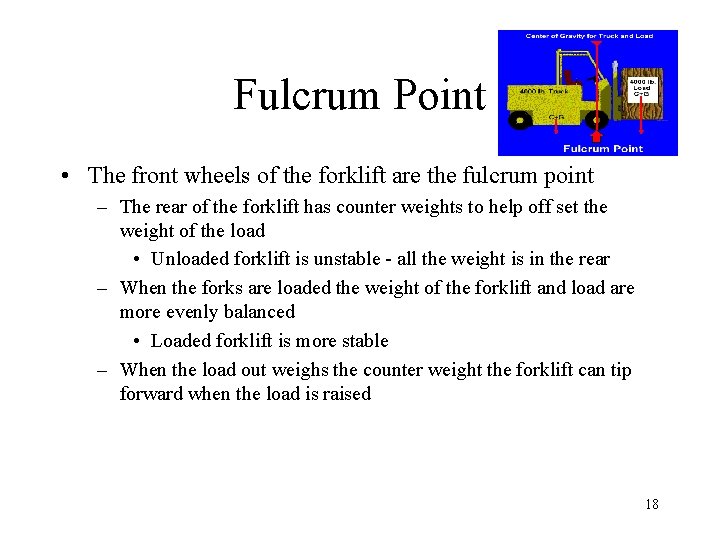
Fulcrum Point • The front wheels of the forklift are the fulcrum point – The rear of the forklift has counter weights to help off set the weight of the load • Unloaded forklift is unstable - all the weight is in the rear – When the forks are loaded the weight of the forklift and load are more evenly balanced • Loaded forklift is more stable – When the load out weighs the counter weight the forklift can tip forward when the load is raised 18
Tipping Forklift • What should you do? – Must be wearing seatbelt • Will keep you from falling out of caged area – Hold tightly to steering wheel with both hands • Keep hands and arms inside caged area – Plant feet flat on floor and press down • Keeps body stable and keeps legs in caged area – Lean in opposite direction 19
Handling and Moving Loads • Picking up load – Approach the load straight on with the forks in the travel position – Stop when the fork tips are approx. 1 foot away from the load – Level forks and drive slowly forward until load is against backrest – Lift the load high enough to clear what is under it 20
Handling and Moving Loads • Picking up load (cont. ) – Look over both shoulders to make sure you are clear and slowly back out one foot • Sound horn before backing if can’t clearly see behind you – Slowly tilt mast back to stabilize the load 21
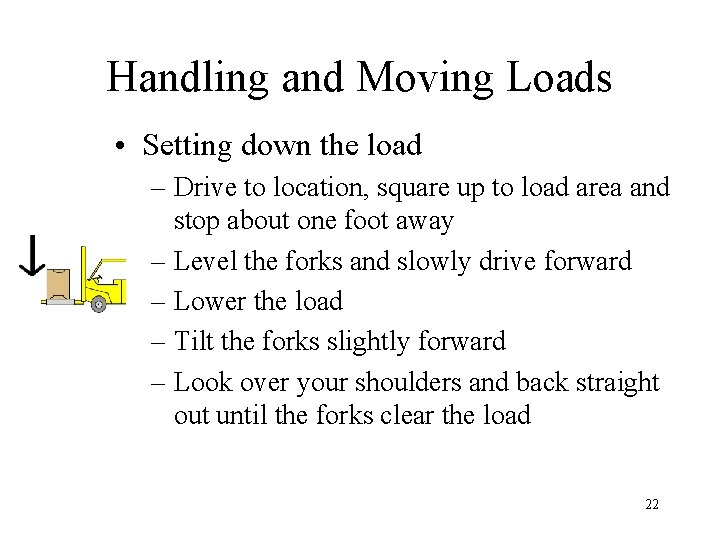
Handling and Moving Loads • Setting down the load – Drive to location, square up to load area and stop about one foot away – Level the forks and slowly drive forward – Lower the load – Tilt the forks slightly forward – Look over your shoulders and back straight out until the forks clear the load 22
Stacking and Unstacking • Lifting a load – Approach the load slowly with the forks in the travel position – Stop approx. one foot away from the load and raise forks to correct height – Level forks and drive forward until load is flush against backrest 23
Stacking and Unstacking • Lifting a load (Cont. ) – Lift high enough to clear the bottom load, look over both shoulders to see if clear to back and slowly back straight out – After clearing top of stack, stop and lower mast to travel position – Tilt forks back – Proceed to destination 24
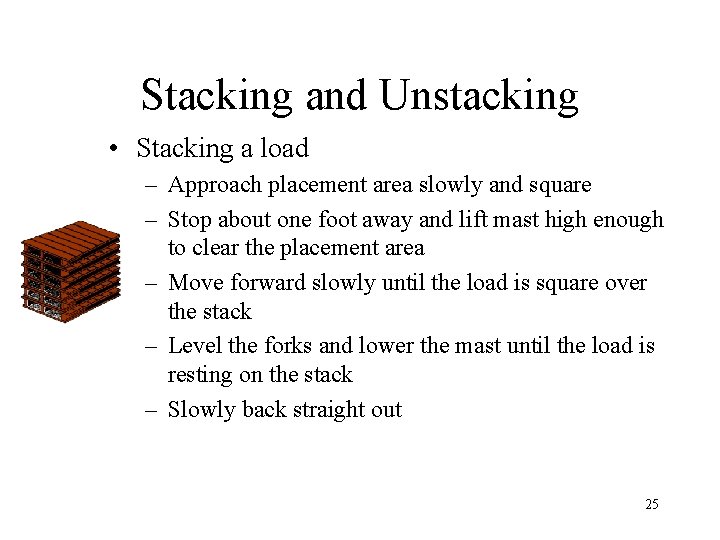
Stacking and Unstacking • Stacking a load – Approach placement area slowly and square – Stop about one foot away and lift mast high enough to clear the placement area – Move forward slowly until the load is square over the stack – Level the forks and lower the mast until the load is resting on the stack – Slowly back straight out 25
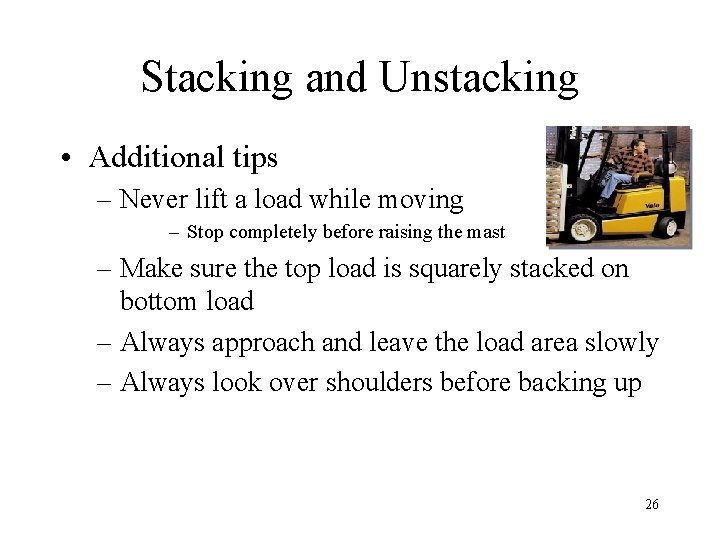
Stacking and Unstacking • Additional tips – Never lift a load while moving – Stop completely before raising the mast – Make sure the top load is squarely stacked on bottom load – Always approach and leave the load area slowly – Always look over shoulders before backing up 26
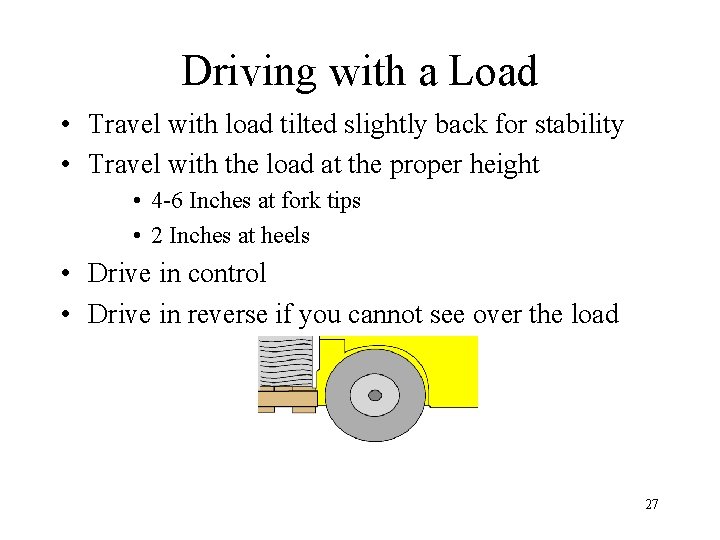
Driving with a Load • Travel with load tilted slightly back for stability • Travel with the load at the proper height • 4 -6 Inches at fork tips • 2 Inches at heels • Drive in control • Drive in reverse if you cannot see over the load 27
Driving on Inclines - Ramp/Slope • Always drive with the heavier or less stable end of the forklift pointing up the incline – If the forklift is loaded (heavier/less stable in front) • Drive forward up the incline with the load • Drive in reverse coming down the incline with the load pointed up the incline – If the forklift is not loaded (heavier in rear) • Drive forward down the ramp • Drive in reverse going up the ramp 28
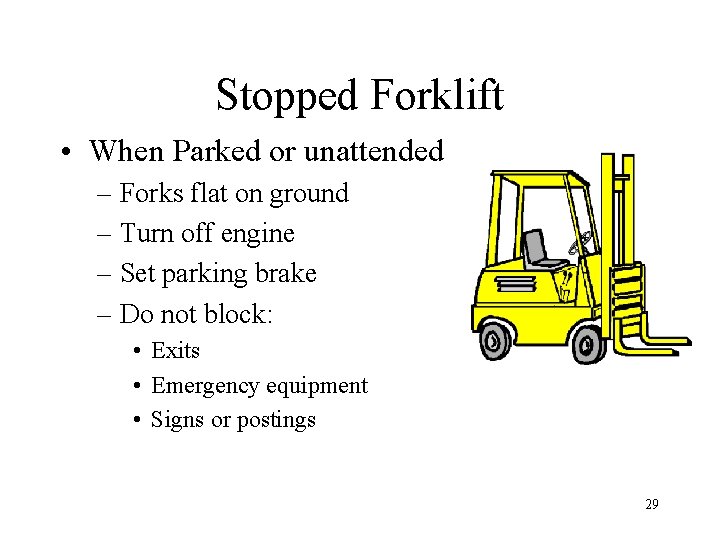
Stopped Forklift • When Parked or unattended – Forks flat on ground – Turn off engine – Set parking brake – Do not block: • Exits • Emergency equipment • Signs or postings 29
Pedestrians • Pedestrians have the right of way – Slow down at intersections – Look before backing – Use horn when coming around blind corners and at blind intersections – Check mirrors at intersections if they are present in workplace • Pedestrians must be cautious in areas where forklifts may be operating 30
Conclusion • Forklifts are more hazardous than most people usually perceive them to be • Pre-use inspections must be performed before each shift • It is important to understand how the load will affect the stability of the forklift • The operator must always be on the look out for hazards and pedestrians 31