
Safety Training Earthquake Overview Measures Against Earthquakes Fire
- Slides: 39
Safety Training üEarthquake Overview üMeasures Against Earthquakes üFire Basics üClasses of Fire üPortable Fire Extinguisher Overview üExtinguishing a Fire
EARTHQUAKE THINGS TO REMEMBER? 1. INEVITABLE 2. OCCURS ANYTIME OF THE DAY. 3. DOESN’T CHOOSE THE TIME AND PLACE OF OCCURRENCE. 4. SO, ALWAYS EXPECT IT.
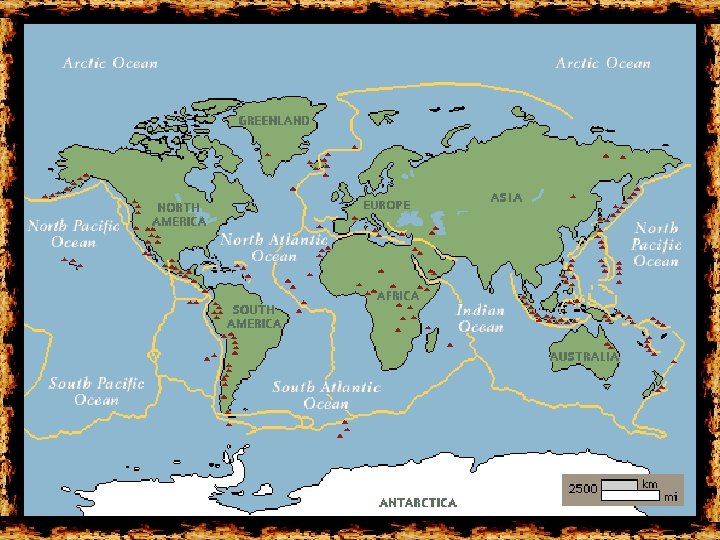
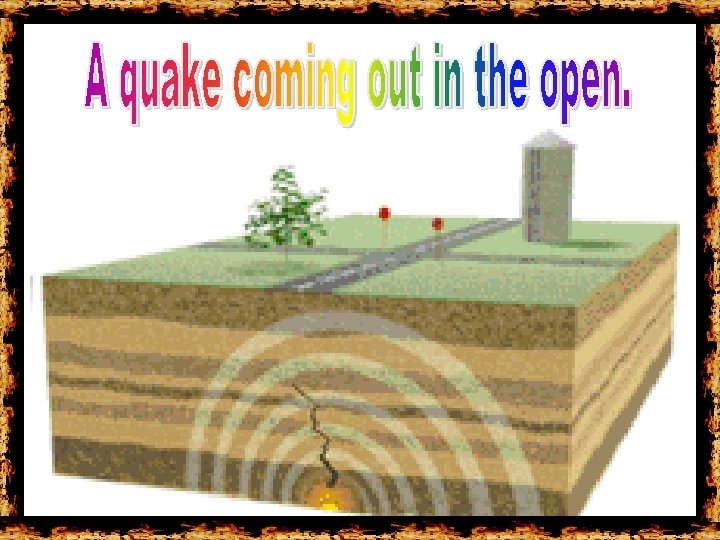
CAUSES OF EARTH QUAKE 1. Earthquake, shaking of the Earth’s surface caused by rapid movement of the Earth’s rocky outer layer. 2. Earthquakes occur when energy stored within the Earth, usually in the form of strain in rocks, suddenly releases. 3. This energy is transmitted to the surface of the Earth by earthquake waves. 4. The study of earthquakes and the waves they create is called seismology (from the Greek seismos, “to shake”).
• Most earthquakes are caused by the sudden slip along geologic faults. The faults slip because of movement of the Earth’s tectonic plates. This concept is called the elastic rebound theory. The rocky tectonic plates move very slowly, floating on top of a weaker rocky layer. As the plates collide with each other or slide past each other, pressure builds up within the rocky crust. • Earthquakes occur when pressure within the crust increases slowly over hundreds of years and finally exceeds the strength of the rocks. • Earthquakes also occur when human activities, such as the filling of reservoirs, increase stress in the Earth’s crust.
Precautionary Measures against Earthquakes Indoors: • Don’t panic and stay inside. If you have time, walk fast outside of the building and be careful of falling debris; • Take cover under doors, tables or beds; • Stay away from chimneys or windows; • Put out domestic fires; • If damage has occurred, turn off electricity; • Converse water in tank and cisterns; • Don’t use match or open flames if leaking gas is suspected.
Precautionary Measures against Earthquakes Outdoors: • Keep clear of buildings, high walls and electric power lines; • If caught beside big building, seek refuge under archways or doorways; • Don’t re-enter badly damage building; • If driving, stop and remain in your car until you have assessed damage around you.
FIRE – it is a chemical reaction that takes place between fuel, heat and oxygen in form of light and noticeable heat.
HOW FIRE BURNS? Fire occurs whenever a given material is heated on the presence of oxygen to a temperature corresponding to the ignition point of the material.
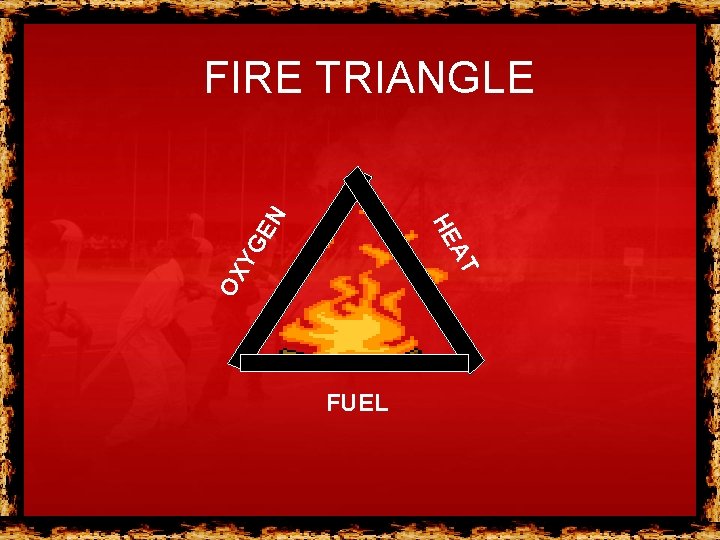
ELEMENTS OF FIRE • FUEL • OXYGEN • HEAT
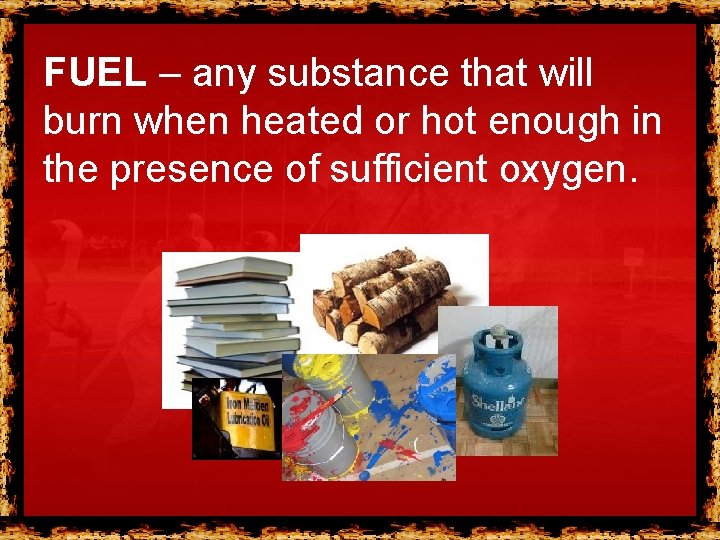
FUEL – any substance that will burn when heated or hot enough in the presence of sufficient oxygen.
OXYGEN – atmosphere consists of 21% of oxygen, 78% nitrogen and 1% of other elements.
HEAT Three Stages: 1. Flash point – lowest temperature at which a flammable substance will give off vapor that will ignite when a flame or spark is introduced in the presence of sufficient oxygen. 2. Fire point – a temperature which is a few degrees higher than a flash point in which a flammable substance will continue to burn after it has been ignited. 3. Ignition point – a temperature which is higher than a fire point at which a substance is heated to give off vapor that will burn without the application of spark or a flame in the presence of sufficient oxygen.
OX AT HE YG EN FIRE TRIANGLE FUEL
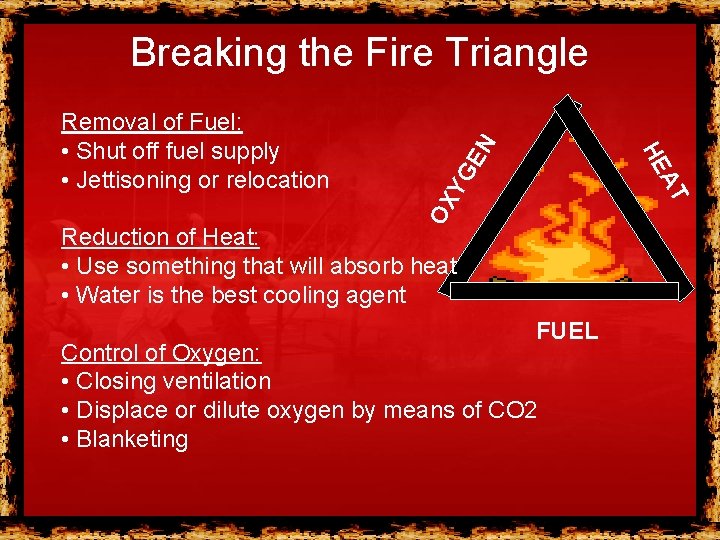
OX AT YG HE Removal of Fuel: • Shut off fuel supply • Jettisoning or relocation EN Breaking the Fire Triangle Reduction of Heat: • Use something that will absorb heat • Water is the best cooling agent FUEL Control of Oxygen: • Closing ventilation • Displace or dilute oxygen by means of CO 2 • Blanketing
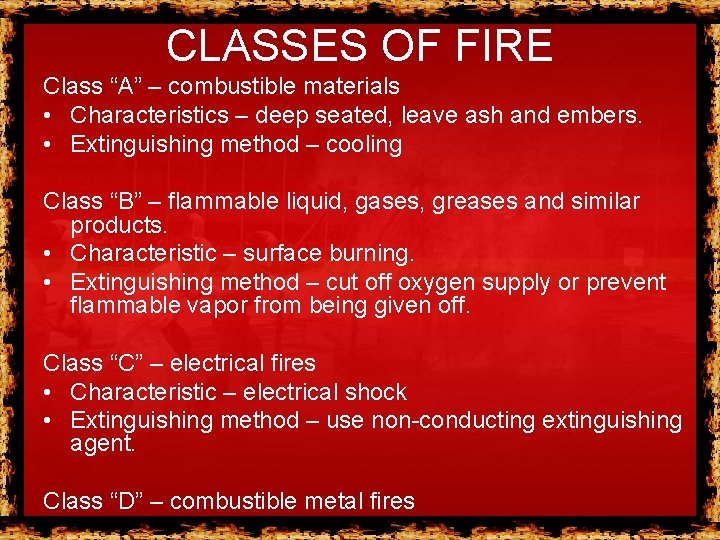
CLASSES OF FIRE Class “A” – combustible materials • Characteristics – deep seated, leave ash and embers. • Extinguishing method – cooling Class “B” – flammable liquid, gases, greases and similar products. • Characteristic – surface burning. • Extinguishing method – cut off oxygen supply or prevent flammable vapor from being given off. Class “C” – electrical fires • Characteristic – electrical shock • Extinguishing method – use non-conducting extinguishing agent. Class “D” – combustible metal fires
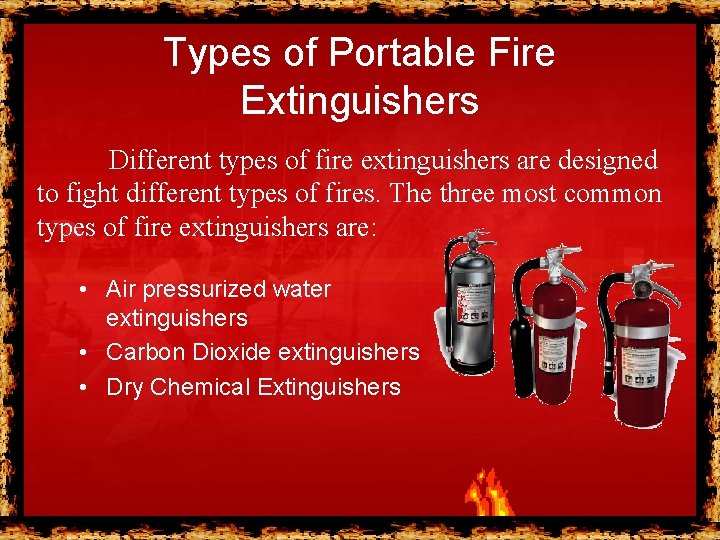
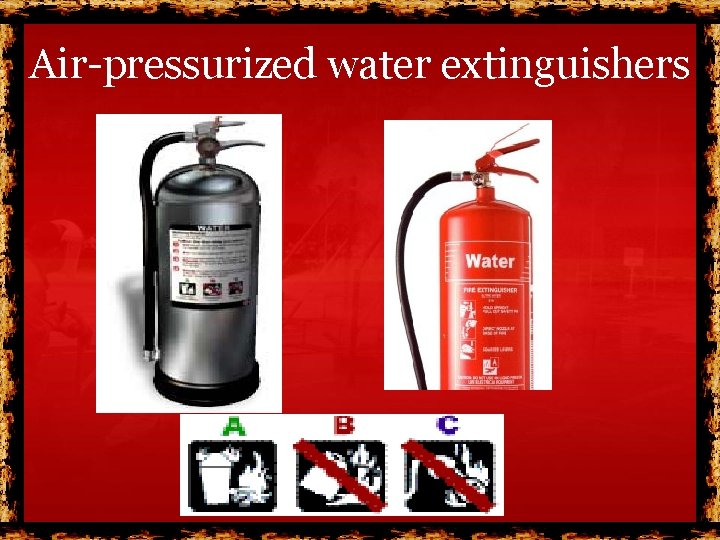
Types of Portable Fire Extinguishers Different types of fire extinguishers are designed to fight different types of fires. The three most common types of fire extinguishers are: • Air pressurized water extinguishers • Carbon Dioxide extinguishers • Dry Chemical Extinguishers
Air-pressurized water extinguishers
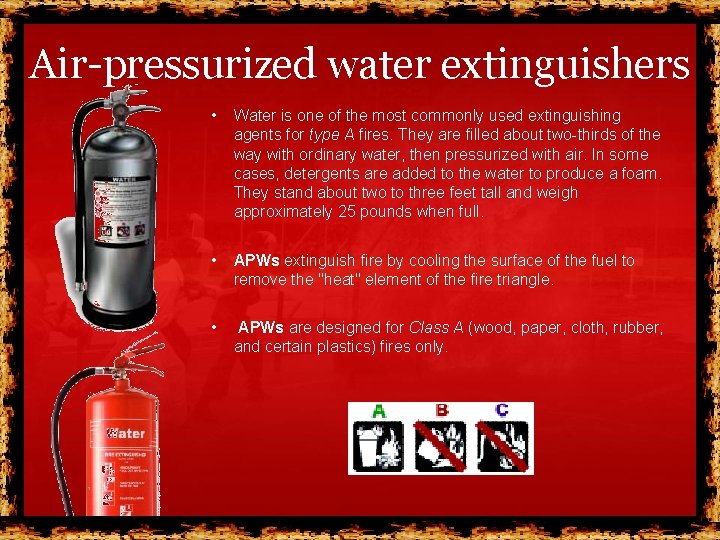
Air-pressurized water extinguishers • Water is one of the most commonly used extinguishing agents for type A fires. They are filled about two-thirds of the way with ordinary water, then pressurized with air. In some cases, detergents are added to the water to produce a foam. They stand about two to three feet tall and weigh approximately 25 pounds when full. • APWs extinguish fire by cooling the surface of the fuel to remove the "heat" element of the fire triangle. • APWs are designed for Class A (wood, paper, cloth, rubber, and certain plastics) fires only.
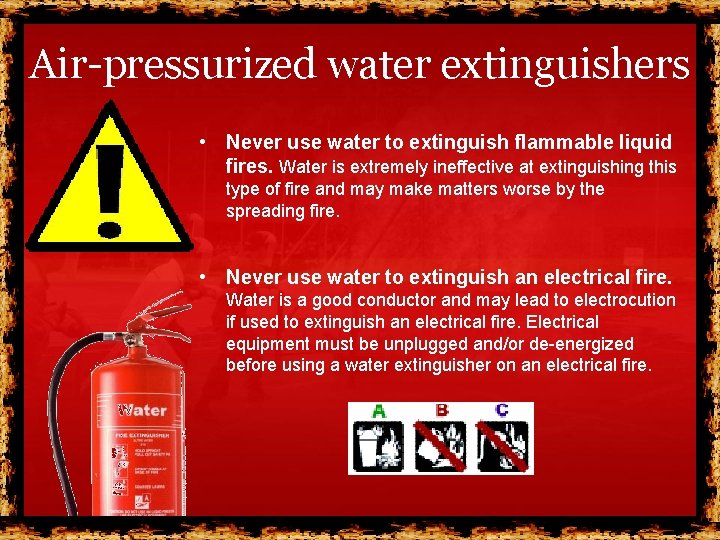
Air-pressurized water extinguishers • Never use water to extinguish flammable liquid fires. Water is extremely ineffective at extinguishing this type of fire and may make matters worse by the spreading fire. • Never use water to extinguish an electrical fire. Water is a good conductor and may lead to electrocution if used to extinguish an electrical fire. Electrical equipment must be unplugged and/or de-energized before using a water extinguisher on an electrical fire.
Carbon Dioxide extinguishers
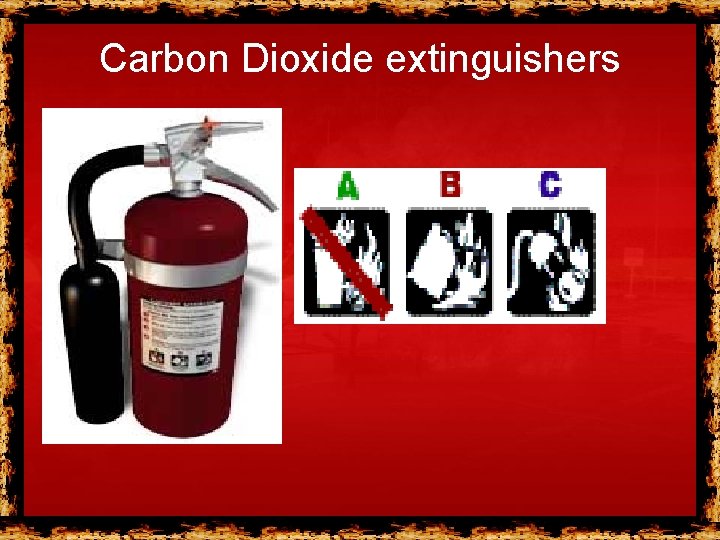
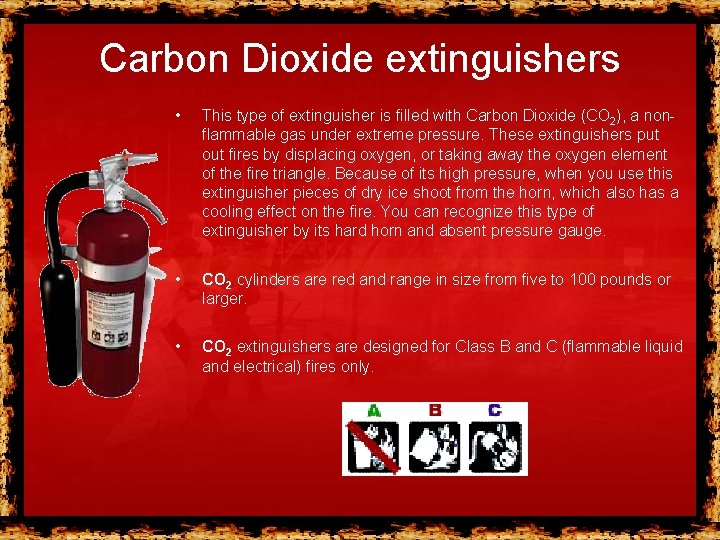
Carbon Dioxide extinguishers • This type of extinguisher is filled with Carbon Dioxide (CO 2), a nonflammable gas under extreme pressure. These extinguishers put out fires by displacing oxygen, or taking away the oxygen element of the fire triangle. Because of its high pressure, when you use this extinguisher pieces of dry ice shoot from the horn, which also has a cooling effect on the fire. You can recognize this type of extinguisher by its hard horn and absent pressure gauge. • CO 2 cylinders are red and range in size from five to 100 pounds or larger. • CO 2 extinguishers are designed for Class B and C (flammable liquid and electrical) fires only.
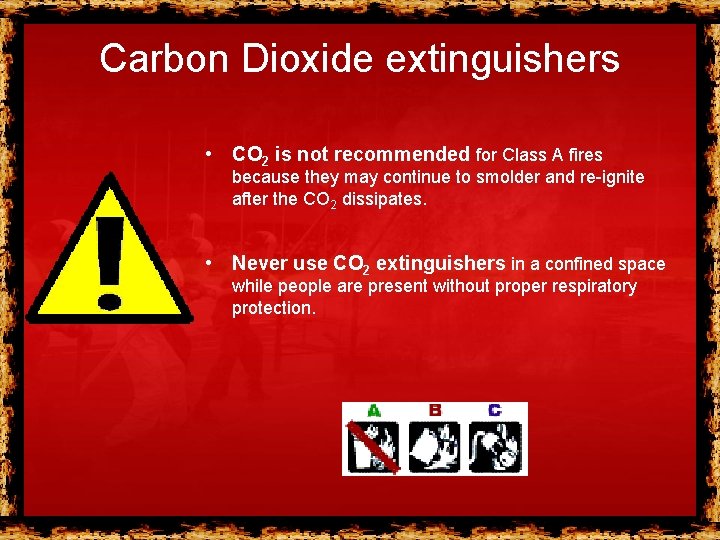
Carbon Dioxide extinguishers • CO 2 is not recommended for Class A fires because they may continue to smolder and re-ignite after the CO 2 dissipates. • Never use CO 2 extinguishers in a confined space while people are present without proper respiratory protection.
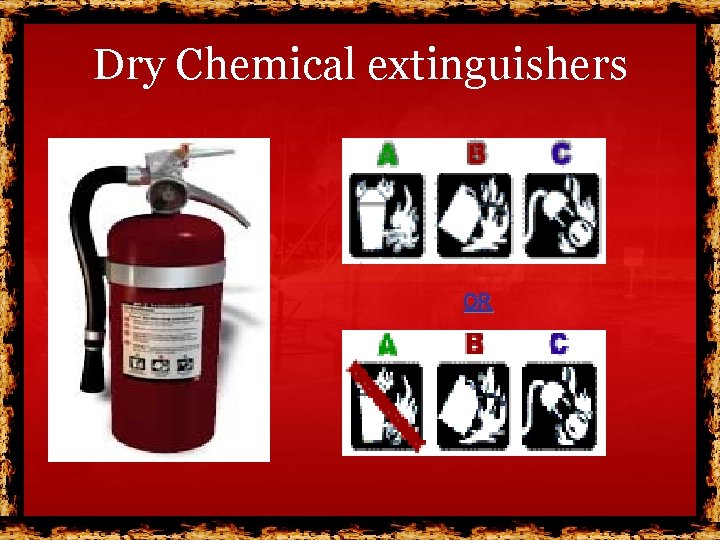
Dry Chemical extinguishers OR
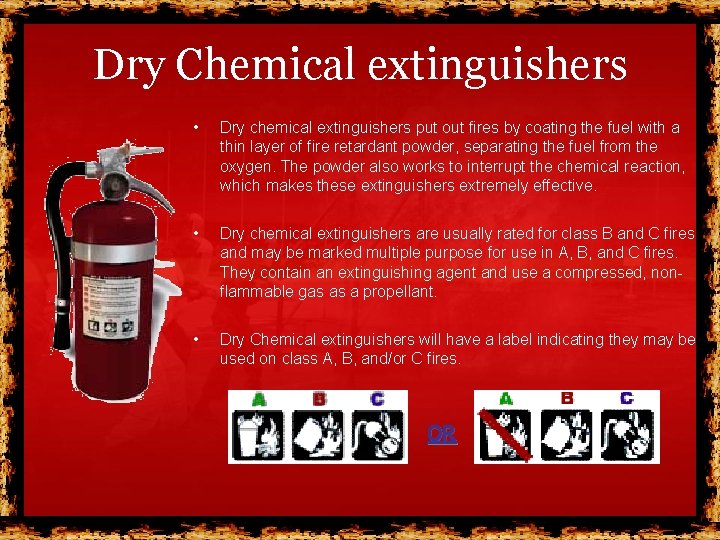
Dry Chemical extinguishers • Dry chemical extinguishers put out fires by coating the fuel with a thin layer of fire retardant powder, separating the fuel from the oxygen. The powder also works to interrupt the chemical reaction, which makes these extinguishers extremely effective. • Dry chemical extinguishers are usually rated for class B and C fires and may be marked multiple purpose for use in A, B, and C fires. They contain an extinguishing agent and use a compressed, nonflammable gas as a propellant. • Dry Chemical extinguishers will have a label indicating they may be used on class A, B, and/or C fires. OR
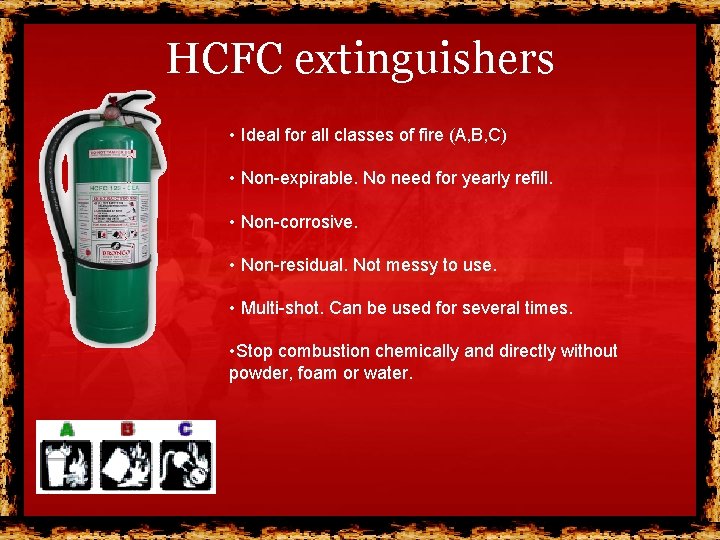
HCFC extinguishers • Ideal for all classes of fire (A, B, C) • Non-expirable. No need for yearly refill. • Non-corrosive. • Non-residual. Not messy to use. • Multi-shot. Can be used for several times. • Stop combustion chemically and directly without powder, foam or water.
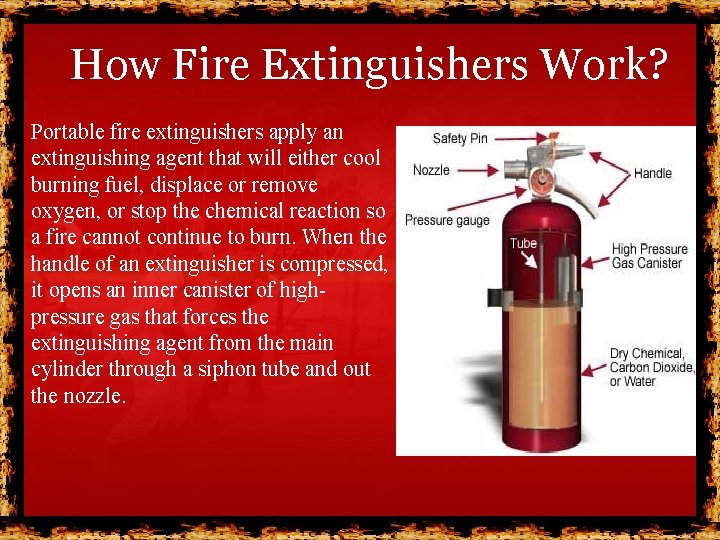
How Fire Extinguishers Work? Portable fire extinguishers apply an extinguishing agent that will either cool burning fuel, displace or remove oxygen, or stop the chemical reaction so a fire cannot continue to burn. When the handle of an extinguisher is compressed, it opens an inner canister of highpressure gas that forces the extinguishing agent from the main cylinder through a siphon tube and out the nozzle.
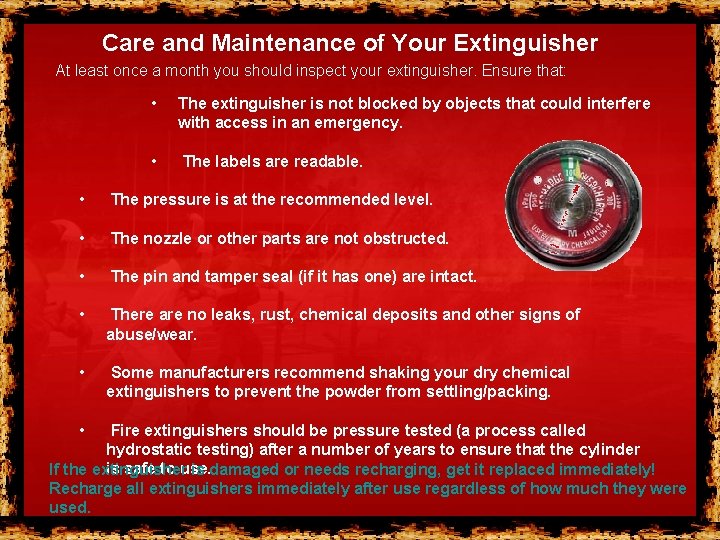
Care and Maintenance of Your Extinguisher At least once a month you should inspect your extinguisher. Ensure that: • The extinguisher is not blocked by objects that could interfere with access in an emergency. • The labels are readable. • The pressure is at the recommended level. • The nozzle or other parts are not obstructed. • The pin and tamper seal (if it has one) are intact. • There are no leaks, rust, chemical deposits and other signs of abuse/wear. • Some manufacturers recommend shaking your dry chemical extinguishers to prevent the powder from settling/packing. • Fire extinguishers should be pressure tested (a process called hydrostatic testing) after a number of years to ensure that the cylinder is safe to use. If the extinguisher is damaged or needs recharging, get it replaced immediately! Recharge all extinguishers immediately after use regardless of how much they were used.
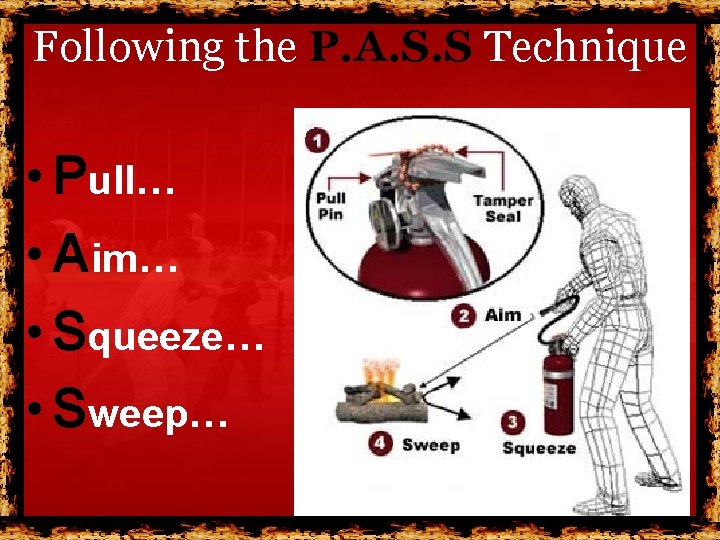
Following the P. A. S. S Technique • Pull… • Aim… • Squeeze… • Sweep…
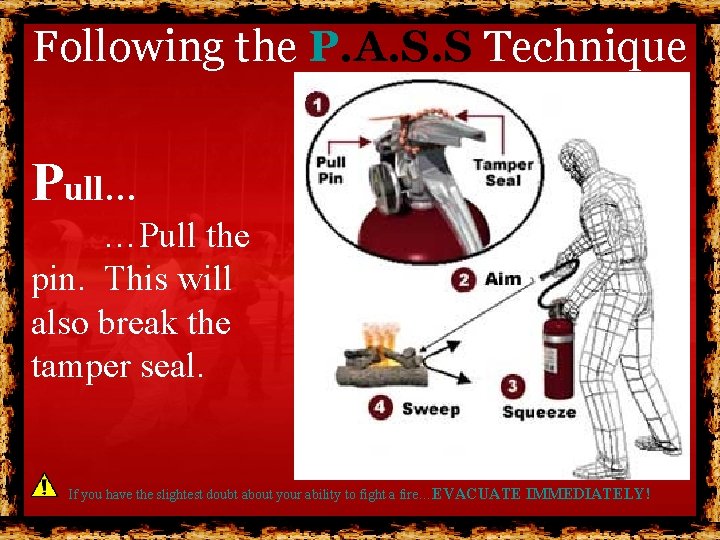
Following the P. A. S. S Technique Pull… …Pull the pin. This will also break the tamper seal. If you have the slightest doubt about your ability to fight a fire…EVACUATE IMMEDIATELY!
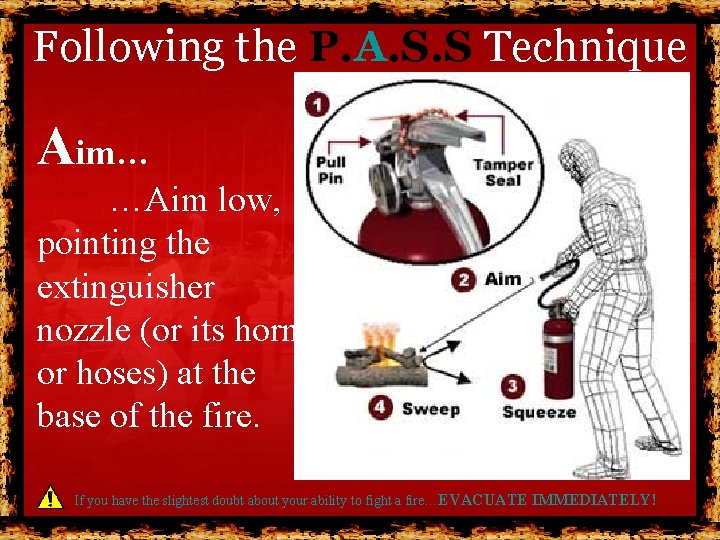
Following the P. A. S. S Technique Aim… …Aim low, pointing the extinguisher nozzle (or its horn or hoses) at the base of the fire. If you have the slightest doubt about your ability to fight a fire…EVACUATE IMMEDIATELY!
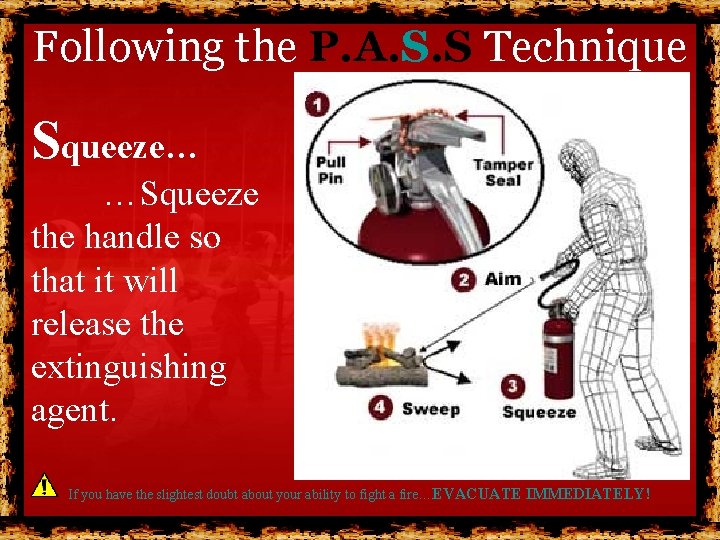
Following the P. A. S. S Technique Squeeze… …Squeeze the handle so that it will release the extinguishing agent. If you have the slightest doubt about your ability to fight a fire…EVACUATE IMMEDIATELY!
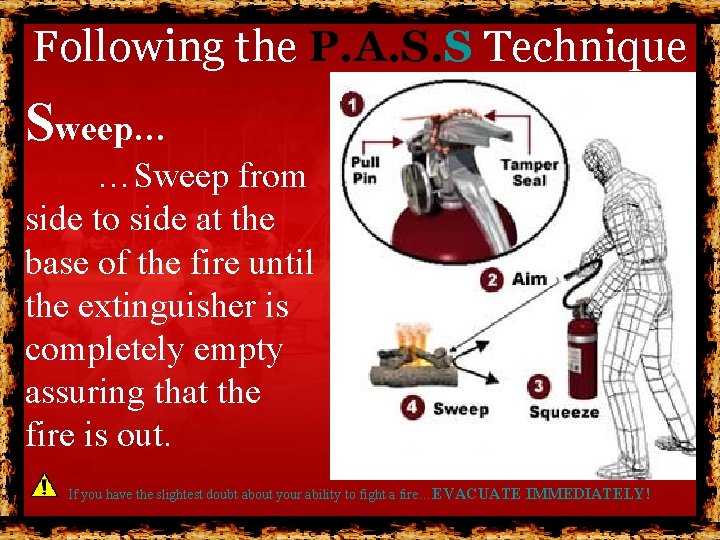
Following the P. A. S. S Technique Sweep… …Sweep from side to side at the base of the fire until the extinguisher is completely empty assuring that the fire is out. If you have the slightest doubt about your ability to fight a fire…EVACUATE IMMEDIATELY!
Fire extinguishers can represent an important segment of any overall fire protection program. However, their successful functioning depends upon the following conditions having been met: • (a) The fire extinguisher is properly located and in working order. • (b) The fire extinguisher is of the proper type for a fire that can occur. • (c) The fire is discovered while still small enough for the fire extinguisher to be effective. • (d) The fire is discovered by a person ready, willing, and able to use the fire extinguisher.
In The Event of Fire ind nform eact Xtinguish or evacuate
CU Safety and Health Committee Dr. V. Salas – VPOPD 3/M J. Echeveria – Safety Officer, Safety Leader (CME) Mr. L. Pangan – PPFMO Dr. N. Salubre – Medical Officer Dr. A. Aladano – Safety Leader (Graduate School) Dr. M. Campano – Safety Leader (College of Education) Engr. R. Feliciano – Safety Leader (College of Engineering) Mrs. A. Cruz – Safety Leader (College of Business Administration) Mr. F. Dela Fuente, Jr. – Safety Leader (College of Criminology) Mr. C. Rañoa – Safety Leader (College of Arts and Sciences) Mr. H. Fabre – Safety Leader (College of Nursing and Midwifery) Mr. A. Ranido – Safety Leader (College of Computer Studies) Mr. B. Cortes, Jr. - Safety Leader (CUBED)