
Safety Talk ST 082 Controlling Bleeding Sheet 1
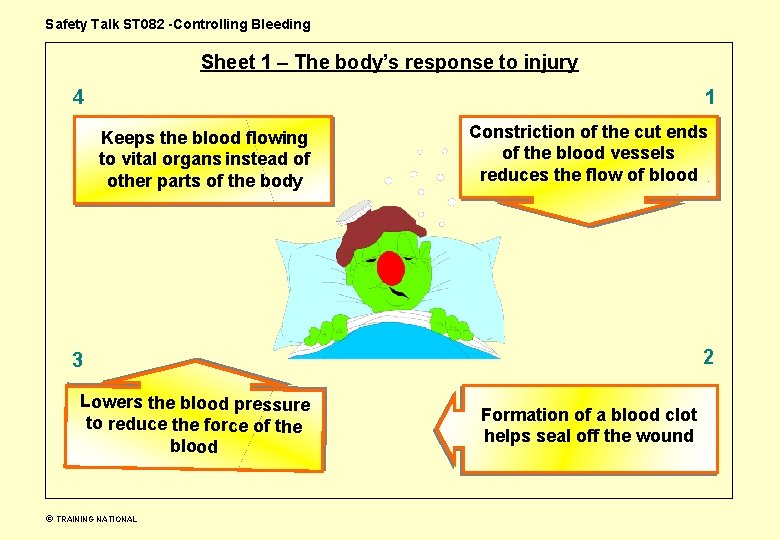
Safety Talk ST 082 -Controlling Bleeding Sheet 1 – The body’s response to injury 4 1 Keeps the blood flowing to vital organs instead of other parts of the body Constriction of the cut ends of the blood vessels reduces the flow of blood 2 3 Lowers the blood pressure to reduce the force of the blood TRAINING NATIONAL Formation of a blood clot helps seal off the wound

Safety Talk ST 082 -Controlling Bleeding Sheet 2 – Treating Major External Bleeding Check the wound is free of foreign objects. Apply direct pressure to control bleeding. Get the casualty to lie down. Elevate the bleeding point. Do not remove large foreign objects as they may act as a plug and restrict bleeding. Place a sterile, bulky, unmedicated dressing over the wound, pressing down firmly and securing it with a bandage. Seek medical aid and transport the patient to a hospital in a calm and safe manner. TRAINING NATIONAL
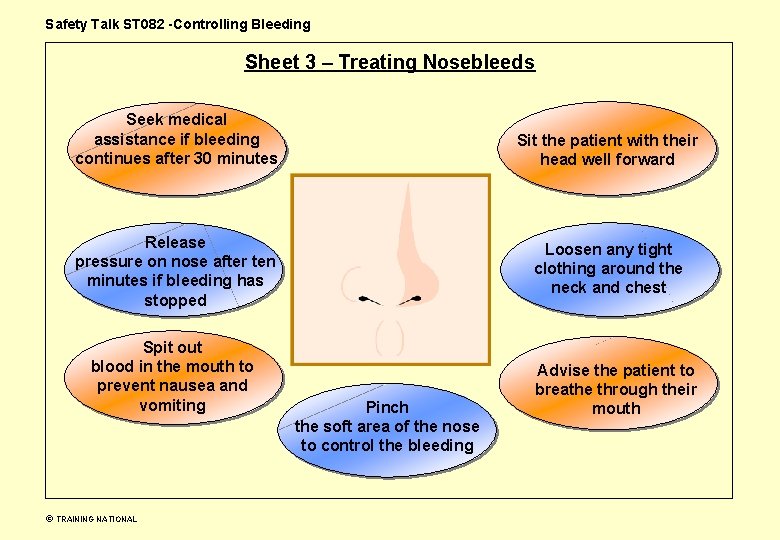
Safety Talk ST 082 -Controlling Bleeding Sheet 3 – Treating Nosebleeds Seek medical assistance if bleeding continues after 30 minutes Sit the patient with their head well forward Release pressure on nose after ten minutes if bleeding has stopped Spit out blood in the mouth to prevent nausea and vomiting TRAINING NATIONAL Loosen any tight clothing around the neck and chest Pinch the soft area of the nose to control the bleeding Advise the patient to breathe through their mouth
Safety Talk ST 082 -Controlling Bleeding Sheet 4 – Summary The body has a variety of different responses which all help to reduce the effects of an injury. Major external bleeding should be treated by controlling the bleeding with the use of a clean dressing and transporting the patient to hospital as soon as possible. Injuries to the head and face area should be treated with particular care to avoid: obstruction of the airways; neck or spine injuries; and damage to the brain; blood loss. TRAINING NATIONAL
- Slides: 4