
Safety Talk ST 077 Occupational Overuse Syndrome Sheet
- Slides: 6
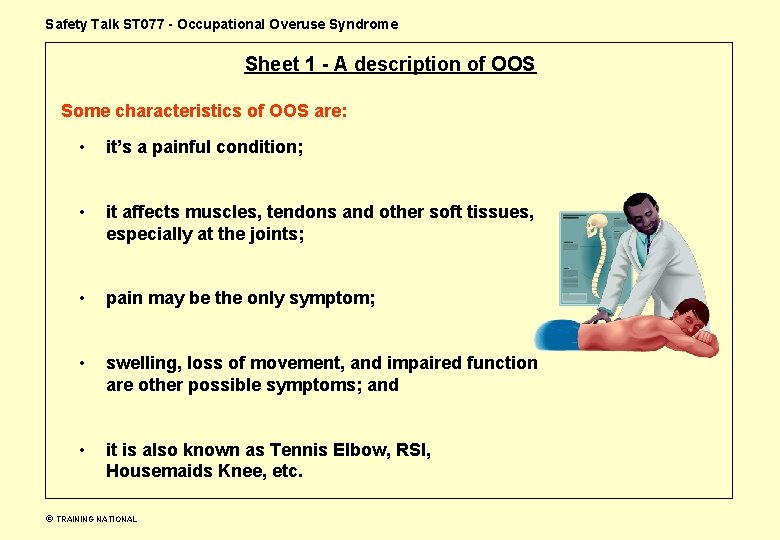
Safety Talk ST 077 - Occupational Overuse Syndrome Sheet 1 - A description of OOS Some characteristics of OOS are: • it’s a painful condition; • it affects muscles, tendons and other soft tissues, especially at the joints; • pain may be the only symptom; • swelling, loss of movement, and impaired function are other possible symptoms; and • it is also known as Tennis Elbow, RSI, Housemaids Knee, etc. TRAINING NATIONAL
Safety Talk ST 077 - Occupational Overuse Syndrome Sheet 2 - Physical factors affecting OOS Some of the physical factors that could contribute to OOS are: • workstations, equipment and tools are not matched to the worker; • the number and duration of pauses; • the duration and variation of tasks; • tasks that require you to adopt awkward body positions or to apply force; • poor job design, such as repetitive movements; and • vibration and sudden impact forces. TRAINING NATIONAL
Safety Talk ST 077 - Occupational Overuse Syndrome Sheet 3 - Psycho-social factors affecting OOS Some of the psycho-social factors you could experience are: • organisational change and uncertainty; • uncomfortable noise, vibration, lighting or temperature levels; • work underload or overload; • communication problems; • supervisory problems; • lack of peer or social support; and • being subjected to client or customer abuse and aggression. TRAINING NATIONAL
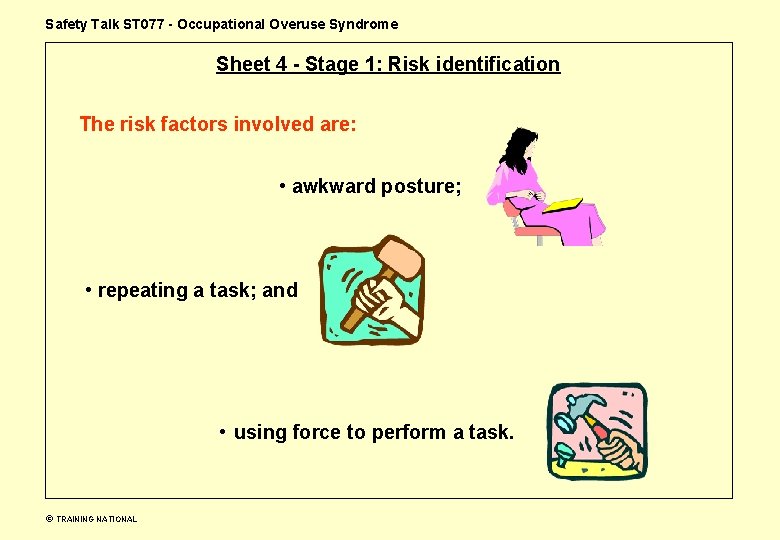
Safety Talk ST 077 - Occupational Overuse Syndrome Sheet 4 - Stage 1: Risk identification The risk factors involved are: • awkward posture; • repeating a task; and • using force to perform a task. TRAINING NATIONAL
Safety Talk ST 077 - Occupational Overuse Syndrome Sheet 5 - Stage 2: Risk assessment Assess the risks by asking yourself the questions: • Is everything I use within easy reach? • Do I have to twist or move awkwardly? • Are things easy to grasp or pick up? • Can I see everything easily? TRAINING NATIONAL
Safety Talk ST 077 - Occupational Overuse Syndrome Sheet 6 - Stage 3: risk control The strategies for controlling the risk are: • eliminate the risk; and • reduce the risk. Ask yourself a series of questions regarding the work to be done: • Is the job or task necessary? • Is redesign of the job or task practical? • Is it practical to use mechanical aids? • What training and eductions will reduce the risk? TRAINING NATIONAL