
Safety Talk Excavation Work Sheet 1 Underground services
- Slides: 8
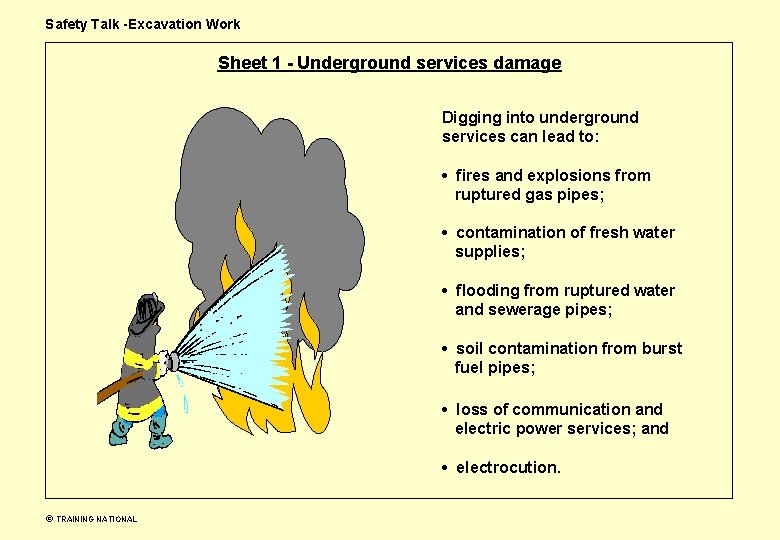
Safety Talk -Excavation Work Sheet 1 - Underground services damage Digging into underground services can lead to: • fires and explosions from ruptured gas pipes; • contamination of fresh water supplies; • flooding from ruptured water and sewerage pipes; • soil contamination from burst fuel pipes; • loss of communication and electric power services; and • electrocution. TRAINING NATIONAL
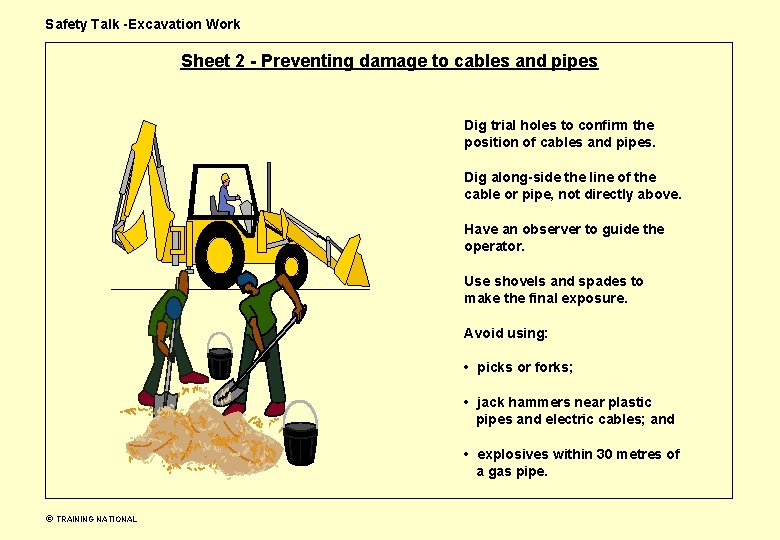
Safety Talk -Excavation Work Sheet 2 - Preventing damage to cables and pipes Dig trial holes to confirm the position of cables and pipes. Dig along-side the line of the cable or pipe, not directly above. Have an observer to guide the operator. Use shovels and spades to make the final exposure. Avoid using: • picks or forks; • jack hammers near plastic pipes and electric cables; and • explosives within 30 metres of a gas pipe. TRAINING NATIONAL
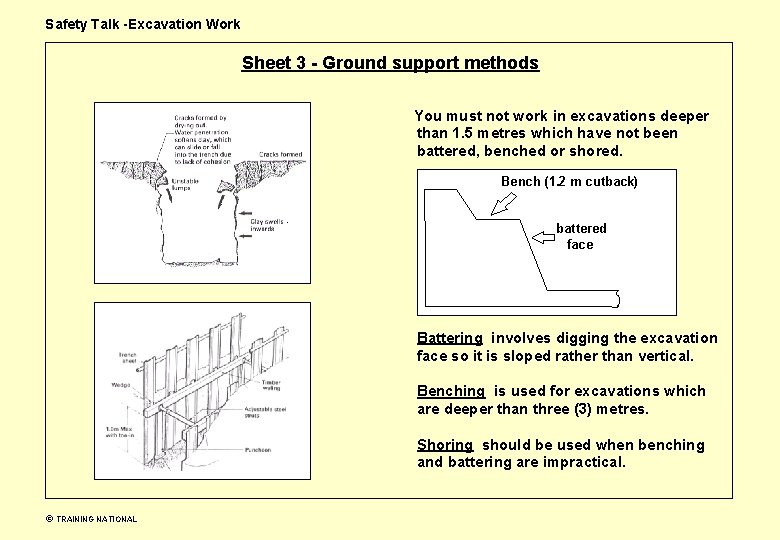
Safety Talk -Excavation Work Sheet 3 - Ground support methods You must not work in excavations deeper than 1. 5 metres which have not been battered, benched or shored. Bench (1. 2 m cutback) battered face Battering involves digging the excavation face so it is sloped rather than vertical. Benching is used for excavations which are deeper than three (3) metres. Shoring should be used when benching and battering are impractical. TRAINING NATIONAL
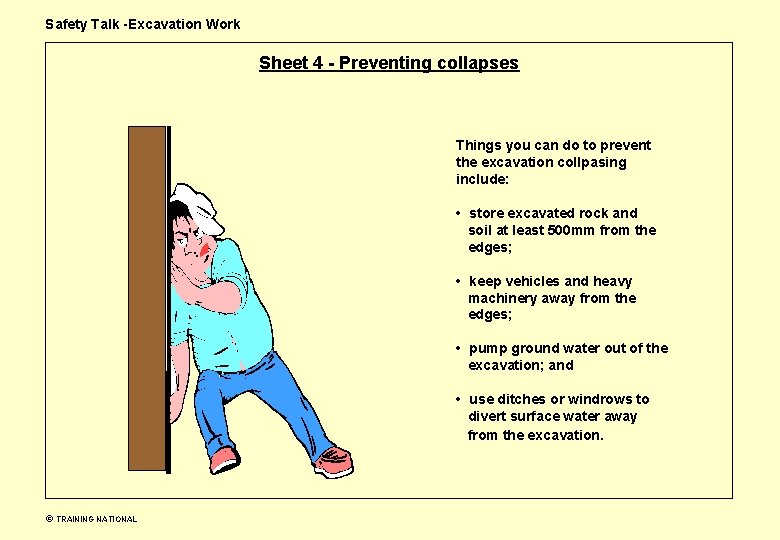
Safety Talk -Excavation Work Sheet 4 - Preventing collapses Things you can do to prevent the excavation collpasing include: • store excavated rock and soil at least 500 mm from the edges; • keep vehicles and heavy machinery away from the edges; • pump ground water out of the excavation; and • use ditches or windrows to divert surface water away from the excavation. TRAINING NATIONAL
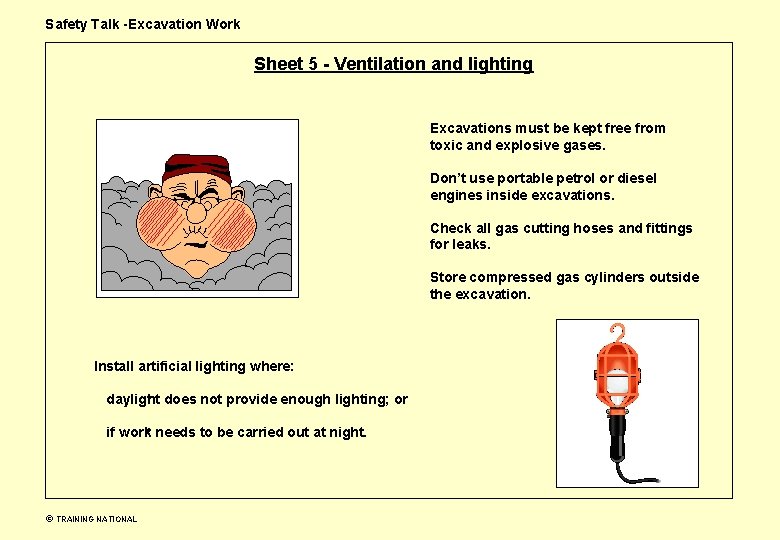
Safety Talk -Excavation Work Sheet 5 - Ventilation and lighting Excavations must be kept free from toxic and explosive gases. Don’t use portable petrol or diesel engines inside excavations. Check all gas cutting hoses and fittings for leaks. Store compressed gas cylinders outside the excavation. Install artificial lighting where: • does not provide enough lighting; or daylight if work • needs to be carried out at night. TRAINING NATIONAL
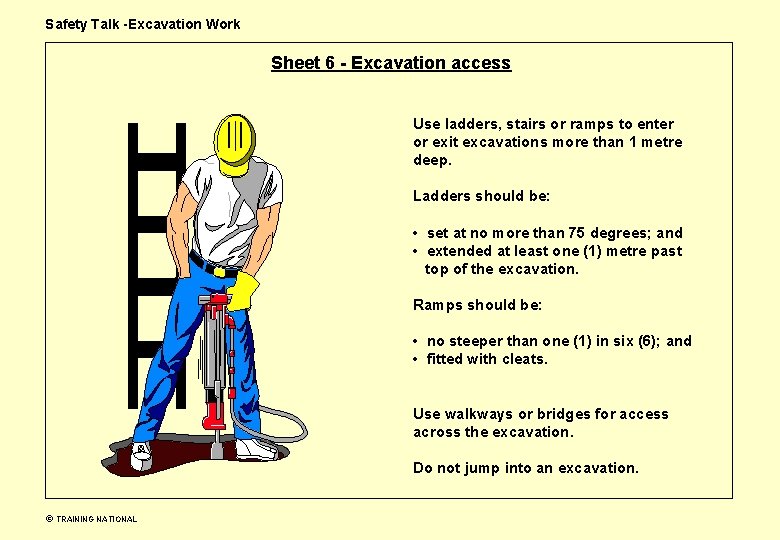
Safety Talk -Excavation Work Sheet 6 - Excavation access Use ladders, stairs or ramps to enter or exit excavations more than 1 metre deep. Ladders should be: • set at no more than 75 degrees; and • extended at least one (1) metre past top of the excavation. Ramps should be: • no steeper than one (1) in six (6); and • fitted with cleats. Use walkways or bridges for access across the excavation. Do not jump into an excavation. TRAINING NATIONAL
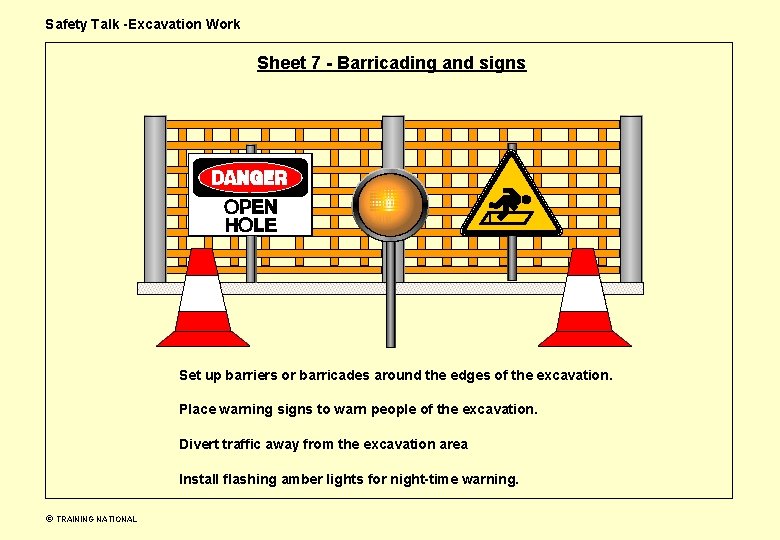
Safety Talk -Excavation Work Sheet 7 - Barricading and signs Set up barriers or barricades around the edges of the excavation. Place warning signs to warn people of the excavation. Divert traffic away from the excavation area Install flashing amber lights for night-time warning. TRAINING NATIONAL
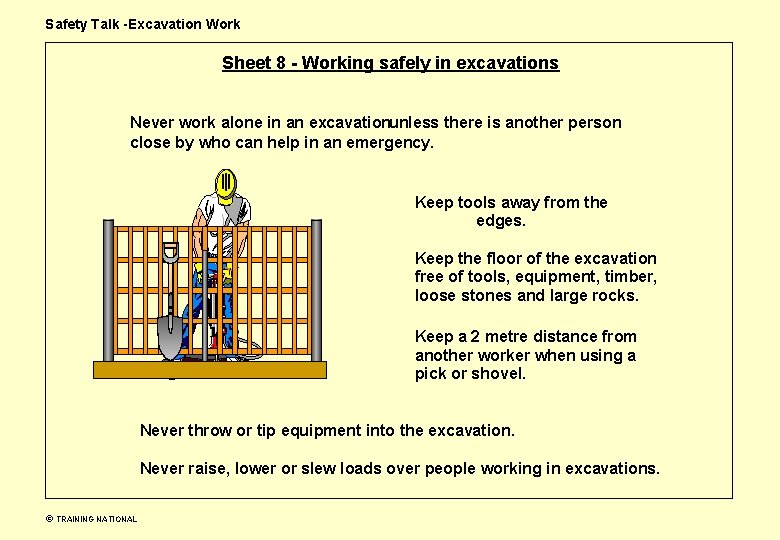
Safety Talk -Excavation Work Sheet 8 - Working safely in excavations Never work alone in an excavationunless there is another person close by who can help in an emergency. Keep tools away from the edges. Keep the floor of the excavation free of tools, equipment, timber, loose stones and large rocks. Keep a 2 metre distance from another worker when using a pick or shovel. Never throw or tip equipment into the excavation. Never raise, lower or slew loads over people working in excavations. TRAINING NATIONAL