
SAFETY TALK Bat Removal During warm summer months
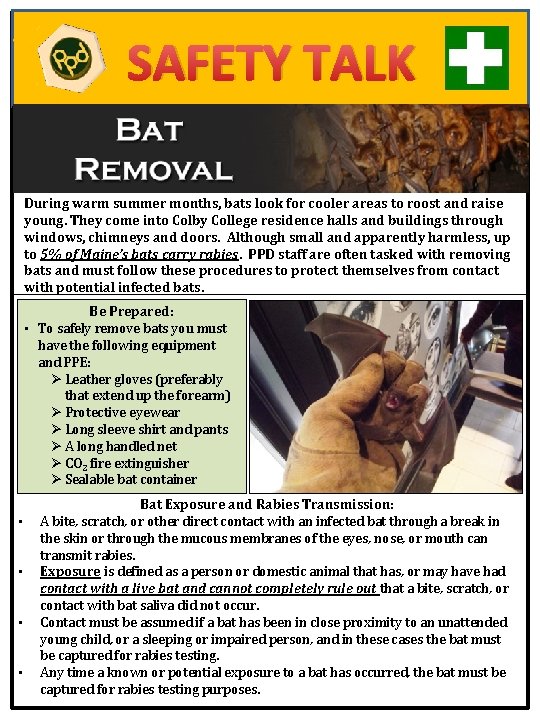
SAFETY TALK Bat Removal During warm summer months, bats look for cooler areas to roost and raise young. They come into Colby College residence halls and buildings through windows, chimneys and doors. Although small and apparently harmless, up to 5% of Maine’s bats carry rabies. PPD staff are often tasked with removing bats and must follow these procedures to protect themselves from contact with potential infected bats. Be Prepared: • To safely remove bats you must have the following equipment and PPE: Ø Leather gloves (preferably that extend up the forearm) Ø Protective eyewear Ø Long sleeve shirt and pants Ø A long handled net Ø CO 2 fire extinguisher Ø Sealable bat container • • Bat Exposure and Rabies Transmission: A bite, scratch, or other direct contact with an infected bat through a break in the skin or through the mucous membranes of the eyes, nose, or mouth can transmit rabies. Exposure is defined as a person or domestic animal that has, or may have had contact with a live bat and cannot completely rule out that a bite, scratch, or contact with bat saliva did not occur. Contact must be assumed if a bat has been in close proximity to an unattended young child, or a sleeping or impaired person, and in these cases the bat must be captured for rabies testing. Any time a known or potential exposure to a bat has occurred, the bat must be captured for rabies testing purposes.
If the bat is located in an area that is not typically accessible to faculty, staff and students, such as an attic, it should be left alone until it can be removed by a licensed wildlife contractor, specializing in bat removal. If the bat is located within a space that presents a risk to faculty, staff and students, such as in a bedroom, an office, a corridor or other common space where potential human exposure is possible, the bat shall be removed. o Do not release a bat unless known for sure that an Assess the Situation: to ainperson animal has not occurred. • If exposure* the bat is located an area or thatdomestic is not typically accessible to faculty, staff, and such an attic, itasshould be leftor alone until it can be removed by a or * students, Exposure - isasdefined a person domestic animal that has, licensed wildlife contractor specializing in bat with removal. may have had contact a live • If the bat is located within a space that presents a risk to faculty, staff, and bat and cannot out that a bite, scratch or space contact students, such as incompletely a bedroom, anrule office, a corridor, or other common with bat saliva did not where potential human exposure is possible, the occur. bat shall be removed. • Example – a. Bat person that wakes up to find a bat in the Capture Procedures: room, or a room in which a bat and pet are found together, even if Bat on Ceiling/Wall Option 1: With Gloves Donned no wounds are visible is considered a potential exposure. Ø Clear the area or room and close the doors and windows If a known or potential exposure to a bat has occurred, the Ø Slowly (because bats are sensitive to movement) place a large open batcontainer must be captured for atesting mouth over the bat slide piece ofpurposes. cardboard between the wall and the container relocating the or batthe to the insideofofthe can/container. o If the bat is not captured, brain bat has been Ø Place appropriate over top ofthe can/container while simultaneously damaged in the attemptcover to capture, required testing cannot be removing the cardboard. done, andlid it will have to. BAT be–assumed that the bat has rabies. Ø Label of container Do Not Open • Option 2: 5% all Extinguisher bats tested are found to be “positive” for rabies. CO 2 of. Fire in a badthe location, such as a corner of or theequipment area or room, that spray � Ø If the Dobat notis strike bat with such force the bat with CO 2 from a CO 2 fire extinguisher. the brain will be compromised. Ø The bat will drop to the floor into a pre-placed container that you can o As long ason, the captured for decisions about place a cover orbat pickis the bat up with thetesting, bat gloves, place it into a container with securable capwait or cover, label post-exposure prophylaxis can untiland test results are obtained. Bat o in Flight – with bat gloves donned Once the bat is captured, it must be brought to the Ø With the net, you need to capture the bat from behind. following location; Ø Once the bat is in the net, pull and secure the draw string to keep the bat � If the bat is not captured, or the brain of the bat has been from escaping. Ø Tointransfer the bat from the net, freeze the bat withtesting a CO 2 extinguisher, damaged the attempt to capture, the required cannot be and transfer to the labeled container. done, and it will have to be assumed that the bat has rabies. SAFETY TALK Bat Removal
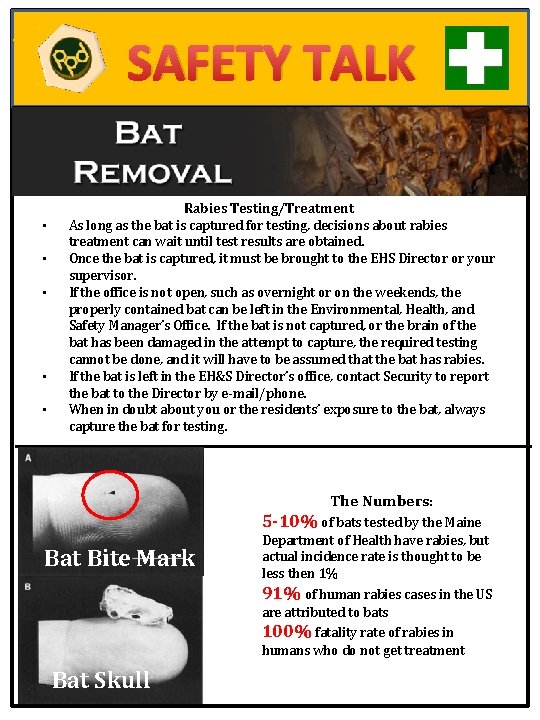
SAFETY TALK Bat Removal • • • Rabies Testing/Treatment As long as the bat is captured for testing, decisions about rabies treatment can wait until test results are obtained. Once the bat is captured, it must be brought to the EHS Director or your supervisor. If the office is not open, such as overnight or on the weekends, the properly contained bat can be left in the Environmental, Health, and Safety Manager’s Office. If the bat is not captured, or the brain of the bat has been damaged in the attempt to capture, the required testing cannot be done, and it will have to be assumed that the bat has rabies. If the bat is left in the EH&S Director’s office, contact Security to report the bat to the Director by e-mail/phone. When in doubt about you or the residents’ exposure to the bat, always capture the bat for testing. The Numbers: 5 -10% of bats tested by the Maine Bat Bite Mark Department of Health have rabies, but actual incidence rate is thought to be less then 1% 91% of human rabies cases in the US are attributed to bats 100% fatality rate of rabies in humans who do not get treatment Bat Skull

SAFETY TALK Bat Removal 1. 2. 3. Questions/Discussion: Where are some areas you feel it is best to leave the bats alone as they are not a threat to Colby students, visitors, or employees? Where must they be immediately removed? Do you have the proper gear to capture bats safety? Where is it stored? What would be considered contact with a bat, i. e. , exposure and require the bat be captured for testing? Printed Name Signature Questions, concerns or comments contact the EHS Director at extension 5504.
- Slides: 4