
Safety Session IEFC workshop 2011 Ralf Trant chair

- Slides: 6
Safety Session IEFC workshop 2011 Ralf Trant, chair Ghislain Roy, secretary
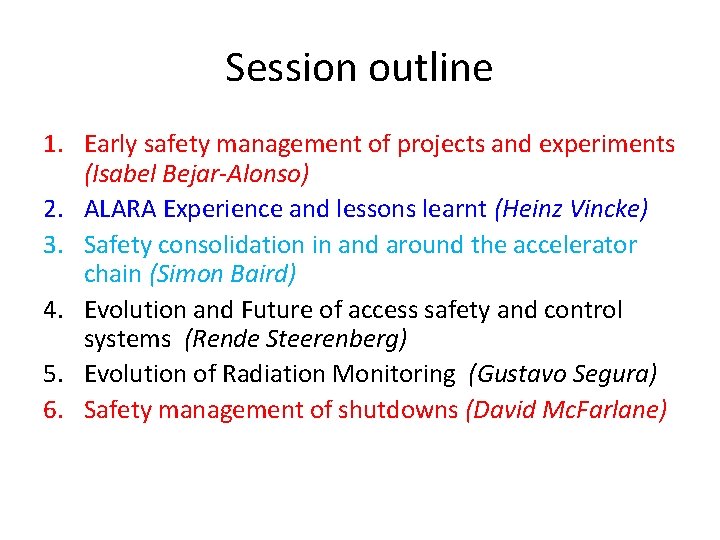
Session outline 1. Early safety management of projects and experiments (Isabel Bejar-Alonso) 2. ALARA Experience and lessons learnt (Heinz Vincke) 3. Safety consolidation in and around the accelerator chain (Simon Baird) 4. Evolution and Future of access safety and control systems (Rende Steerenberg) 5. Evolution of Radiation Monitoring (Gustavo Segura) 6. Safety management of shutdowns (David Mc. Farlane)
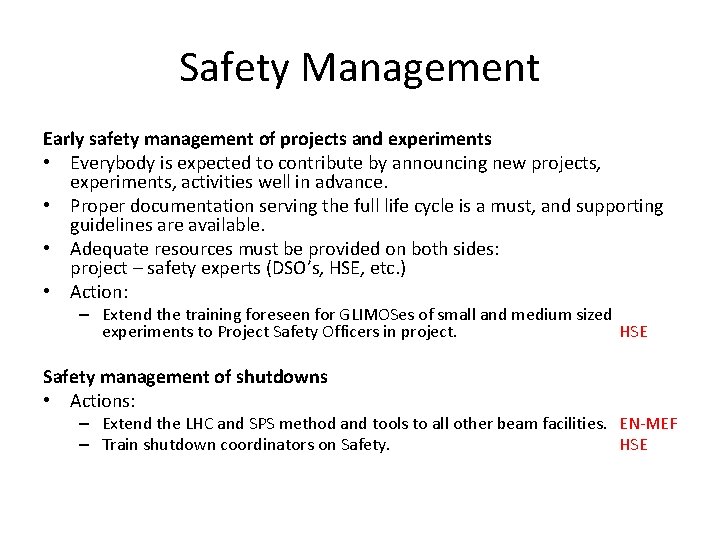
Safety Management Early safety management of projects and experiments • Everybody is expected to contribute by announcing new projects, experiments, activities well in advance. • Proper documentation serving the full life cycle is a must, and supporting guidelines are available. • Adequate resources must be provided on both sides: project – safety experts (DSO’s, HSE, etc. ) • Action: – Extend the training foreseen for GLIMOSes of small and medium sized experiments to Project Safety Officers in project. HSE Safety management of shutdowns • Actions: – Extend the LHC and SPS method and tools to all other beam facilities. EN-MEF – Train shutdown coordinators on Safety. HSE
ALARA experience and lessons learnt • ALARA principles and corresponding methods are well accepted and progressively extended to all facilities. Tune-up of the process must now take place based on lessons learnt over the last few years. DGS/RP, RSOC • Remote handling and monitoring is important for ALARA. Needs top management support, and creation of a dedicated center of competence, e. g. in EN-HE. • Documentation of equipment installed and tasks to be performed in particularly radioactive environment is essential. Examples : taking video footage on site for difficult operations, training with mockups or spare parts before actual intervention.
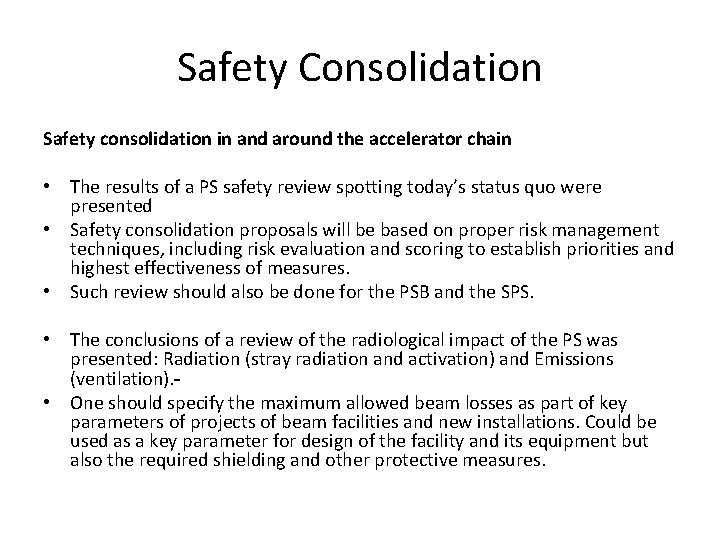
Safety Consolidation Safety consolidation in and around the accelerator chain • The results of a PS safety review spotting today’s status quo were presented • Safety consolidation proposals will be based on proper risk management techniques, including risk evaluation and scoring to establish priorities and highest effectiveness of measures. • Such review should also be done for the PSB and the SPS. • The conclusions of a review of the radiological impact of the PS was presented: Radiation (stray radiation and activation) and Emissions (ventilation). • One should specify the maximum allowed beam losses as part of key parameters of projects of beam facilities and new installations. Could be used as a key parameter for design of the facility and its equipment but also the required shielding and other protective measures.
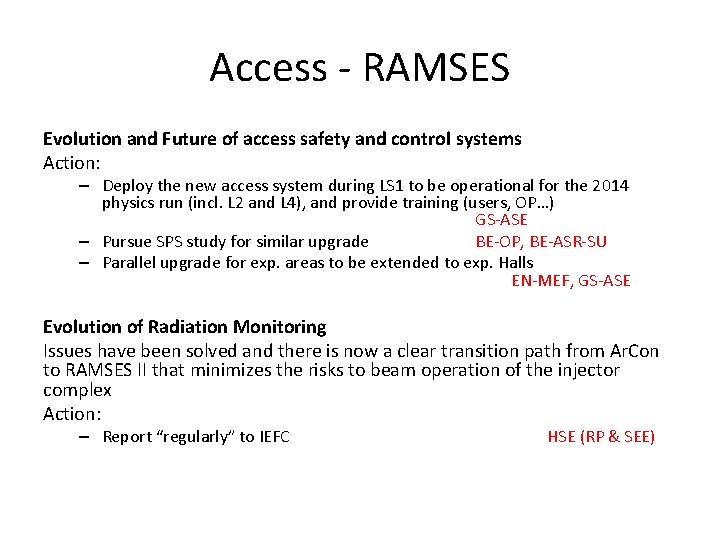
Access - RAMSES Evolution and Future of access safety and control systems Action: – Deploy the new access system during LS 1 to be operational for the 2014 physics run (incl. L 2 and L 4), and provide training (users, OP…) GS-ASE – Pursue SPS study for similar upgrade BE-OP, BE-ASR-SU – Parallel upgrade for exp. areas to be extended to exp. Halls EN-MEF, GS-ASE Evolution of Radiation Monitoring Issues have been solved and there is now a clear transition path from Ar. Con to RAMSES II that minimizes the risks to beam operation of the injector complex Action: – Report “regularly” to IEFC HSE (RP & SEE)