
Safety Scientific Method and Divisions of Earth Science
- Slides: 11
Safety, Scientific Method, and Divisions of Earth Science Introduction to Earth Science
Safety �Be Responsible! �Follow all instructions carefully. �Only touch equipment and materials AFTER you have been instructed to do so. �Be Prepared. �Keep your area clean and neat. �Know what to do if there is an accident or emergency. �If you don’t know, ASK!
Scientific Method �Used when trying to find an answer to a question or a problem �Can be formal or informal �Steps vary depending on the question or problem
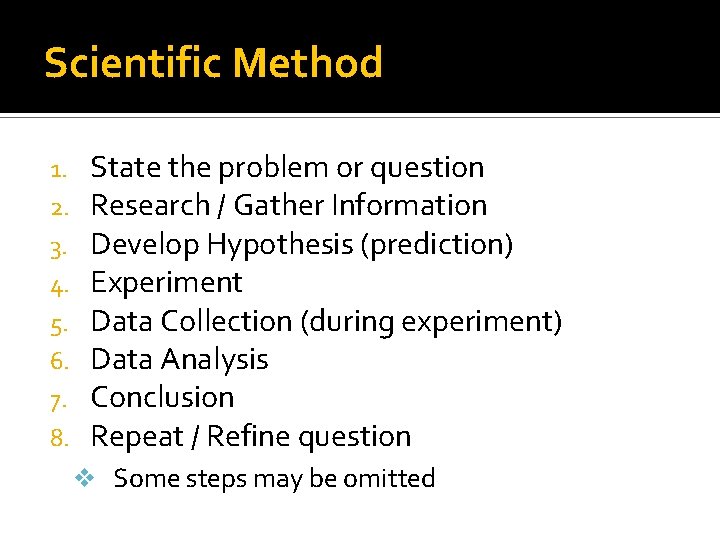
Scientific Method 1. 2. 3. 4. 5. 6. 7. 8. State the problem or question Research / Gather Information Develop Hypothesis (prediction) Experiment Data Collection (during experiment) Data Analysis Conclusion Repeat / Refine question v Some steps may be omitted
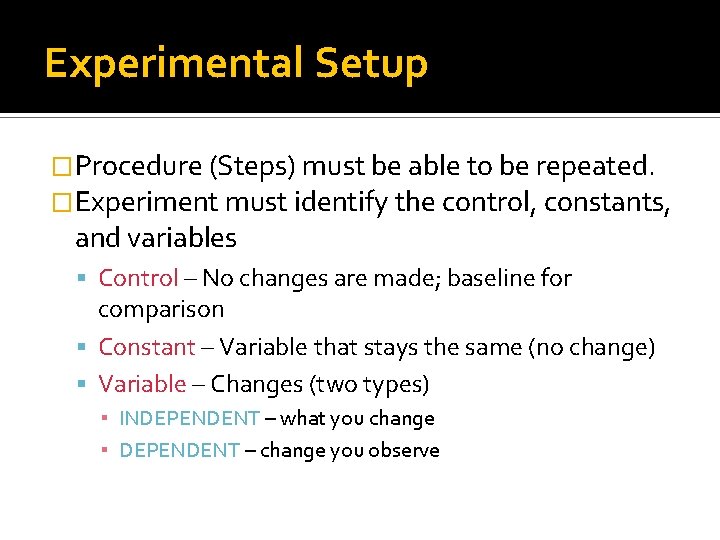
Experimental Setup �Procedure (Steps) must be able to be repeated. �Experiment must identify the control, constants, and variables Control – No changes are made; baseline for comparison Constant – Variable that stays the same (no change) Variable – Changes (two types) ▪ INDEPENDENT – what you change ▪ DEPENDENT – change you observe
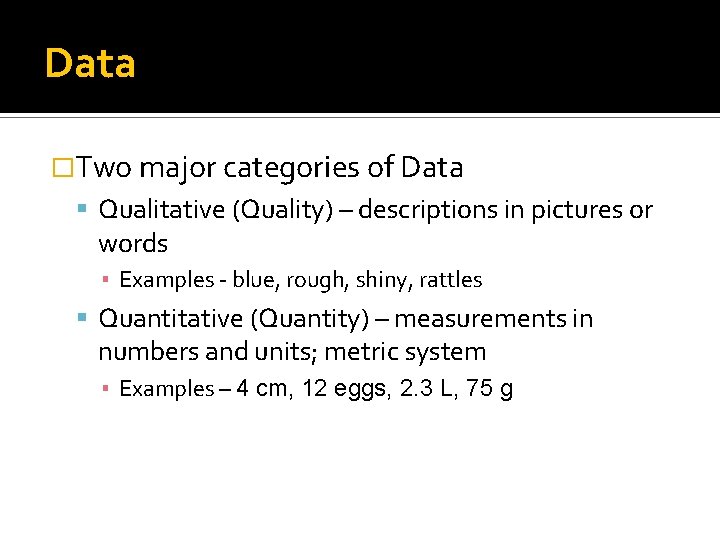
Data �Two major categories of Data Qualitative (Quality) – descriptions in pictures or words ▪ Examples - blue, rough, shiny, rattles Quantitative (Quantity) – measurements in numbers and units; metric system ▪ Examples – 4 cm, 12 eggs, 2. 3 L, 75 g
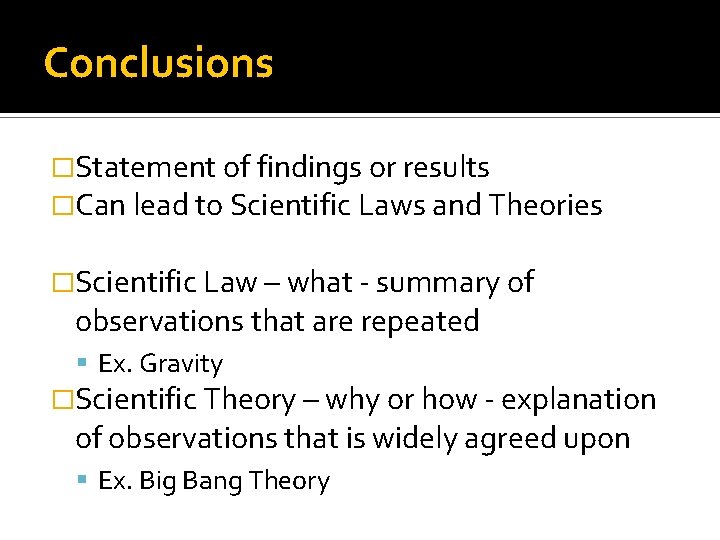
Conclusions �Statement of findings or results �Can lead to Scientific Laws and Theories �Scientific Law – what - summary of observations that are repeated Ex. Gravity �Scientific Theory – why or how - explanation of observations that is widely agreed upon Ex. Big Bang Theory
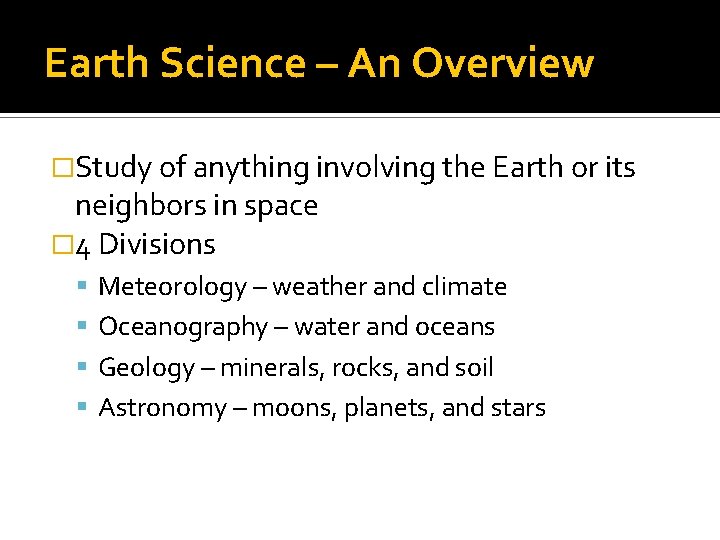
Earth Science – An Overview �Study of anything involving the Earth or its neighbors in space � 4 Divisions Meteorology – weather and climate Oceanography – water and oceans Geology – minerals, rocks, and soil Astronomy – moons, planets, and stars
Earth �The Earth can be described as 4 distinct spheres. Atmosphere Biosphere Hydrosphere Geosphere �All 4 spheres are connected. How would a volcanic eruption affect each of the four spheres?
Mapping the Earth �Map – 2 dimensional representation of the Earth �Globe – 3 dimensional representation of the Earth �Types of Maps Road Political Geologic Topographic Etc.
Map Features �Compass – direction �Legend or Key – meaning of symbols �Gridlines – location Latitude – Vertical (North-South) Longitude – Horizontal (West-East)