
Safety Scanning Are we overlooking a hazard ELIMINATE


- Slides: 14
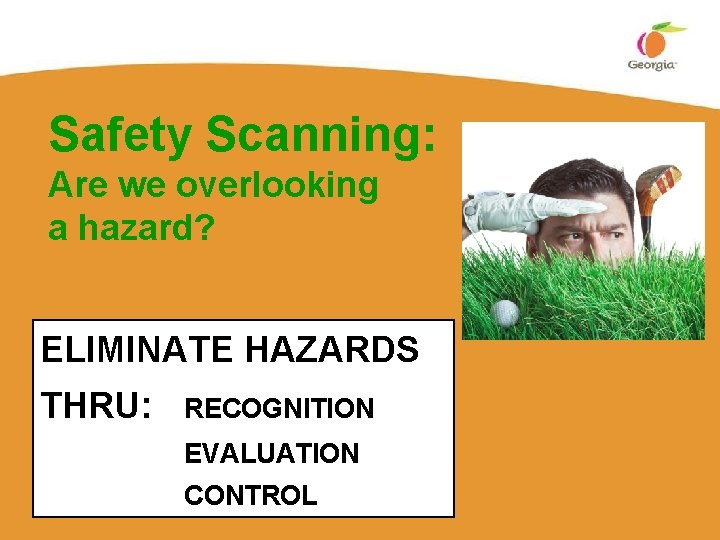
Safety Scanning: Are we overlooking a hazard? ELIMINATE HAZARDS THRU: RECOGNITION EVALUATION CONTROL
OBJECTIVES • Become effective “Safety Scanners” ▪ Constantly be looking for hazards ▪ Spot and recognize hazards ▪ Take action to reduce or eliminate • Understand basic hazards • Safety is not a Spectator Sport • Especially Important when performing Non-Routine Tasks 2
RECOGNIZING HAZARDS • • • Training Job Experience Familiarity with operation Lack of familiarity with area Use of safety scanning survey technique • Unusual Tasks 3
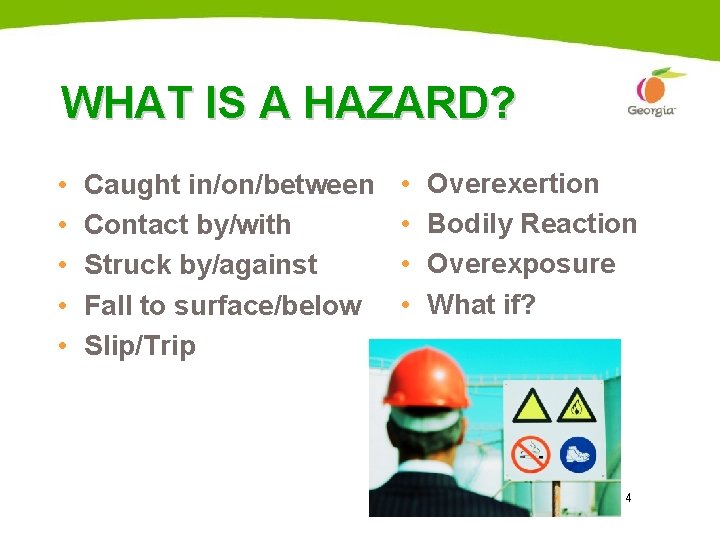
WHAT IS A HAZARD? • • • Caught in/on/between Contact by/with Struck by/against Fall to surface/below Slip/Trip • • Overexertion Bodily Reaction Overexposure What if? 4
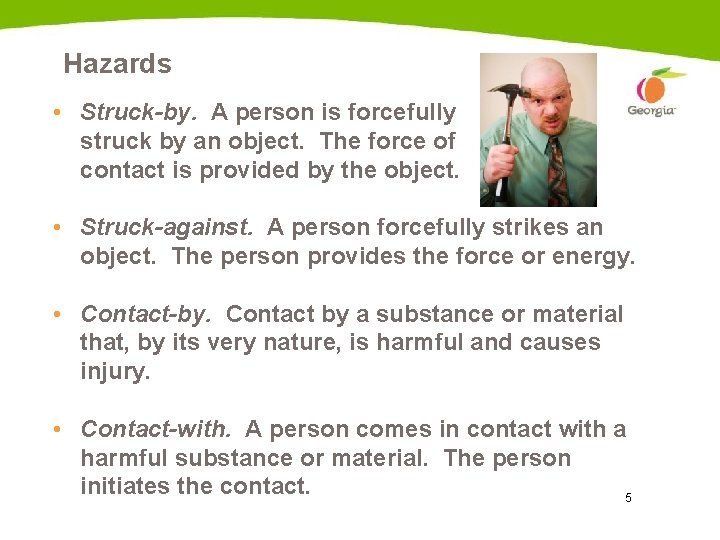
Hazards • Struck-by. A person is forcefully struck by an object. The force of contact is provided by the object. • Struck-against. A person forcefully strikes an object. The person provides the force or energy. • Contact-by. Contact by a substance or material that, by its very nature, is harmful and causes injury. • Contact-with. A person comes in contact with a harmful substance or material. The person initiates the contact. 5
Hazards • Caught-on. A person or part of his/her clothing or equipment is caught on an object that is either moving or stationary. • Caught-in. A person or part of him/ is trapped or otherwise caught opening or enclosure. her in an • Caught-between. A person is crushed, pinched, or otherwise caught between a moving and a stationary object or between two moving objects. 6
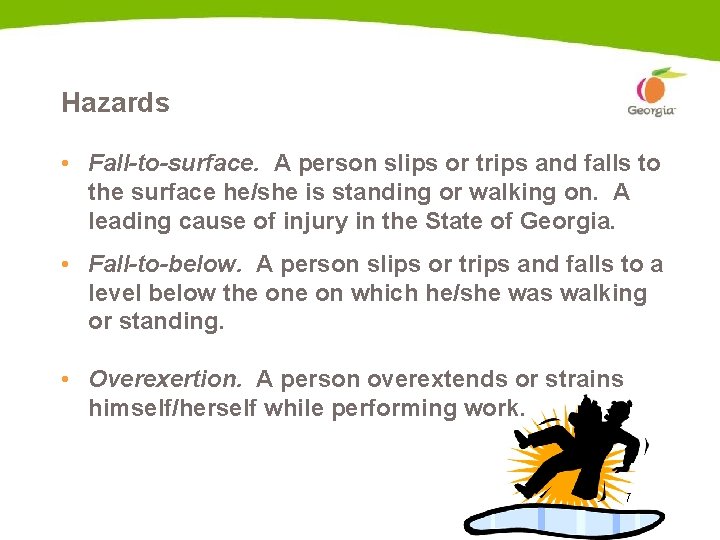
Hazards • Fall-to-surface. A person slips or trips and falls to the surface he/she is standing or walking on. A leading cause of injury in the State of Georgia. • Fall-to-below. A person slips or trips and falls to a level below the on which he/she was walking or standing. • Overexertion. A person overextends or strains himself/herself while performing work. 7
Hazards • Bodily reaction. Caused solely from stress imposed by free movement of the body. Sudden motions, bends, slips or trips without falling. A common cause of injury. • Overexposure. Over a period of time, a person is exposed to harmful energy (noise, heat), lack of energy (cold), or substances (toxic chemicals/atmospheres). 8
HOW TO SCAN • Sweep eyes around work area • Hazards present? • Analyze possible/probable results • React to hazards/ Control measures • Proceed 9
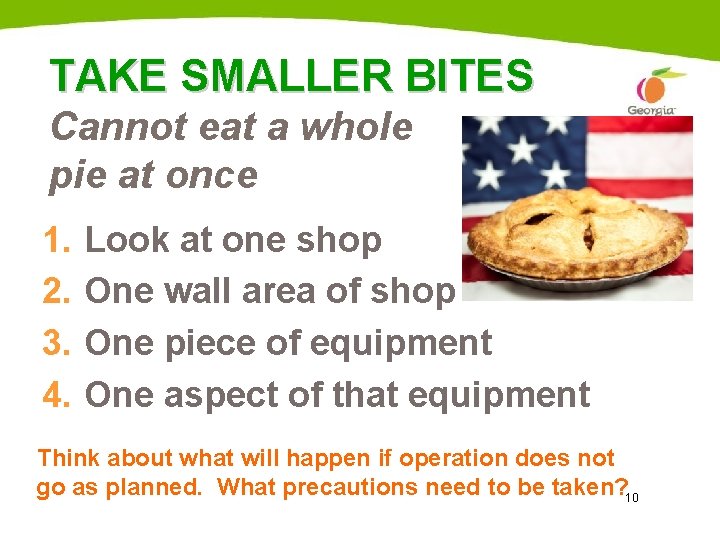
TAKE SMALLER BITES Cannot eat a whole pie at once 1. 2. 3. 4. Look at one shop One wall area of shop One piece of equipment One aspect of that equipment Think about what will happen if operation does not go as planned. What precautions need to be taken? 10
HAZARDS IDENTIFIED • • • Correct Yourself? Contact Property Manager? Refer to Supervisor? Bring up in Safety Meeting? Refer to Safety Committee? Warn/Reduce the Hazard until Fixed? 11
PRACTICE • Practice to be effective • Start with small area and short time • Increase area and time practiced • Make it AUTOMATIC Also consider “What If” Scenarios. 12
F-O-C-U-S • Remember the “S” in the FOCUS tool. • “See the big picture. ” See hazards around you and protect yourself from them. • See the potential chain of events that could lead up to an accident. • What barriers are in place to prevent an incident? • Understand what you are doing and see 13 the hazards.
Questions? 14