
Safety of Flight Collision Avoidance VFR Means the



- Slides: 31
Safety of Flight
Collision Avoidance • VFR: Means the airplane is operating under “see and avoid” principles • 91. 113 • IFR: Means the airplane is being separated by ATC • Contrast with meteorological conditions: • IMC: Instrument Meteorological Conditions (can not see) • VMC: Visual Meteorological Conditions (can see) © 2015 Coast Flight Training. All Rights Reserved.
Collision Avoidance - Scanning • Pilot cannot go into IMC without an Instrument Rating • Pilot’s duty to see and avoid in visual flight conditions • To see and avoid other aircraft, we need to learn to scan © 2015 Coast Flight Training. All Rights Reserved.
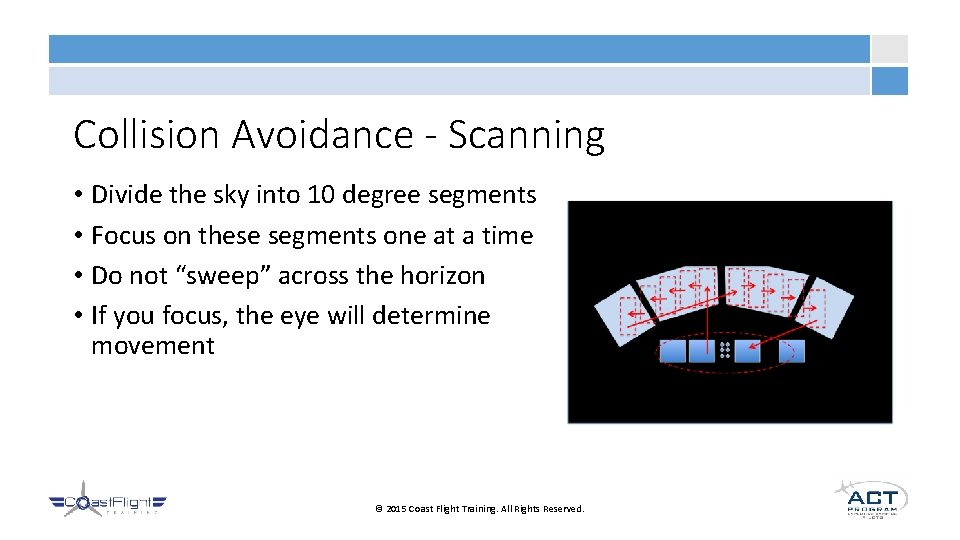
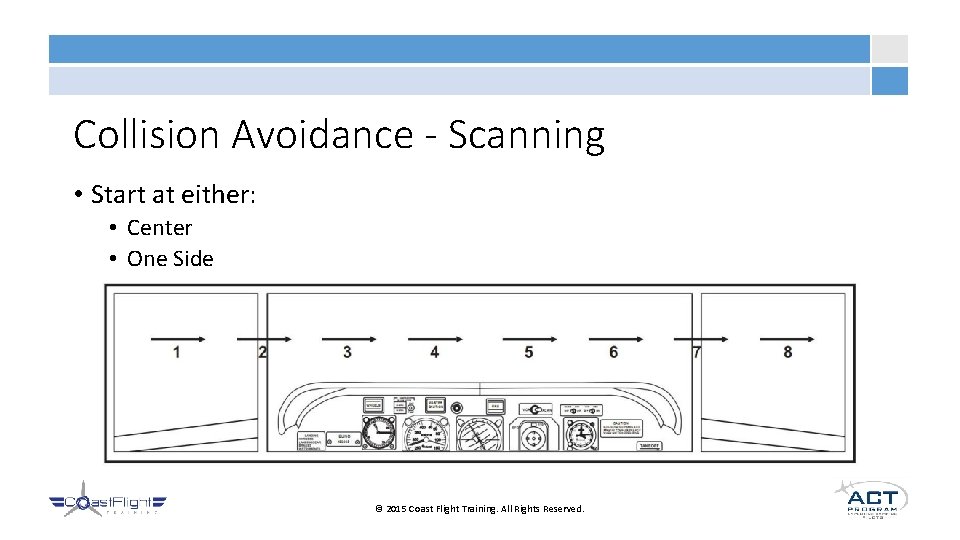
Collision Avoidance - Scanning • Divide the sky into 10 degree segments • Focus on these segments one at a time • Do not “sweep” across the horizon • If you focus, the eye will determine movement © 2015 Coast Flight Training. All Rights Reserved.
Collision Avoidance - Scanning • Start at either: • Center • One Side © 2015 Coast Flight Training. All Rights Reserved.
Empty-Field Myopia • In low visibility, the eye tends to focus 10 to 30 feet ahead • Only happens when sky is devoid of objects • Means that spots on the windshield could appear to be airplanes • Also happens at night (Night Myopia) © 2015 Coast Flight Training. All Rights Reserved.
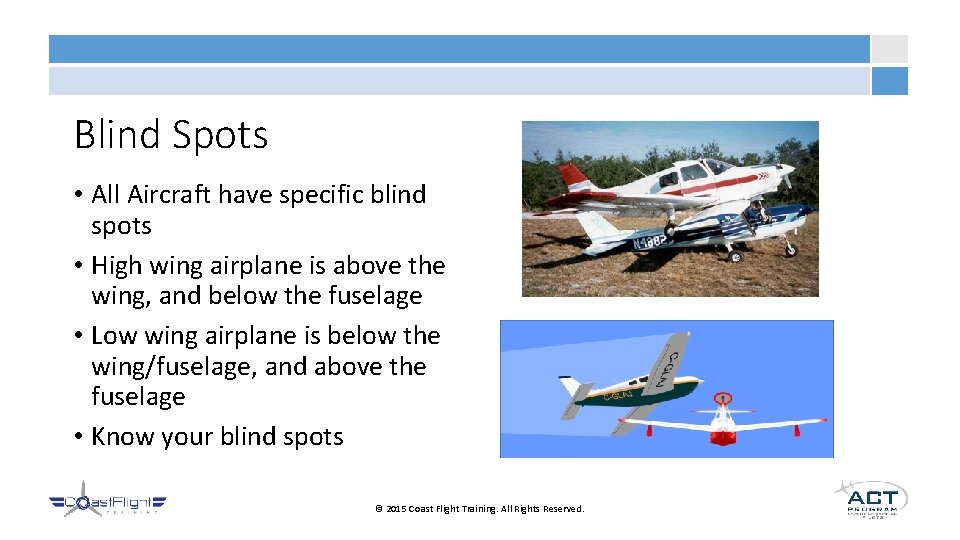
Blind Spots • All Aircraft have specific blind spots • High wing airplane is above the wing, and below the fuselage • Low wing airplane is below the wing/fuselage, and above the fuselage • Know your blind spots © 2015 Coast Flight Training. All Rights Reserved.
Airport Operations • Pilot’s need to exercise extreme caution in airport environments • More airplanes in this environment • At any given moment at Montgomery Field there could be 10 planes in the pattern © 2015 Coast Flight Training. All Rights Reserved.
Airport Operations • FAA has started Operation Lights On • Voluntary program that encourages pilots to turn on all lights when within 10 miles of an airport • Both day and night • Anti-collision Lights required to be on when engine running (FAR) © 2015 Coast Flight Training. All Rights Reserved.
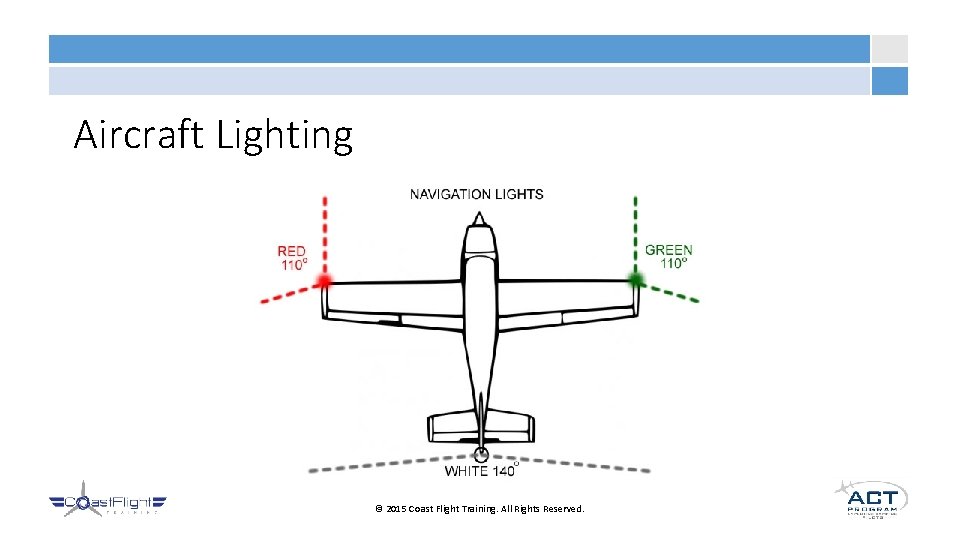
Aircraft Lighting © 2015 Coast Flight Training. All Rights Reserved.
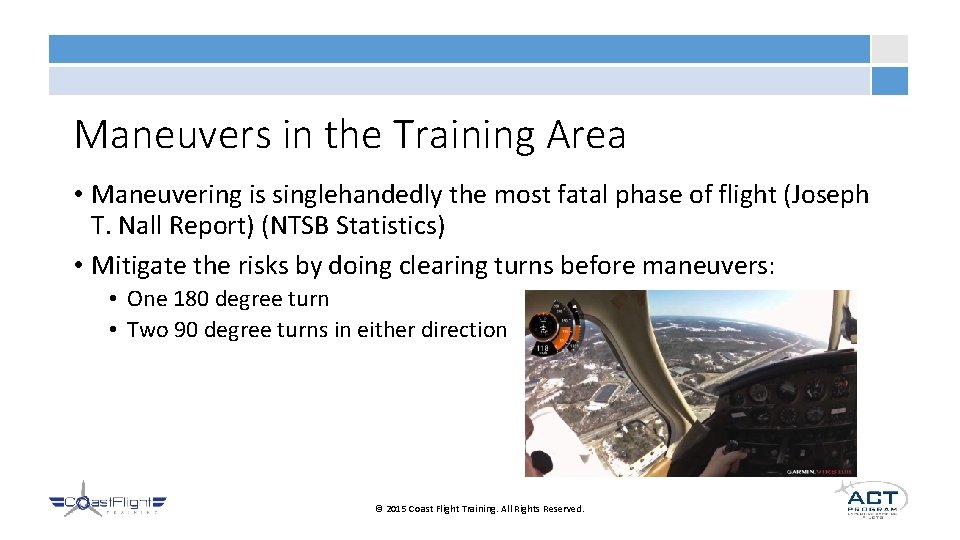
Maneuvers in the Training Area • Maneuvering is singlehandedly the most fatal phase of flight (Joseph T. Nall Report) (NTSB Statistics) • Mitigate the risks by doing clearing turns before maneuvers: • One 180 degree turn • Two 90 degree turns in either direction © 2015 Coast Flight Training. All Rights Reserved.
The Pre-Maneuver Checklist • Coast Flight Training incorporates the Clearing Turns into the Pre. Maneuver Checklist • All students MUST memorize this checklist • See Maneuvers Guide: (IP 3 C’s) • Instruments • Position • Checklist (Configure) • Fuel, Ignition, Lights • Clear • Call © 2015 Coast Flight Training. All Rights Reserved.
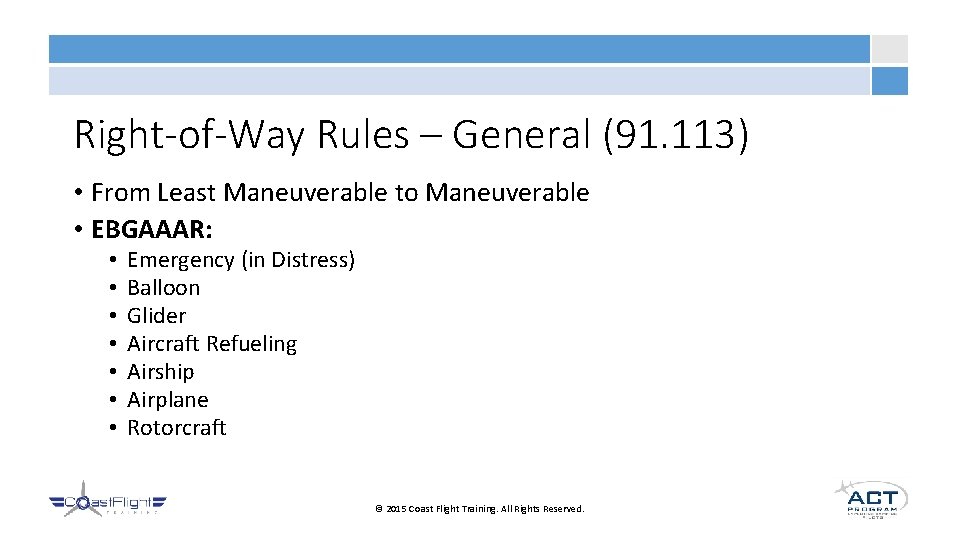
Right-of-Way Rules – General (91. 113) • From Least Maneuverable to Maneuverable • EBGAAAR: • • Emergency (in Distress) Balloon Glider Aircraft Refueling Airship Airplane Rotorcraft © 2015 Coast Flight Training. All Rights Reserved.
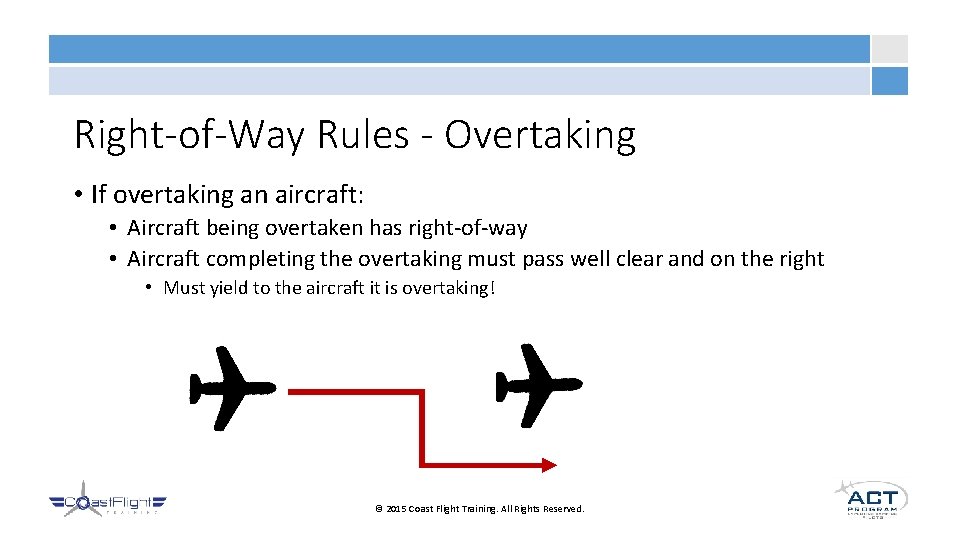
Right-of-Way Rules - Overtaking • If overtaking an aircraft: • Aircraft being overtaken has right-of-way • Aircraft completing the overtaking must pass well clear and on the right • Must yield to the aircraft it is overtaking! © 2015 Coast Flight Training. All Rights Reserved.
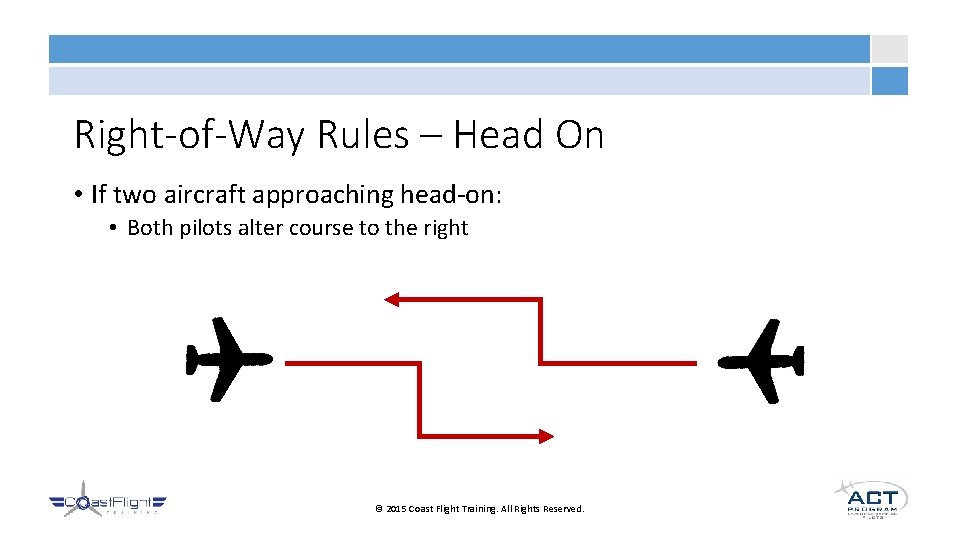
Right-of-Way Rules – Head On • If two aircraft approaching head-on: • Both pilots alter course to the right © 2015 Coast Flight Training. All Rights Reserved.
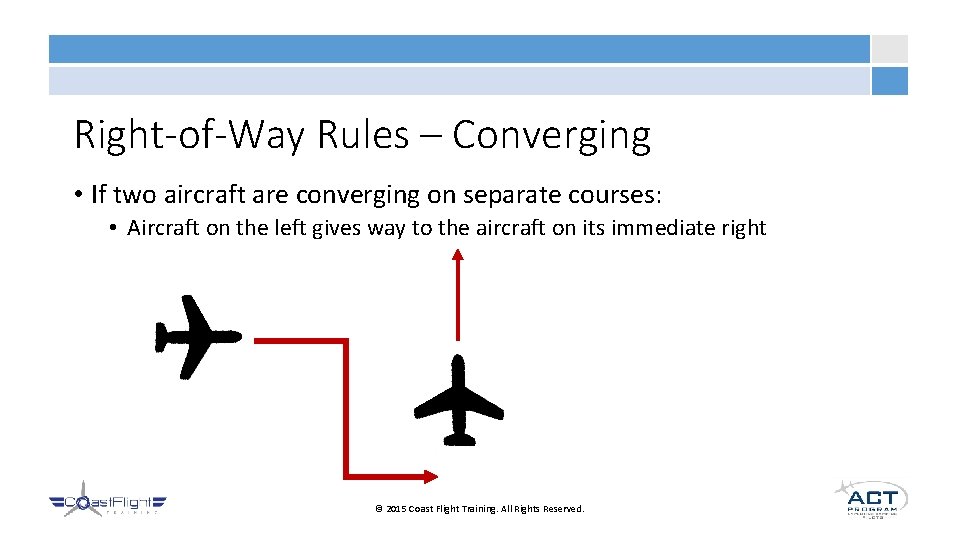
Right-of-Way Rules – Converging • If two aircraft are converging on separate courses: • Aircraft on the left gives way to the aircraft on its immediate right © 2015 Coast Flight Training. All Rights Reserved.
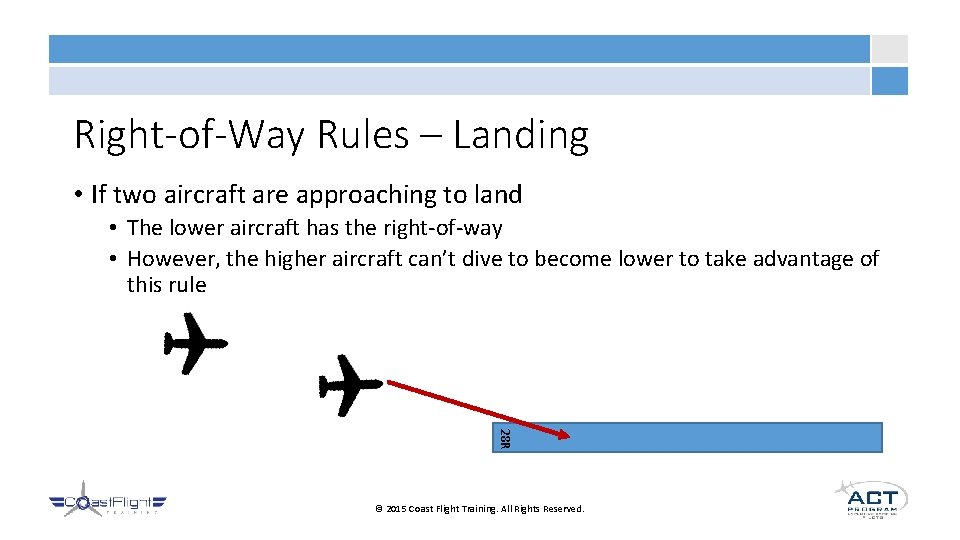
Right-of-Way Rules – Landing • If two aircraft are approaching to land • The lower aircraft has the right-of-way • However, the higher aircraft can’t dive to become lower to take advantage of this rule 28 R © 2015 Coast Flight Training. All Rights Reserved.
Minimum Safe Altitudes - General • Except when Takeoff or Landing • Altitude that if power fails, an emergency landing can be made without undue hazard to persons or property on the surface • This rule is all-encompassing © 2015 Coast Flight Training. All Rights Reserved.
Minimum Safe Altitudes – Congested Areas • What is a congested area? (91. 119) • GREY AREA (undefined) • 1000 feet above highest obstacle • 2000 feet horizontally between obstacles © 2015 Coast Flight Training. All Rights Reserved.
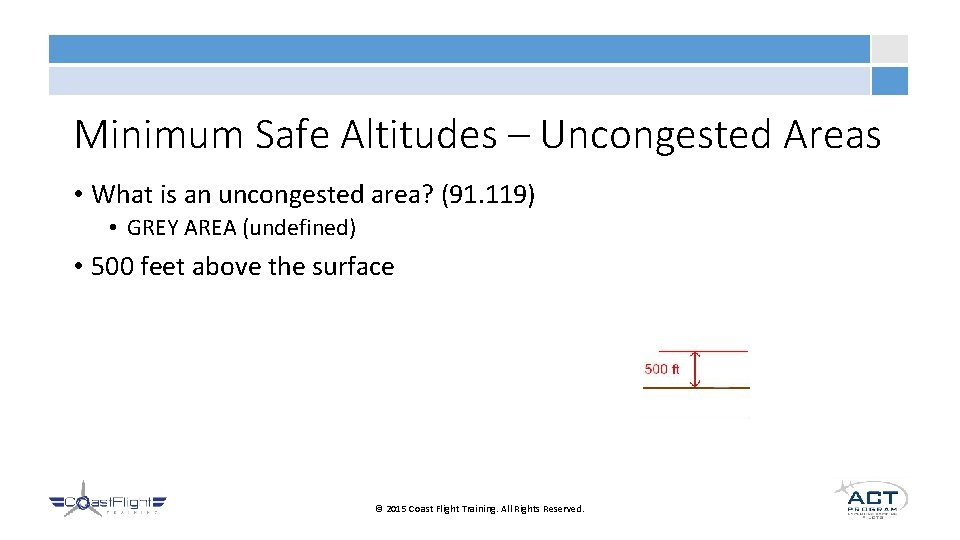
Minimum Safe Altitudes – Uncongested Areas • What is an uncongested area? (91. 119) • GREY AREA (undefined) • 500 feet above the surface © 2015 Coast Flight Training. All Rights Reserved.
Minimum Safe Altitudes – Sparsely Populated • What is a sparsely populated area? (91. 119) • GREY AREA (undefined) • May not be operated closer than 500 feet to any person, vessel, vehicle or structure © 2015 Coast Flight Training. All Rights Reserved.
Wire Strike Avoidance • Wire strike accidents mainly occur below 100 feet AGL • Maintain a 2000 feet horizontal distance from any tower • Flying at least 1000 feet dramatically reduces chances of wire strike • Higher risk when approaching to land • Stay on glide-path during approach – especially at night or at an unfamiliar airport • NOTAMS! (We’ll talk about these in a moment) © 2015 Coast Flight Training. All Rights Reserved.
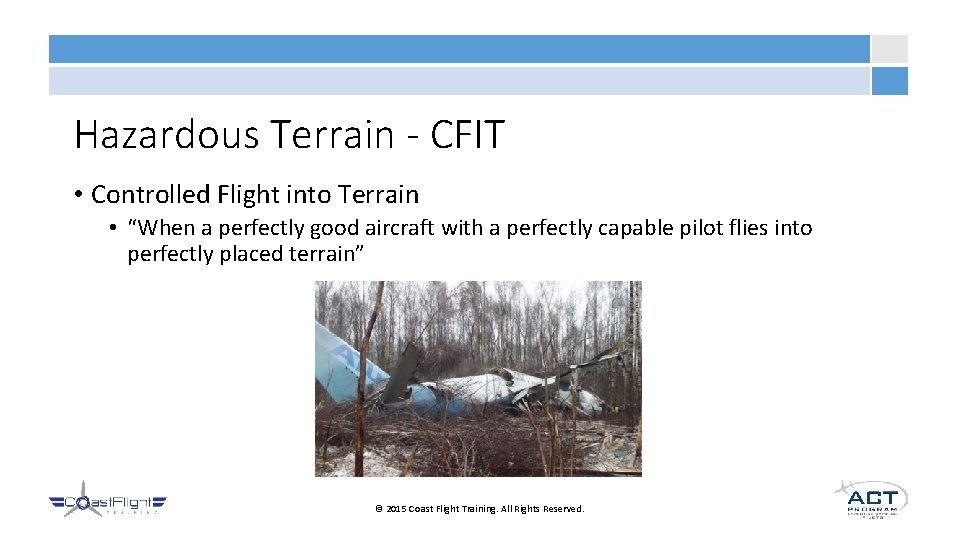
Hazardous Terrain - CFIT • Controlled Flight into Terrain • “When a perfectly good aircraft with a perfectly capable pilot flies into perfectly placed terrain” © 2015 Coast Flight Training. All Rights Reserved.
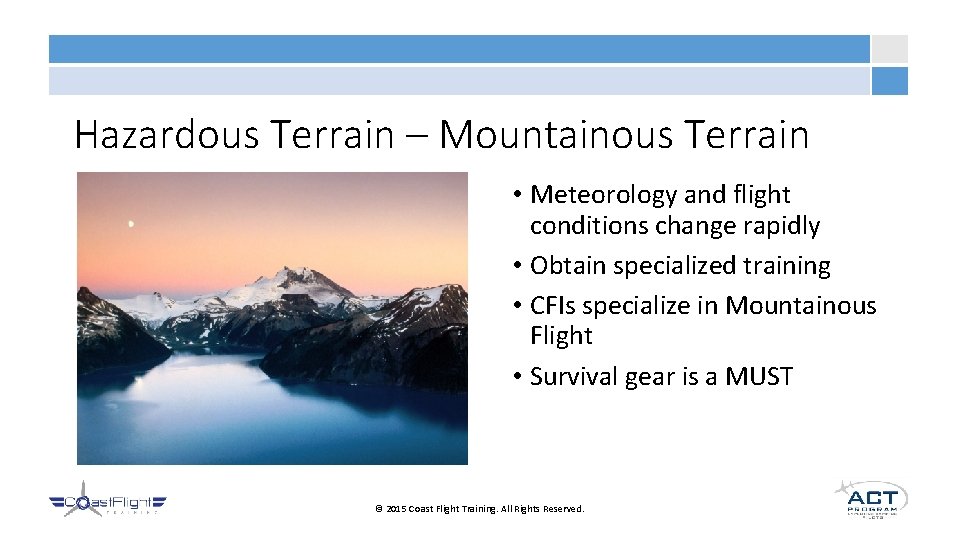
Hazardous Terrain – Mountainous Terrain • Meteorology and flight conditions change rapidly • Obtain specialized training • CFIs specialize in Mountainous Flight • Survival gear is a MUST © 2015 Coast Flight Training. All Rights Reserved.
Hazardous Terrain – Open Water • Engine out procedures are more pronounced • Obtain specialized training • Most don’t learn until 135 or 121 training • Survival gear is required by law (91. 205(b)(12)) © 2015 Coast Flight Training. All Rights Reserved.
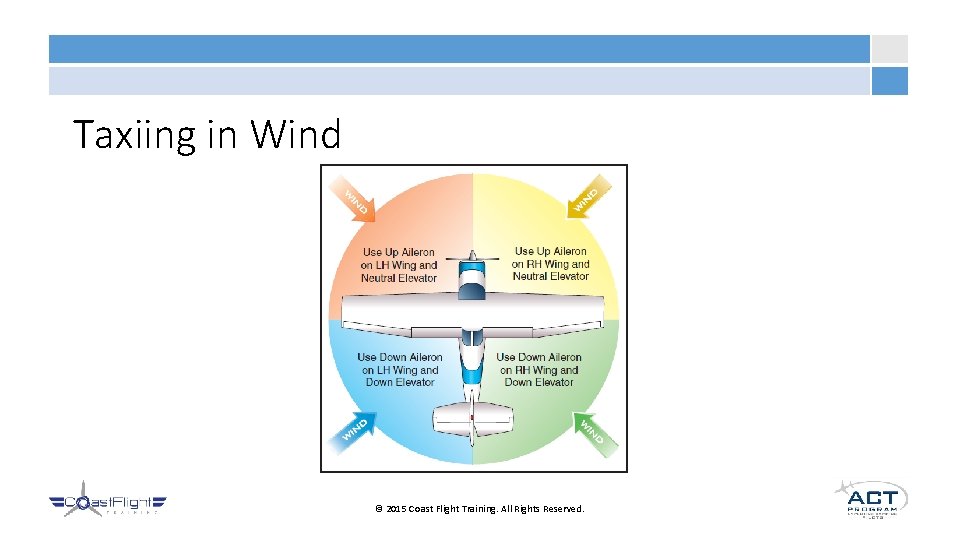
Taxiing in Wind • “Turn into or dive away from” • Left quarter headwind – Turn into, neutral elevator • Right quarter headwind – Turn into, neutral elevator • Left quarter tailwind – Turn away from, dive down • Right quarter tailwind – Turn away from, dive down © 2015 Coast Flight Training. All Rights Reserved.
Taxiing in Wind © 2015 Coast Flight Training. All Rights Reserved.
The Positive Exchange of Flight Controls • Importance of knowing who is flying the plane • Pilot passing: “You have the flight controls” • Pilot taking control: “I have the flight controls” • Pilot passing: “You have the flight controls” • “My Airplane” is NO LONGER ACCEPTED • Why? © 2015 Coast Flight Training. All Rights Reserved.
The Sterile Cockpit • Airline rule below 10, 000 feet: • The flight deck will remain silent unless it is critical to the phase of flight • We will use this at Coast below 1000 • Violation shall face reprimand • Don’t be afraid to tell your instructor to be quiet © 2015 Coast Flight Training. All Rights Reserved.
Aviation Safety Reporting System • If you see or do something unsafe, report it • NASA ASRS form • Anonymous • Can mitigate or eliminate penalties from the FAA • Doesn’t erase from record, but suspends penalty • When should you fill one out? • Who should fill one out? © 2015 Coast Flight Training. All Rights Reserved.
Final Words on Safety • Safety is everyone’s responsibility • We’re training you to be creatures of habit • Make safety a habit • "The best safety device in any aircraft is a well-trained crew. " © 2015 Coast Flight Training. All Rights Reserved.