
Safety Observations are visits to work areas to
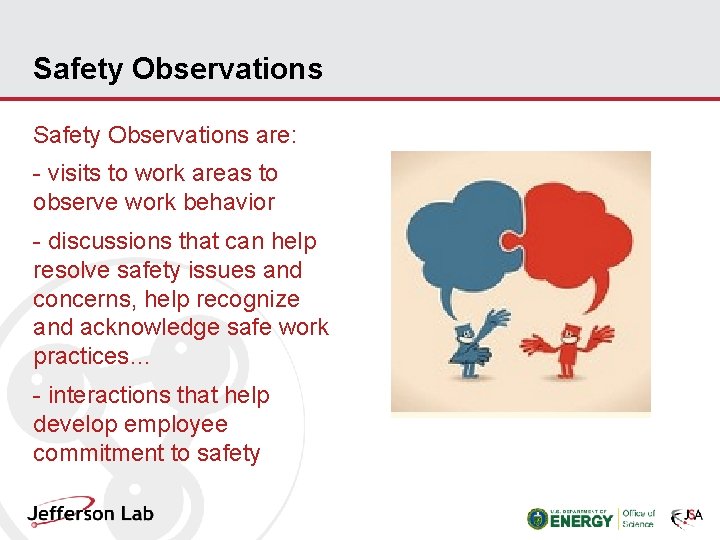
Safety Observations are: - visits to work areas to observe work behavior - discussions that can help resolve safety issues and concerns, help recognize and acknowledge safe work practices… - interactions that help develop employee commitment to safety

Safety Observations, cont’d. • Safety Observations (SO) are the singular most effective way we have to positively reinforce safety culture at JLab • SO are the principal leading performance indicator for the effectiveness of our safety program • Who does SO? -Most managers are trained to do SO in their employee workspaces (manager – worker SO) • Lab Director, AD, Department Heads, Group Leaders, Line Managers • There is a growing number of non-manager staff trained to conduct SO on peers (worker – worker SO) Safety Observations 2
Safety Observations, cont’d. • What do you do if you are observed in an SO? -Pause work and talk openly about what you are doing. This will help the SO observer get context about what they are seeing -Answer questions honestly; the SO observer is usually not an expert at what you happen to be doing -During your conversation, expect questions like: • What is/are the principal hazards(s) associated with your work? • How do you protect yourself? • Is there anything that you (the worker) would like to change about the work process you are using or related safety aspects? • What happens afterward? -The interaction is recorded but worker identity is not -Potential improvements developed during conversation are recorded (as well as the need for any follow-up) Safety Observations 3

Safety Observations, cont’d. • The SO training and process is being updated to include a Human Performance Improvement (HPI) focus -This will additional elements to the SO that are designed to look for • Error-likely situations (activity and process steps that lead to a higher degree of risk) • Influences to individual behavior (stressors, underlying messages in the organization or organizational weakness that lead to errorlike situations) • Situations that place workers at risk or situations where additional risk is ignored because it appears too difficult to change • Want to get trained to do SO? -Read SAF 120 kd -Contact Bob May may@jlab. org to participate in a practical demonstration Safety Observations 4
- Slides: 4