
Safety Observation Process Pathway to an Injury Free
Safety Observation Process Pathway to an Injury Free Career If we can predict it: we can prevent it! Safety Observation
What Is a Safety Observation? • Tool to raise safety awareness in a non-threatening way • Allows for directed / guided observation teams • Tool to build trust • Feedback loop mechanism • ↑ increase safety awareness • ↓ decrease anxiety or threat of reporting errors • Goal is to fix things quickly and effectively Safety Observation
Effective Safety Management Characteristics of effective safety performance: Ø Ø Ø Measurable. Focuses on positive activities. Direct impact on outcomes. Opportunity for two-way feedback and positive reinforcement. Opportunity for goal setting based on performance data. Safety Observation
Observations identify job site hazards, controls, conditions, manage exposure to risks, reduce exposure, and thereby reduce injury. Apply a strategic approach: ØAnticipate and prevent active error at the job site. ØReduce total number of “at-risk” critical behaviors and/or conditions. ØIdentify and eliminate the related barriers/latent organizational weaknesses. ØChange other factors to encourage safe behaviors. Safety Observation
Safety Observation—Objectives • Provide positive reinforcement / feedback for safe behaviors observed. • Identify error-likely conditions for corrective actions. • Gather meaningful data for analysis that identifies institutional weaknesses in work management systems. Do Work Safely Safety Observation
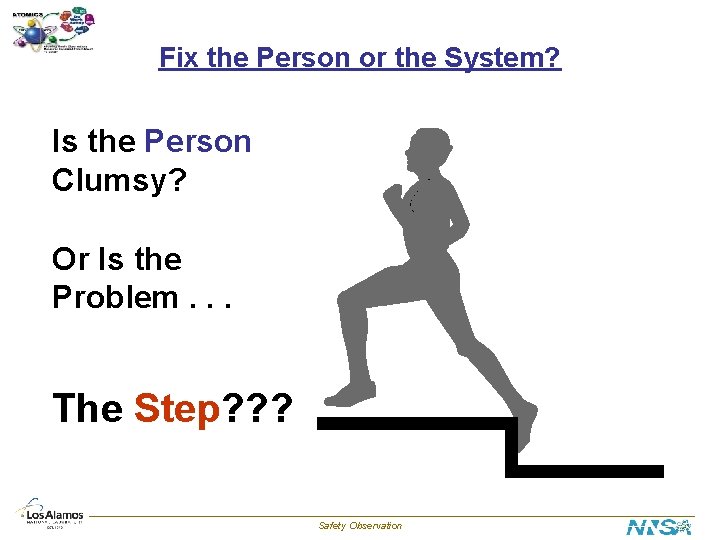
Fix the Person or the System? Is the Person Clumsy? Or Is the Problem. . . The Step? ? ? Safety Observation
II. Human Performance & Integrated Safety Management Safety Observation

Human Performance Improvement Five Basic Principles 1. People are fallible, and even the best make mistakes. 2. Error-likely situations are predictable, manageable, and preventable. 3. Individual behavior is influenced by organizational processes and values. 4. People achieve high levels of performance based largely on the encouragement and reinforcement received from leaders, peers, and subordinates. 5. Events can be avoided by understanding the reasons mistakes occur and applying the lessons learned from past events. Safety Observation

Industry Statistics on Causes of Events Human Error System Induced Error Operational Upset Human Error (organizational weakness) Equipment Failures Safety Observation Unexpected Error
When Things Go Wrong How It Is Now… Human error is the cause of accidents: How It Should Be… Human error is a symptom of trouble deeper inside a system. You are highly trained You are human and If you did as trained, you would not make mistakes Humans make mistakes so so so Let’s also explore why the system allowed, or failed to accommodate your mistake You should be PUNISHED! Let’s IMPROVE THE SYSTEM! You weren’t careful enough Safety Observation
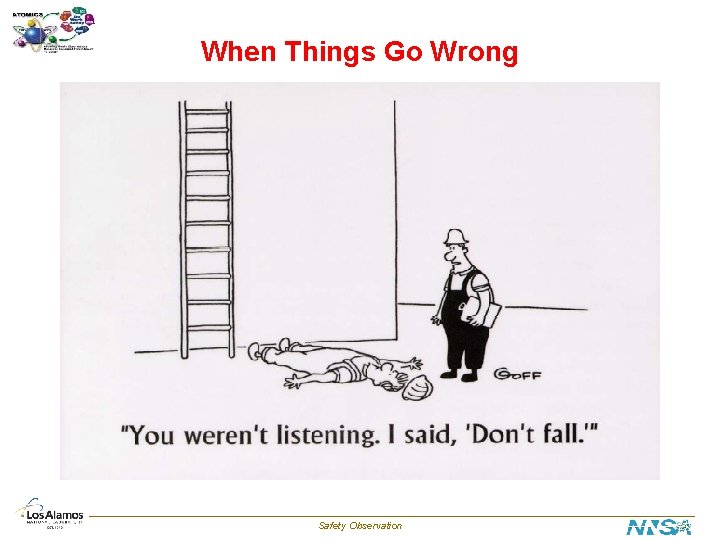
When Things Go Wrong Safety Observation
Where we are coming from: I keep entering this in the system but something needs to be done. The majority of the traffic going down and up Pecos drive is speeding. and a lot of the traffic is Gov. vehicles. Speed humps need to be put in place. Someone is going to get hit. There should be Speed humps installed on Pecos Road because of the excess speeding going on while people are walking to there buildings in the morning and also during lunch. Gov. vehicles and personal vehicles driving very fast up and down the road. NEED SPEED HUMPS!!!! As I was walking from the guard gate into PF-1, I observed a craft trucking speeding from the south to the north in a 10 MPH posted area. I was about to step into the crosswalk when they saw me and stopped suddenly. I motioned to the driver to slow down. They just laughed. Safety Observation
Where we are headed: Vehicle Operator Observation 1. 0 Pre Trip Inspection • Observed multiple cars in TA-55 parking lot and discovered that several of their tires were either under inflated or over inflated. with weather conditions becoming a factor proper tier pressure is important to check before driving. • Frost on windshield caused potential visibility problem. On discussing the issue it was decided to be late for a meeting and take the necessary time to completely clean the frost from the window before travelling. • During inspection of my motorcycle prior to leaving home for work, I found the brake light to be non-operational. The tail light was working, but not the brake light. I installed a spare bulb and that fixed the problem. • Observed LANL semi driver leaving yard pulling trailer, he did not do a pull test on trailer to make sure it was secure to tractor, stopped driver helped with pull test. Safety Observation
Vehicle Operator Observation 2. 0 Stopping • Driver initially stopped with about 1/2 car length distance between our vehicle and the vehicle in front of us, but increased this to a full car length after discussion. • Driver did a rolling stop at the stop sign. Pointed out the "California" stop in a nice way and driver agreed that full stop would have been safer. • Driver in government vehicle did not fully stop at stop sign when leaving parking lot. I noted who the driver was (someone I knew) and spoke/teased them about it later. They agreed that they should have fully stopped. • Driver often yields at stop signs rather than stops. A discussion was held concerning the behavior and the drive admitted to fault and stated that through awareness, the drive will be comply to stop signs and making a complete stop. In addition, a discussion was held concerning crashes that could be prevented if the drivers stopped completely as required by law. Vehicle Operator Observation 3. 0 Parking • Several cars were noted in the parking lot as having parked outside of designated spaces. I spoke with one driver, who didn't really care that they might get a ticket. They did not want to have to walk from TA-50 parking lot stating that it was more dangerous to walk and possibly slip on the ice than park in an unmarked spot. • The driver did forget the turn the wheels while parking on a hill. This behavior was identified and will be corrected for future vehicle operations. Safety Observation
Vehicle Operator Observation 4. 0 Backing • Airports could be designed so that airplanes would never have to back up. • Driver and Observer do not understand this question. Is this asking if the passenger backed up the vehicle before the driver did? • Driver failed to check rear of vehicle for any possible hazards before backing up. Spotter was needed and used after being notified. • The driver was not aware that it is a good driving practice to sound the horn prior to, and if possible, during the backing up process. He concurred that this signals pedestrians behind the vehicle to clear the area and committed to begin using this practice. • The driver did not sound the horn while backing up. This was a safety concern that both the observer and the observee learned by performing the ATOMICS observation. • Driver and Observer do not understand this question. Is this asking if the driver backs up the vehicle by turning the wheels 90 degrees and moving the vehicle side ways? Safety Observation
Safety Observer Roles and Responsibilities Observer rules for observing performance: Judge the behavior of the worker being observed with the same criteria you would use for yourself. We judge ourselves with external factors. We judge others with internal factors. Safety Observation
Fundamental Tenets of Safety Observations Ø Focuses on behaviors and conditions Ø No name, no blame process Ø Process is for people, it involves everybody Ø Gives positive reinforcement for safe behaviors. Ø Pro-active; uses leading indicators Ø Statistically driven. Ø Unlike TRC/DART provides process numbers workers control. Safety Observation
ATOMICS Safety Process 4 Essential Elements Ø Identify the critical behaviors and conditions Ø Collect data Ø Provide feedback Ø Use data to reduce/remove latent organizational weaknesses. Safety Observation
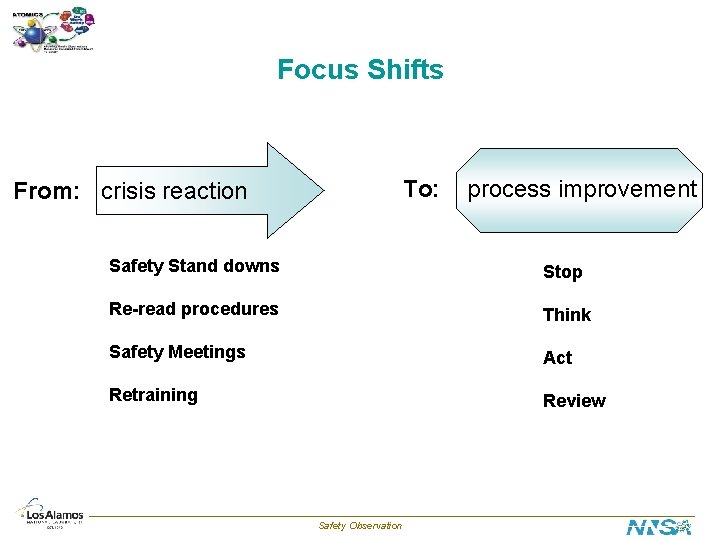
Focus Shifts To: From: crisis reaction process improvement Safety Stand downs Stop Re-read procedures Think Safety Meetings Act Retraining Review Safety Observation
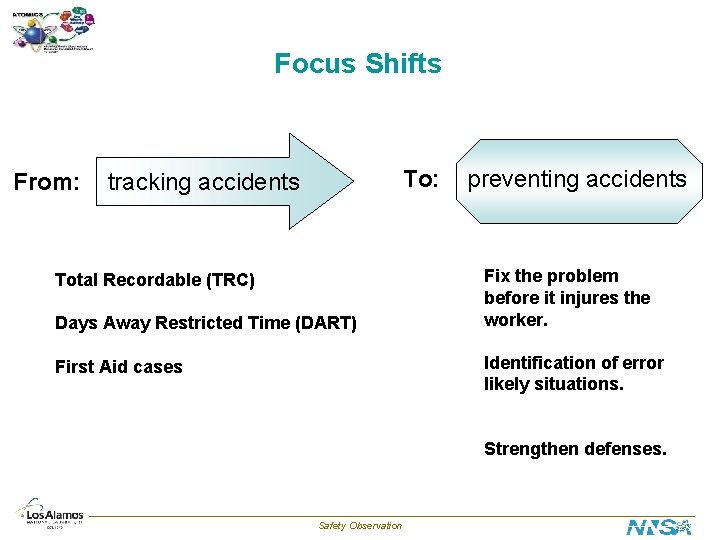
Focus Shifts From: To: tracking accidents Total Recordable (TRC) Days Away Restricted Time (DART) preventing accidents Fix the problem before it injures the worker. Identification of error likely situations. First Aid cases Strengthen defenses. Safety Observation
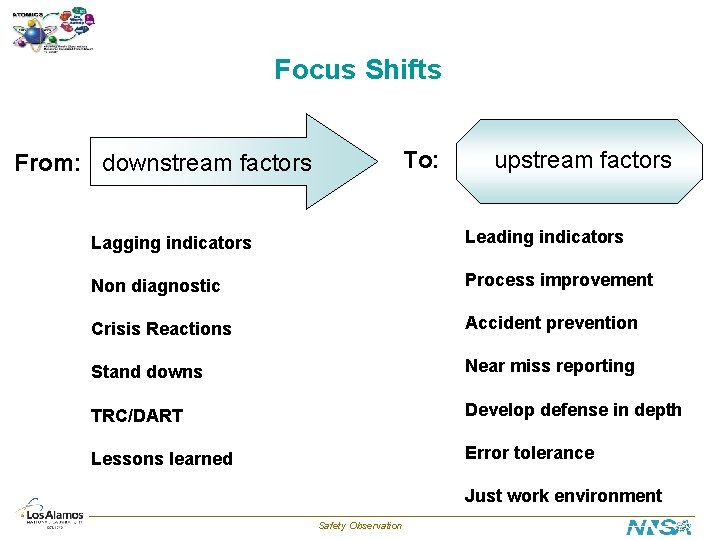
Focus Shifts To: From: downstream factors upstream factors Lagging indicators Leading indicators Non diagnostic Process improvement Crisis Reactions Accident prevention Stand downs Near miss reporting TRC/DART Develop defense in depth Lessons learned Error tolerance Just work environment Safety Observation
Observations manage exposure to risks, reduce exposure, and reduce injury. Apply a strategic approach: ØAnticipate and prevent active error at the job site. ØReduce total number of “at-risk” critical behaviors. ØIdentify and eliminate the related barriers/latent organizational weaknesses. ØChange other factors to encourage safe behaviors. Safety Observation
How do we change behavior? Traditional methods to improve safety performance: ØProgressive Discipline Ø Committees ØAdministrative Policies Ø Focus Groups ØVisions, Goals, Plans Ø Additional Defense Layers ØCore Value Statements Ø Contests & Awards ØSafety Training Ø Safety meetings ØNew Safety Initiatives Ø Motivational speakers Safety Observation
How do we change behavior? Traditional safety response: Injury: employee finished cleaning toilet inside stall turned tight and hit head on coat hanger… Response: retrain employee on being more aware of surroundings and potential hazards. Injury: walking to truck, slipped on ice Response: employee reminded to check walking area before proceeding to vehicle for slippery conditions Injury: employee walking around vehicle-slipped on ice and almost fell Response: retrain employee on slips, trips, and falls safety. Injury: employee missed dip in sidewalk, slipped and fell Response: be conscious of where you are walking Injury: employee sneezed acute internal pain in lower left rib cage area Response: encourage employee to stabilize body alignment before sneezing Injury: disposing metal piece, cut edge caught employees glove cutting through and cutting finger Response: need to describe to workers conditions that make up “line of fire” and self control of natural reflexes. Safety Observation
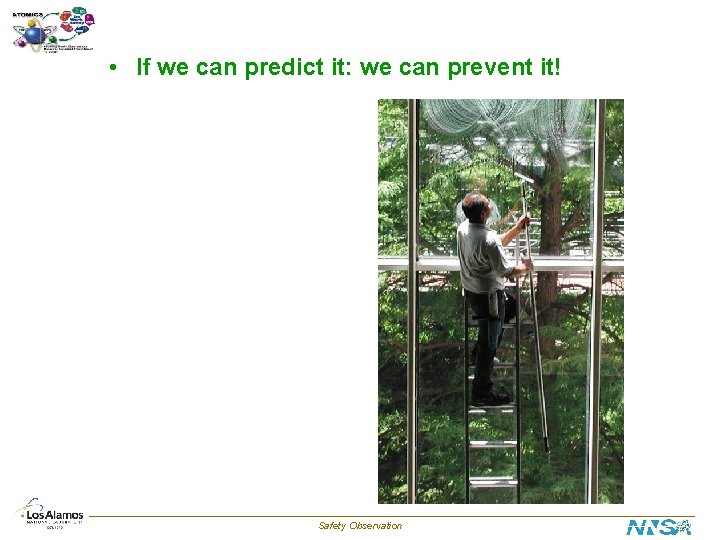
• If we can predict it: we can prevent it! Safety Observation

Observations identify job site hazards, controls, conditions, manage exposure to risks, reduce exposure, and thereby reduce injury. Safety Observation
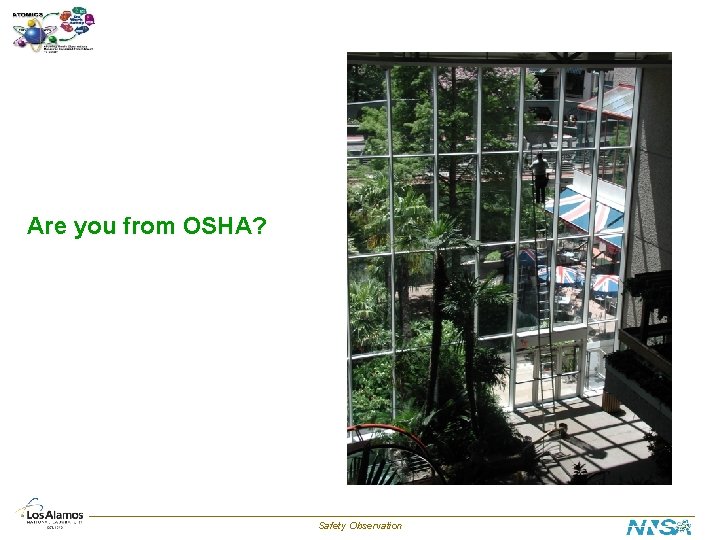
Are you from OSHA? Safety Observation
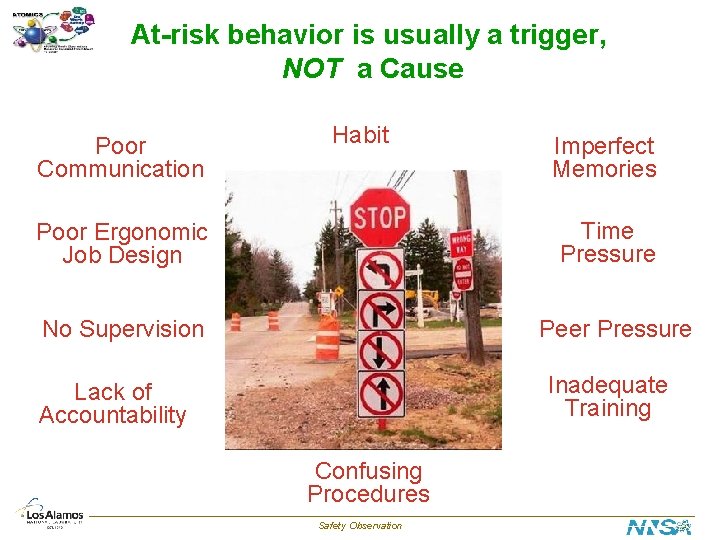
At-risk behavior is usually a trigger, NOT a Cause Poor Communication Habit Imperfect Memories Time Pressure Poor Ergonomic Job Design Peer Pressure No Supervision Inadequate Training Lack of Accountability Confusing Procedures Safety Observation
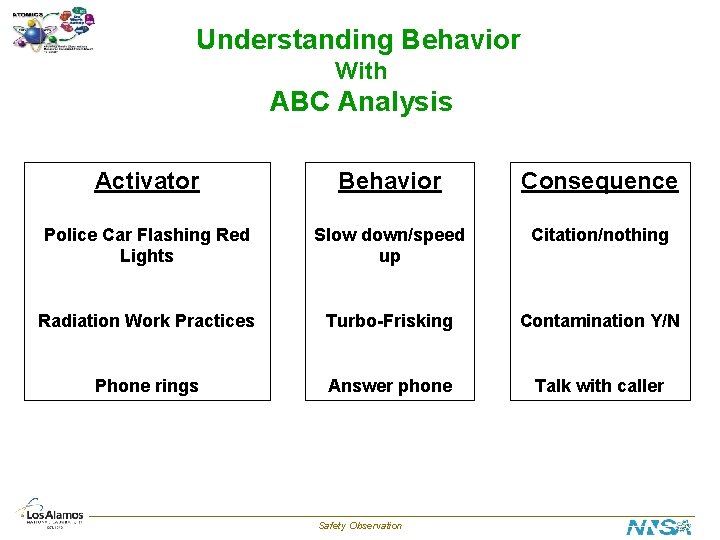
Understanding Behavior With ABC Analysis Activator Behavior Consequence Police Car Flashing Red Lights Slow down/speed up Citation/nothing Radiation Work Practices Turbo-Frisking Contamination Y/N Phone rings Answer phone Talk with caller Safety Observation
Influencing Long-term Behavior Consequences control behavior! Safety Observation
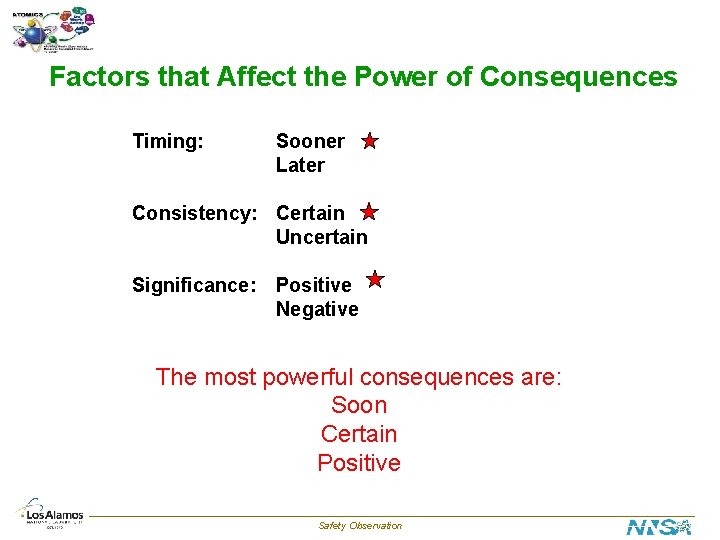
Factors that Affect the Power of Consequences Timing: Sooner Later Consistency: Certain Uncertain Significance: Positive Negative The most powerful consequences are: Soon Certain Positive Safety Observation
Feedback is a powerful way to influence behavior Feedback is a consequence. To be effective it must be: Ø soon, Ø certain, Ø and positive Safety Observation
Organizational Responsibilities Reducing Errors (observations) It is naïve (foolish) to think that positive reinforcement is the single mechanism for safety observations success. Managing Defenses (data analysis) The organizational change initiative, identification of system, facility, and equipment issues identified are at least as likely to be primary improvement mechanisms as positive reinforcement. Safety Observation
Interaction Technique Before the observation: Ø Let people know you are observing them Ø Answer any questions about the process Ø Mention that there will be feedback/discussion after After the observation: Ø Observer reinforces safe behaviors, and, if needed, discusses observed at-risk actions and options to avoid future occurrence, Safety Observation
Giving Feedback Discuss “at-risks and explore barriers to working “safely” Ø Separate discussion of “at-risk” behaviors from positive feedback. Ø Ask open-ended questions (Ex: What’s the worst accident that can happen? How could you be hurt doing this task. Why are you doing it this way? ) Ø Ask for suggestions/ideas, draw out the corrective action that may be required from the person. Ø Record comments. Seek a personal commitment from that the individual will carry out the action and thank them for participating. Safety Observation
Giving Feedback Ø The goal of the behavioral observation is to improve (influence) the performance (behavior) of the workers observed. Ø It is critical for workers to understand the types of behaviors and conditions that either increase exposure (at-risk behaviors) or reduce the risk of exposure (identified safe behaviors). Safety Observation
A Safety Observation Ø Is a sampling procedure Ø Is the cornerstone of the safety process Ø Is systematic and standardized Ø Samples behaviors and conditions, not individuals Safety Observation
A Safety Observation Shares expertise: From January 2010 to May 2010 the Vehicle Operator Observation sheet was utilized by the ASM-MM group 24 times and by all other organizations 314 times. From January 2010 to May 2010 the Lifting Observation sheet was utilized by ASM-MM 62 times and by all other organizations 268 times. Safety Observation
- Slides: 38