
Safety Ne X Wireless Gas Detection System Technical




- Slides: 40
Safety. Ne. X Wireless Gas Detection System Technical Overview
Safety. Ne. X System Design
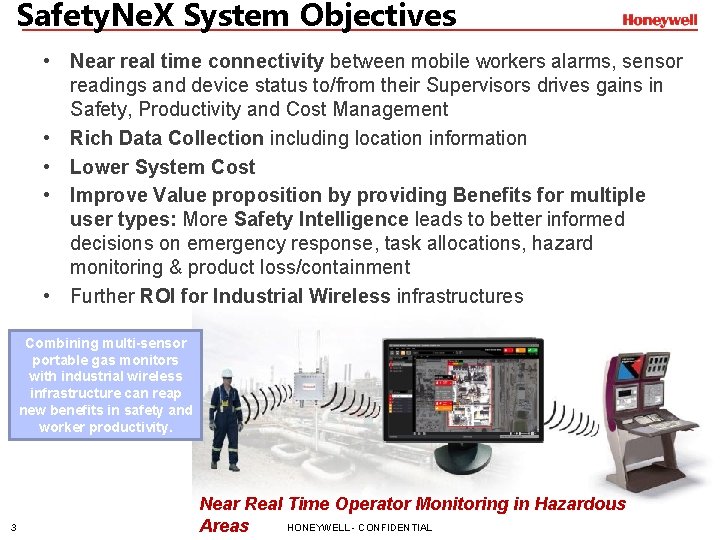
Safety. Ne. X System Objectives • Near real time connectivity between mobile workers alarms, sensor readings and device status to/from their Supervisors drives gains in Safety, Productivity and Cost Management • Rich Data Collection including location information • Lower System Cost • Improve Value proposition by providing Benefits for multiple user types: More Safety Intelligence leads to better informed decisions on emergency response, task allocations, hazard monitoring & product loss/containment • Further ROI for Industrial Wireless infrastructures Combining multi-sensor portable gas monitors with industrial wireless infrastructure can reap new benefits in safety and worker productivity. 3 Near Real Time Operator Monitoring in Hazardous HONEYWELL - CONFIDENTIAL Areas
System Product/Design Concept • Utilize Wi. Fi connected Personal Gas Detectors to transmit gas levels, alarm, status and Wi. Fi signal strength information to a central server. - Use existing or Customer supplied standard Wi. Fi networks to lower connection cost • Utilize the Wi. Fi RSSI collected by the Personal Gas Detectors to calculate an estimated location of the Gas Detectors - RSSI for location inside process units - Use Lower cost location Anchors to enhance location resolution - Reduce Gas detector size and cost with same radio for both communications and location - Support optional GPS receiver for enhanced accuracy if clear view of the GPS satellites • Detectors send data every 10 seconds in alarm, 2 minutes in normal mode to conserve battery life while providing “near real time” updates • Detectors retain full Life Safety functionality independent of the rest of the system. Safety. Ne. X enhances the detector functionality but is not classified as a Life Safety critical system 4 HONEYWELL - CONFIDENTIAL
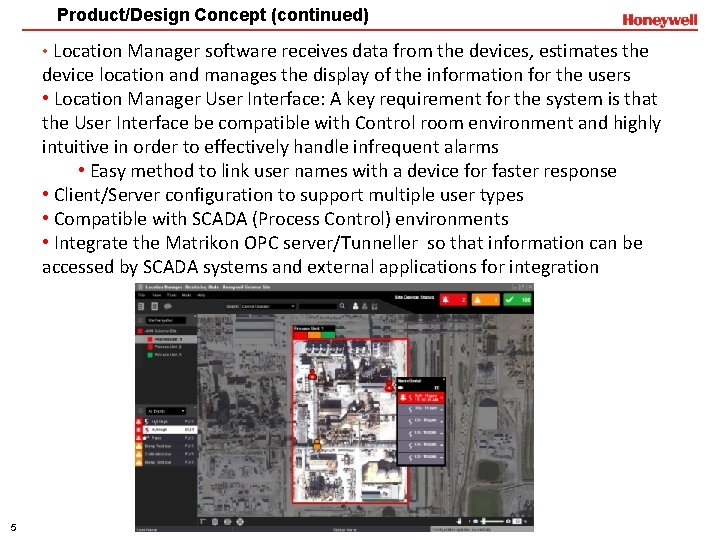
Product/Design Concept (continued) • Location Manager software receives data from the devices, estimates the device location and manages the display of the information for the users • Location Manager User Interface: A key requirement for the system is that the User Interface be compatible with Control room environment and highly intuitive in order to effectively handle infrequent alarms • Easy method to link user names with a device for faster response • Client/Server configuration to support multiple user types • Compatible with SCADA (Process Control) environments • Integrate the Matrikon OPC server/Tunneller so that information can be accessed by SCADA systems and external applications for integration 5 HONEYWELL - CONFIDENTIAL
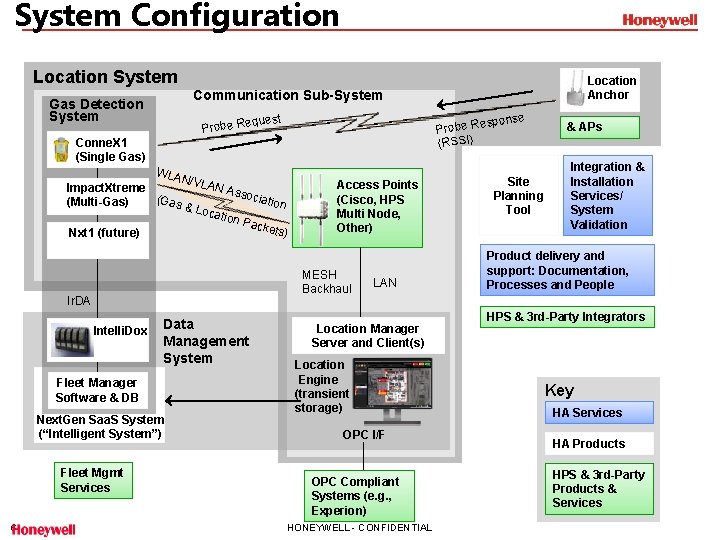
System Configuration Location System Gas Detection System nse quest espo Probe R (RSSI) Probe Re Conne. X 1 (Single Gas) WLA N/ VLAN Impact. Xtreme Asso ciatio (Gas (Multi-Gas) n & Lo catio n Pa ckets ) Nxt 1 (future) Ir. DA Data Management System Fleet Manager Software & DB Next. Gen Saa. S System (“Intelligent System”) Fleet Mgmt Services 6 Access Points (Cisco, HPS Multi Node, Other) MESH Backhaul Intelli. Dox Location Anchor Communication Sub-System LAN Location Manager Server and Client(s) Location Engine (transient storage) OPC I/F OPC Compliant Systems (e. g. , Experion) HONEYWELL - CONFIDENTIAL Site Planning Tool & APs Integration & Installation Services/ System Validation Product delivery and support: Documentation, Processes and People HPS & 3 rd-Party Integrators Key HA Services HA Products HPS & 3 rd-Party Products & Services
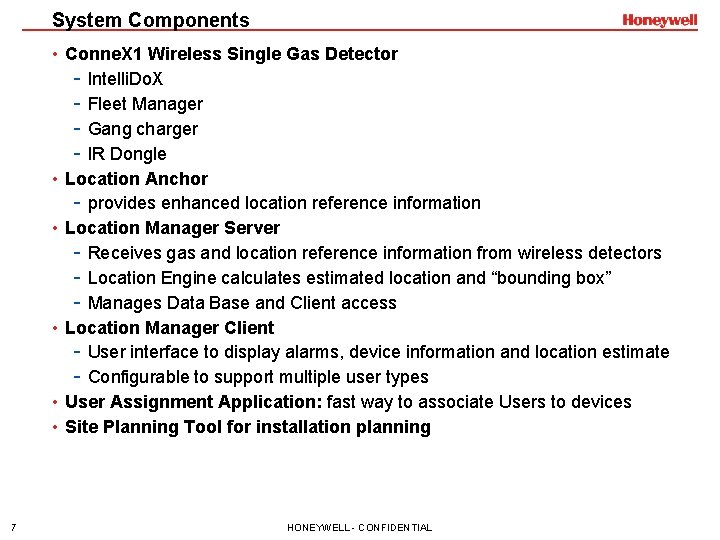
System Components • Conne. X 1 Wireless Single Gas Detector - Intelli. Do. X - Fleet Manager - Gang charger - IR Dongle • Location Anchor - provides enhanced location reference information • Location Manager Server - Receives gas and location reference information from wireless detectors - Location Engine calculates estimated location and “bounding box” - Manages Data Base and Client access • Location Manager Client - User interface to display alarms, device information and location estimate - Configurable to support multiple user types • User Assignment Application: fast way to associate Users to devices • Site Planning Tool for installation planning 7 HONEYWELL - CONFIDENTIAL
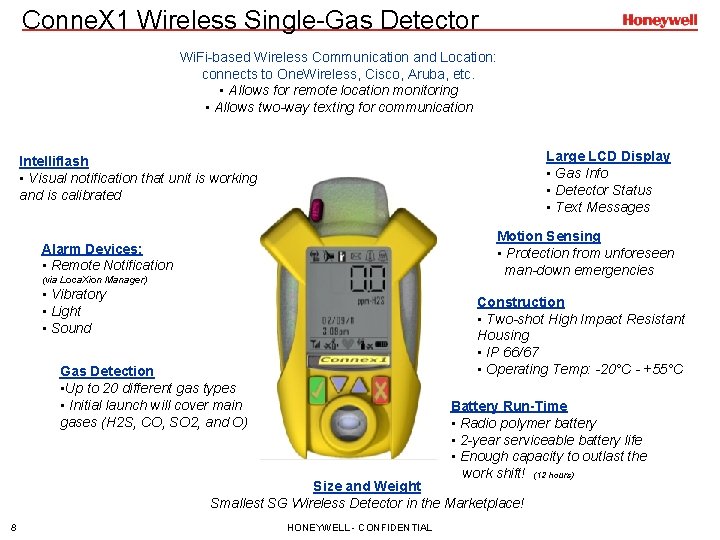
Conne. X 1 Wireless Single-Gas Detector Wi. Fi-based Wireless Communication and Location: connects to One. Wireless, Cisco, Aruba, etc. • Allows for remote location monitoring • Allows two-way texting for communication Large LCD Display • Gas Info • Detector Status • Text Messages Intelliflash • Visual notification that unit is working and is calibrated Motion Sensing • Protection from unforeseen man-down emergencies Alarm Devices: • Remote Notification (via Loca. Xion Manager) • Vibratory • Light • Sound Construction • Two-shot High Impact Resistant Housing • IP 66/67 • Operating Temp: -20°C - +55°C Gas Detection • Up to 20 different gas types • Initial launch will cover main gases (H 2 S, CO, SO 2, and O) Battery Run-Time • Radio polymer battery • 2 -year serviceable battery life • Enough capacity to outlast the work shift! (12 hours) Size and Weight Smallest SG Wireless Detector in the Marketplace! 8 HONEYWELL - CONFIDENTIAL
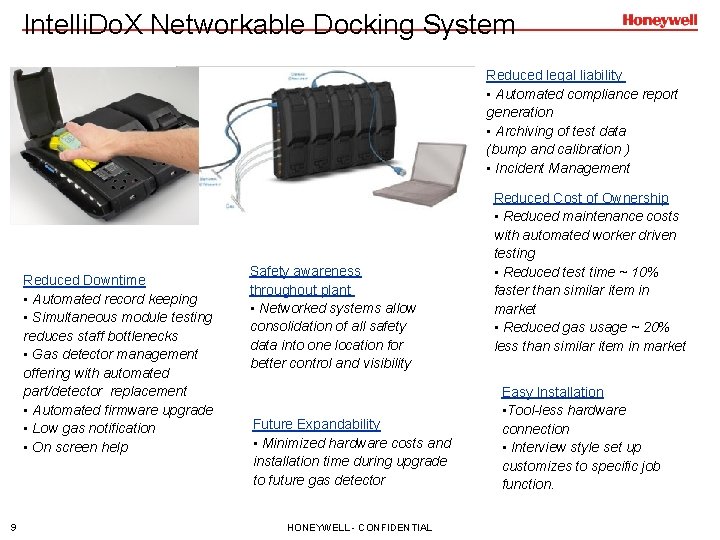
Intelli. Do. X Networkable Docking System Reduced legal liability • Automated compliance report generation • Archiving of test data (bump and calibration ) • Incident Management Reduced Downtime • Automated record keeping • Simultaneous module testing reduces staff bottlenecks • Gas detector management offering with automated part/detector replacement • Automated firmware upgrade • Low gas notification • On screen help 9 Safety awareness throughout plant • Networked systems allow consolidation of all safety data into one location for better control and visibility Future Expandability • Minimized hardware costs and installation time during upgrade to future gas detector HONEYWELL - CONFIDENTIAL Reduced Cost of Ownership • Reduced maintenance costs with automated worker driven testing • Reduced test time ~ 10% faster than similar item in market • Reduced gas usage ~ 20% less than similar item in market Easy Installation • Tool-less hardware connection • Interview style set up customizes to specific job function.
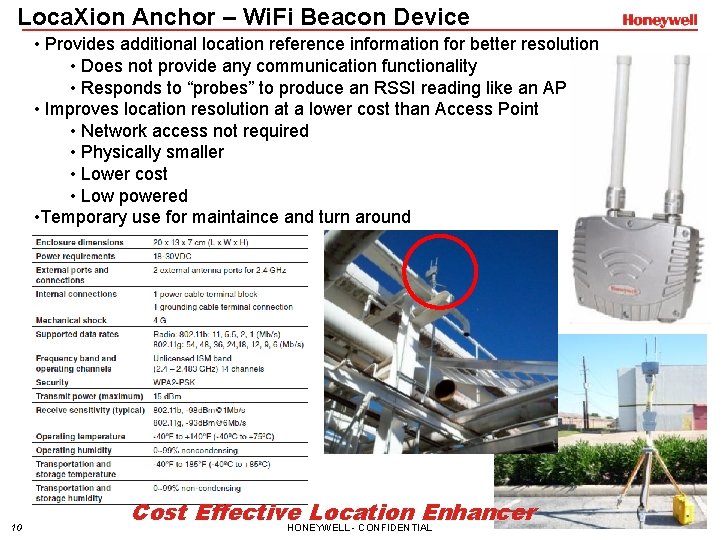
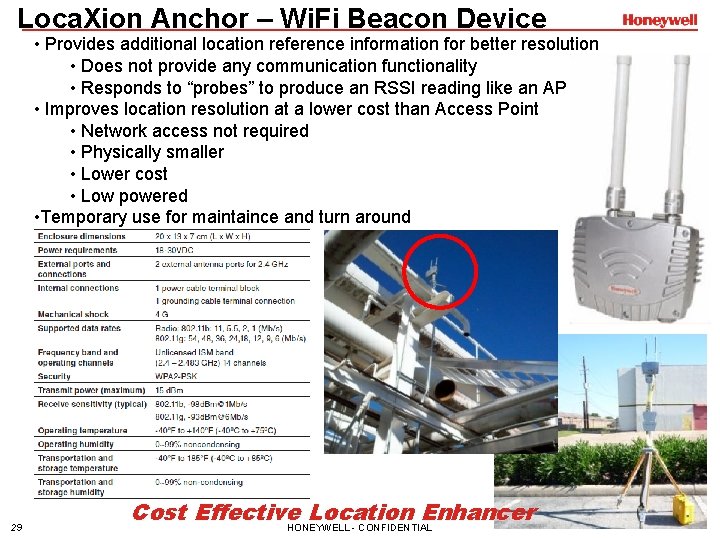
Loca. Xion Anchor – Wi. Fi Beacon Device • Provides additional location reference information for better resolution • Does not provide any communication functionality • Responds to “probes” to produce an RSSI reading like an AP • Improves location resolution at a lower cost than Access Point • Network access not required • Physically smaller • Lower cost • Low powered • Temporary use for maintaince and turn around 10 Cost Effective Location Enhancer HONEYWELL - CONFIDENTIAL
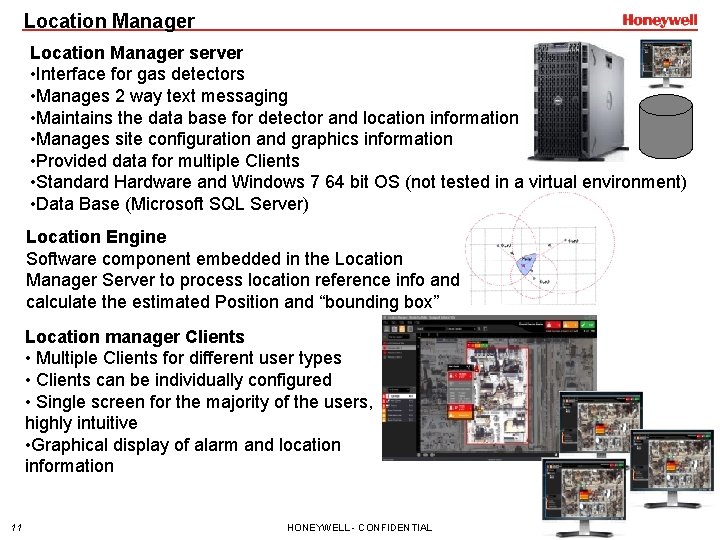
Location Manager server • Interface for gas detectors • Manages 2 way text messaging • Maintains the data base for detector and location information • Manages site configuration and graphics information • Provided data for multiple Clients • Standard Hardware and Windows 7 64 bit OS (not tested in a virtual environment) • Data Base (Microsoft SQL Server) Location Engine Software component embedded in the Location Manager Server to process location reference info and calculate the estimated Position and “bounding box” Location manager Clients • Multiple Clients for different user types • Clients can be individually configured • Single screen for the majority of the users, highly intuitive • Graphical display of alarm and location information 11 HONEYWELL - CONFIDENTIAL
Interaction View 12 HONEYWELL - CONFIDENTIAL
Component view 13 HONEYWELL - CONFIDENTIAL
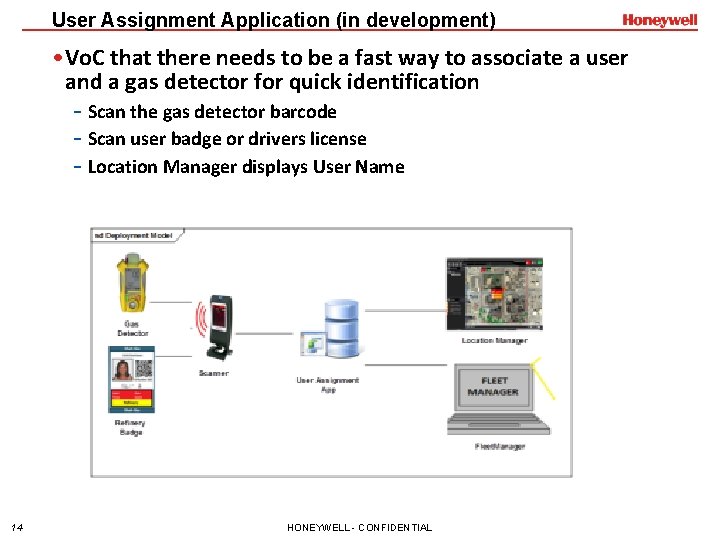
User Assignment Application (in development) • Vo. C that there needs to be a fast way to associate a user and a gas detector for quick identification - Scan the gas detector barcode - Scan user badge or drivers license - Location Manager displays User Name 14 HONEYWELL - CONFIDENTIAL
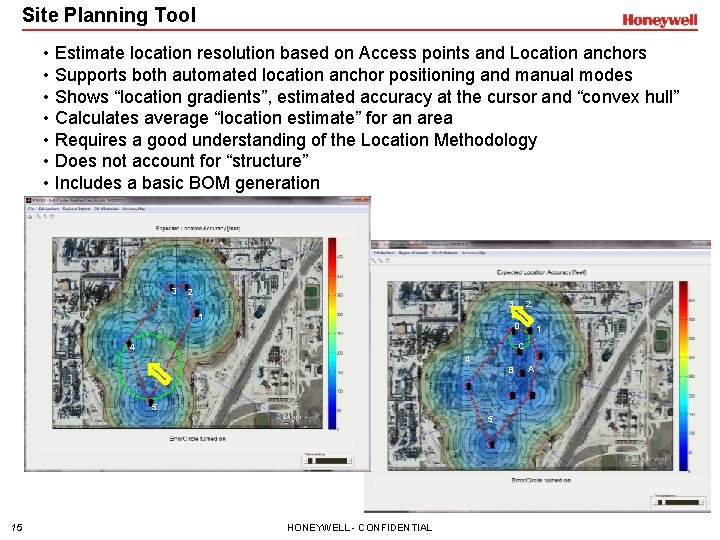
Site Planning Tool • Estimate location resolution based on Access points and Location anchors • Supports both automated location anchor positioning and manual modes • Shows “location gradients”, estimated accuracy at the cursor and “convex hull” • Calculates average “location estimate” for an area • Requires a good understanding of the Location Methodology • Does not account for “structure” • Includes a basic BOM generation 3 2 3 1 D 1 C 4 4 B 5 5 15 2 HONEYWELL - CONFIDENTIAL A
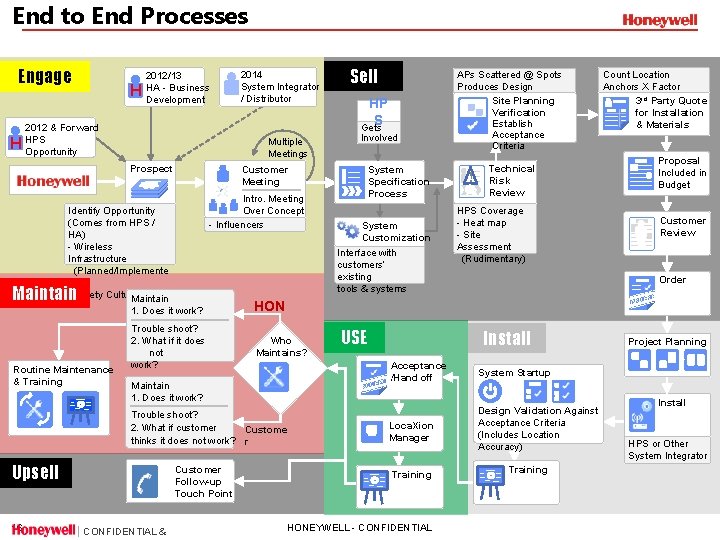
End to End Processes Engage H H 2012/13 HA - Business Development 2012 & Forward HPS Opportunity Multiple Meetings Prospect Intro. Meeting Over Concept - Influencers Maintain 1. Does it work? Trouble shoot? 2. What if it does not work? Customer Follow-up Touch Point | CONFIDENTIAL & Involved System Specification Process System Customization Interface with customers’ existing tools & systems ! Count Location Anchors X Factor 3 rd Party Quote for Installation & Materials Proposal Included in Budget Technical Risk Review HPS Coverage - Heat map - Site Assessment (Rudimentary) Customer Review Order Who Maintains? ? USE Install Acceptance /Hand off ACC System Startup Loca. Xion Manager Design Validation Against Acceptance Criteria (Includes Location Accuracy) ED EPT Training HONEYWELL - CONFIDENTIAL D ERE ORD Trouble shoot? 2. What if customer Custome thinks it does not work? r 16 HP S Gets APs Scattered @ Spots Produces Design Site Planning Verification Establish Acceptance Criteria HON Maintain 1. Does it work? Upsell Sell Customer Meeting Identify Opportunity (Comes from HPS / HA) - Wireless Infrastructure (Planned/Implemente d) - Safety Culture Maintain Routine Maintenance & Training 2014 System Integrator / Distributor Training Project Planning Install HPS or Other System Integrator
Communications
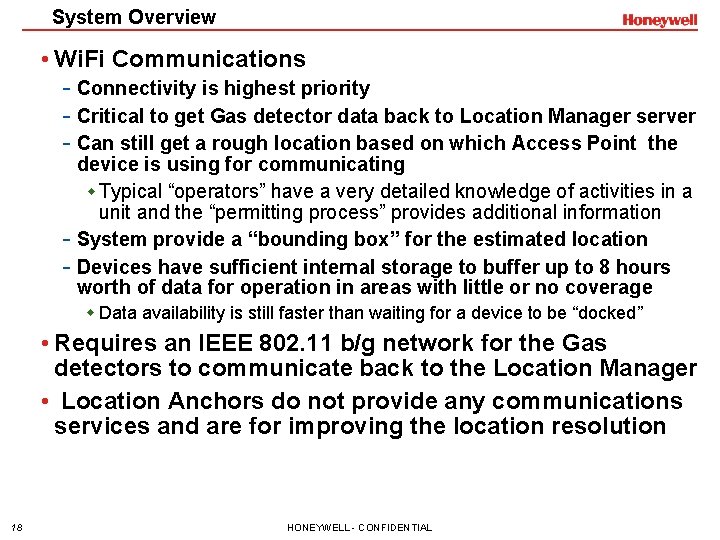
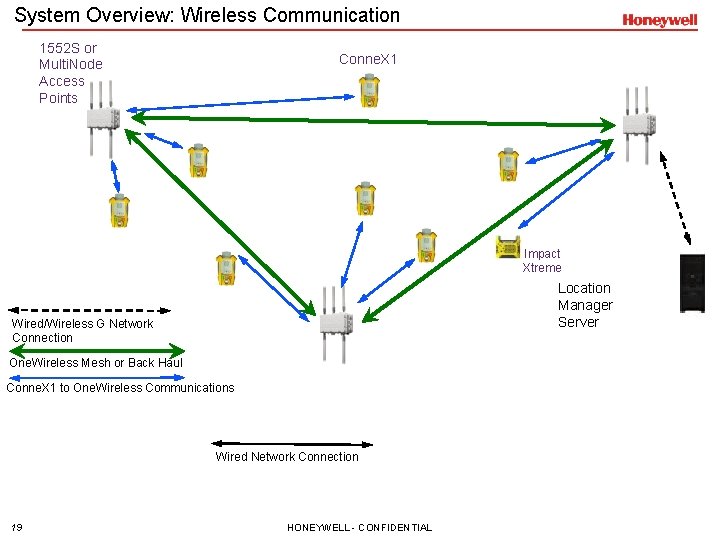
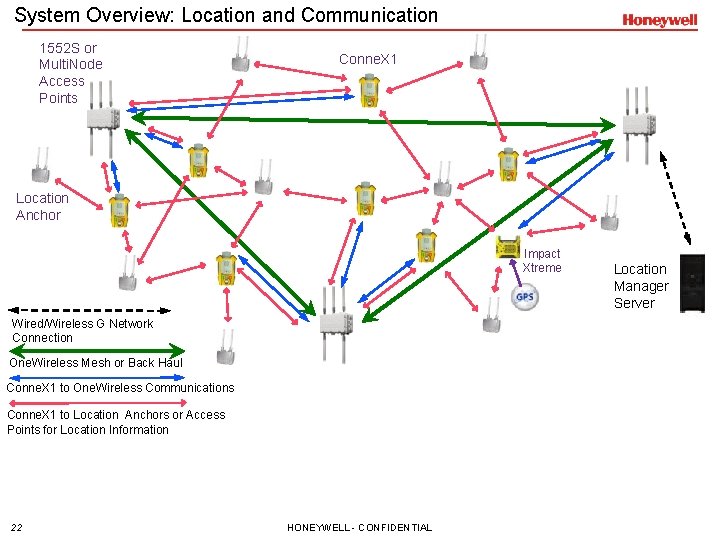
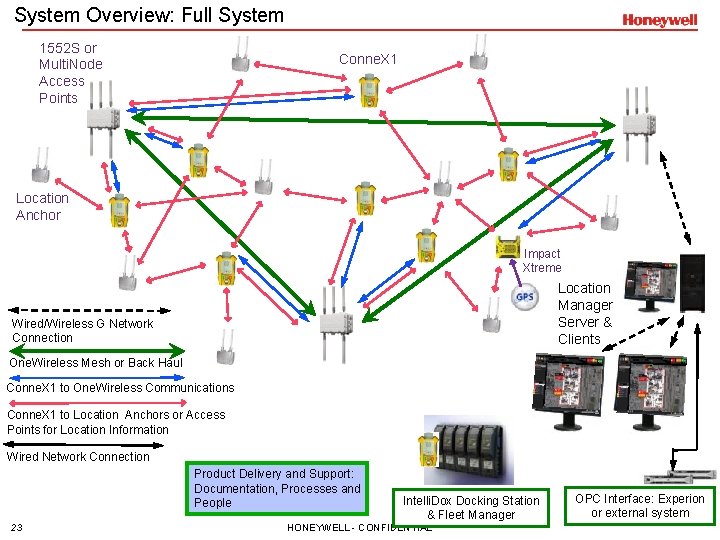
System Overview • Wi. Fi Communications - Connectivity is highest priority - Critical to get Gas detector data back to Location Manager server - Can still get a rough location based on which Access Point the device is using for communicating w Typical “operators” have a very detailed knowledge of activities in a unit and the “permitting process” provides additional information - System provide a “bounding box” for the estimated location - Devices have sufficient internal storage to buffer up to 8 hours worth of data for operation in areas with little or no coverage w Data availability is still faster than waiting for a device to be “docked” • Requires an IEEE 802. 11 b/g network for the Gas detectors to communicate back to the Location Manager • Location Anchors do not provide any communications services and are for improving the location resolution 18 HONEYWELL - CONFIDENTIAL
System Overview: Wireless Communication 1552 S or Multi. Node Access Points Conne. X 1 Impact Xtreme Location Manager Server Wired/Wireless G Network Connection One. Wireless Mesh or Back Haul Conne. X 1 to One. Wireless Communications Wired Network Connection 19 HONEYWELL - CONFIDENTIAL
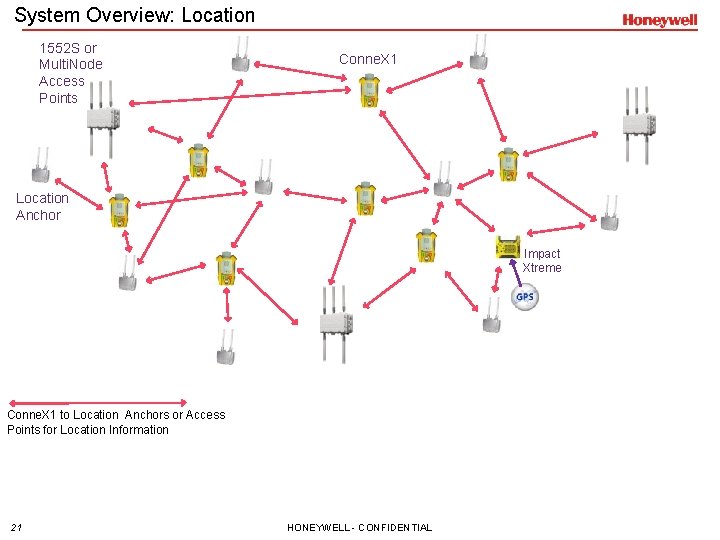
Location Reference • Location is independent of Communication • The number of Location Anchors is determined by the Location Resolution and there is no relationship to the number of access points - Using Access Points for location reference can reduce the number of Location Anchors required • Devices will collect RSSI information from any reference that has an SSID matching the VLAN or the Location Anchors • The actual location estimate is done by the Location Engine component in the Location Manager server and not by the device 20 HONEYWELL - CONFIDENTIAL
System Overview: Location 1552 S or Multi. Node Access Points Conne. X 1 Location Anchor Impact Xtreme Conne. X 1 to Location Anchors or Access Points for Location Information 21 HONEYWELL - CONFIDENTIAL
System Overview: Location and Communication 1552 S or Multi. Node Access Points Conne. X 1 Location Anchor Impact Xtreme Wired/Wireless G Network Connection One. Wireless Mesh or Back Haul Conne. X 1 to One. Wireless Communications Conne. X 1 to Location Anchors or Access Points for Location Information 22 HONEYWELL - CONFIDENTIAL Location Manager Server
System Overview: Full System 1552 S or Multi. Node Access Points Conne. X 1 Location Anchor Impact Xtreme Location Manager Server & Clients Wired/Wireless G Network Connection One. Wireless Mesh or Back Haul Conne. X 1 to One. Wireless Communications Conne. X 1 to Location Anchors or Access Points for Location Information Wired Network Connection Product Delivery and Support: Documentation, Processes and People 23 Intelli. Dox Docking Station & Fleet Manager HONEYWELL - CONFIDENTIAL OPC Interface: Experion or external system
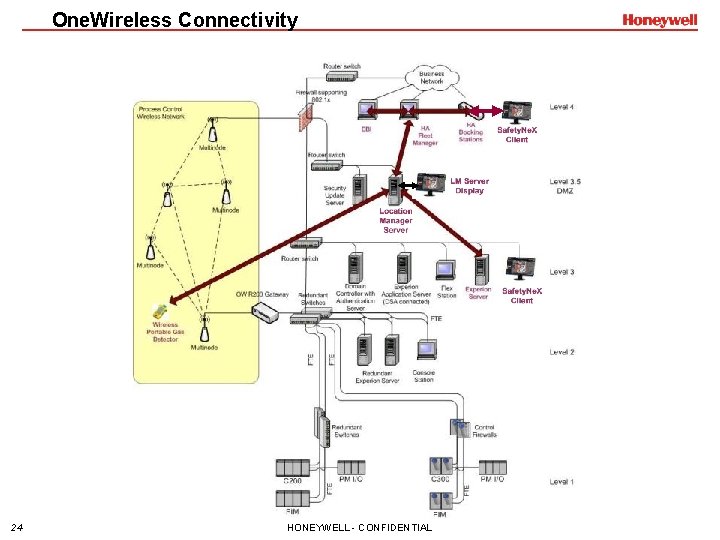
One. Wireless Connectivity 24 HONEYWELL - CONFIDENTIAL
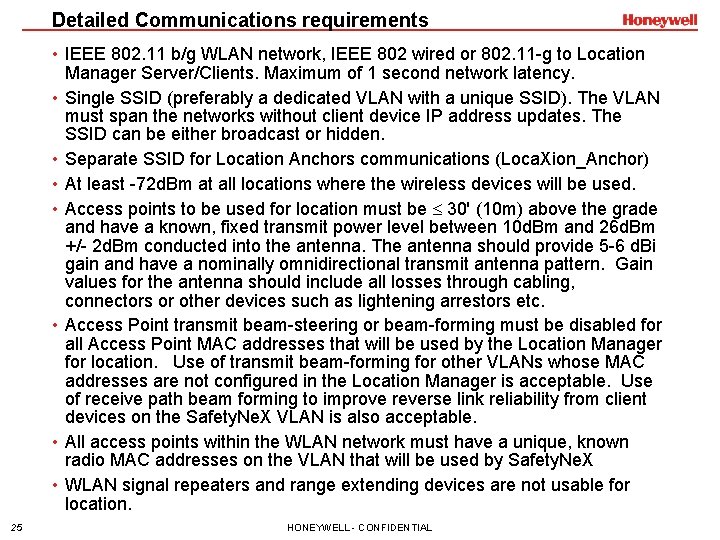
Detailed Communications requirements • IEEE 802. 11 b/g WLAN network, IEEE 802 wired or 802. 11 -g to Location Manager Server/Clients. Maximum of 1 second network latency. • Single SSID (preferably a dedicated VLAN with a unique SSID). The VLAN must span the networks without client device IP address updates. The SSID can be either broadcast or hidden. • Separate SSID for Location Anchors communications (Loca. Xion_Anchor) • At least -72 d. Bm at all locations where the wireless devices will be used. • Access points to be used for location must be 30' (10 m) above the grade and have a known, fixed transmit power level between 10 d. Bm and 26 d. Bm +/- 2 d. Bm conducted into the antenna. The antenna should provide 5 -6 d. Bi gain and have a nominally omnidirectional transmit antenna pattern. Gain values for the antenna should include all losses through cabling, connectors or other devices such as lightening arrestors etc. • Access Point transmit beam-steering or beam-forming must be disabled for all Access Point MAC addresses that will be used by the Location Manager for location. Use of transmit beam-forming for other VLANs whose MAC addresses are not configured in the Location Manager is acceptable. Use of receive path beam forming to improve reverse link reliability from client devices on the Safety. Ne. X VLAN is also acceptable. • All access points within the WLAN network must have a unique, known radio MAC addresses on the VLAN that will be used by Safety. Ne. X • WLAN signal repeaters and range extending devices are not usable for location. 25 HONEYWELL - CONFIDENTIAL
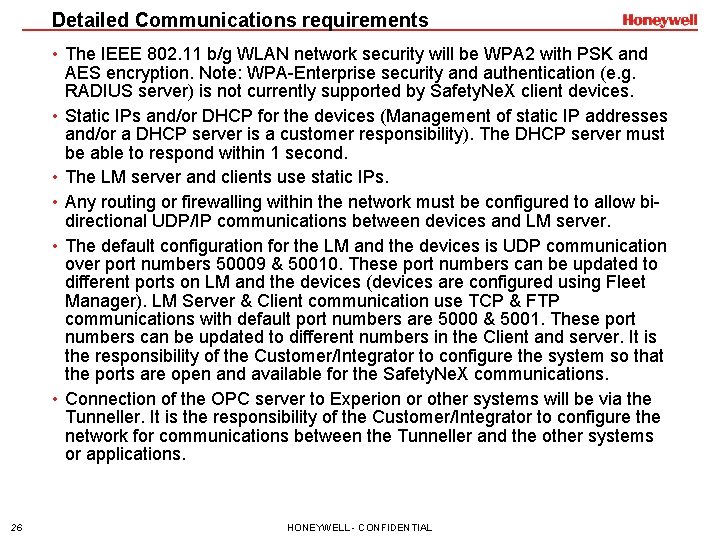
Detailed Communications requirements • The IEEE 802. 11 b/g WLAN network security will be WPA 2 with PSK and AES encryption. Note: WPA-Enterprise security and authentication (e. g. RADIUS server) is not currently supported by Safety. Ne. X client devices. • Static IPs and/or DHCP for the devices (Management of static IP addresses and/or a DHCP server is a customer responsibility). The DHCP server must be able to respond within 1 second. • The LM server and clients use static IPs. • Any routing or firewalling within the network must be configured to allow bidirectional UDP/IP communications between devices and LM server. • The default configuration for the LM and the devices is UDP communication over port numbers 50009 & 50010. These port numbers can be updated to different ports on LM and the devices (devices are configured using Fleet Manager). LM Server & Client communication use TCP & FTP communications with default port numbers are 5000 & 5001. These port numbers can be updated to different numbers in the Client and server. It is the responsibility of the Customer/Integrator to configure the system so that the ports are open and available for the Safety. Ne. X communications. • Connection of the OPC server to Experion or other systems will be via the Tunneller. It is the responsibility of the Customer/Integrator to configure the network for communications between the Tunneller and the other systems or applications. 26 HONEYWELL - CONFIDENTIAL
Location Theory and Practice
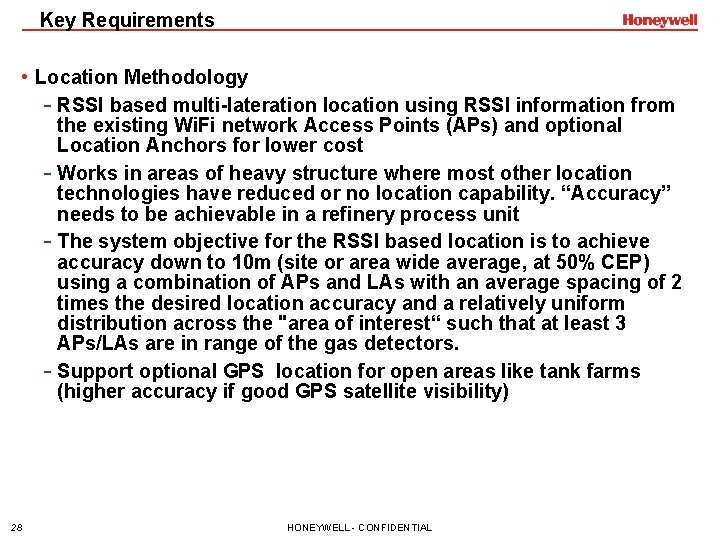
Key Requirements • Location Methodology - RSSI based multi-lateration location using RSSI information from the existing Wi. Fi network Access Points (APs) and optional Location Anchors for lower cost - Works in areas of heavy structure where most other location technologies have reduced or no location capability. “Accuracy” needs to be achievable in a refinery process unit - The system objective for the RSSI based location is to achieve accuracy down to 10 m (site or area wide average, at 50% CEP) using a combination of APs and LAs with an average spacing of 2 times the desired location accuracy and a relatively uniform distribution across the "area of interest“ such that at least 3 APs/LAs are in range of the gas detectors. - Support optional GPS location for open areas like tank farms (higher accuracy if good GPS satellite visibility) 28 HONEYWELL - CONFIDENTIAL
Loca. Xion Anchor – Wi. Fi Beacon Device • Provides additional location reference information for better resolution • Does not provide any communication functionality • Responds to “probes” to produce an RSSI reading like an AP • Improves location resolution at a lower cost than Access Point • Network access not required • Physically smaller • Lower cost • Low powered • Temporary use for maintaince and turn around 29 Cost Effective Location Enhancer HONEYWELL - CONFIDENTIAL
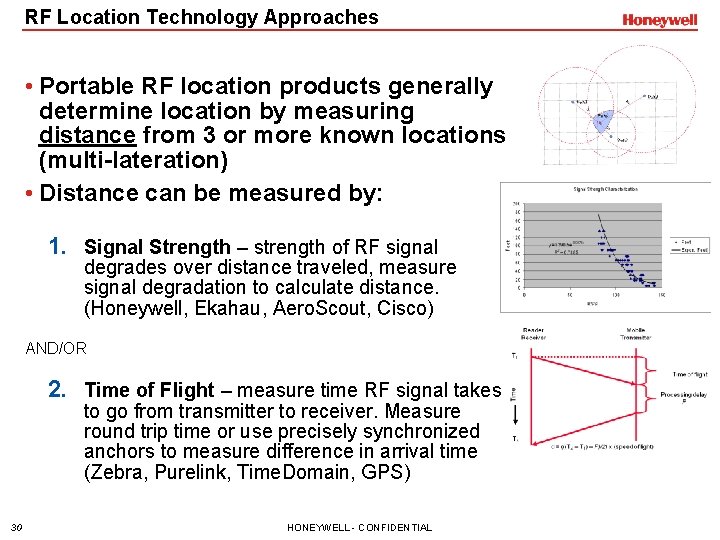
RF Location Technology Approaches • Portable RF location products generally determine location by measuring distance from 3 or more known locations (multi-lateration) • Distance can be measured by: 1. Signal Strength – strength of RF signal degrades over distance traveled, measure signal degradation to calculate distance. (Honeywell, Ekahau, Aero. Scout, Cisco) AND/OR 2. Time of Flight – measure time RF signal takes to go from transmitter to receiver. Measure round trip time or use precisely synchronized anchors to measure difference in arrival time (Zebra, Purelink, Time. Domain, GPS) 30 HONEYWELL - CONFIDENTIAL
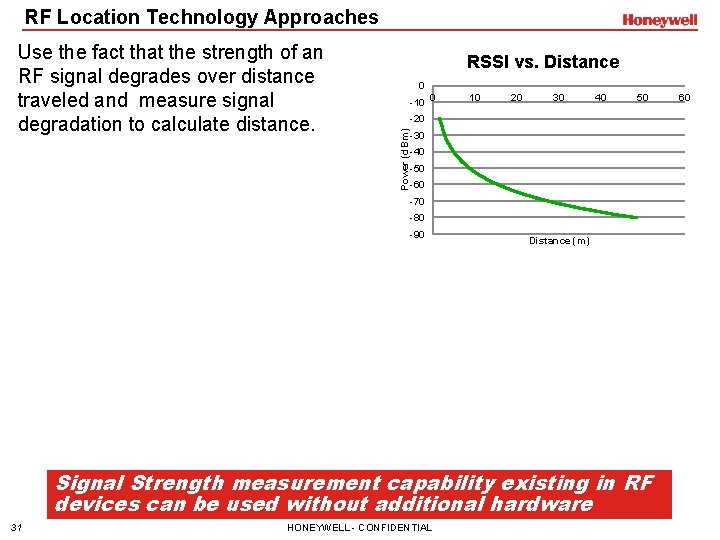
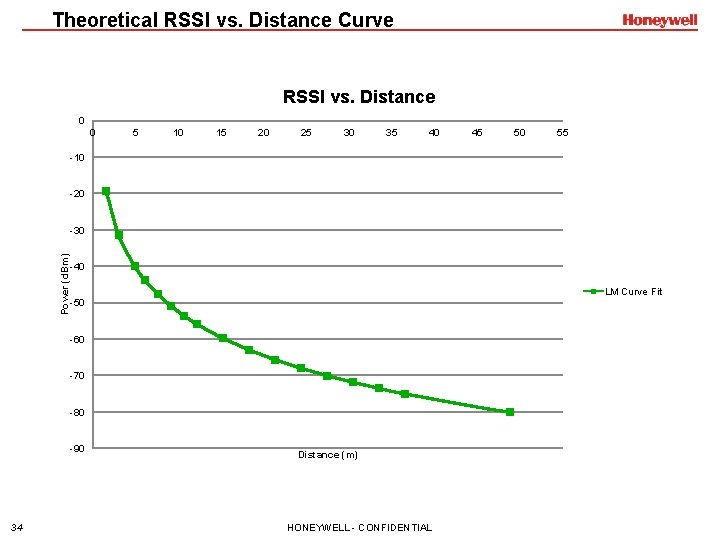
RF Location Technology Approaches RSSI vs. Distance 0 -10 0 10 20 30 40 50 -20 Power (d. Bm) Use the fact that the strength of an RF signal degrades over distance traveled and measure signal degradation to calculate distance. -30 -40 -50 -60 -70 -80 -90 Distance (m) Signal Strength measurement capability existing in RF devices can be used without additional hardware 31 HONEYWELL - CONFIDENTIAL 60
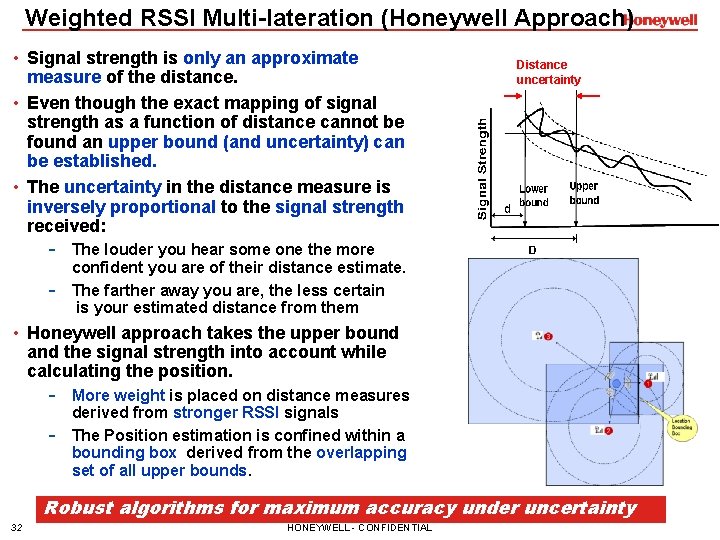
Weighted RSSI Multi-lateration (Honeywell Approach) • Signal strength is only an approximate measure of the distance. • Even though the exact mapping of signal strength as a function of distance cannot be found an upper bound (and uncertainty) can be established. • The uncertainty in the distance measure is inversely proportional to the signal strength received: Distance uncertainty - The louder you hear some one the more - confident you are of their distance estimate. The farther away you are, the less certain is your estimated distance from them • Honeywell approach takes the upper bound and the signal strength into account while calculating the position. - More weight is placed on distance measures - derived from stronger RSSI signals The Position estimation is confined within a bounding box derived from the overlapping set of all upper bounds. Robust algorithms for maximum accuracy under uncertainty 32 HONEYWELL - CONFIDENTIAL
Why Honeywell RSSI Technology? • No additional Infrastructure required (Time of Flight solutions require additional infrastructure e. g. GPS chips, satellites, UWB receivers, special Access Points) • Works both indoors and out (GPS does not work indoors or with obstructed view of sky) • Does not require extensive site surveys (unlike RSSI fingerprinting) • Client-based RSSI collection allows communication back to the device TOF and AP-based RSSI solutions cannot communicate back to the device. Not all APs can be used in AP-based RSSI collection • Scalable accuracy with low cost beaconing anchors ( TOF methods suffer with high anchor density; AP-based RSSI and TOF methods require much higher cost to scale) • Better algorithm – Weighted, Constrained Multi-lateration. An estimated position and a bounding box representing error in estimate are generated. (multi-lateration methods that do not use weights and/or bounding boxes and fingerprinting methods cannot produce bounding boxes of the estimated uncertainty) • Location accuracy topology mapping for cost optimized installation • Real-time position error estimation and monitoring Honeywell provides best value with a low cost , scalable accuracy solution 33 HONEYWELL - CONFIDENTIAL
Theoretical RSSI vs. Distance Curve RSSI vs. Distance 0 0 5 10 15 20 25 30 35 40 45 50 55 -10 -20 Power (d. Bm) -30 -40 LM Curve Fit -50 -60 -70 -80 -90 34 Distance (m) HONEYWELL - CONFIDENTIAL
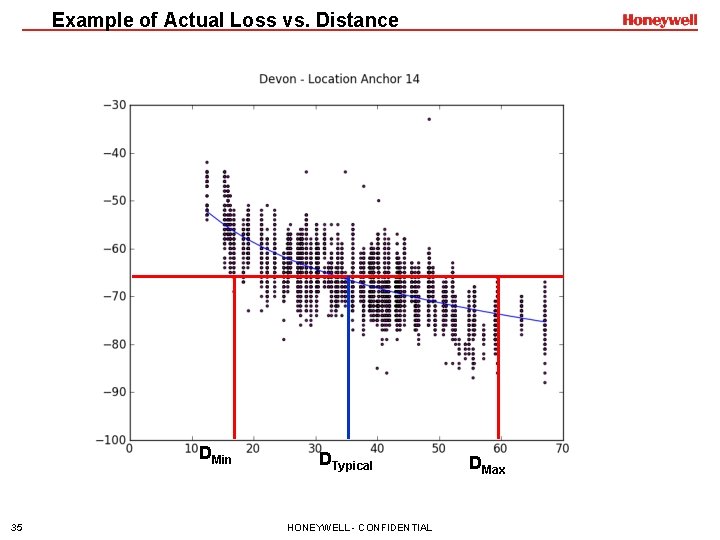
Example of Actual Loss vs. Distance DMin 35 DTypical HONEYWELL - CONFIDENTIAL DMax
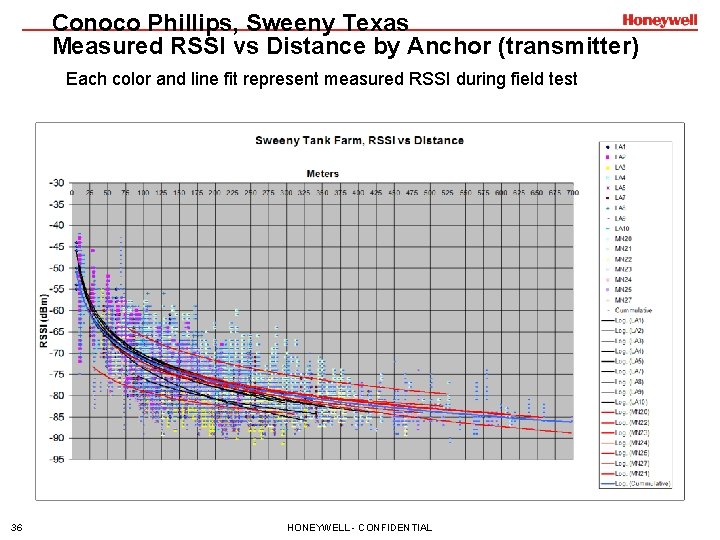
Conoco Phillips, Sweeny Texas Measured RSSI vs Distance by Anchor (transmitter) Each color and line fit represent measured RSSI during field test 36 HONEYWELL - CONFIDENTIAL
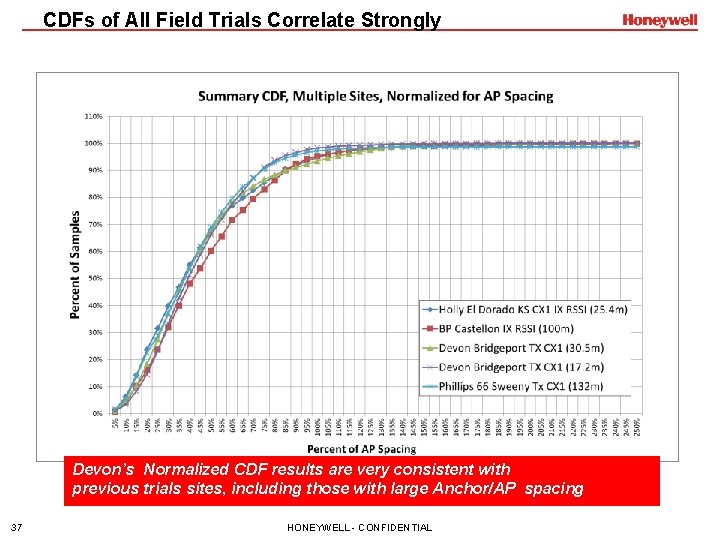
CDFs of All Field Trials Correlate Strongly Devon’s Normalized CDF results are very consistent with previous trials sites, including those with large Anchor/AP spacing 37 HONEYWELL - CONFIDENTIAL
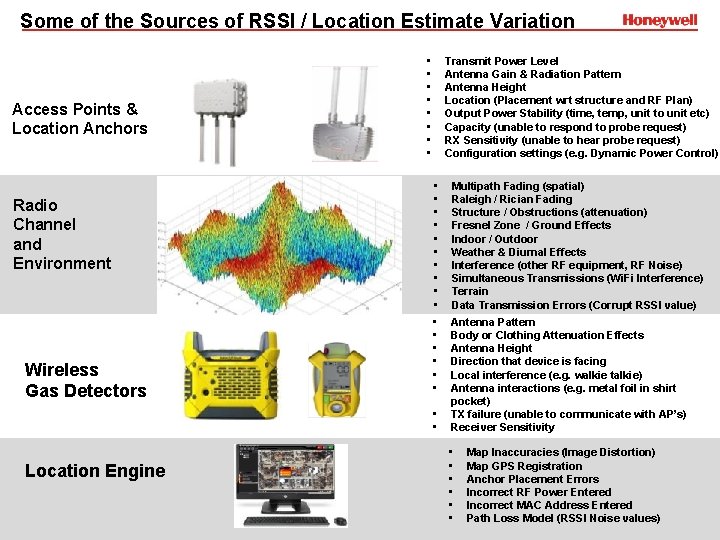
Some of the Sources of RSSI / Location Estimate Variation Access Points & Location Anchors • • Transmit Power Level Antenna Gain & Radiation Pattern Antenna Height Location (Placement wrt structure and RF Plan) Output Power Stability (time, temp, unit to unit etc) Capacity (unable to respond to probe request) RX Sensitivity (unable to hear probe request) Configuration settings (e. g. Dynamic Power Control) • • • • Radio Channel and Environment Wireless Gas Detectors • • Location Engine 38 HONEYWELL - CONFIDENTIAL Multipath Fading (spatial) Raleigh / Rician Fading Structure / Obstructions (attenuation) Fresnel Zone / Ground Effects Indoor / Outdoor Weather & Diurnal Effects Interference (other RF equipment, RF Noise) Simultaneous Transmissions (Wi. Fi Interference) Terrain Data Transmission Errors (Corrupt RSSI value) Antenna Pattern Body or Clothing Attenuation Effects Antenna Height Direction that device is facing Local interference (e. g. walkie talkie) Antenna interactions (e. g. metal foil in shirt pocket) TX failure (unable to communicate with AP’s) Receiver Sensitivity • • • Map Inaccuracies (Image Distortion) Map GPS Registration Anchor Placement Errors Incorrect RF Power Entered Incorrect MAC Address Entered Path Loss Model (RSSI Noise values)
Qualitative “Pareto” of contributions to estimate error 39 HONEYWELL - CONFIDENTIAL
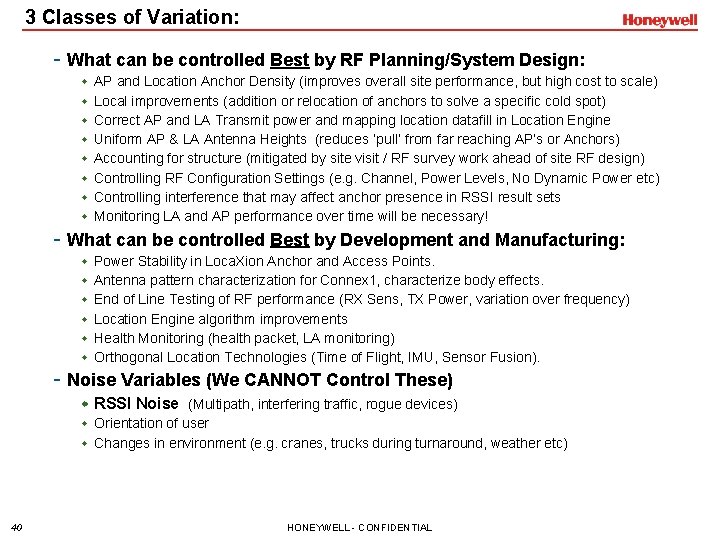
3 Classes of Variation: - What can be controlled Best by RF Planning/System Design: w w w w AP and Location Anchor Density (improves overall site performance, but high cost to scale) Local improvements (addition or relocation of anchors to solve a specific cold spot) Correct AP and LA Transmit power and mapping location datafill in Location Engine Uniform AP & LA Antenna Heights (reduces ‘pull’ from far reaching AP’s or Anchors) Accounting for structure (mitigated by site visit / RF survey work ahead of site RF design) Controlling RF Configuration Settings (e. g. Channel, Power Levels, No Dynamic Power etc) Controlling interference that may affect anchor presence in RSSI result sets Monitoring LA and AP performance over time will be necessary! - What can be controlled Best by Development and Manufacturing: w w w Power Stability in Loca. Xion Anchor and Access Points. Antenna pattern characterization for Connex 1, characterize body effects. End of Line Testing of RF performance (RX Sens, TX Power, variation over frequency) Location Engine algorithm improvements Health Monitoring (health packet, LA monitoring) Orthogonal Location Technologies (Time of Flight, IMU, Sensor Fusion). - Noise Variables (We CANNOT Control These) w RSSI Noise (Multipath, interfering traffic, rogue devices) w Orientation of user w Changes in environment (e. g. cranes, trucks during turnaround, weather etc) 40 HONEYWELL - CONFIDENTIAL