
Safety Management Systems SMS Systems Cliff Edwards Quality
- Slides: 54
Safety Management Systems SMS Systems Cliff Edwards Quality and Safety Development Manager Shell Aircraft Ltd.
Safety Management Systems OVERVIEW l Industry Approach to Safety l The Need for Change l Management Systems l Key Elements of a Safety Management System l Conclusions l Hazard Management
Safety Management Systems Approach to Safety - “Safety Is No Accident”: Is it a clever play on words? Or the truth? • Unfortunately, in many companies “safety is an accident”! • Safety was not the planned outcome, but the result of “how things worked out”! • Operations that don’t plan for safety require individuals to do “the right thing” without direction. • As “professionals, ” pilots, engineers and others, often achieve the levels of safety sought! But can we rely on that? • Are we doing enough? - We don’t believe so!
Safety Management Systems Approach to safety - Why? Is there a need to change? • Public transport aviation is a fundamentally safe industry: - - but aviation is facing difficult times in the coming years, made worse by the events of September 11 th, - - the effects of that disaster have had far reaching implications on aviation and remain likely to have an impact on the potential for accidents and incidents, and - - the industry faces falling incomes, rising costs and the loss of experience. • The safety record to date has been driven primarily by regulatory compliance and the experience and training of its participants
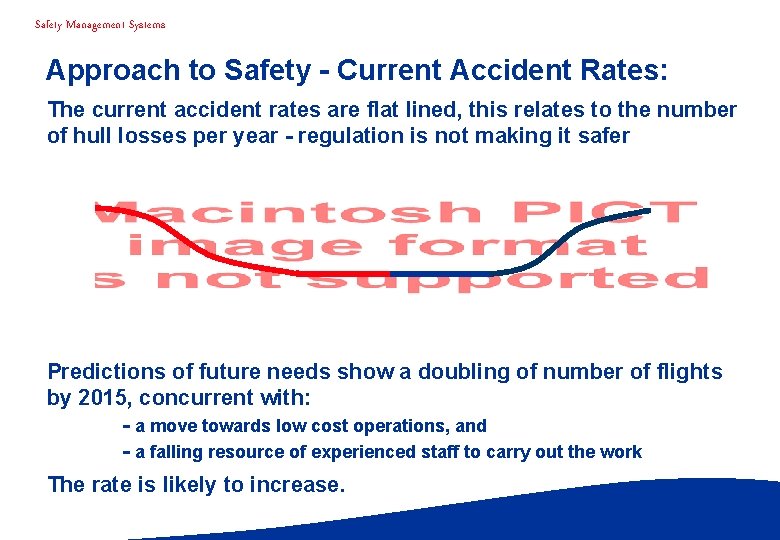
Safety Management Systems Approach to Safety - Current Accident Rates: The current accident rates are flat lined, this relates to the number of hull losses per year - regulation is not making it safer Predictions of future needs show a doubling of number of flights by 2015, concurrent with: - a move towards low cost operations, and - a falling resource of experienced staff to carry out the work The rate is likely to increase.
Safety Management Systems OVERVIEW l Industry Approach to Safety l The Need for Change l Management Systems l Key Elements of a Safety Management System l Conclusions l Hazard Management
Safety Management Systems The Need for Change • Whether for business survival, quality or safety, there has never been a more important time to improve performance. • Our industry leaders are faced with very few choices to achieve the improvements that they need to make to survive; these are: • • • Improved fiscal control, and/or higher fares. Reductions in competition through mergers or buy-outs. Improved utilisation of the aircraft and staff. Improved reliability of the aircraft and its maintenance. Improved safety, through loss control measures • If nothing changes the safety record will get worse!
Safety Management Systems The Need for Change - What do Top Safety Performing Companies do? Better safety performance in “World Class” companies is achieved through their “Management of Safety” and the development of the “Safety Culture” of the Company. World Class Safety Performers deliver 4 key business elements: • Committed and involved leadership providing vision and seeing their initiatives through to conclusion. • Individual accountability cascaded throughout the workforce. • An empowered workforce that feel, and are, involved in the process of delivering a quality product safely. • A workforce that is compliant with its standards and committed to the Company’s objectives. These are the keystone tenets of a Safety Management System.
Safety Management Systems OVERVIEW l Industry Approach to Safety l The Need for Change l Management Systems l Key Elements of a Safety Management System l Conclusions l Hazard Management
Safety Management Systems: • Most Companies have a number of systems of management: • The Board’s management system. • Financial Management. • Quality Assurance. • Safety Management. • Local Fiefdoms. • The way things are run around here. • In reality, there should be only one real system of management in any Company and that must be modelled to manage all facets of the business.
Safety Management Systems - Leadership & Management? • To meet the challenge requires clear objectives, effective direction, stated plans and demonstrated commitment. • Although named as the Accountable Managers, CEO’s often are not involved and have little knowledge of these systems, or the problems in the workplace. • Top management often delegate the responsibility for systems such as QA and SMS to allow themselves the chance to get on with running the business - this is flawed thinking. • It is almost certain that top management will be involved in the management of the finances, due to the associated risks. • Safety Management should be no different.
Safety Management Systems - Why Introduce an SMS? • If you are contracted to the Shell Group, it’s a contractual requirement. • If you’re a public transport operator, JAR-Ops 1/3. 037 states: “An Operator shall establish an accident prevention and flight safety programme, which may be integrated with the Quality system, including programmes to achieve and maintain risk awareness by all persons involved in operations”. Effectively an SMS. • UK operators are required to operate to the Health and Safety Executive statutes § Companies are required to manage the risks of their business, § HSG 65 guidance on the means of compliance describes a SMS.
Safety Management Systems - Definitions Safety Management Systems A Safety Management System is the methodology by which a company manages safety throughout its organisation, utilising a systematic approach to ensure that all parts of the business are addressed, and that all risks are identified and subsequently managed. Safety Cases (one or many) are subordinate to an SMS - as a minimum, they incorporate the process used to demonstrate the Company’s “fitness for purpose” through the identification and control of the major risks.
Safety Management Systems OVERVIEW l Industry Approach to Safety l The Need for Change l Management Systems l Key Elements of a Safety Management System l Conclusions l Hazard Management
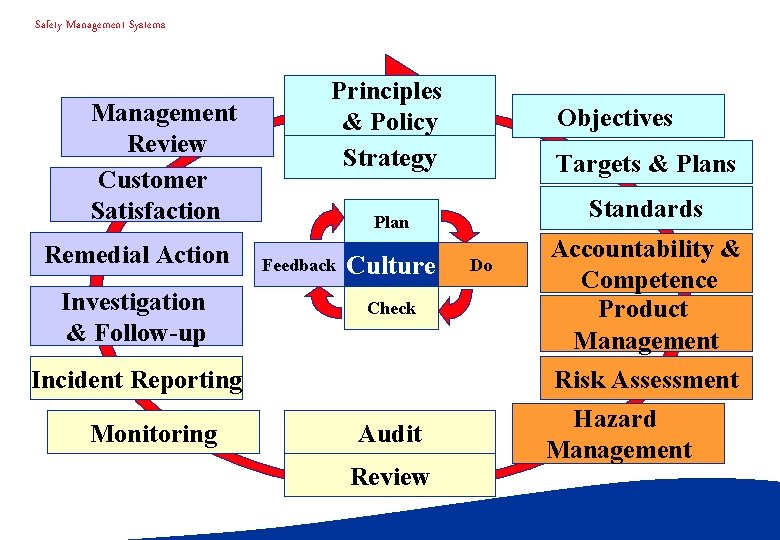
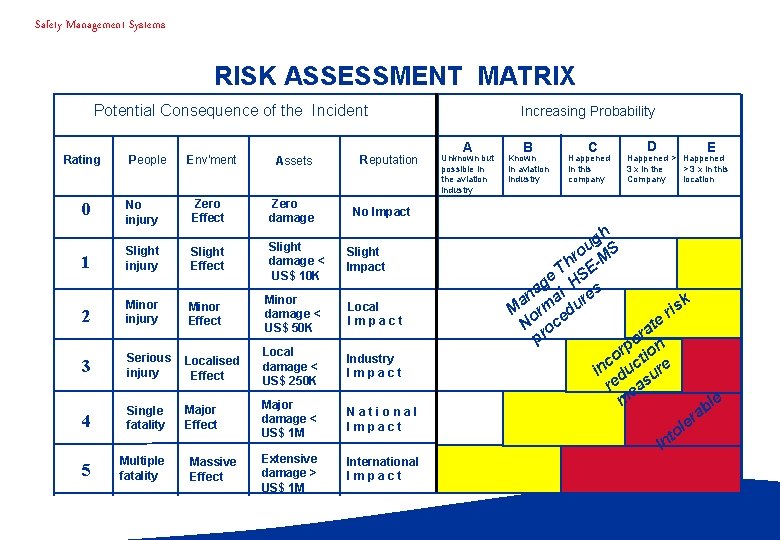
Safety Management Systems Key Elements of an SMS • As in other systems of Management, where financial or quality risks are the focus, Safety Management Systems bring a systematic approach the management of safety risks. • The same model system that is embedded in ISO 9000 -2000 is used, because this is an approach that is capable of managing any part of the business. • The management system needs to be underpinned by other tools, such the “Risk Assessment Matrix”, or a hazard analysis “Bow-Tie”. • As in all Management Systems, an SMS can only add value to the organisation if Top Management are actively driving it.
Safety Management Systems Management Review Customer Satisfaction Remedial Action Investigation & Follow-up Principles & Policy Strategy Targets & Plans Plan Standards Feedback Culture Check Incident Reporting Monitoring Audit Review Objectives Do Accountability & Competence Product Management Risk Assessment Hazard Management
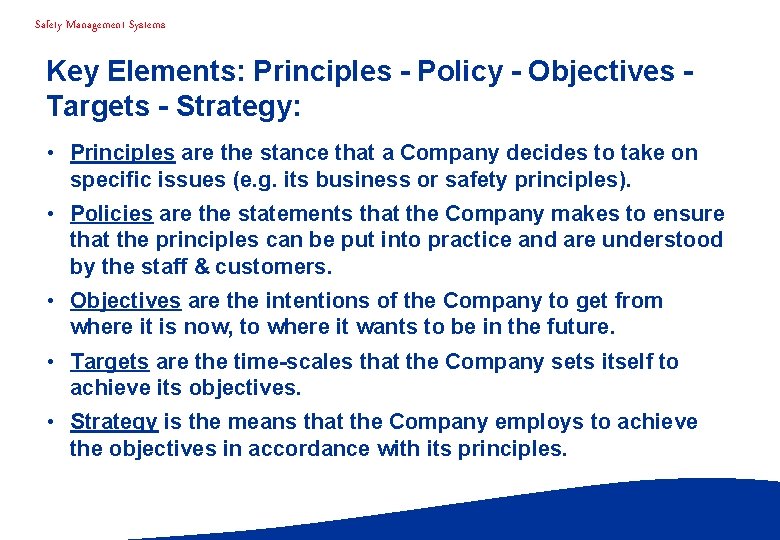
Safety Management Systems Key Elements: Principles - Policy - Objectives Targets - Strategy: • Principles are the stance that a Company decides to take on specific issues (e. g. its business or safety principles). • Policies are the statements that the Company makes to ensure that the principles can be put into practice and are understood by the staff & customers. • Objectives are the intentions of the Company to get from where it is now, to where it wants to be in the future. • Targets are the time-scales that the Company sets itself to achieve its objectives. • Strategy is the means that the Company employs to achieve the objectives in accordance with its principles.
Safety Management Systems Key Elements - Commitment: • Introducing new systems of working such as QA/SMS takes significant commitment. • From Management to support and fund the initial resource requirements. • From the System Custodian to shape working processes. • From the Staff who must use the processes. • And they all need ongoing reinforcement that it will make a difference; this comes from passion and commitment. Commitment is often stated, but only sometimes demonstrated by management; this weakens the safety climate in the company. “If you don’t mean it Don’t Say It”
Safety Management Systems Key Elements - Accountability and Competence: • Accountability for each position should be clearly defined. • The accountabilities of the CEO should be cascaded down throughout the organisation. • Accountabilities could be seen at three levels, as they apply to the individual, the team and the company. • Achievement against accountabilities and competence to fulfil them should be reviewed in the Company appraisal process. • The post holder must be competent to carry out the tasks they are accountable for, typically this requires job profiles. • Shortfalls in competencies should be addressed through the annual Training Plan.
Safety Management Systems Key Elements - Planning: • In business, success is achieved by planning. • The business needs a Business Plan, QA needs a Quality Plan, Safety needs a Safety Plan. • Resource allocation needs to be planned to meet the safety programme and safety targets. • Resources are people, time, equipment, facilities and funding. • Good plans will only add value if there adequate resources to execute them.
Safety Management Systems Key Elements - Performance Measurement: “What’s not measured is not managed? ” - generally true • Companies are able to develop through their management teams knowing what needs to be improved. • Commercial performance is usually measured. • Operational performance is often measured through the use of key performance indicators, such as “on time departures”. • Safety performance may not be measured, because this displays the company’s failures (incidents or accidents). • Companies might also demonstrate control of its hazards and risks, as a positive means of measuring safety.
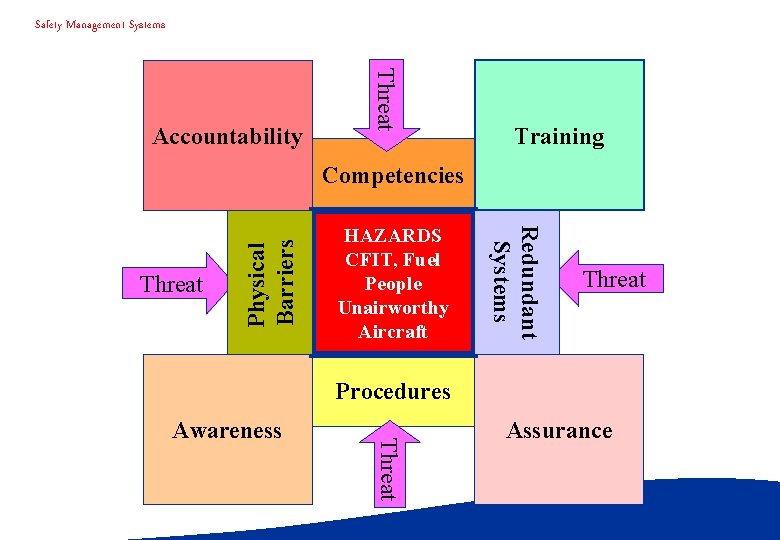
Safety Management Systems Key Elements - Process Management: • This is the “doing” part of the business. “Fly” or “Maintain aircraft” typically, are key processes in an aircraft operation. • To apply a systematic approach to the business, each critical process should be reviewed and improved if necessary. • The risk to the business of not applying the process effectively should be evaluated and appropriate steps taken to manage those processes assessed as critical to the business. • A Safety Management System requires clear focus on the risk bearing processes that, if not done correctly, will cause harm. • The controls of hazard management are embedded in the normal systems of working in aviation (checklists, competencies, training and system redundancy.
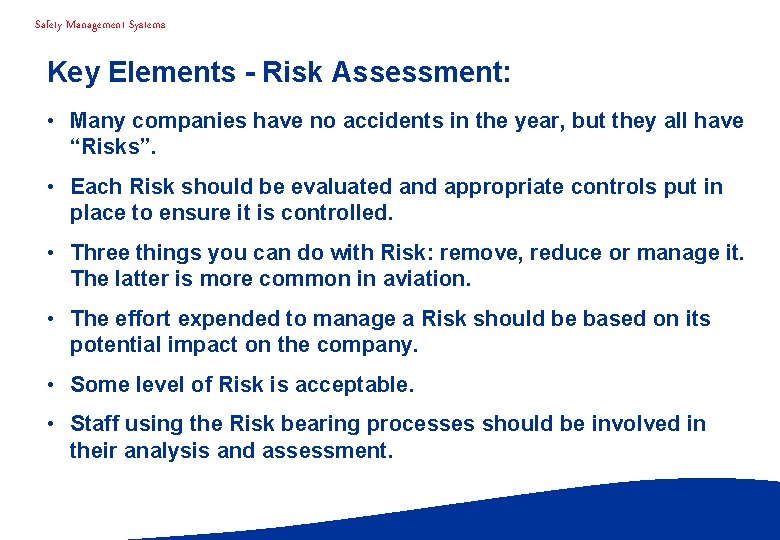
Safety Management Systems Key Elements - Risk Assessment: • Many companies have no accidents in the year, but they all have “Risks”. • Each Risk should be evaluated and appropriate controls put in place to ensure it is controlled. • Three things you can do with Risk: remove, reduce or manage it. The latter is more common in aviation. • The effort expended to manage a Risk should be based on its potential impact on the company. • However, some level of Risk is acceptable. • Staff using the Risk bearing processes should be involved in their analysis and assessment.
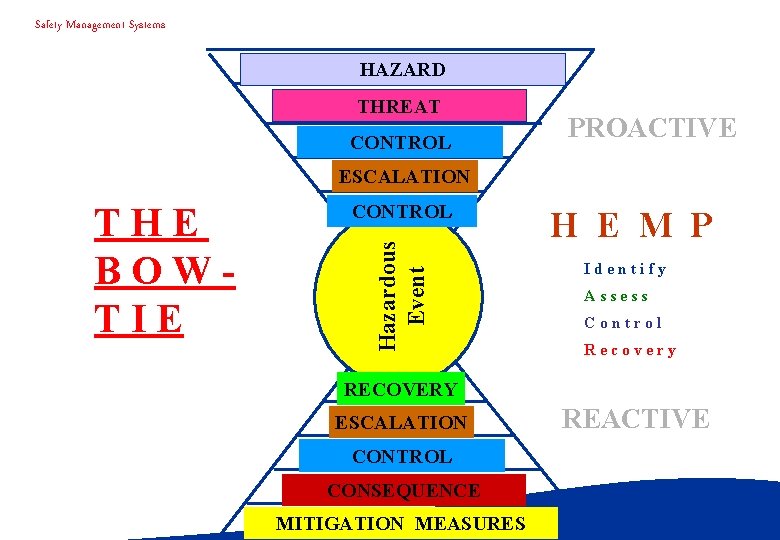
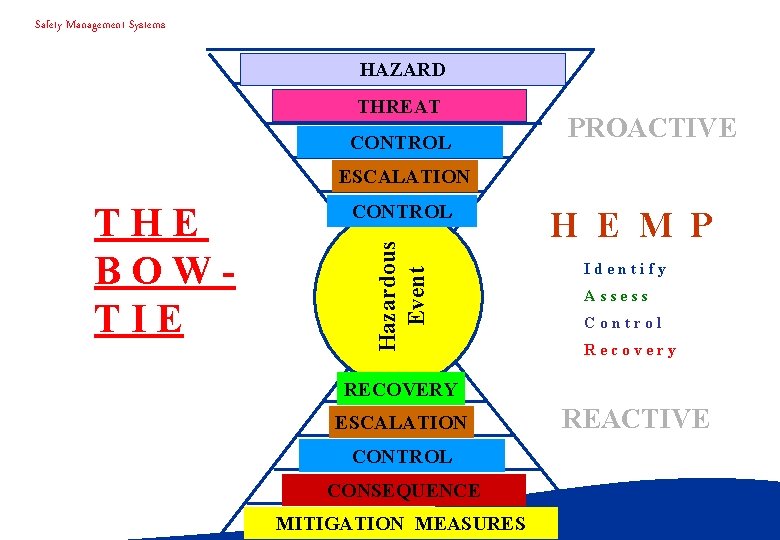
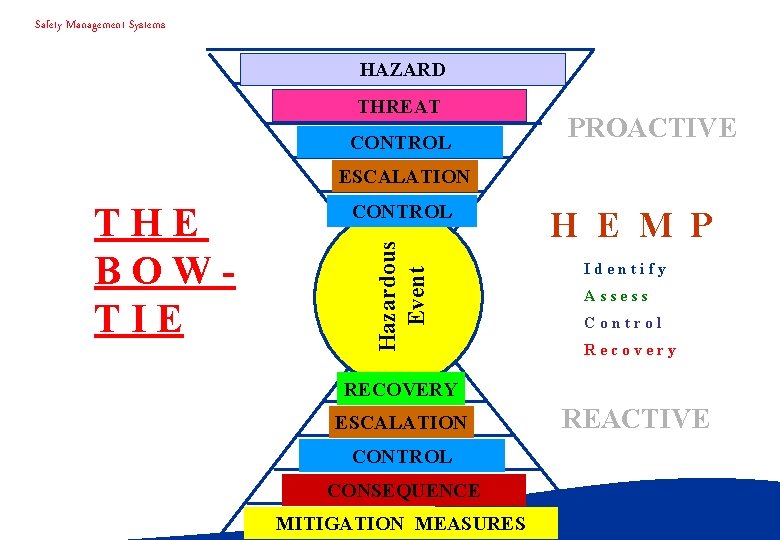
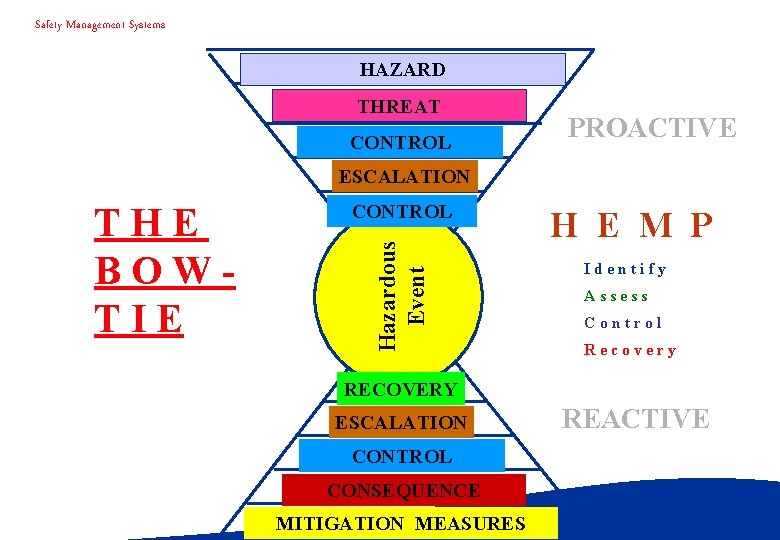
Safety Management Systems Key Elements - Hazard Management: • Identify and categorise potential sources of harm (Hazards). • Identify all undesirable events associated with each hazard which, could result in harm being caused (Threats). • Develop or improve appropriate measures to prevent occurrence (Controls). • Define the measures necessary to re-establish a safe operating situation (Recovery Measures). • Reduce the impact of any consequences incurred (Mitigation Measures).
Safety Management Systems Key Elements - Review: • The process of checking if what is “in place” remains valid. • Policies, standards, processes and procedures should be routinely reviewed to confirm their ongoing validity. • The outcomes of business (good or bad) should be reviewed. • Review is one of the least used verification tools. • Reviews should be carried out by users, as it requires their unique knowledge to add value. • The outcomes of reviews are best tracked through a common Remedial Action Process.
Safety Management Systems Key Elements - Monitoring: • Monitoring is about finding out how people achieve tasks, as opposed to how they are expected to to do them (actual versus plan). • Monitoring is unpopular as it deals face-to-face with people and their miscommunications, errors and violations. • Monitoring is not intended to be a trapping exercise, but to understand the problems of the workplace. • Monitoring should be done on two levels: $ Compliance monitoring as a form of audit, $ Task monitoring done by line staff (peers or supervisors).
Safety Management Systems Key Elements - Audit: • Audit is the process of verification that formally requires parts of the business to be checked against standards, or trainedfor actions. • Audit is often limited to site inspections and document checks. • Audit should be focussed more at the processes rather than its locations. • Audits should be planned to cover all aspects of the business, but the frequency should reflect the level of problems found. • Audit findings requiring resolution should be formally recorded in the Remedial Action process.
Safety Management Systems Key Elements - Incident Reporting & Investigation: • Open incident reporting is a matter of Culture. • Improvement and learning can come from incidents and accidents, albeit they are “unwanted investments”. • The approach should be to get “a return from investments” from whatever you do, including the errors experienced. • Learning comes from investigation and analysis of the facts, primary causes and underlying causal factors. • Often underlying causal factors are embedded in the systems of work that require line management action to resolve. • Learning can also be shared through “safety data exchange”.
Safety Management Systems Key Elements - Remedial Action: • From numerous sources, remedial actions will be raised. • Remedial actions should be recorded in a single control system, which must enhance visibility for Line Management. • Targets dates set for action and agreed with the Line Manager. • Follow-up action by the Safety Manager should ensure that appropriate action has been taken and is now working. • The remedial actions not being addressed on target should be reported through the Management Review Board.
Safety Management Systems Key Elements - Customer Satisfaction: • ISO 9000 -2000 Quality System sets Customer Satisfaction as a key requirement; this is the same for safety management. • Measurement of customer satisfaction is rarely done well and, even less, seen as part of the management system. • Customer Safety is an issue of satisfaction, and safety management systems can aid the development of this. • Dissatisfied customer don’t come back and as an industry we are highly reliant on return business.
Safety Management Systems Key Elements - Management Review: • Periodically there must be a formal Management Review Process. • Management Review is the final step of feedback in the closed loop • Top management must be involved in the Management Review Board process, in order for them to be informed. • Reviews include Policy, Objectives, Customer Satisfaction, Training, Audits, KPIs, Supplier Performance, Changes and Remedial Actions not yet resolved.
Safety Management Systems Key Elements - Culture: • Culture of the Company determines the approach everybody takes toward work, especially safety and risk taking. • There may be sub-cultures, but the corporate culture is a reflection of the management’s commitment and leadership. • The culture of the Company can be changed but it is a slow process and is easily damaged - there are no “quick fixes”. • Safety cultures range from “blame” to “no blame” but the aim should be for a “Just and Learning Culture”, and open to improvement.
Safety Management Systems OVERVIEW l Industry Approach to Safety l The Need for Change l Management Systems l Key Elements of a Safety Management System l Conclusions l Hazard Management
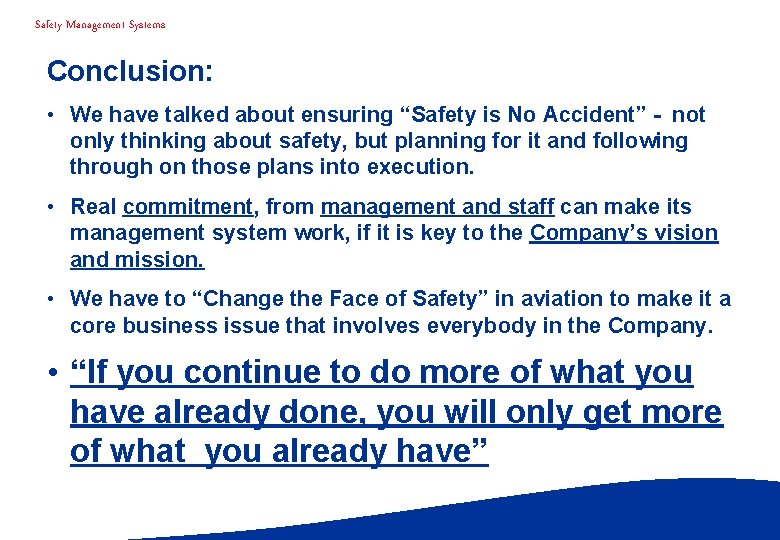
Safety Management Systems Conclusion: • We have talked about ensuring “Safety is No Accident” - not only thinking about safety, but planning for it and following through on those plans into execution. • Real commitment, from management and staff can make its management system work, if it is key to the Company’s vision and mission. • We have to “Change the Face of Safety” in aviation to make it a core business issue that involves everybody in the Company. • “If you continue to do more of what you have already done, you will only get more of what you already have”
Safety Management Systems OVERVIEW l Industry Approach to Safety l The Need for Change l Management Systems l Key Elements of a Safety Management System l Conclusions l Hazard Management
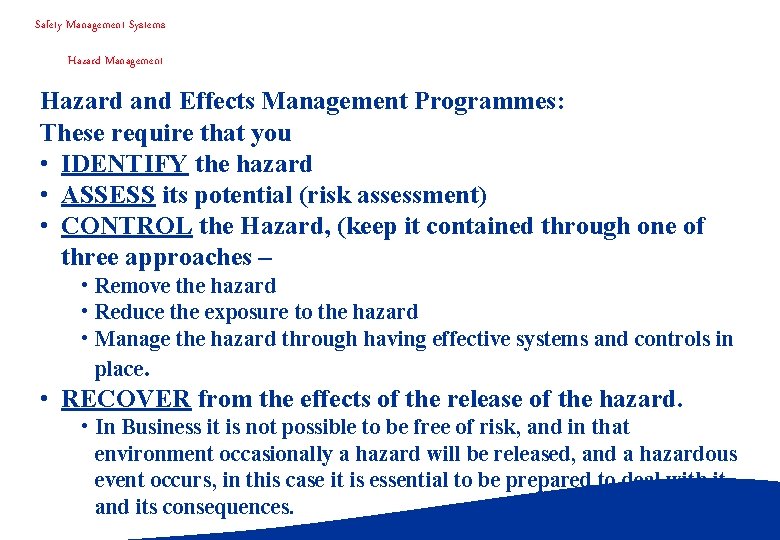
Safety Management Systems Hazard Management Hazard and Effects Management Programmes: These require that you • IDENTIFY the hazard • ASSESS its potential (risk assessment) • CONTROL the Hazard, (keep it contained through one of three approaches – • Remove the hazard • Reduce the exposure to the hazard • Manage the hazard through having effective systems and controls in place. • RECOVER from the effects of the release of the hazard. • In Business it is not possible to be free of risk, and in that environment occasionally a hazard will be released, and a hazardous event occurs, in this case it is essential to be prepared to deal with it and its consequences.
Safety Management Systems Threat Accountability Training HAZARDS CFIT, Fuel People HAZARDS Unairworthy Aircraft Redundant Systems Threat Physical Barriers Competencies Threat Procedures Threat Awareness Assurance
Safety Management Systems Key Elements - Risk Assessment: • Many companies have no accidents in the year, but they all have “Risks”. • Each Risk should be evaluated and appropriate controls put in place to ensure it is controlled. • Three things you can do with Risk: remove, reduce or manage it. The latter is more common in aviation. • The effort expended to manage a Risk should be based on its potential impact on the company. • Some level of Risk is acceptable. • Staff using the Risk bearing processes should be involved in their analysis and assessment.
Safety Management Systems RISK ASSESSMENT MATRIX Potential Consequence of the Incident Rating People Env'ment Assets Zero Effect Zero damage 1 Slight injury Slight Effect Slight damage < US$ 10 K 2 Minor injury Minor Effect 3 Serious injury 4 Single fatality 5 Multiple fatality 0 No injury Reputation A Unknown but possible in the aviation industry B Known in aviation industry C Happened in this company D E Happened > Happened 3 x in the > 3 x in this Company location No Impact Slight Impact Minor damage < US$ 50 K Local Impact Localised Effect Local damage < US$ 250 K Industry Impact Major Effect Major damage < US$ 1 M National Impact Extensive damage > US$ 1 M International Impact Massive Effect Increasing Probability gh u ro -MS h T SE e ag l H es n a r k a M orm edu ris e N oc at r r p po on r co cti re n i du u re eas e m bl a er l to In
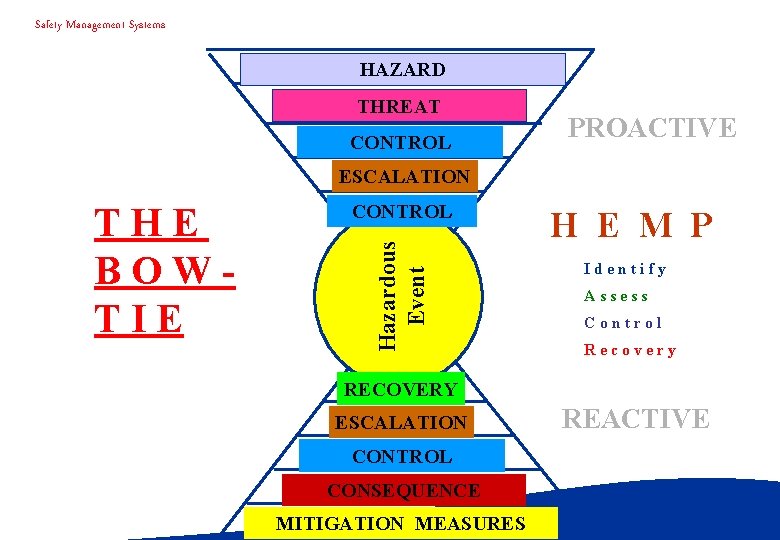
Safety Management Systems HAZARD THREAT CONTROL PROACTIVE ESCALATION Hazardous Event THE BOWTIE CONTROL H E M P Identify Assess Control Recovery RECOVERY ESCALATION CONTROL CONSEQUENCE MITIGATION MEASURES REACTIVE
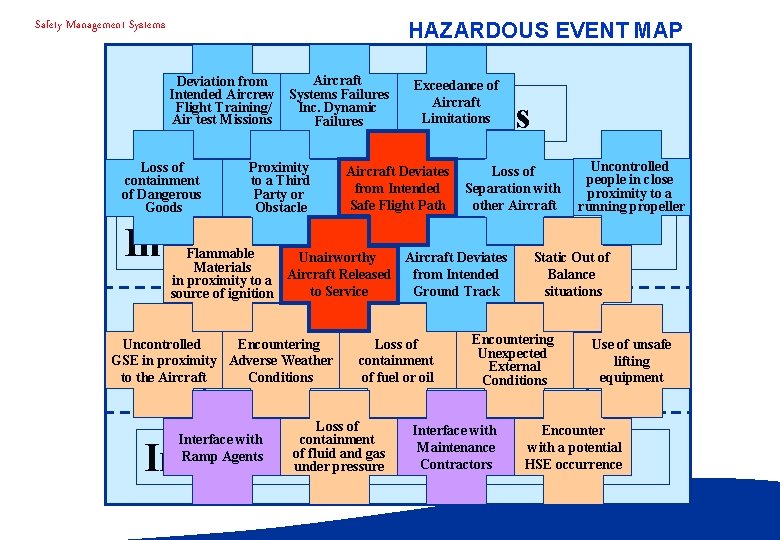
Safety Management Systems HAZARDOUS EVENT MAP Aircraft Deviation from Intended Aircrew Systems Failures Flight Training/ Inc. Dynamic Air test Missions Failures Exceedance of Aircraft Limitations Flight Operations Loss of containment of Dangerous Goods Proximity to a Third Party or Obstacle Aircraft Deviates from Intended Safe Flight Path Loss of Separation with other Aircraft Uncontrolled people in close proximity to a running propeller Internal Interface Operations Flammable Unairworthy Aircraft Deviates Materials from Intended in proximity to a Aircraft Released to Service Ground Track source of ignition Static Out of Balance situations Ground Operations and Maintenance Uncontrolled Encountering GSE in proximity Adverse Weather to the Aircraft Conditions Interface with Ramp Agents Loss of containment of fuel or oil Loss of containment of fluid and gas under pressure Encountering Unexpected External Conditions Interface with Maintenance Contractors Use of unsafe lifting equipment Encounter with a potential HSE occurrence Interfaces with Contractors
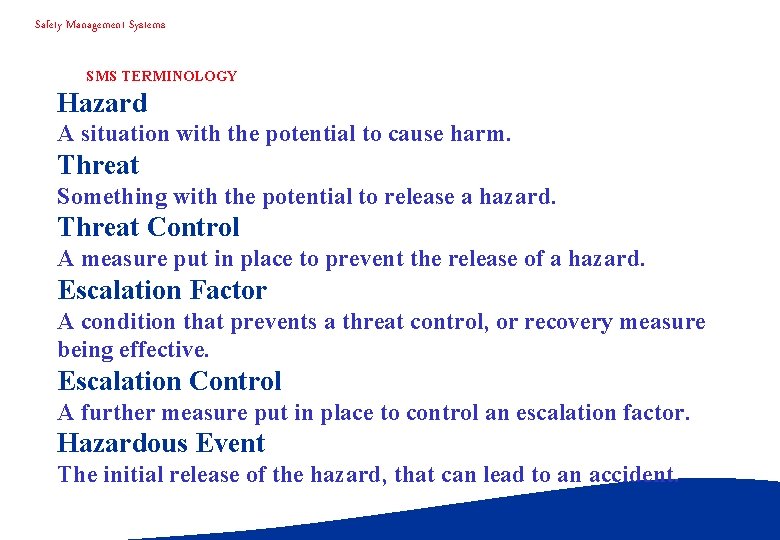
Safety Management Systems SMS TERMINOLOGY Hazard A situation with the potential to cause harm. Threat Something with the potential to release a hazard. Threat Control A measure put in place to prevent the release of a hazard. Escalation Factor A condition that prevents a threat control, or recovery measure being effective. Escalation Control A further measure put in place to control an escalation factor. Hazardous Event The initial release of the hazard, that can lead to an accident.
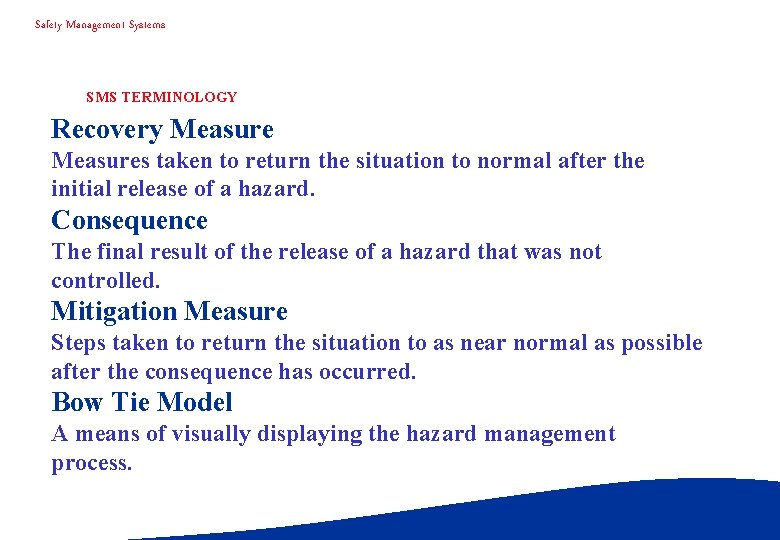
Safety Management Systems SMS TERMINOLOGY Recovery Measures taken to return the situation to normal after the initial release of a hazard. Consequence The final result of the release of a hazard that was not controlled. Mitigation Measure Steps taken to return the situation to as near normal as possible after the consequence has occurred. Bow Tie Model A means of visually displaying the hazard management process.
Safety Management Systems HAZARD THREAT CONTROL PROACTIVE ESCALATION Hazardous Event THE BOWTIE CONTROL H E M P Identify Assess Control Recovery RECOVERY ESCALATION CONTROL CONSEQUENCE MITIGATION MEASURES REACTIVE
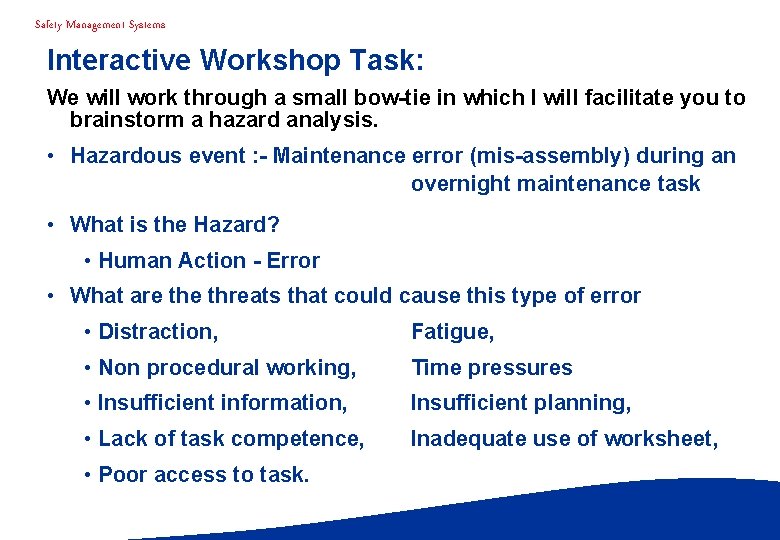
Safety Management Systems Interactive Workshop Task: We will work through a small bow-tie in which I will facilitate you to brainstorm a hazard analysis. • Hazardous event : - Maintenance error (mis-assembly) during an overnight maintenance task • What is the Hazard? • Human Action - Error • What are threats that could cause this type of error • Distraction, Fatigue, • Non procedural working, Time pressures • Insufficient information, Insufficient planning, • Lack of task competence, Inadequate use of worksheet, • Poor access to task.
Safety Management Systems HAZARD THREAT CONTROL PROACTIVE ESCALATION Hazardous Event THE BOWTIE CONTROL H E M P Identify Assess Control Recovery RECOVERY ESCALATION CONTROL CONSEQUENCE MITIGATION MEASURES REACTIVE
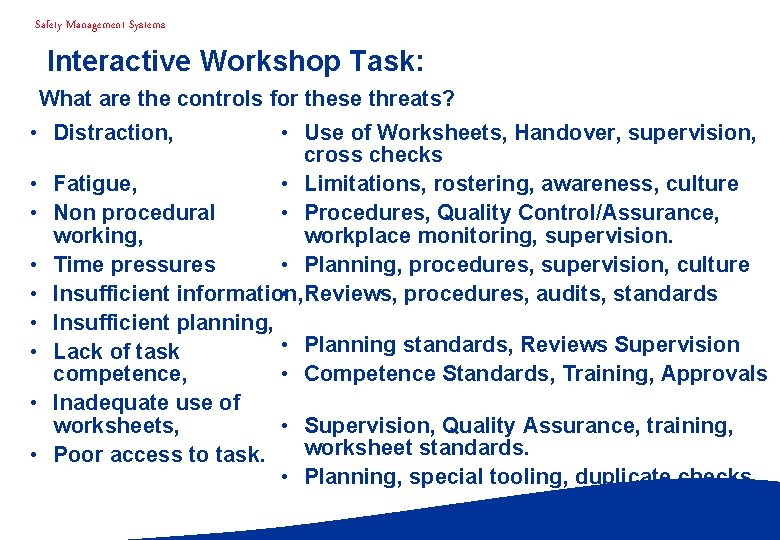
Safety Management Systems Interactive Workshop Task: What are the controls for these threats? • Distraction, • • • Use of Worksheets, Handover, supervision, cross checks Fatigue, • Limitations, rostering, awareness, culture Non procedural • Procedures, Quality Control/Assurance, working, workplace monitoring, supervision. Time pressures • Planning, procedures, supervision, culture Insufficient information, • Reviews, procedures, audits, standards Insufficient planning, • Planning standards, Reviews Supervision Lack of task competence, • Competence Standards, Training, Approvals Inadequate use of worksheets, • Supervision, Quality Assurance, training, worksheet standards. Poor access to task. • Planning, special tooling, duplicate checks.
Safety Management Systems HAZARD THREAT CONTROL PROACTIVE ESCALATION Hazardous Event THE BOWTIE CONTROL H E M P Identify Assess Control Recovery RECOVERY ESCALATION CONTROL CONSEQUENCE MITIGATION MEASURES REACTIVE
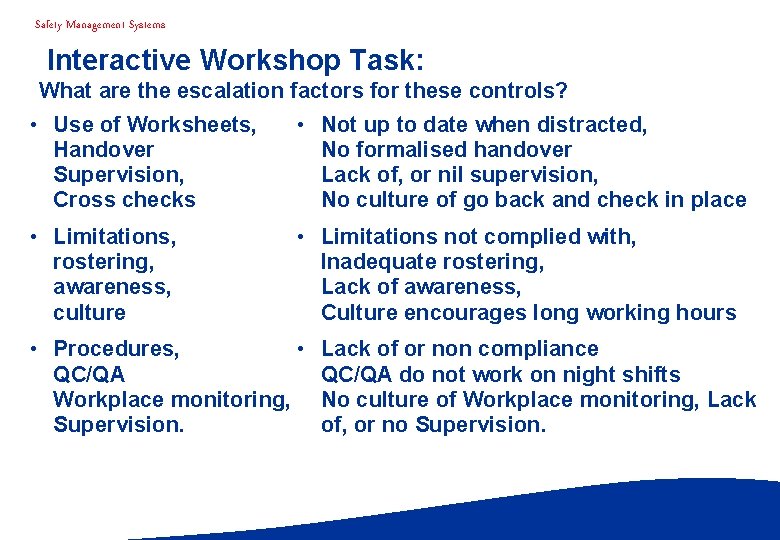
Safety Management Systems Interactive Workshop Task: What are the escalation factors for these controls? • Use of Worksheets, Handover Supervision, Cross checks • Not up to date when distracted, No formalised handover Lack of, or nil supervision, No culture of go back and check in place • Limitations, rostering, awareness, culture • Limitations not complied with, Inadequate rostering, Lack of awareness, Culture encourages long working hours • Procedures, • QC/QA Workplace monitoring, Supervision. Lack of or non compliance QC/QA do not work on night shifts No culture of Workplace monitoring, Lack of, or no Supervision.
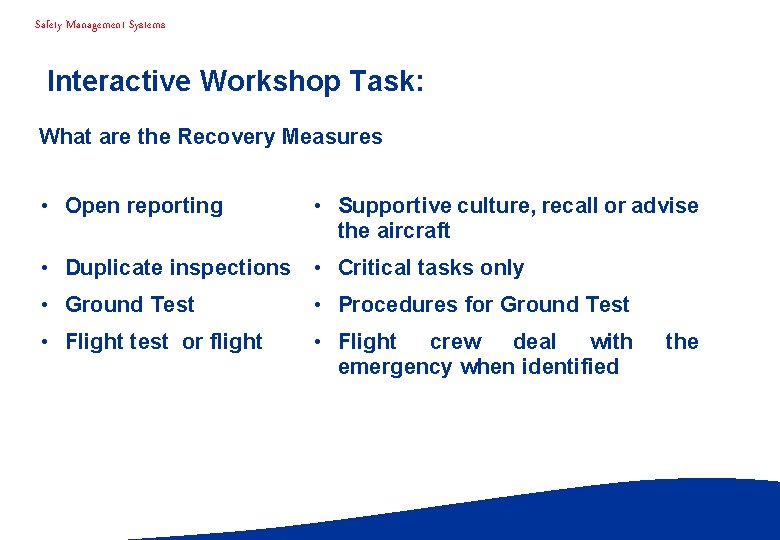
Safety Management Systems Interactive Workshop Task: What are the Recovery Measures • Open reporting • Supportive culture, recall or advise the aircraft • Duplicate inspections • Critical tasks only • Ground Test • Procedures for Ground Test • Flight test or flight • Flight crew deal with emergency when identified the
Safety Management Systems HAZARD THREAT CONTROL PROACTIVE ESCALATION Hazardous Event THE BOWTIE CONTROL H E M P Identify Assess Control Recovery RECOVERY ESCALATION CONTROL CONSEQUENCE MITIGATION MEASURES REACTIVE
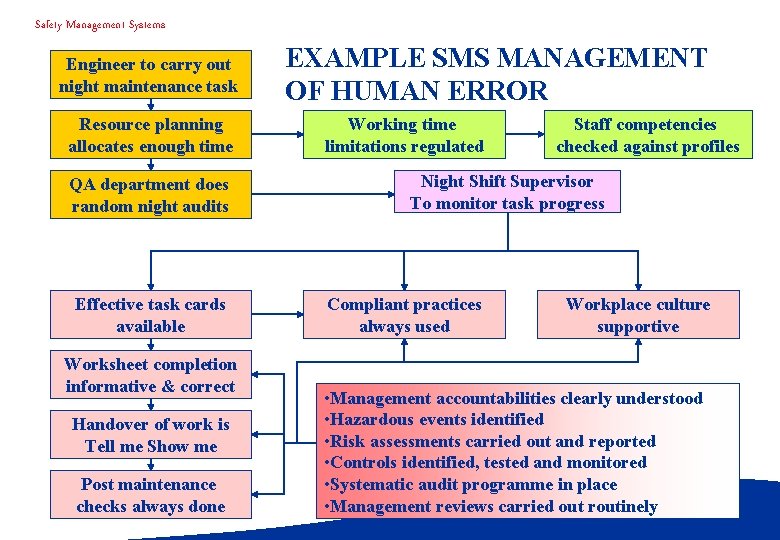
Safety Management Systems Engineer to carry out night maintenance task Resource planning allocates enough time QA department does random night audits Effective task cards available Worksheet completion informative & correct Handover of work is Tell me Show me Post maintenance checks always done EXAMPLE SMS MANAGEMENT OF HUMAN ERROR Working time limitations regulated Staff competencies checked against profiles Night Shift Supervisor To monitor task progress Compliant practices always used Workplace culture supportive • Management accountabilities clearly understood • Hazardous events identified • Risk assessments carried out and reported • Controls identified, tested and monitored • Systematic audit programme in place • Management reviews carried out routinely
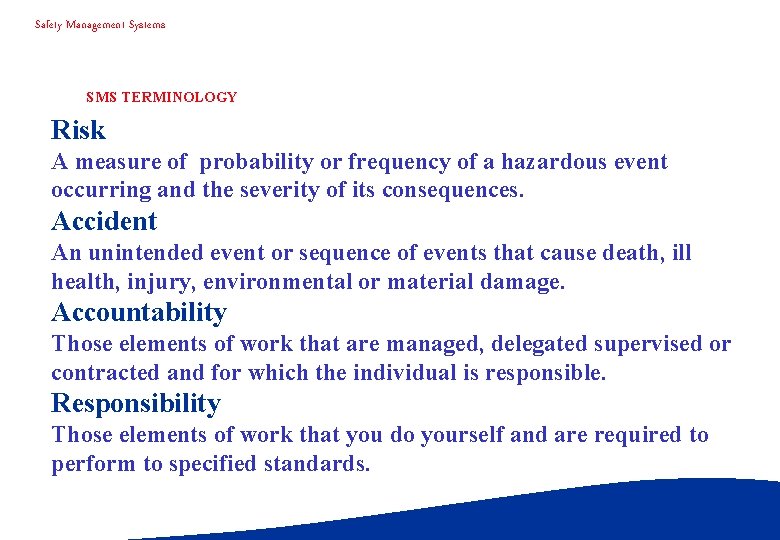
Safety Management Systems SMS TERMINOLOGY Risk A measure of probability or frequency of a hazardous event occurring and the severity of its consequences. Accident An unintended event or sequence of events that cause death, ill health, injury, environmental or material damage. Accountability Those elements of work that are managed, delegated supervised or contracted and for which the individual is responsible. Responsibility Those elements of work that you do yourself and are required to perform to specified standards.
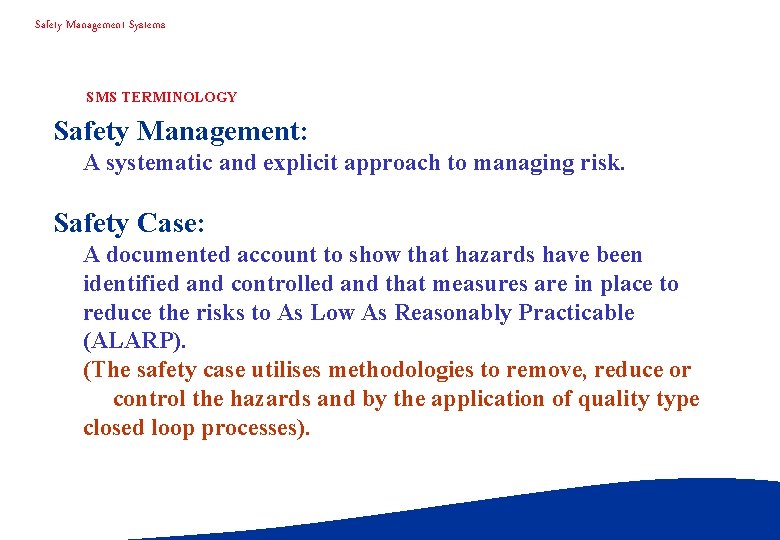
Safety Management Systems SMS TERMINOLOGY Safety Management: A systematic and explicit approach to managing risk. Safety Case: A documented account to show that hazards have been identified and controlled and that measures are in place to reduce the risks to As Low As Reasonably Practicable (ALARP). (The safety case utilises methodologies to remove, reduce or control the hazards and by the application of quality type closed loop processes).