
Safety Management in French CAA k From 91
![Involve staff representatives k Some Safety matters examined in WG including staff representatives ]Operator](https://slidetodoc.com/presentation_image/32c4764eeeae5649ab467c8763a24120/image-20.jpg "Involve staff representatives k Some Safety matters examined in WG including staff representatives ]Operator")
- Slides: 24
Safety Management in French CAA k. From 91 to 95 in France k 95 : EATCHIP safety policy k. From 96 : a formal safety plan k. Where are we in 2000 ? CENA 1
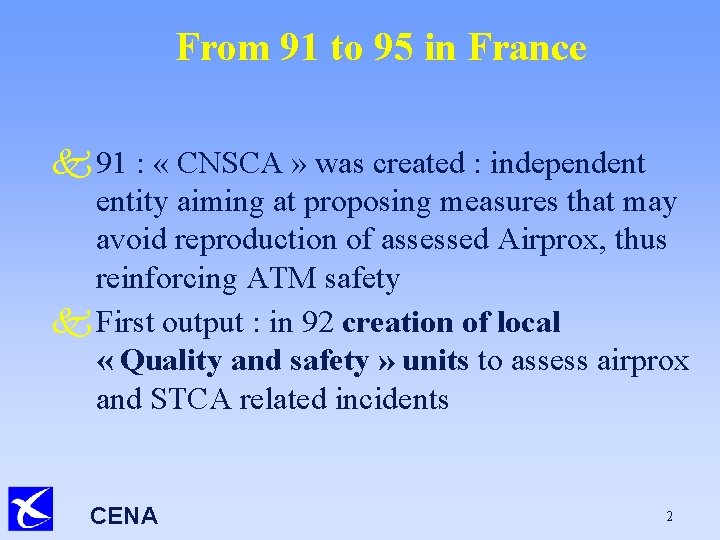
From 91 to 95 in France k 91 : « CNSCA » was created : independent entity aiming at proposing measures that may avoid reproduction of assessed Airprox, thus reinforcing ATM safety k First output : in 92 creation of local « Quality and safety » units to assess airprox and STCA related incidents CENA 2
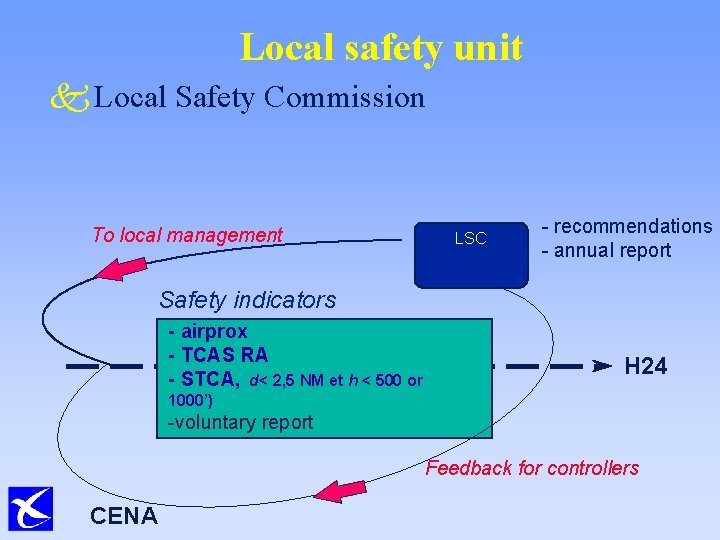
Local safety unit k Local Safety Commission To local management LSC - recommendations - annual report Safety indicators - airprox - TCAS RA - STCA, d< 2, 5 NM et h < 500 or H 24 1000’) -voluntary report Feedback for controllers CENA
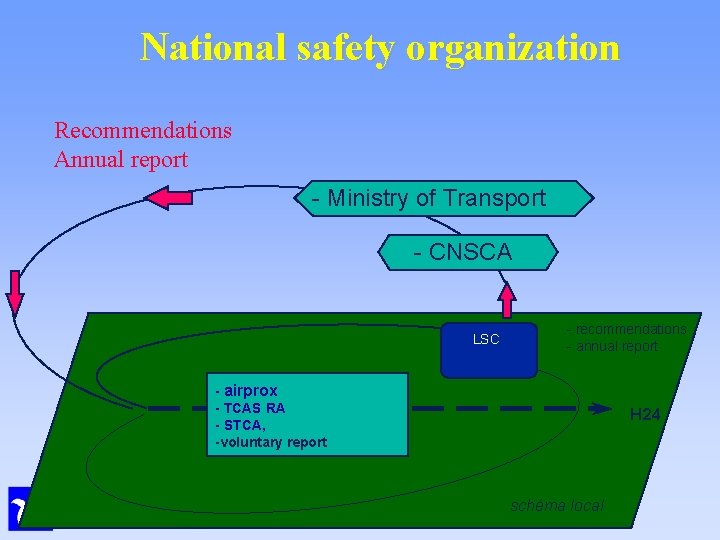
National safety organization Recommendations Annual report - Ministry of Transport - CNSCA LSC - recommendations - annual report - airprox - TCAS RA - STCA, -voluntary report CENA H 24 schéma local
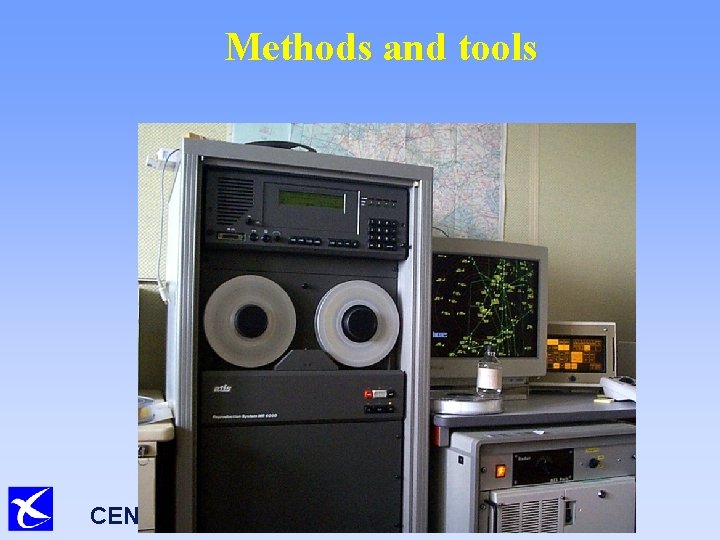
Methods and tools CENA
Nov 95 : EATCHIP SAFETY POLICY k. Almost all principles of the Policy were applied in France k. In particular were considered as adequate : i The incident reporting procedure (loss of separation type, Airprox, STCA, TCAS) i the incident analysis and associated lesson learning procedures including CNSCA k. However, there was some doubt whether DNA had i «an explicit, pro-active approach to Safety management» CENA
96 -97 : building up a safety action plan k. How do we perceive safety in France ? i Is there a safety policy ? Who is aware of it ? i How do we learn and what have we identified ? i What are our technical means and human resources ? k. What should be achieved to comply with EATCHIP and have a more pro-active approach ? i List of actions k. Is there a need to change the safety organization ? WG with 25 « experts » , including Union representatives CENA
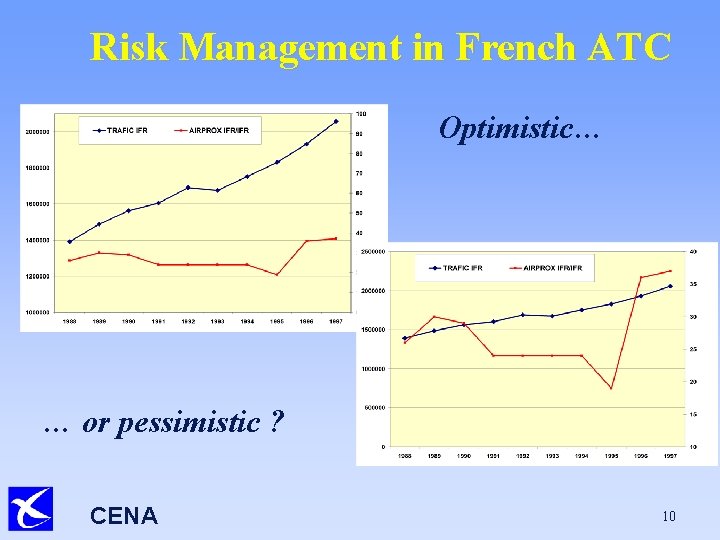
Risk Management in French ATC Optimistic… … or pessimistic ? CENA 10
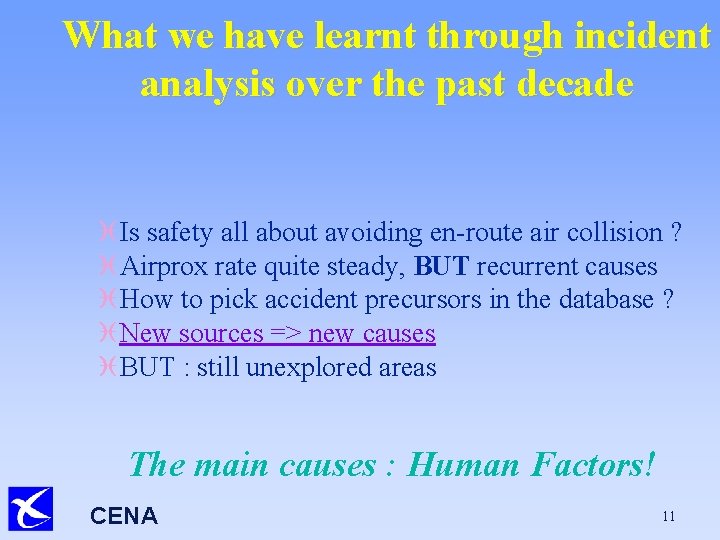
What we have learnt through incident analysis over the past decade i Is safety all about avoiding en-route air collision ? i Airprox rate quite steady, BUT recurrent causes i How to pick accident precursors in the database ? i New sources => new causes i BUT : still unexplored areas The main causes : Human Factors! CENA 11
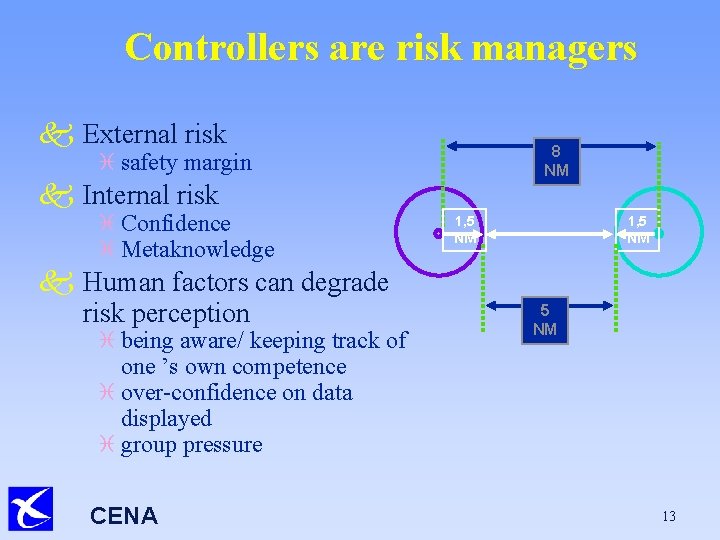
Controllers are risk managers k External risk 8 NM i safety margin k Internal risk i Confidence i Metaknowledge k Human factors can degrade risk perception i being aware/ keeping track of one ’s own competence i over-confidence on data displayed i group pressure CENA 1, 5 NM 13
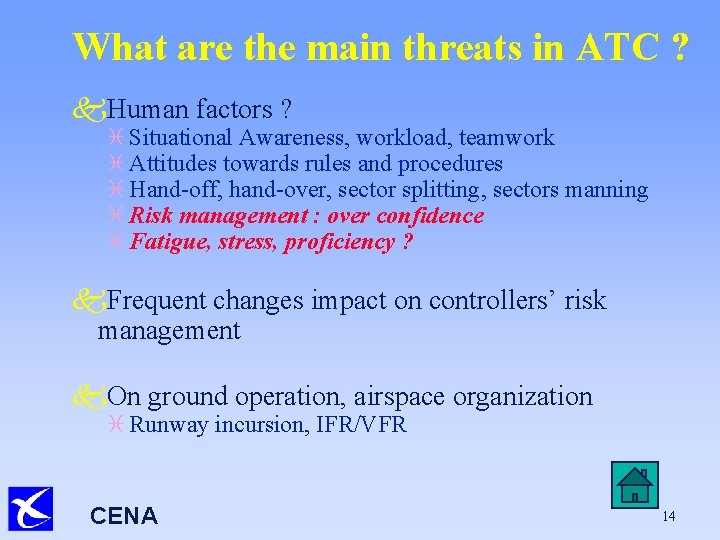
What are the main threats in ATC ? k. Human factors ? i Situational Awareness, workload, teamwork i Attitudes towards rules and procedures i Hand-off, hand-over, sector splitting, sectors manning i Risk management : over confidence i Fatigue, stress, proficiency ? k. Frequent changes impact on controllers’ risk management k. On ground operation, airspace organization i Runway incursion, IFR/VFR CENA 14
DNA Safety Action plan Achieved in July 98 CENA 15
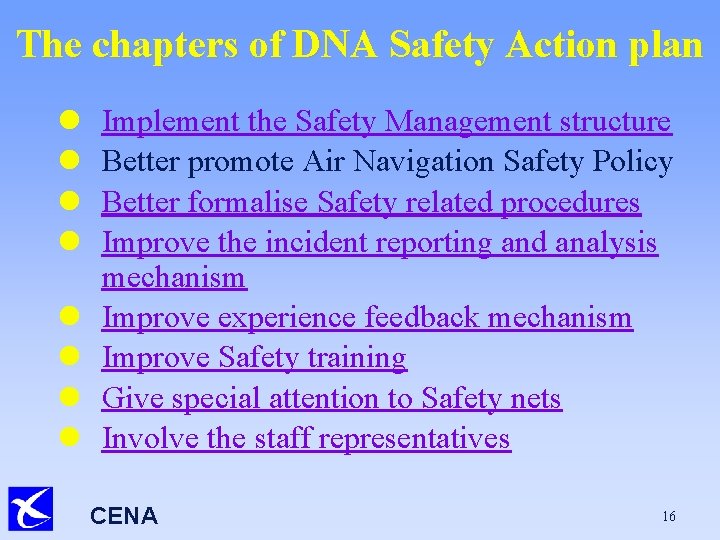
The chapters of DNA Safety Action plan l l l l Implement the Safety Management structure Better promote Air Navigation Safety Policy Better formalise Safety related procedures Improve the incident reporting and analysis mechanism Improve experience feedback mechanism Improve Safety training Give special attention to Safety nets Involve the staff representatives CENA 16
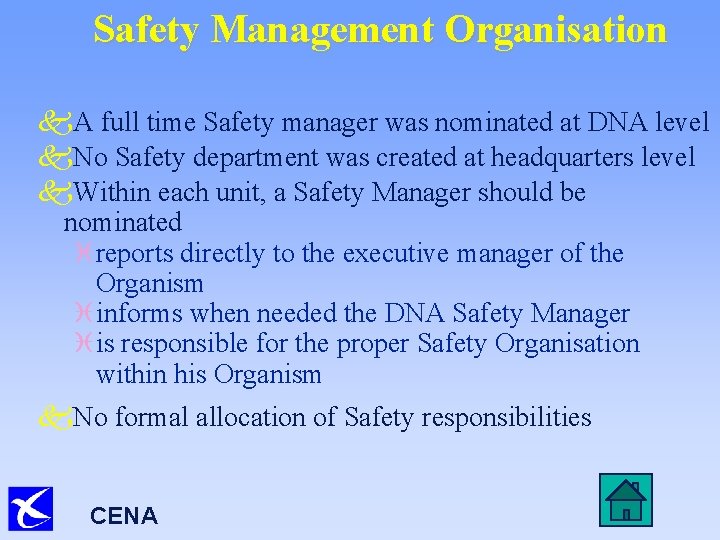
Safety Management Organisation k. A full time Safety manager was nominated at DNA level k. No Safety department was created at headquarters level k. Within each unit, a Safety Manager should be nominated i reports directly to the executive manager of the Organism i informs when needed the DNA Safety Manager i is responsible for the proper Safety Organisation within his Organism k. No formal allocation of Safety responsibilities CENA
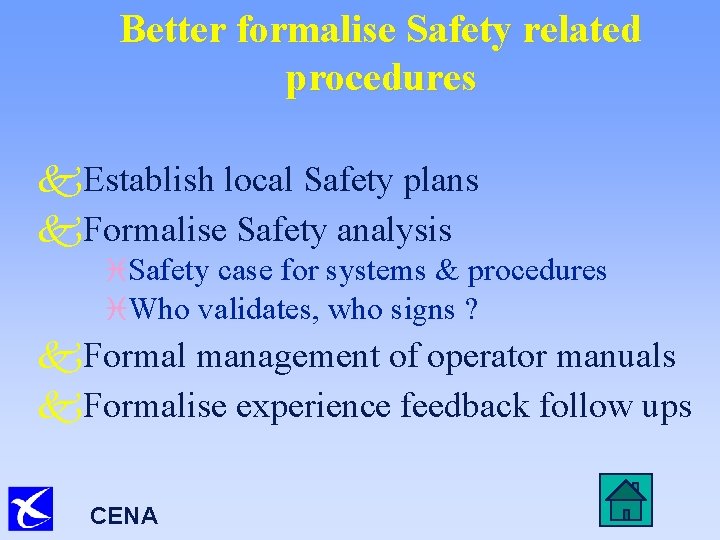
Better formalise Safety related procedures k. Establish local Safety plans k. Formalise Safety analysis i. Safety case for systems & procedures i. Who validates, who signs ? k. Formal management of operator manuals k. Formalise experience feedback follow ups CENA
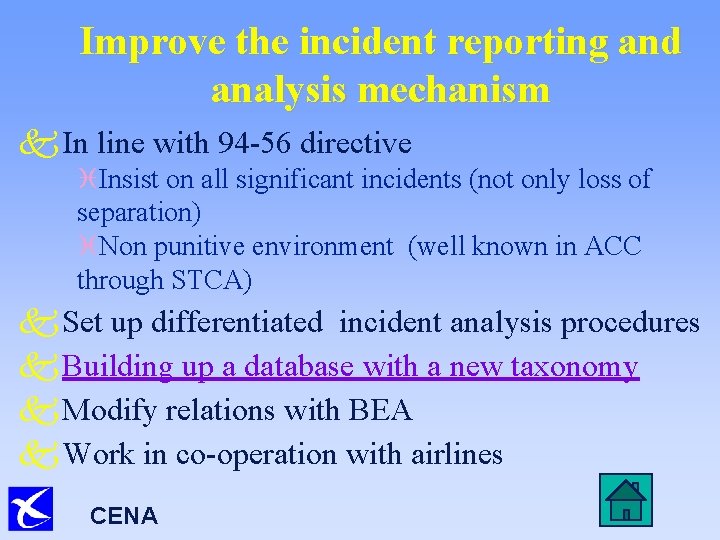
Improve the incident reporting and analysis mechanism k In line with 94 -56 directive i. Insist on all significant incidents (not only loss of separation) i. Non punitive environment (well known in ACC through STCA) k Set up differentiated incident analysis procedures k Building up a database with a new taxonomy k Modify relations with BEA k Work in co-operation with airlines CENA
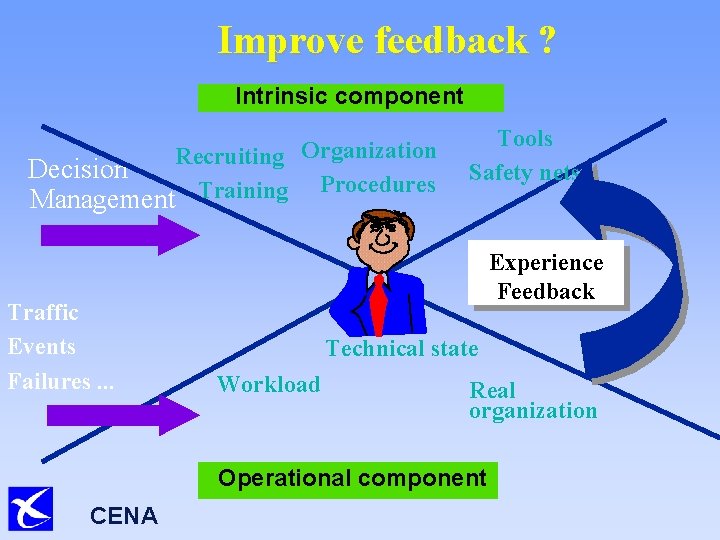
Improve feedback ? Intrinsic component Recruiting Organization Decision Procedures Training Management Traffic Events Failures. . . Tools Safety nets Experience Feedback Technical state Workload Real organization Operational component CENA
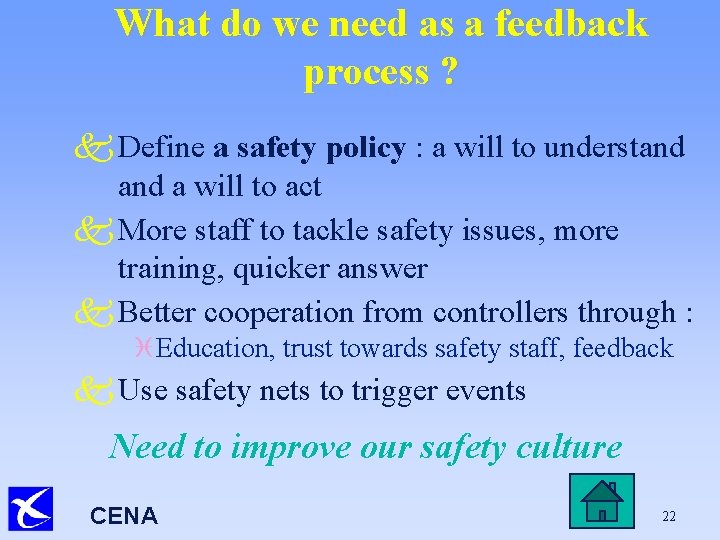
What do we need as a feedback process ? k Define a safety policy : a will to understand a will to act k More staff to tackle safety issues, more training, quicker answer k Better cooperation from controllers through : i Education, trust towards safety staff, feedback k Use safety nets to trigger events Need to improve our safety culture CENA 22
Improve training k. Safety Management courses at ENAC k. Include TRM k. Use tools like RITA k. Enhance the training on emergency handling CENA
Involve staff representatives k Some Safety matters examined in WG including staff representatives ]Operator manual ]QS manning ]Runway incursions ]Emergency handling ]Met information on radar screen ]Control units manning ] Positive feedback ]MSAW example CENA 24
CAP 2001 Air Navigation Safety Folder k. Orientation document drafted in spring 99 i by a group of motivated staff (not only management) k. The DNA has defined key actions j practical actions rather then philosophy j in line with the DNA Safety action plan j follow up managed by DGAC k. Adoption : end 1999 CENA 25
Where are we in 2000 ? From CENA studies (Safety and Human Factors approach) CENA 28
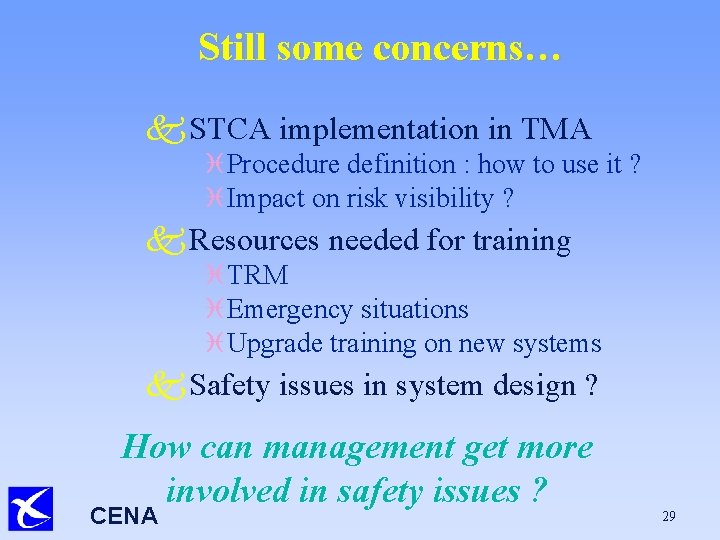
Still some concerns… k STCA implementation in TMA i Procedure definition : how to use it ? i Impact on risk visibility ? k Resources needed for training i TRM i Emergency situations i Upgrade training on new systems k Safety issues in system design ? How can management get more involved in safety issues ? CENA 29
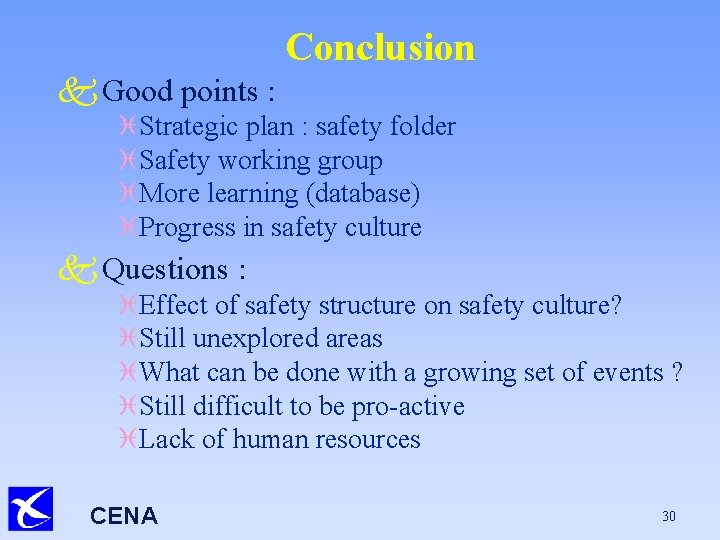
Conclusion k Good points : i Strategic plan : safety folder i Safety working group i More learning (database) i Progress in safety culture k Questions : i Effect of safety structure on safety culture? i Still unexplored areas i What can be done with a growing set of events ? i Still difficult to be pro-active i Lack of human resources CENA 30