
Safety Lab Station ONE Scenario During a lab
Safety Lab
Station ONE �Scenario: During a lab, a student at your lab table knocked over a bottle of ethyl alcohol. You have a Bunsen burner going. Answer the questions on your lab sheet
Station TWO �Eye Wash Station �Hold eyelids open �Do not squint �If you have contacts in, immediately try to take them out! �Run water for 20 minutes �Go to school nurse immediately after �Safety Shower �If a person’s clothes have caught on fire, put them under the safety shower �If a large quantity of an acid or base is spilled on your clothes, use the safety shower �If a large quantity of an unknown chemical spills on your body, use the safety shower
GOGGLES �MUST BE WORN AT ALL TIMES!! �If you do not wear them you will receive a zero. �Each time you take them off you lose 5 points from your lab safety grade. �Contact Safety – �Contacts can be worn in the lab, but you and your parents must sign a release form. While a contact accident should never occur, it is always possible that it might.
Station THREE � Fire Extinguisher �Types A – Combustion (Paper, Wood) B – Liquids (Gasoline, Kerosene) C – Electrical D – Metal (Magnesium, Zinc) �We have an ABC fire extinguisher here in lab. �We only use a D class fire extinguisher when we are working with metals! � Fire Blanket �Used to extinguish fires �Can be placed around a person whose clothes are on fire �Can be placed over larger chemical spills to help soak them up �Should NEVER be placed around the face of another person � First Aid Kit �In case of cuts or burns notify the teacher immediately!!
Station FOUR � Dress Safety in the LAB �No dangling jewelry. Necklaces, bracelets, watches, puffy sleeved shirts, and ID’s that dangle may get caught on glassware, fall into chemicals, or swing into flames. �Long hair – must be tied back at all times in the lab. It can get caught on lab equipment, in fire and in chemicals. You should keep a rubber band or scrunchy in your notebook for your hair �No open toed shoes- This is to prevent broken glass, chemicals, and other harmful materials from getting on your feet. �No shorts or short-skirts allowed in lab – you need to protect your legs with pants on lab days �Don’t wear clothing that you would hate to get dirty. Certain dyes, acids and other chemicals can damage clothes beyond repair. �Wear an apron whenever possible in lab! � It will help prevent chemicals transferring onto your clothes/person. � You can use your apron to put out a small fire at your lab bench!
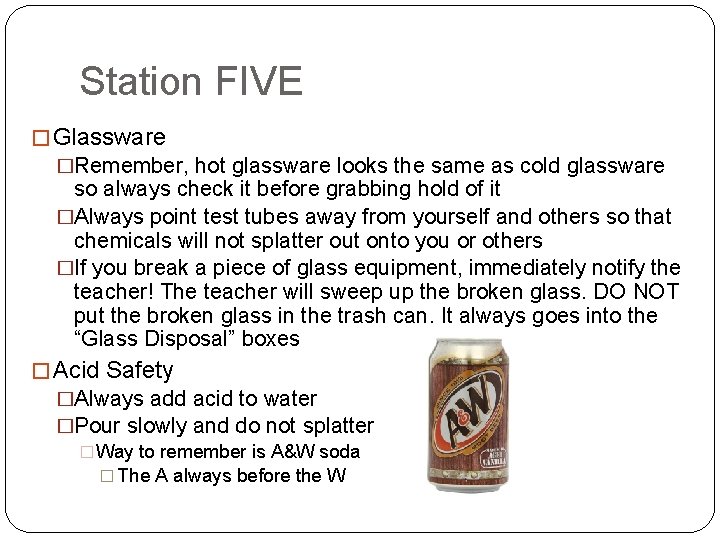
Station FIVE � Glassware �Remember, hot glassware looks the same as cold glassware so always check it before grabbing hold of it �Always point test tubes away from yourself and others so that chemicals will not splatter out onto you or others �If you break a piece of glass equipment, immediately notify the teacher! The teacher will sweep up the broken glass. DO NOT put the broken glass in the trash can. It always goes into the “Glass Disposal” boxes � Acid Safety �Always add acid to water �Pour slowly and do not splatter � Way to remember is A&W soda � The A always before the W
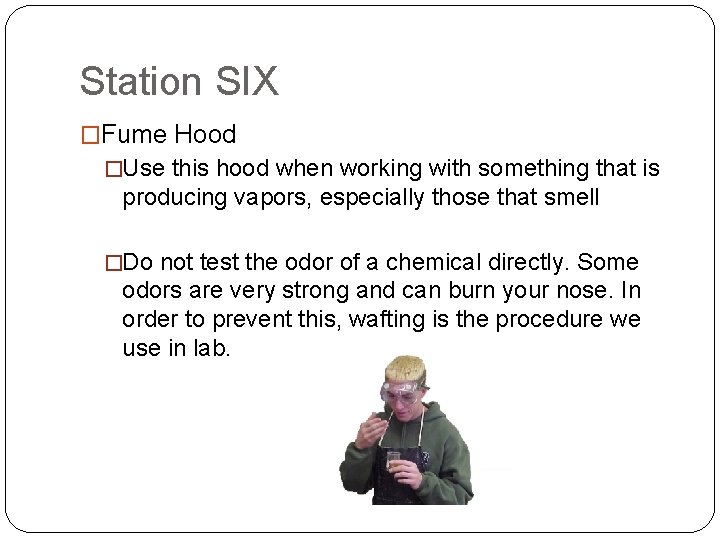
Station SIX �Fume Hood �Use this hood when working with something that is producing vapors, especially those that smell �Do not test the odor of a chemical directly. Some odors are very strong and can burn your nose. In order to prevent this, wafting is the procedure we use in lab.
Station SEVEN � What you need to know about your lab safety grade �How to get a 100/100 � Follow all lab safety rules � Always wear your goggles � Never perform an unauthorized experiment � Avoid horseplay in the lab � Leave your lab area completely clean and organized � Leave the lab in an orderly manner �If you are not dressed appropriately for lab, you will sit out, receive two temporary zeros and be expected to show up to the next tutorial session in the appropriate attire. If you miss this tutorial session it will result in two permanent zeros.
Chemical Disposal � It is never okay to dump pure chemicals down the drain or back into their original container. � Your teacher will always tell you how to dispose of your chemicals. � When you have properly disposed of your chemicals you need to clean all of your glassware and lab area. �This ensures that your equipment is clean for your next experiment and that there are no chemicals left on your work surface. �Always wipe down the counter before leaving.
- Slides: 10