
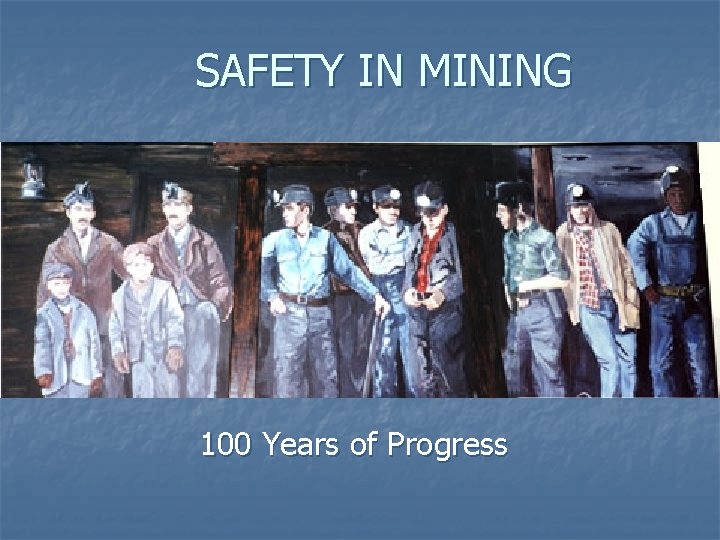
SAFETY IN MINING 100 Years of Progress Mine
- Slides: 75
SAFETY IN MINING 100 Years of Progress
Mine Safety Legislation n Many of us have a tendency to resent what we perceive as unwarranted government interference in our lives. We may even resent laws and regulations that are designed to keep us safe. However, before we condemn the Mine Safety and Health Act of 1977, lets take a look back at an unregulated mining industry.
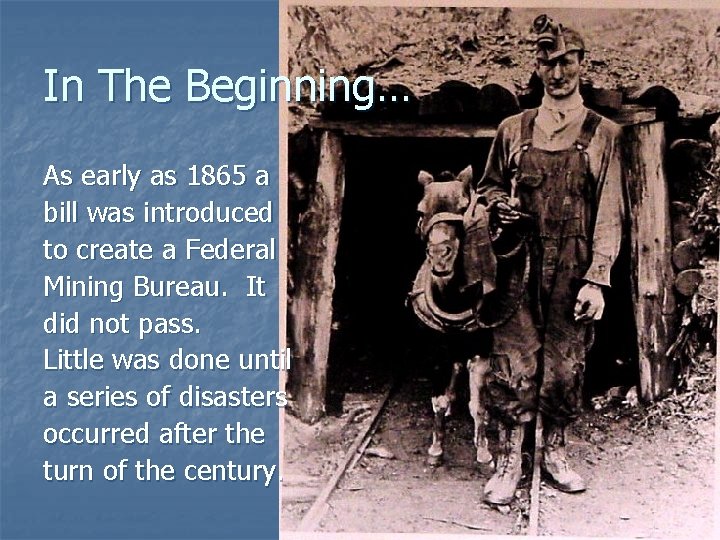
In The Beginning… As early as 1865 a bill was introduced to create a Federal Mining Bureau. It did not pass. Little was done until a series of disasters occurred after the turn of the century.
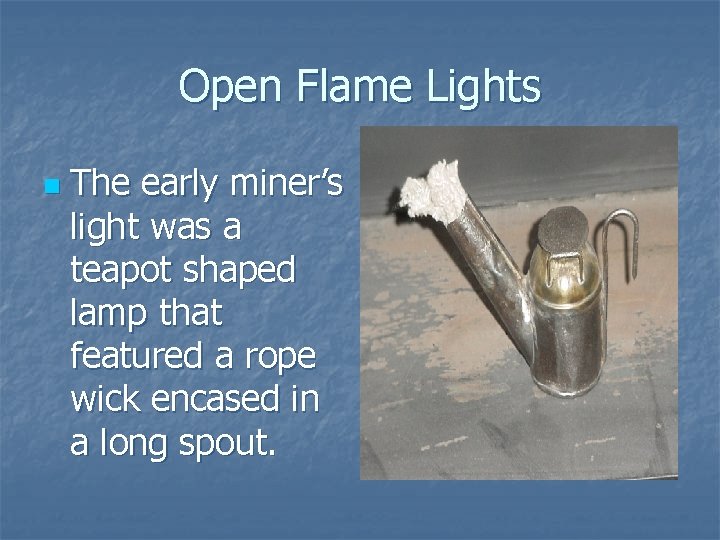
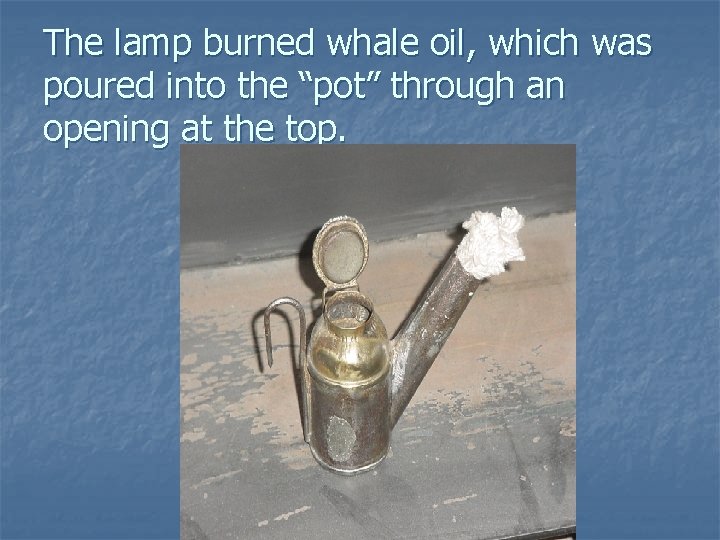
Open Flame Lights n The early miner’s light was a teapot shaped lamp that featured a rope wick encased in a long spout.
The lamp burned whale oil, which was poured into the “pot” through an opening at the top.
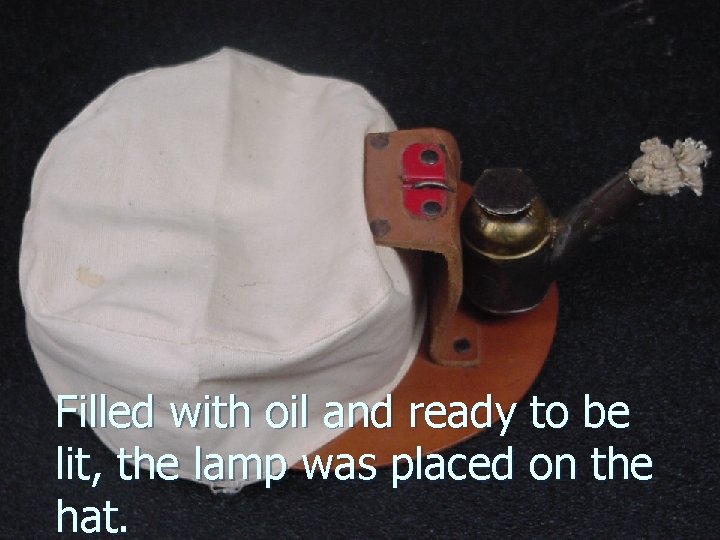
Filled with oil and ready to be lit, the lamp was placed on the hat.
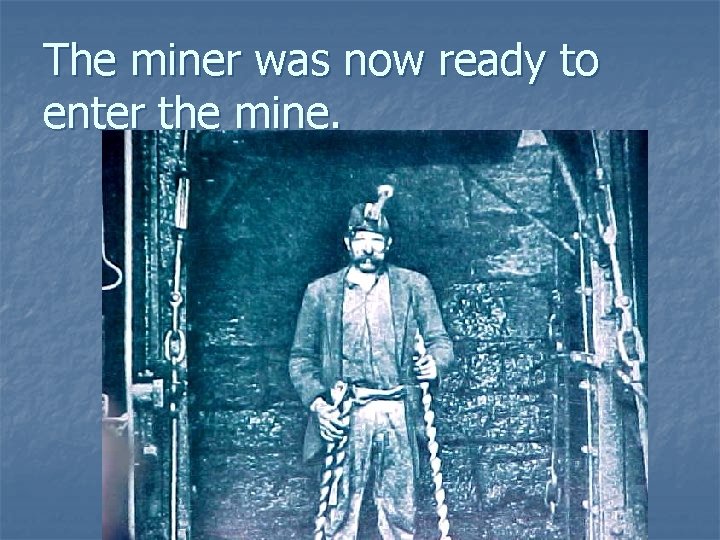
The miner was now ready to enter the mine.
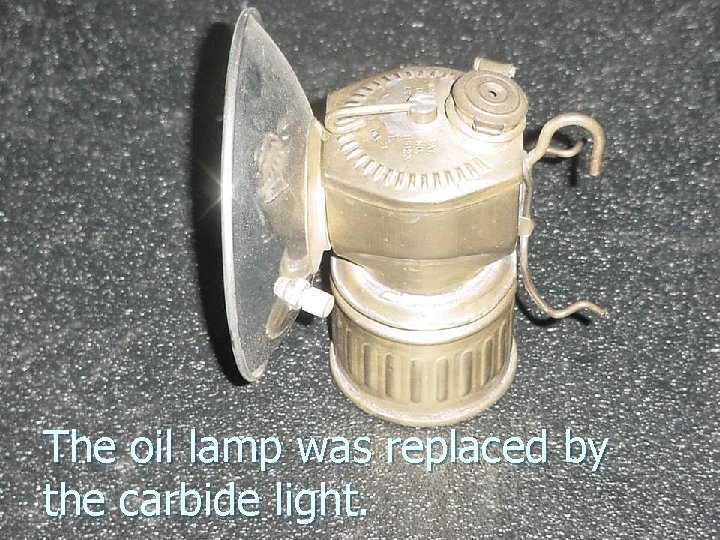
The oil lamp was replaced by the carbide light.
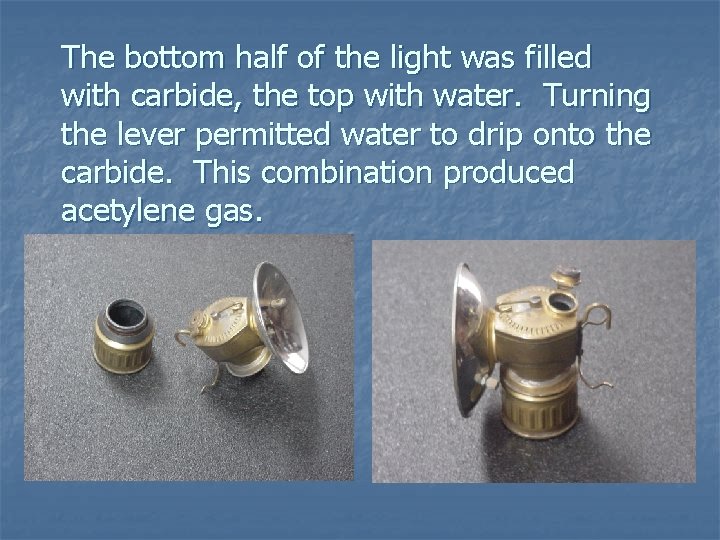
The bottom half of the light was filled with carbide, the top with water. Turning the lever permitted water to drip onto the carbide. This combination produced acetylene gas.
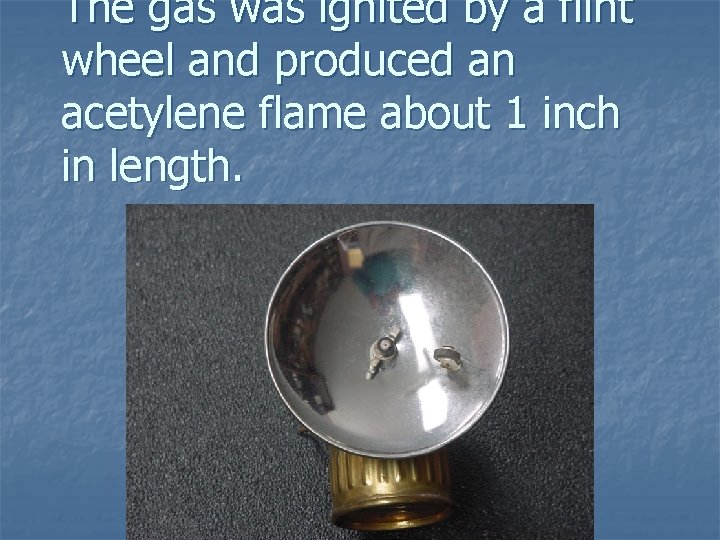
The gas was ignited by a flint wheel and produced an acetylene flame about 1 inch in length.
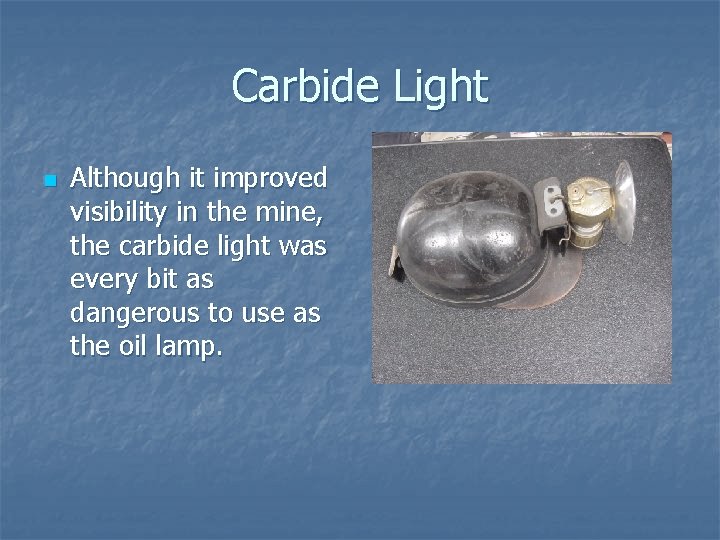
Carbide Light n Although it improved visibility in the mine, the carbide light was every bit as dangerous to use as the oil lamp.
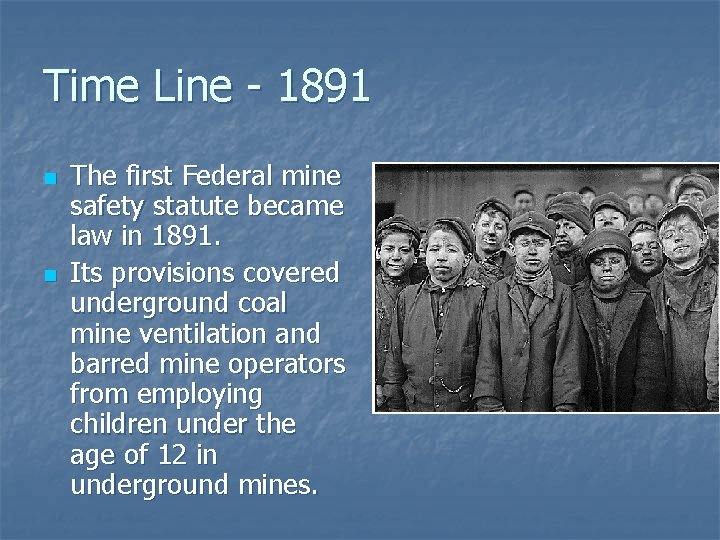
Time Line - 1891 n n The first Federal mine safety statute became law in 1891. Its provisions covered underground coal mine ventilation and barred mine operators from employing children under the age of 12 in underground mines.
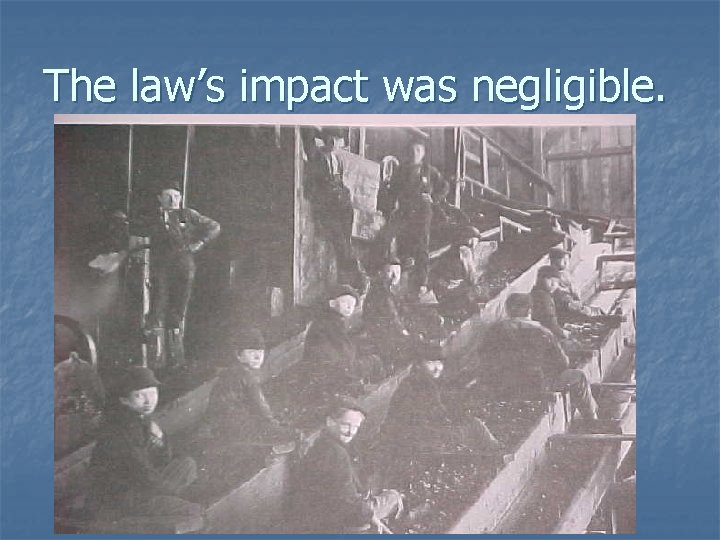
The law’s impact was negligible.
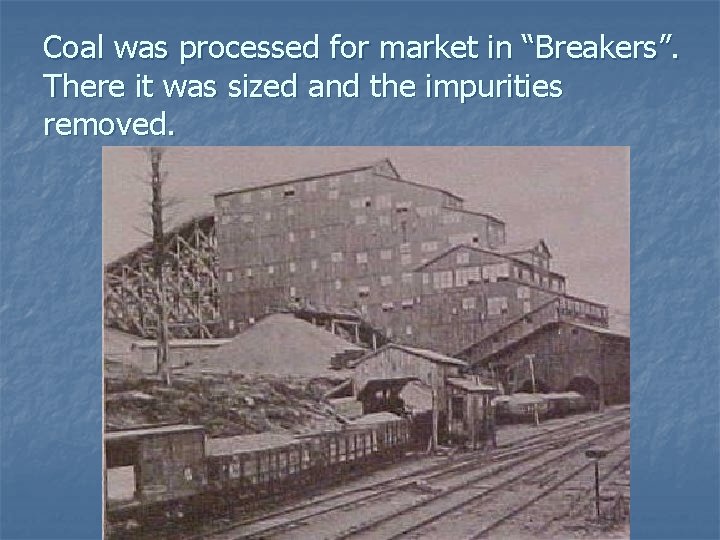
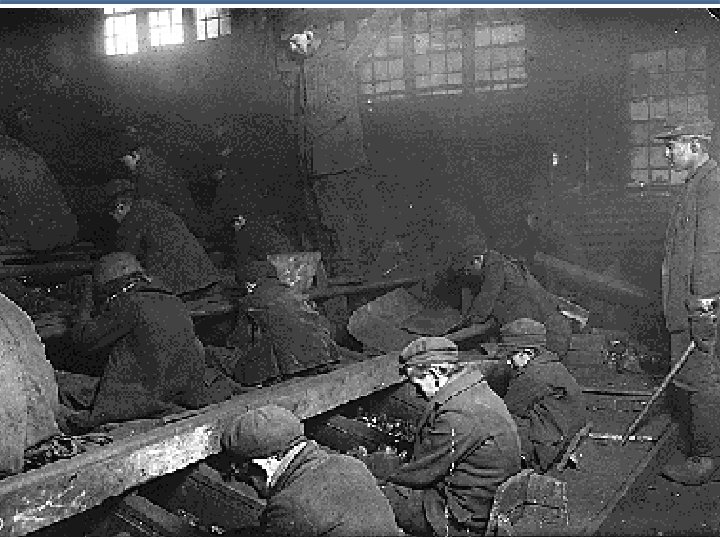
Coal was processed for market in “Breakers”. There it was sized and the impurities removed.
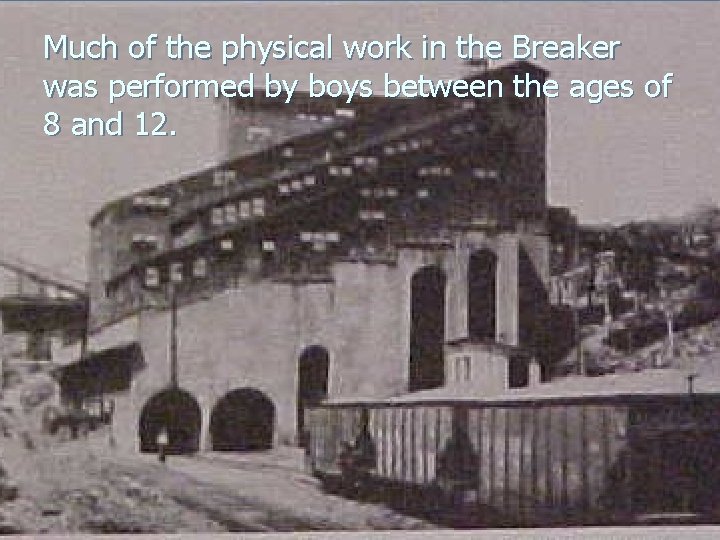
Much of the physical work in the Breaker was performed by boys between the ages of 8 and 12.
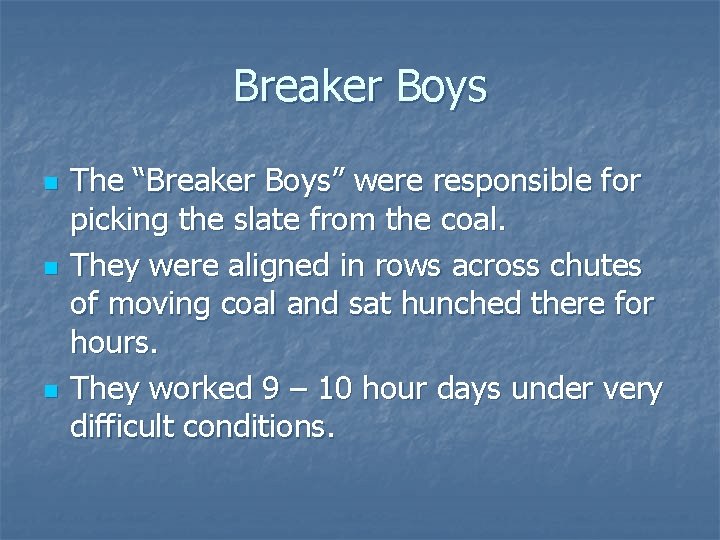
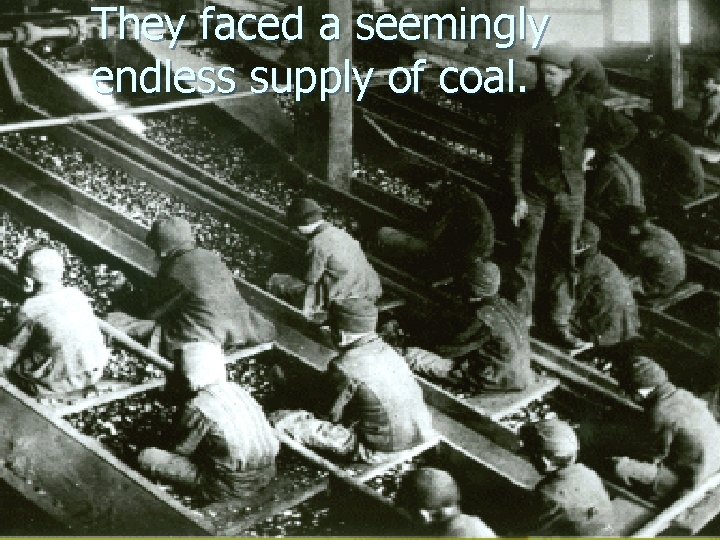
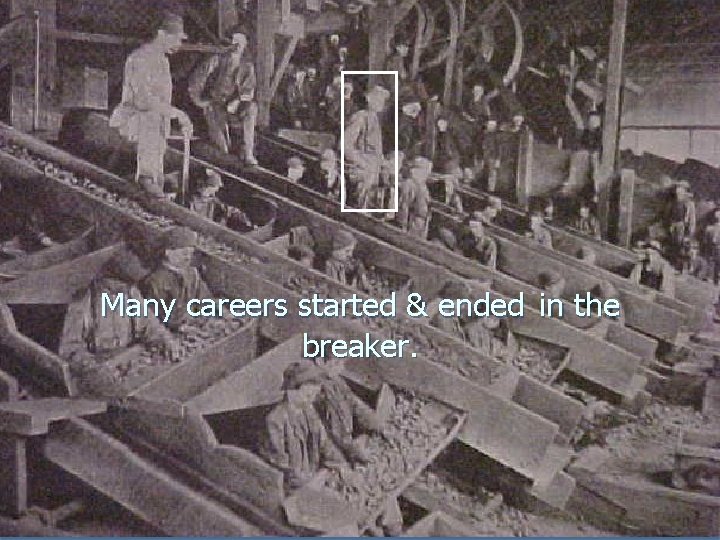
Breaker Boys n n n The “Breaker Boys” were responsible for picking the slate from the coal. They were aligned in rows across chutes of moving coal and sat hunched there for hours. They worked 9 – 10 hour days under very difficult conditions.
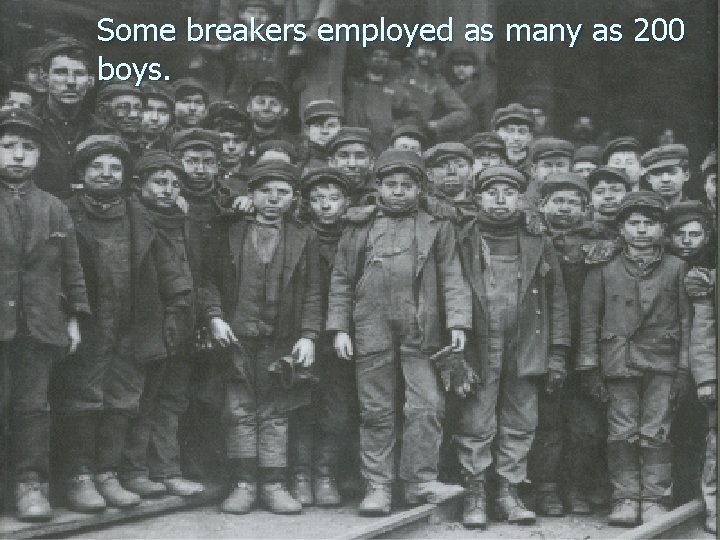
Some breakers employed as many as 200 boys.
They faced a seemingly endless supply of coal.
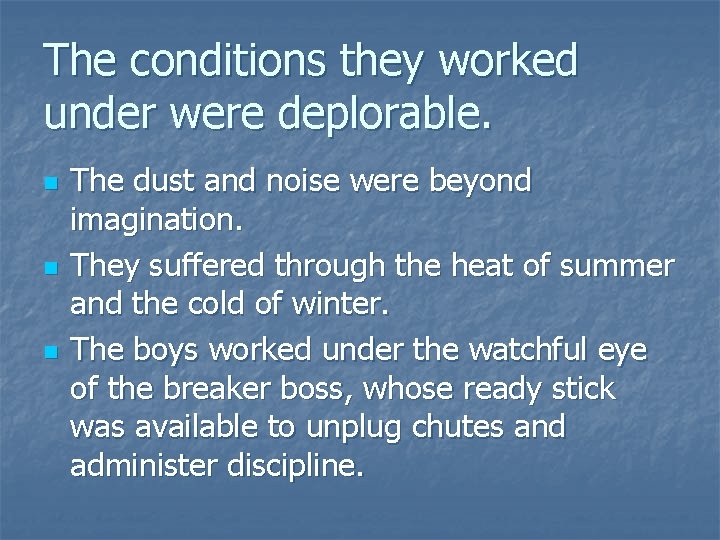
The conditions they worked under were deplorable. n n n The dust and noise were beyond imagination. They suffered through the heat of summer and the cold of winter. The boys worked under the watchful eye of the breaker boss, whose ready stick was available to unplug chutes and administer discipline.
There were no social supports during the early 1900’s. n n n There was no Social Security. There was no Workers’ Compensation. Miners unable to work were left to fend on their own. Some found work back in the Breaker. A labor contract from the early 1900’s contained the job title “Boys, Old Men & Cripples.
Many careers started & ended in the breaker.
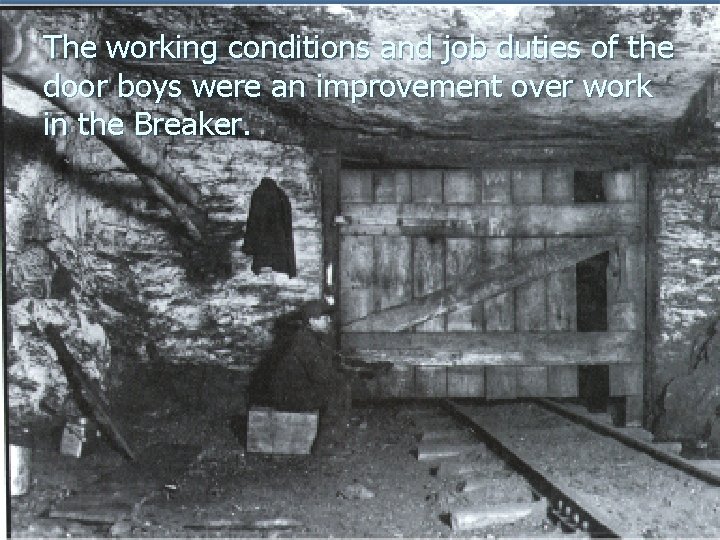
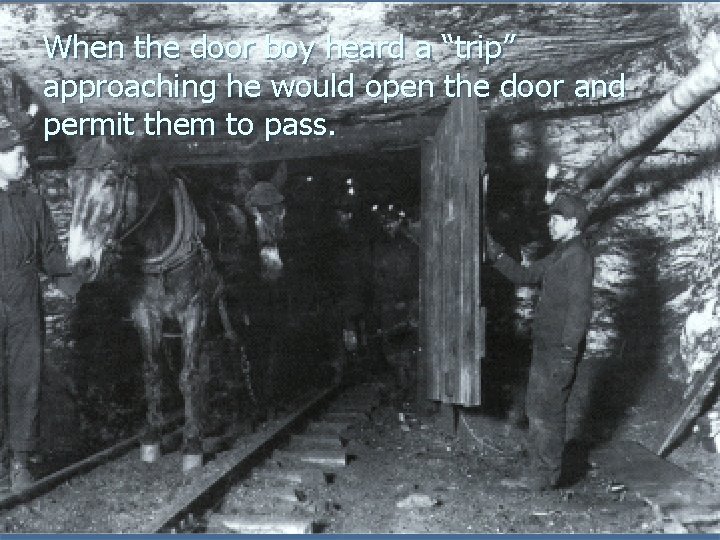
Door Boys n n From all accounts the boys looked forward to their 12 th birthday and the transfer it brought to a position underground. They were assigned to strategic locations and were responsible for opening & closing ventilation doors.
The working conditions and job duties of the door boys were an improvement over work in the Breaker.
When the door boy heard a “trip” approaching he would open the door and permit them to pass.
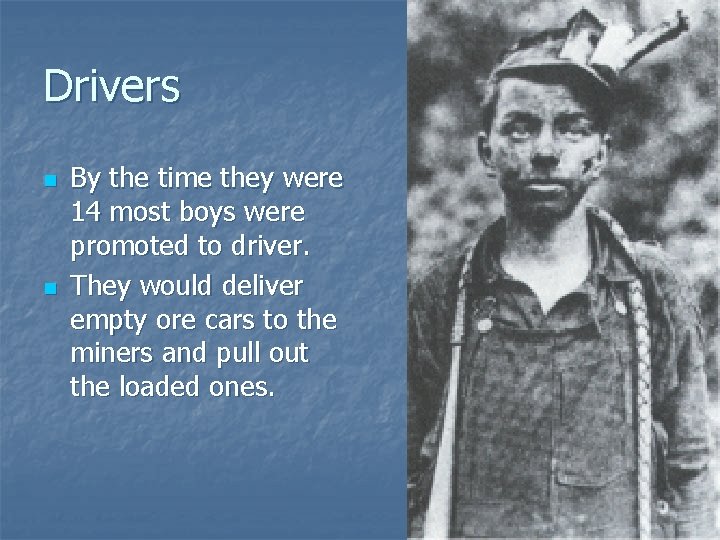
Drivers n n By the time they were 14 most boys were promoted to driver. They would deliver empty ore cars to the miners and pull out the loaded ones.
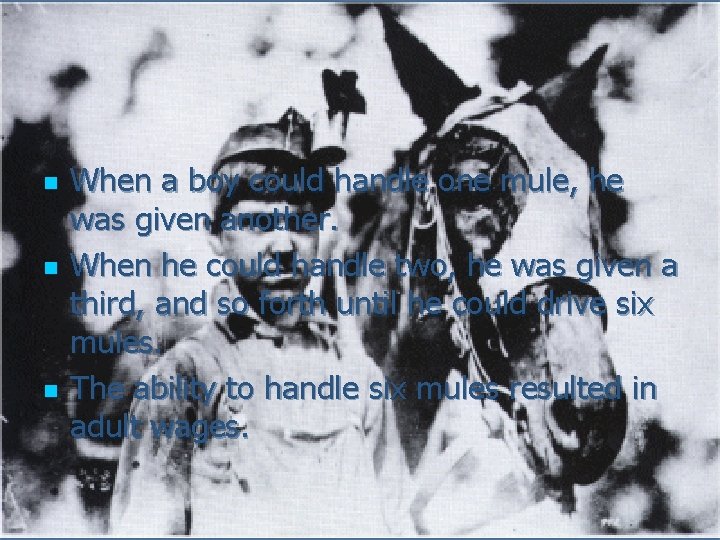
n n n When a boy could handle one mule, he was given another. When he could handle two, he was given a third, and so forth until he could drive six mules. The ability to handle six mules resulted in adult wages.
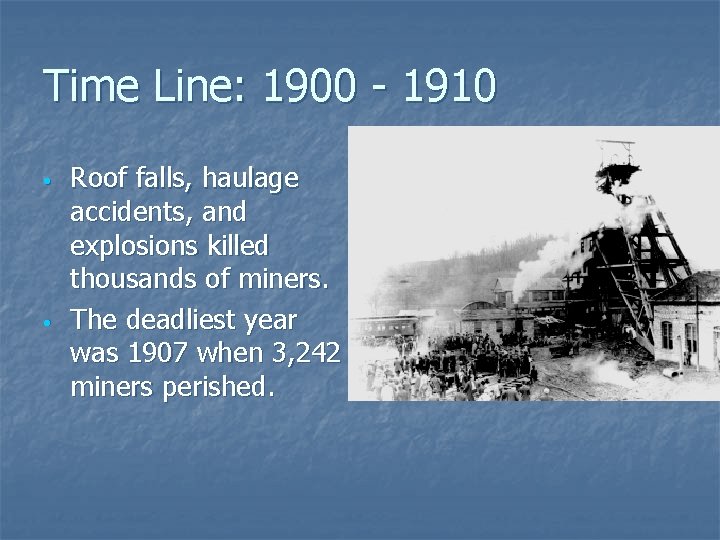
Time Line: 1900 - 1910 • • Roof falls, haulage accidents, and explosions killed thousands of miners. The deadliest year was 1907 when 3, 242 miners perished.
Monongah - 1907 n n n The Monongah Mine of the Fairmont Mining Company was a state of the art operation. It used electrical power, rather than animal power for haulage. The 368 miners and their families lived in the town of Monongah.
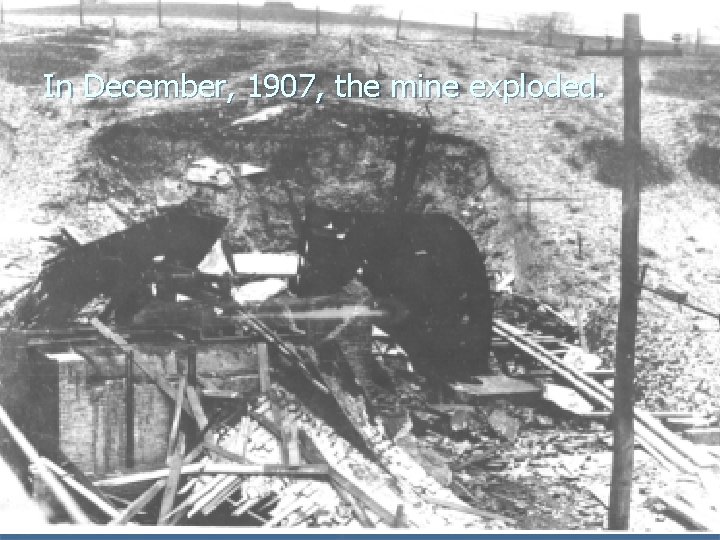
In December, 1907, the mine exploded.
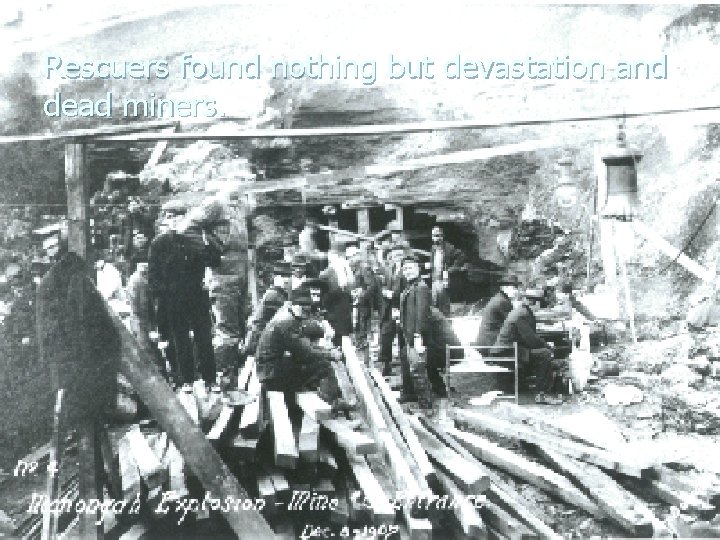
Rescuers found nothing but devastation and dead miners.
Monongah n n 363 miners were killed in the Monongah explosion. It was the deadliest mining accident in U. S. history.
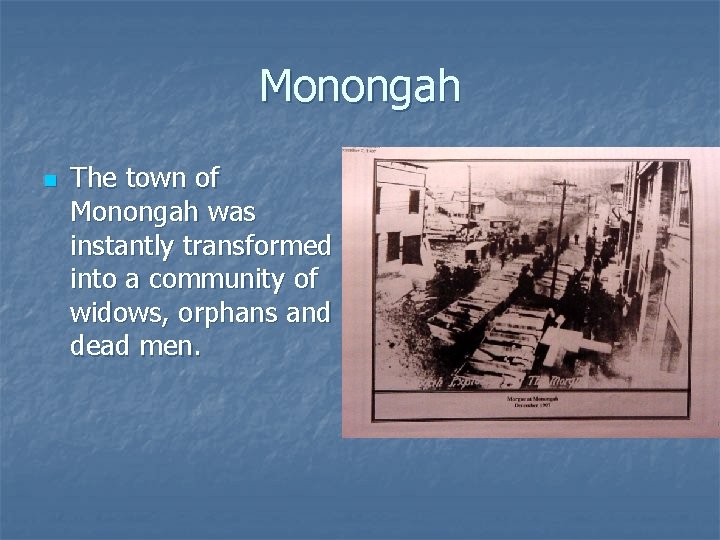
Monongah n The town of Monongah was instantly transformed into a community of widows, orphans and dead men.
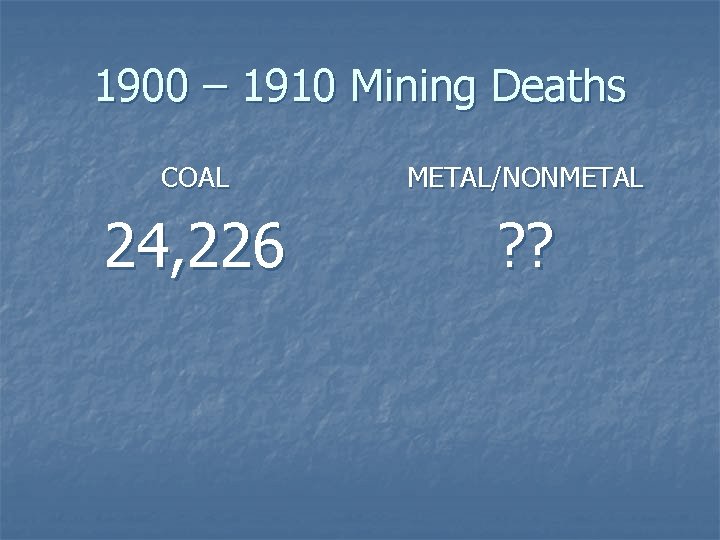
1900 – 1910 Mining Deaths COAL METAL/NONMETAL 24, 226 ? ?
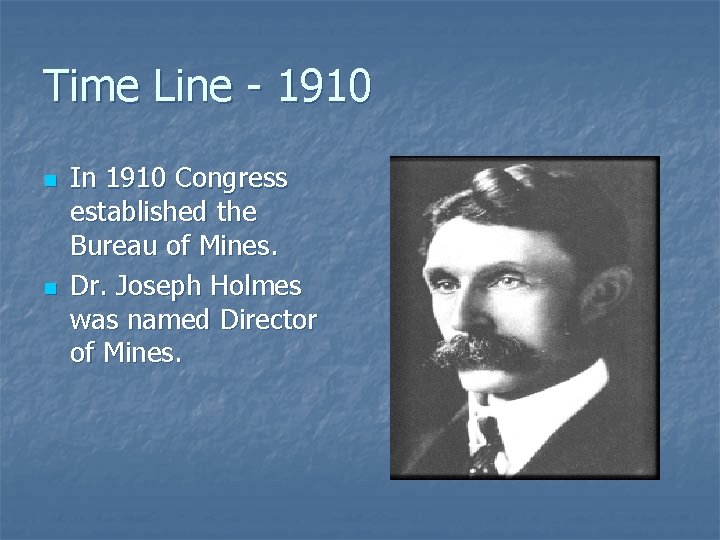
Time Line - 1910 n n In 1910 Congress established the Bureau of Mines. Dr. Joseph Holmes was named Director of Mines.
Time Line 1911 - 1940 n n n The role of Federal inspectors was largely limited to rescue operations. To facilitate rescue efforts Dr. Holmes ordered eight specially designed rail cars. The cars, supplied with first aid and mine rescue equipment, were placed at strategic locations in the mining regions.
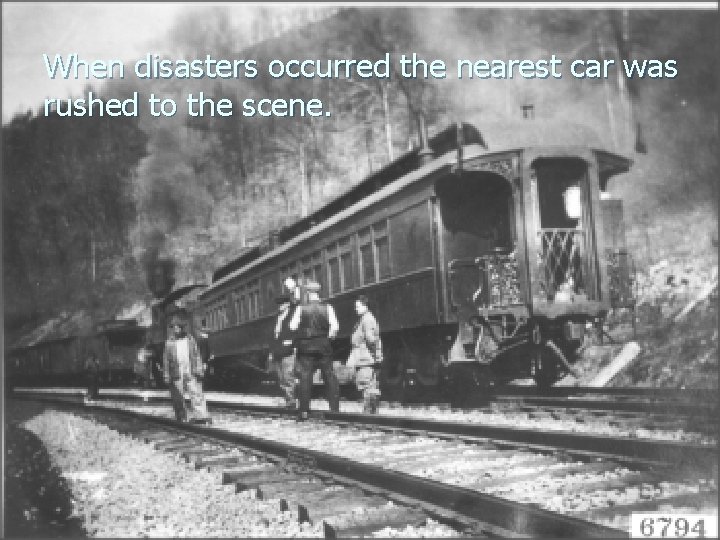
When disasters occurred the nearest car was rushed to the scene.
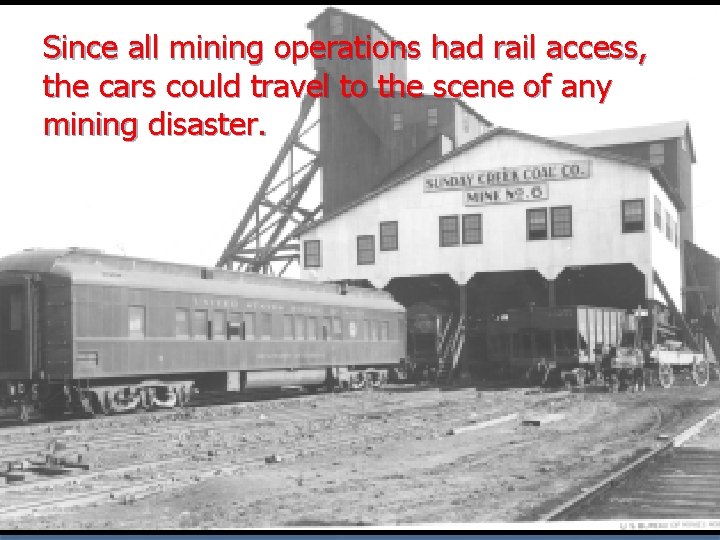
Since all mining operations had rail access, the cars could travel to the scene of any mining disaster.
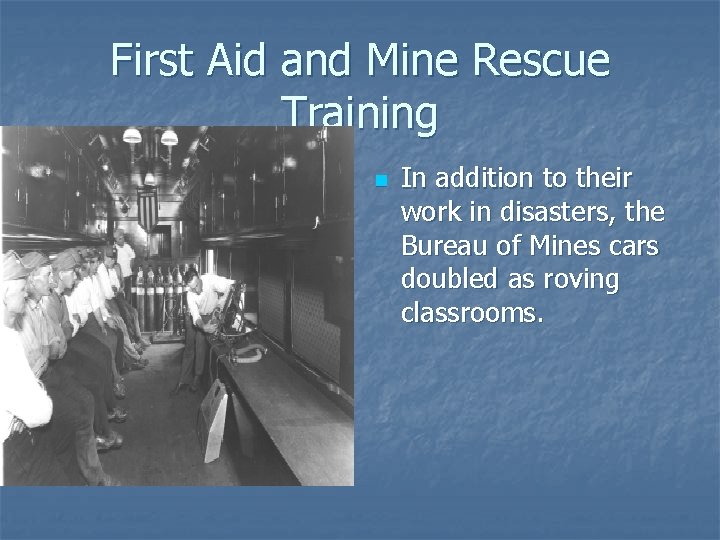
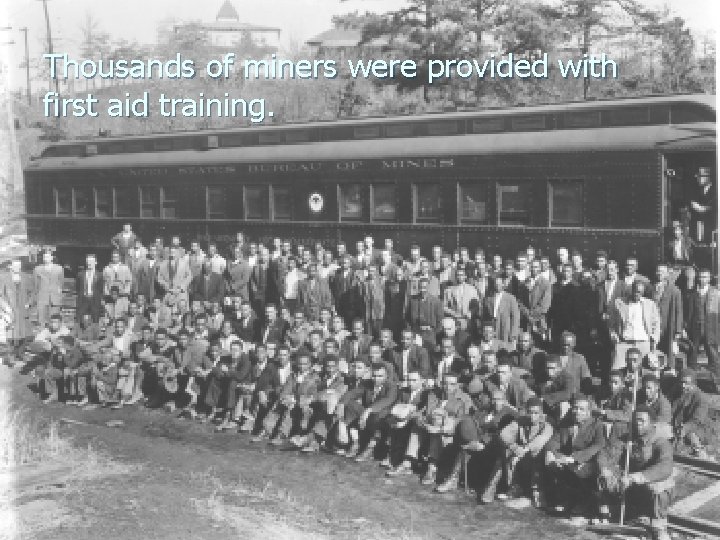
First Aid and Mine Rescue Training n In addition to their work in disasters, the Bureau of Mines cars doubled as roving classrooms.
Thousands of miners were provided with first aid training.
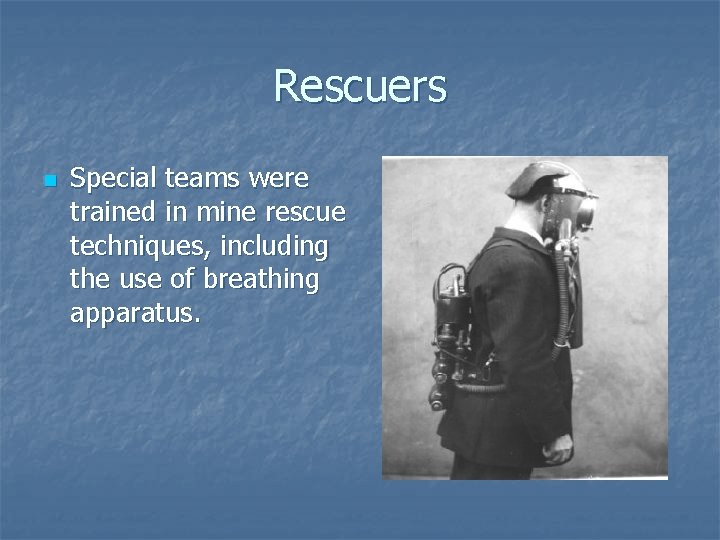
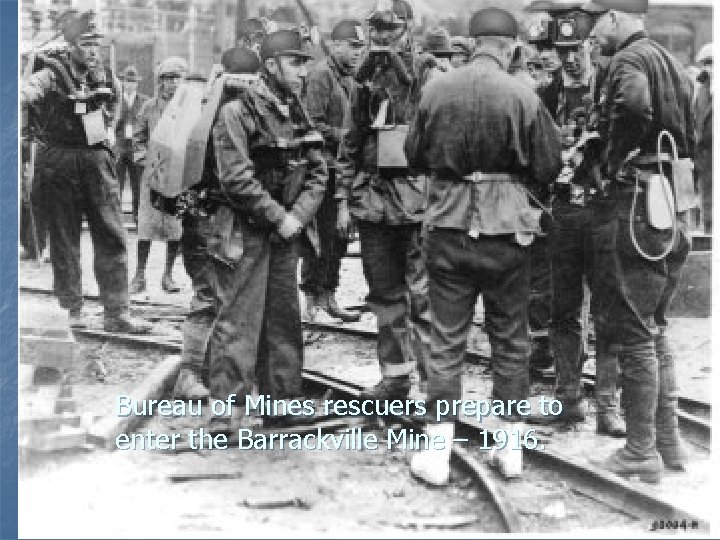
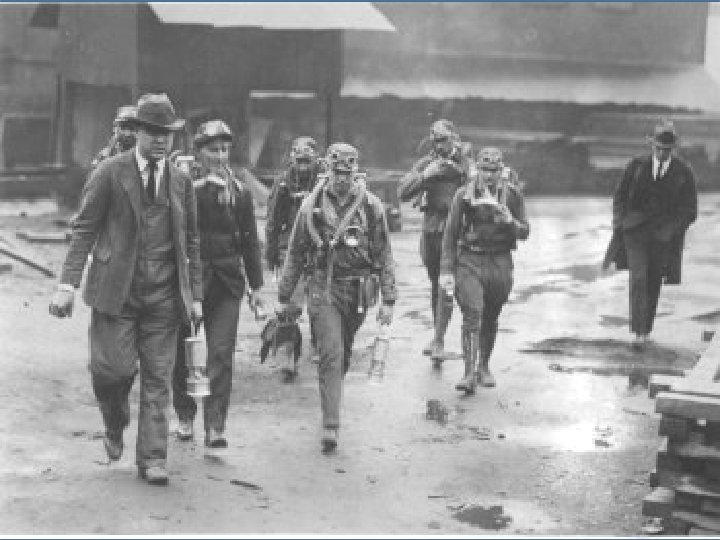
Rescuers n Special teams were trained in mine rescue techniques, including the use of breathing apparatus.
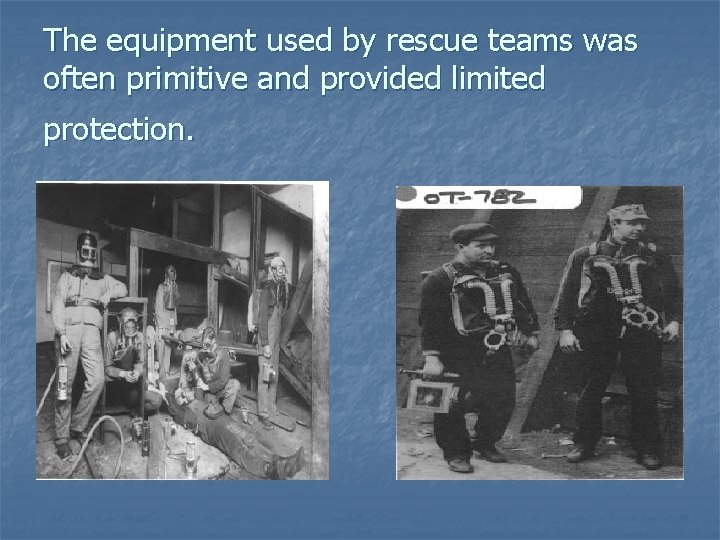
The equipment used by rescue teams was often primitive and provided limited protection.
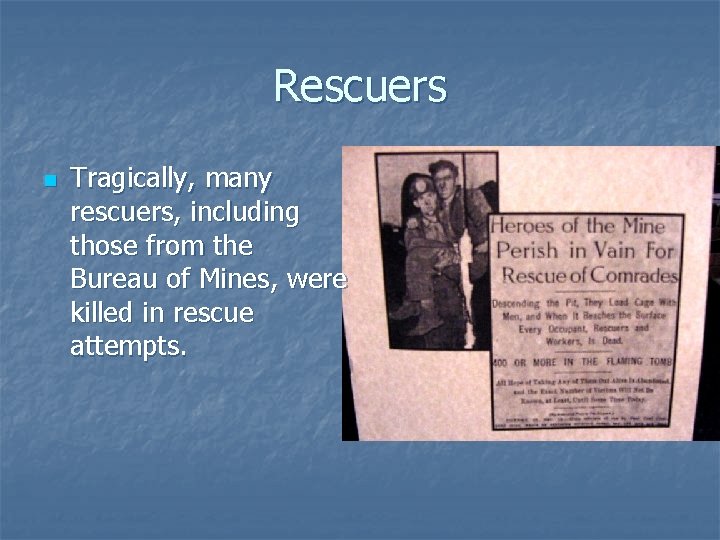
Rescuers n Tragically, many rescuers, including those from the Bureau of Mines, were killed in rescue attempts.
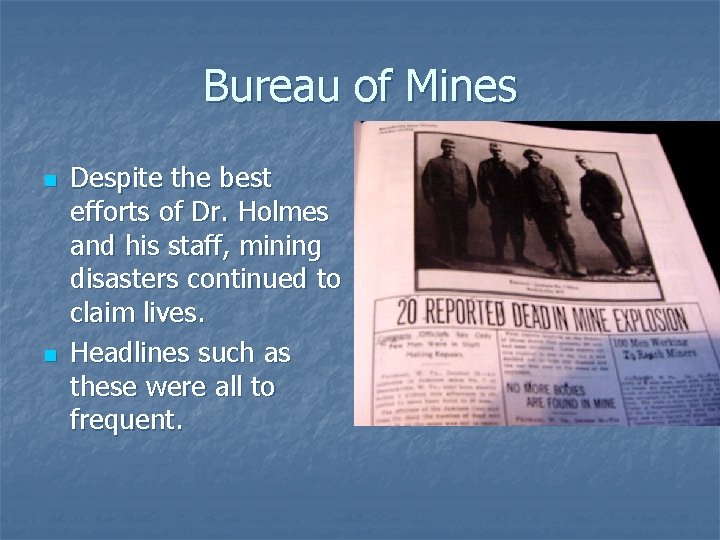
Bureau of Mines n n Despite the best efforts of Dr. Holmes and his staff, mining disasters continued to claim lives. Headlines such as these were all to frequent.
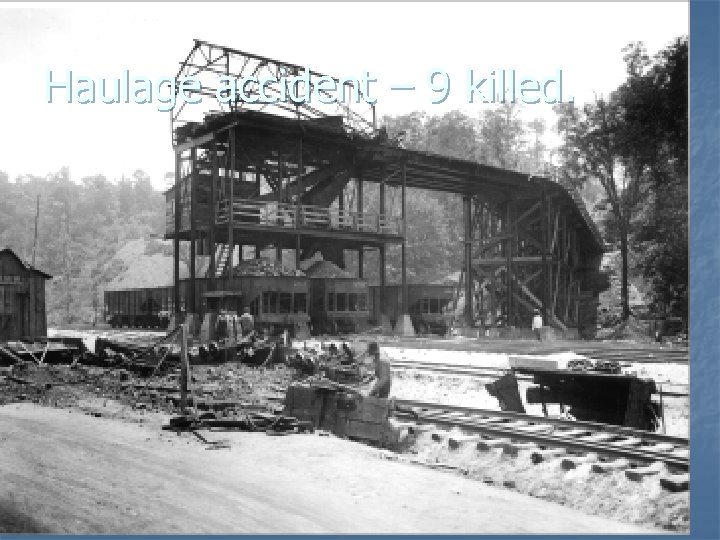
Haulage accident – 9 killed.
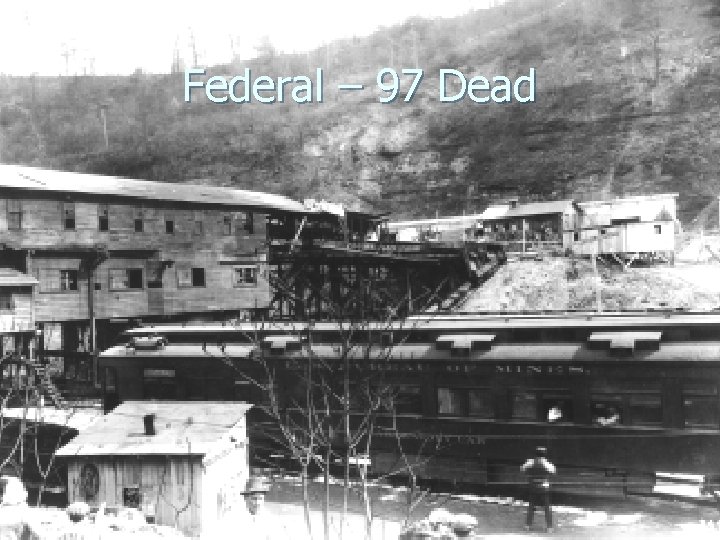
Federal – 97 Dead
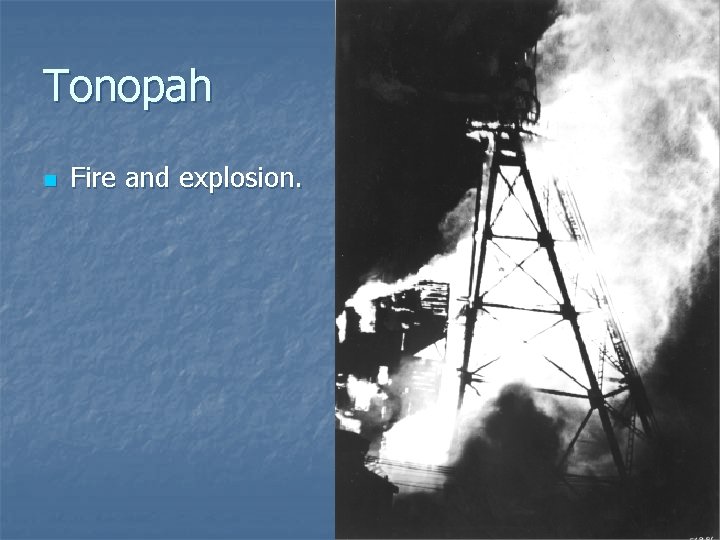
Tonopah n Fire and explosion.
Bureau of Mines rescuers prepare to enter the Barrackville Mine – 1916.
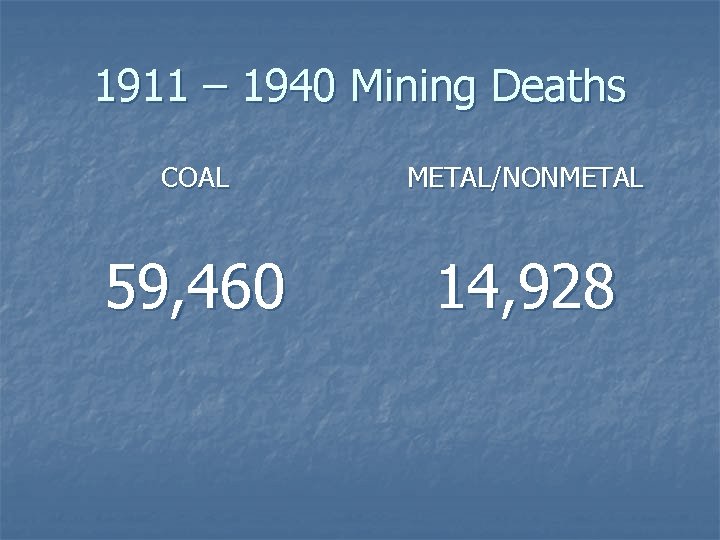
1911 – 1940 Mining Deaths COAL METAL/NONMETAL 59, 460 14, 928
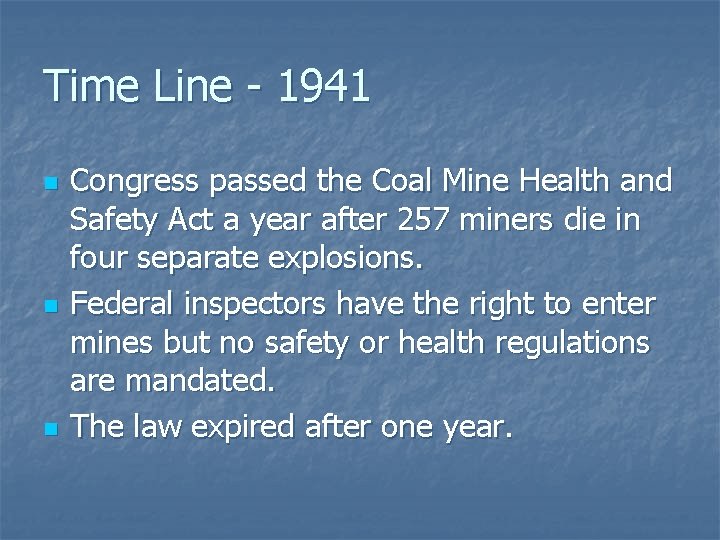
Time Line - 1941 n n n Congress passed the Coal Mine Health and Safety Act a year after 257 miners die in four separate explosions. Federal inspectors have the right to enter mines but no safety or health regulations are mandated. The law expired after one year.
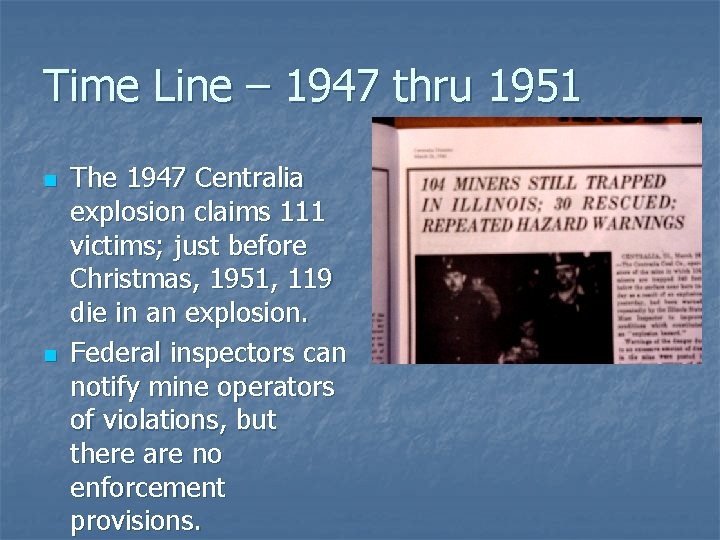
Time Line – 1947 thru 1951 n n The 1947 Centralia explosion claims 111 victims; just before Christmas, 1951, 119 die in an explosion. Federal inspectors can notify mine operators of violations, but there are no enforcement provisions.
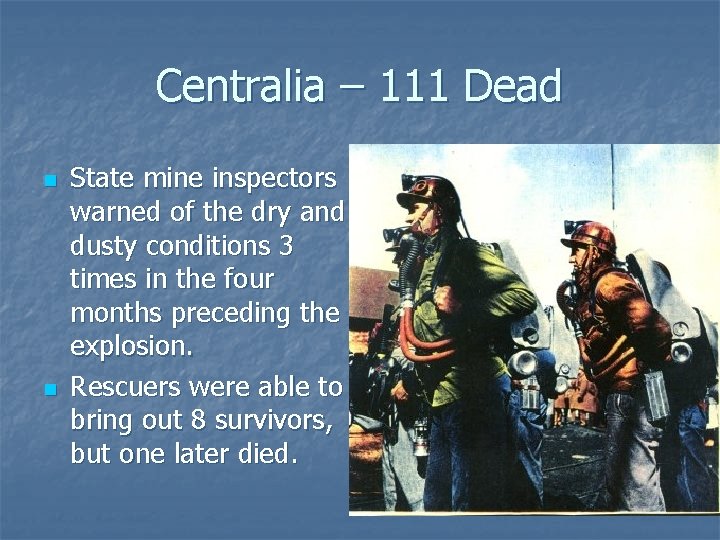
Centralia – 111 Dead n n State mine inspectors warned of the dry and dusty conditions 3 times in the four months preceding the explosion. Rescuers were able to bring out 8 survivors, but one later died.
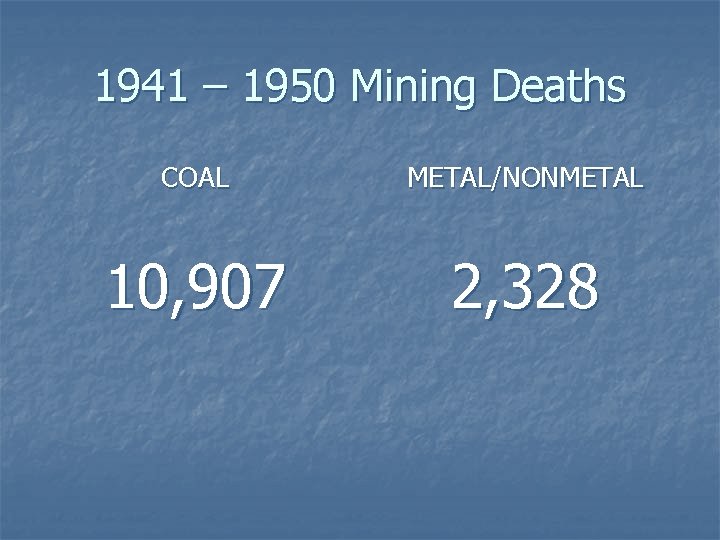
1941 – 1950 Mining Deaths COAL METAL/NONMETAL 10, 907 2, 328
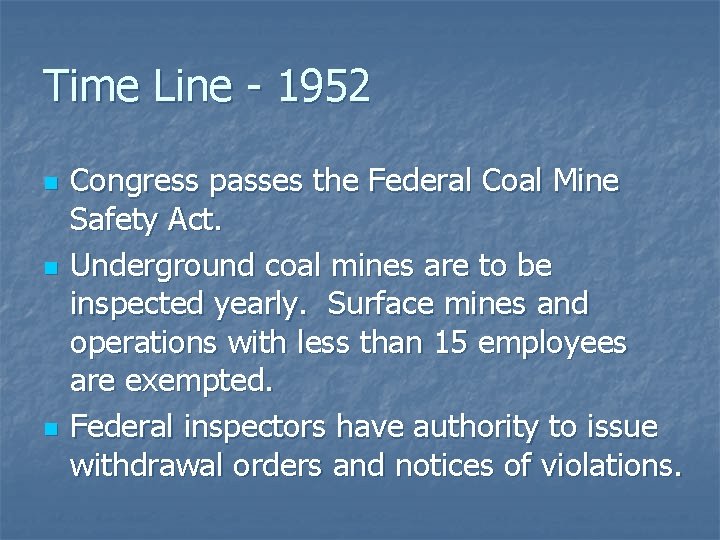
Time Line - 1952 n n n Congress passes the Federal Coal Mine Safety Act. Underground coal mines are to be inspected yearly. Surface mines and operations with less than 15 employees are exempted. Federal inspectors have authority to issue withdrawal orders and notices of violations.
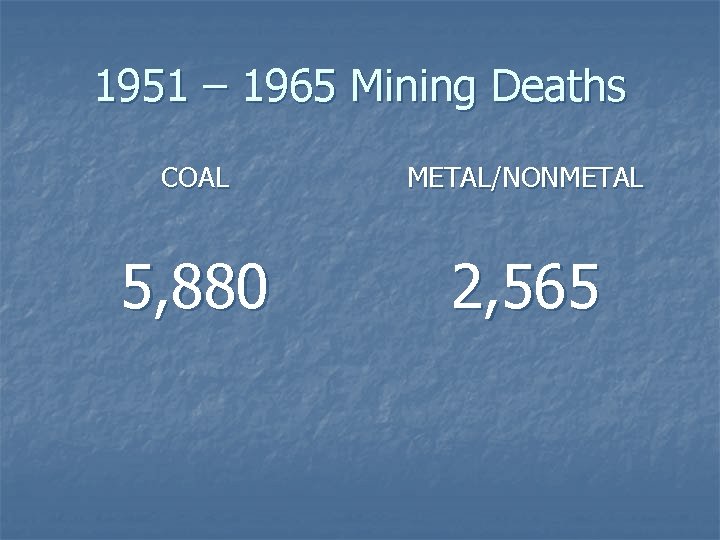
1951 – 1965 Mining Deaths COAL METAL/NONMETAL 5, 880 2, 565
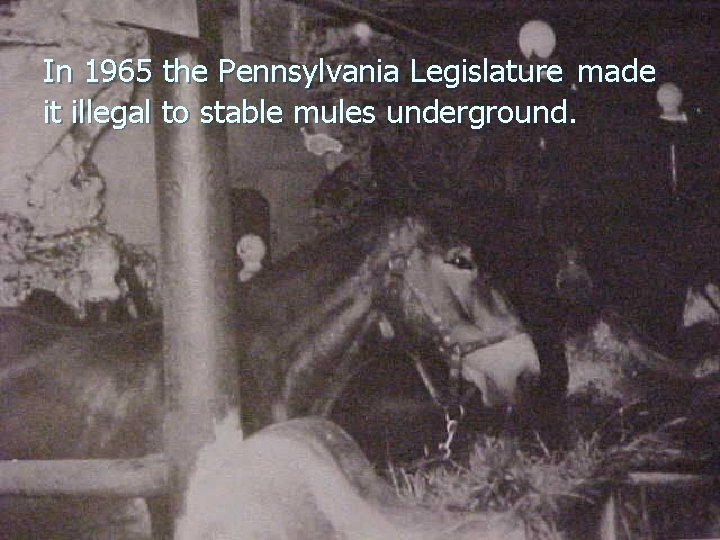
In 1965 the Pennsylvania Legislature made it illegal to stable mules underground.
Time Line - 1966 n n n The 1952 Act is amended. Congress passes the Federal Metal and Nonmetallic Mine Safety Act. Coverage is extended to small underground coal mines. The law expands the scope of education and training programs.
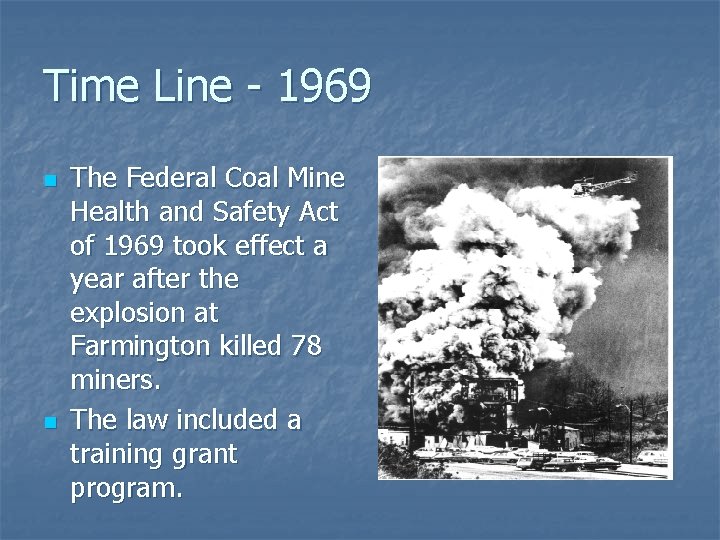
Time Line - 1969 n n The Federal Coal Mine Health and Safety Act of 1969 took effect a year after the explosion at Farmington killed 78 miners. The law included a training grant program.
Time Line – 1972 - 1976 n n Ninety –one miners die in a fire in 1972 at the Sunshine Mine at Kellogg, Idaho. In 1976, a pair of explosions at the Scotia Mine in Kentucky kill 26 people.
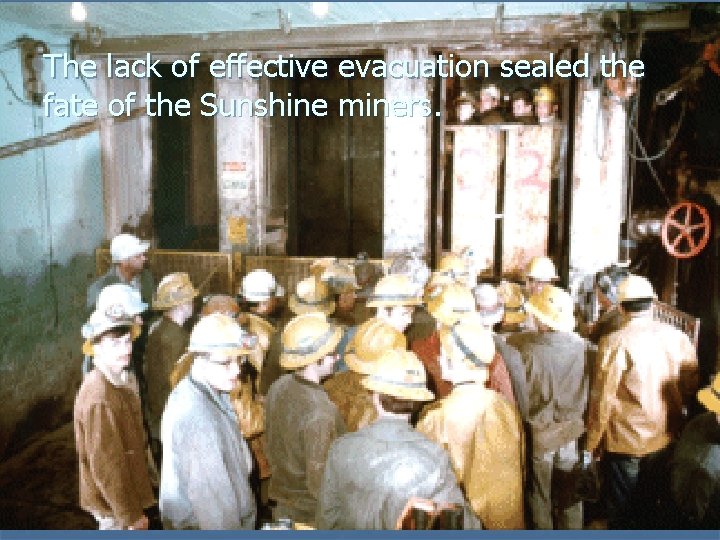
The lack of effective evacuation sealed the fate of the Sunshine miners.
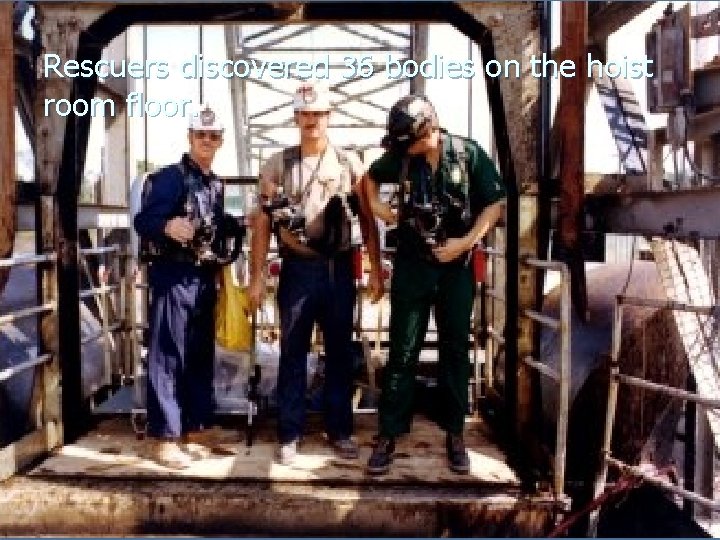
Rescuers discovered 36 bodies on the hoist room floor.
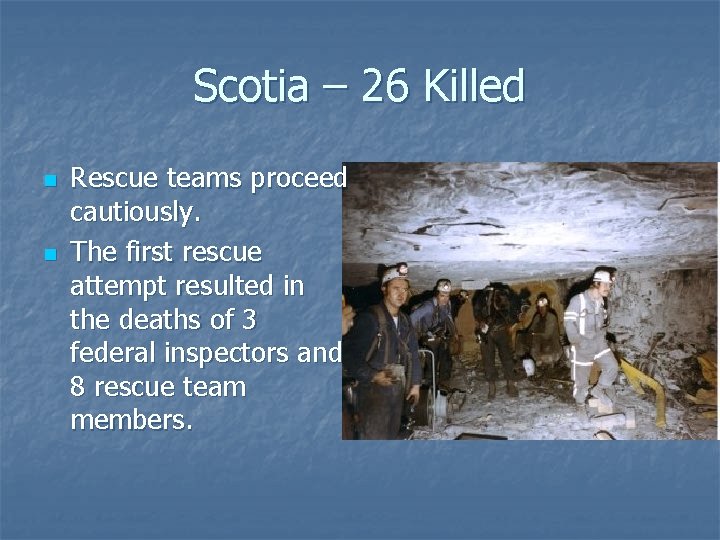
Scotia – 26 Killed n n Rescue teams proceed cautiously. The first rescue attempt resulted in the deaths of 3 federal inspectors and 8 rescue team members.
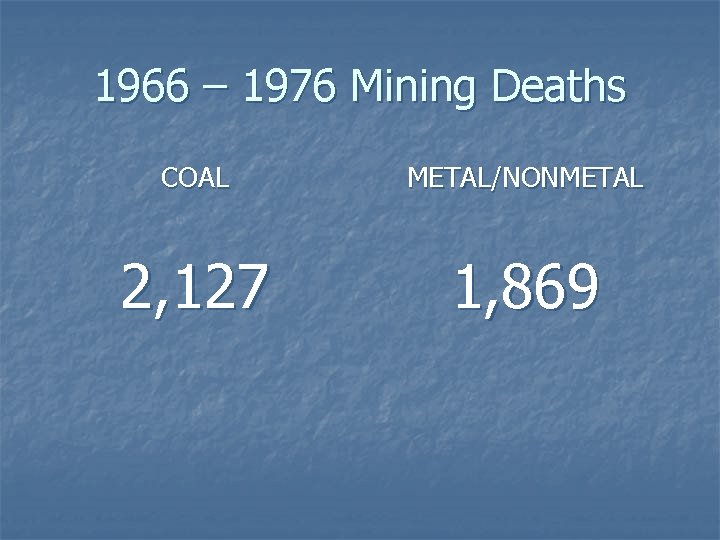
1966 – 1976 Mining Deaths COAL METAL/NONMETAL 2, 127 1, 869
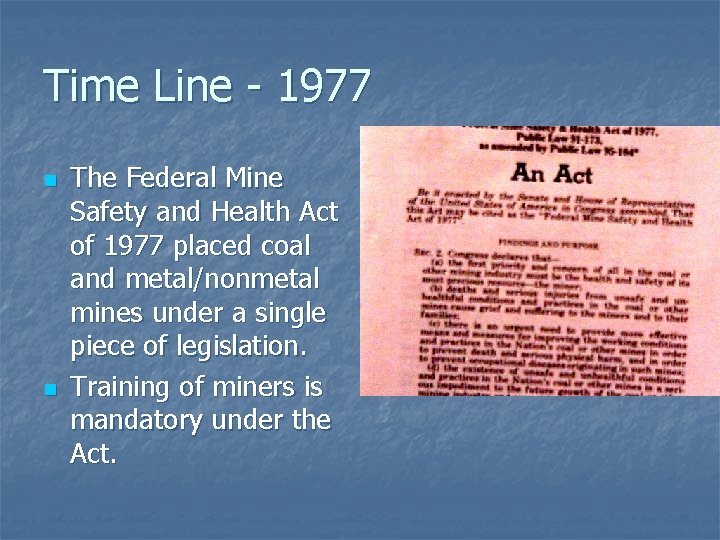
Time Line - 1977 n n The Federal Mine Safety and Health Act of 1977 placed coal and metal/nonmetal mines under a single piece of legislation. Training of miners is mandatory under the Act.
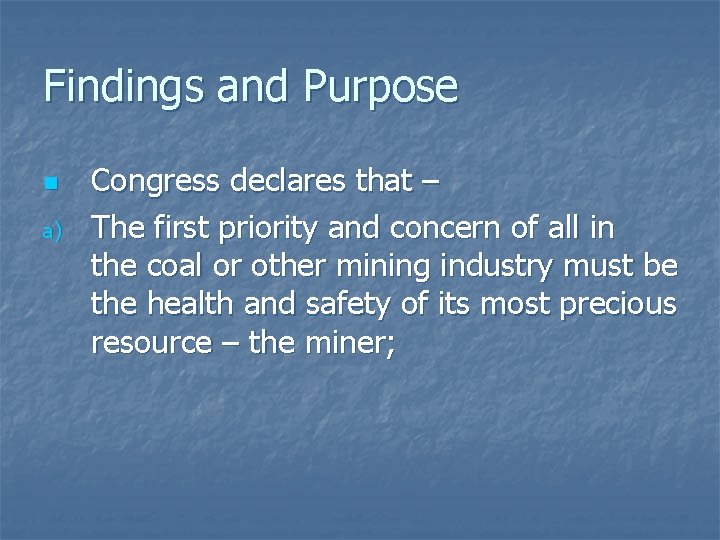
Findings and Purpose n a) Congress declares that – The first priority and concern of all in the coal or other mining industry must be the health and safety of its most precious resource – the miner;
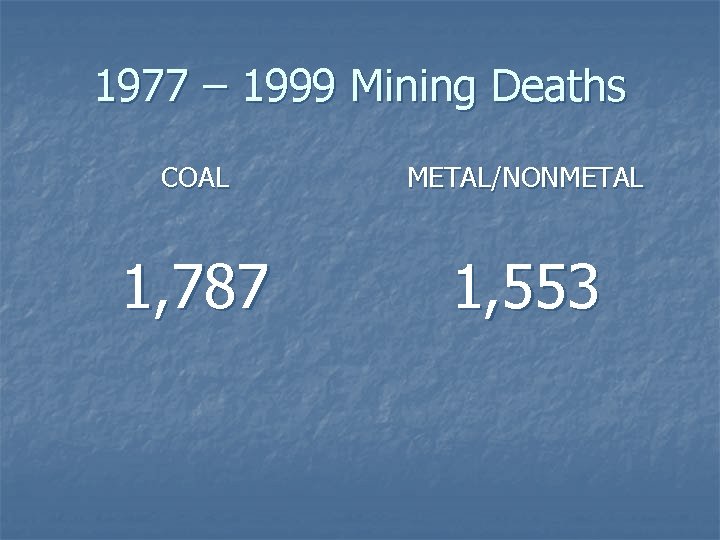
1977 – 1999 Mining Deaths COAL METAL/NONMETAL 1, 787 1, 553
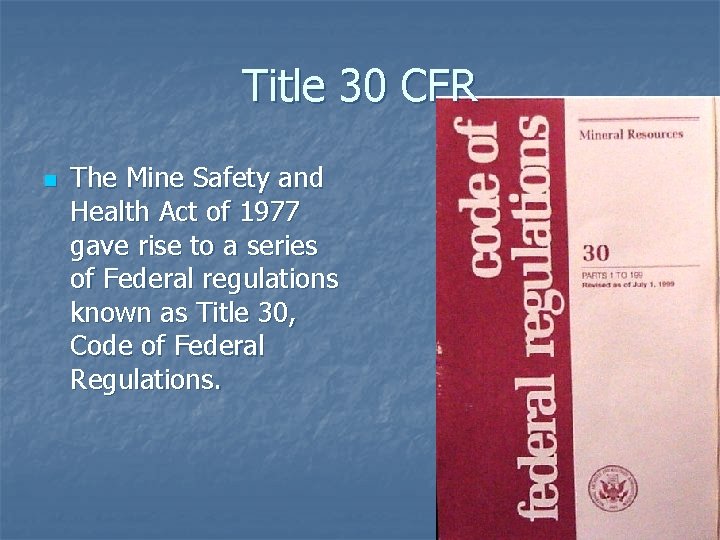
Title 30 CFR n The Mine Safety and Health Act of 1977 gave rise to a series of Federal regulations known as Title 30, Code of Federal Regulations.
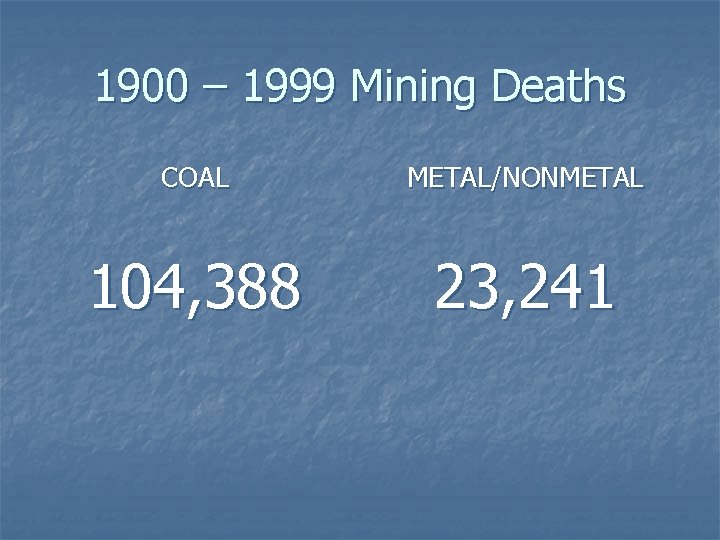
1900 – 1999 Mining Deaths COAL METAL/NONMETAL 104, 388 23, 241
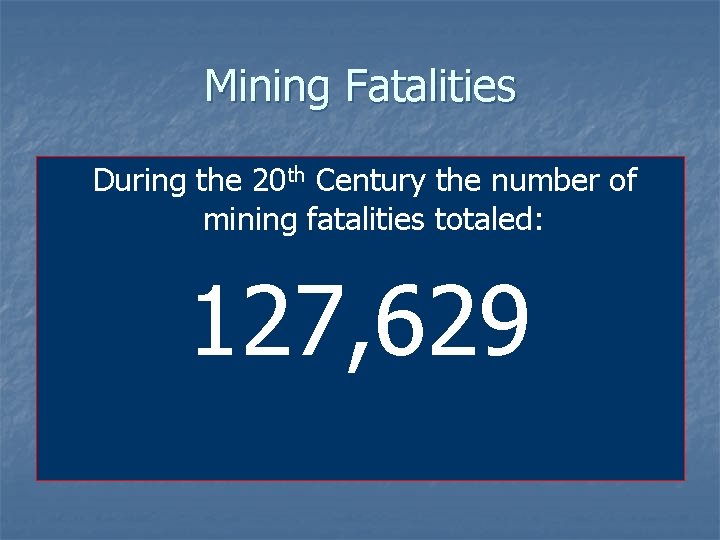
Mining Fatalities During the 20 th Century the number of mining fatalities totaled: 127, 629