
Safety Guide SSG1 Borehole Disposal Facilities for Radioactive
Safety Guide SSG-1 Borehole Disposal Facilities for Radioactive Waste Presenter Name School of Drafting Regulations for Borehole Disposal of DSRS 2016 Vienna, Austria IAEA International Atomic Energy Agency
Content • • • Introduction Legal and organisational framework Safety approach Safety design principles Framework for Disposal. Safety case and safety assessment • Development of borehole disposal facilities • Implementation of the safety strategy for existing borehole disposal facilities IAEA 2
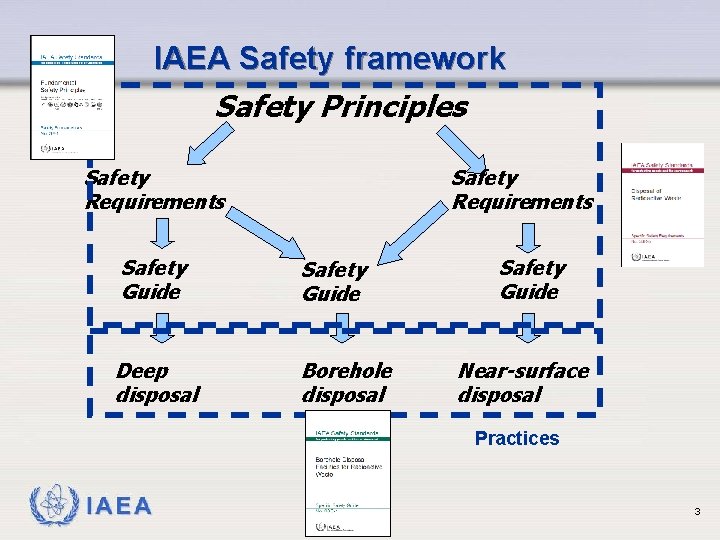
IAEA Safety framework Safety Principles Safety Requirements Safety Guide Deep disposal Borehole disposal Safety Guide Near-surface disposal Practices IAEA 3
Objective • To provide guidance on how the design, construction, operation and closure of borehole facilities for the disposal of radioactive waste may be implemented to meet the relevant IAEA Safety Requirements • The guidance can also be used as a basis for reassessing the safety of existing facilities. • Disposal of Radioactive Waste ü 26 requirements • The Safety Guide follows format of disposal IAEA requirements 4
IAEA SAFETY GUIDE (SSG-1) Scope • Focus is on boreholes with a diameter of no more than a few hundred millimetres and a depth of up to a few hundred meters • This document concentrates on disused sealed sources and small volumes of radioactive waste • Emphasis is placed on ü operational safety, ü the security of the waste and ü the achievement of post closure safety. IAEA 5
Safety Philosophy • ‘Easier’ disposal derives from the small volume and nature of the waste • No decrease in safety standards, these to be set by national authorities, as usual • Impossibility of ‘proving’ safety over thousands of years • Instead, look for ‘reasonable assurance’ of post-closure safety through ü multi-barrier system ü robustness ü avoidance of human intrusion ü management system ü natural analogues • Relies on very low rates of s/s corrosion IAEA 6
Borehole disposal facilities for radioactive waste SSG-1 The main aims of the SG are to: üGive some momentum to a potentially useful disposal practice, üExplain how the safety requirements may be interpreted for borehole disposal of DSS and, most especially, explain how this can be done as simply as possible, and üProvide some practical advice IAEA 7
Borehole Safety Guide - Description • Introduction: • Borehole disposal option & waste safety principles • Protection of human health • Safety strategy - achieving the requirements • This lecture does not cover some aspects addressed in the SSG-1 that will be presented in other lectures IAEA 8
Radiation protection during the operational period • The objective for radiation protection during the operational period of a borehole disposal facility and the related safety criteria are the same as for any licensed nuclear facility, and are as required by the Basic Safety Standards (GSR Part 3) • Only very minor releases of radionuclides (such as small amounts of gaseous radionuclides) may be expected during pre-disposal activities and during the operation of a borehole disposal facility. • A radiological protection programme should be in place during the operational period. IAEA 9
Radiation protection for the post-closure period • The primary goal - to dispose of radioactive waste in a manner that protects human health and the environment in the long term, after the borehole disposal facility has been closed. • The borehole disposal facility should be designed to take account of the characteristics offered by the site, to optimize protection and to keep doses within the dose and/or risk constraints. • The borehole disposal facility should then be constructed, operated and closed according to the assessed design so that the assumed safety characteristics of both the engineered and the natural barriers are realized. IAEA 10
Optimisation • Evaluating whether or not the design will provide an optimized level of protection may require a judgement in which other factors will be considered. • For a borehole disposal facility such circumstances are likely to apply when considering: • The design evolution (see definition in Appendix III) at very distant times in the future; • Very low frequency natural events; • Human intrusion events. IAEA 11
Human intrusion The borehole disposal system has a number of inherent features that reduce the likelihood and the consequences of intrusion. These include: ü The low probability of occurrence; ü The fact that the individuals would be few in number; ü The possibility for such individuals to receive appropriate decontamination and medical treatment; ü The fact that such hazards may be comparable with other occupational risks; ü The possibility that, while doses received due to inadvertent intrusion could be high, it is possible that the associated risk may be outweighed by the higher level of long term protection afforded by borehole disposal, in comparison with other strategies. IAEA 12
Human intrusion • The small ‘footprint’ of a borehole disposal facility will help to reduce the probability of human intrusion and this can be reduced yet further by increasing the depth and length of the disposal zone. • Siting of the facility away from known mineral and water resources will also decrease the likelihood of human intrusion. • Over shorter time scales, actions such as should also help to reduce the incidence of such events: ü preserving records, ü placing restrictions on land use, ü placing warning signs and ü IAEA maintaining passive institutional control 13
Legal and organisational framework 1: Government responsibilities 2: Regulatory Body responsibilities 3: Operator responsibilities ü Waste generator responsibilities General requirements for establishing a national legal and organizational framework are established in GSR Part 1 and were presented in the previous lecture IAEA 14
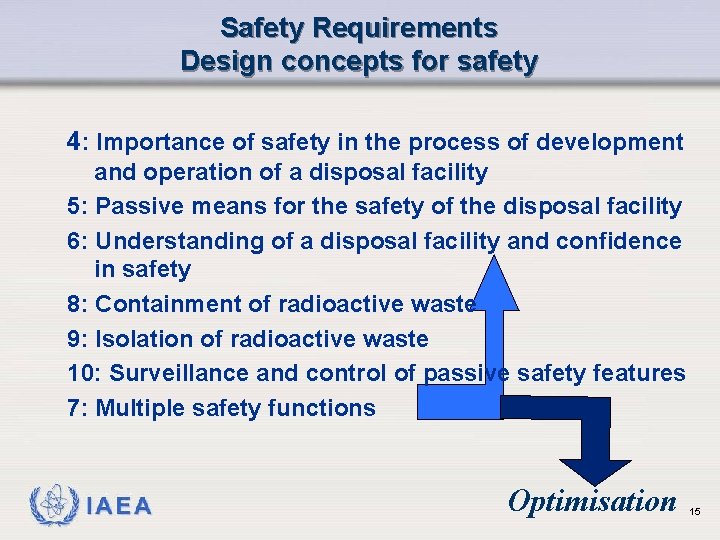
Safety Requirements Design concepts for safety 4: Importance of safety in the process of development and operation of a disposal facility 5: Passive means for the safety of the disposal facility 6: Understanding of a disposal facility and confidence in safety 8: Containment of radioactive waste 9: Isolation of radioactive waste 10: Surveillance and control of passive safety features 7: Multiple safety functions IAEA Optimisation 15
Passive safety (I) • A borehole disposal facility should be sited, designed and constructed so that, when closed, the post-closure safety of the facility will not depend on actions that would need to be taken after the closure. • In practice, even for intermediate depth boreholes, passive institutional controls, including controls on land ownership and restrictions on land use, could be maintained for some time after closure of the facility to further reduce the possibility of inadvertent intrusion and to provide additional public assurance. IAEA 16
Passive safety (II) • Safety assessments should be conducted with the aim of providing reasonable assurance of an adequate level of passive safety for boreholes • Factors contributing to passive safety include: ü the use of chemically stable waste forms, ü high integrity containers, ü borehole backfill between the containers and the borehole casing, ü disposal at a depth greater than 30 m, ü non-chemically reactive groundwater, ü stable geology and ü disposal in a location that provides a low probability of human intrusion IAEA 17
Adequate understanding of and confidence in safety • A borehole disposal facility should be designed and sited so that there is sufficient understanding of the features, events and processes (FEPs) that influence post-closure safety to enable the reasonable assurance of safety that is required to be established. • Understanding of the behaviour of the system in the post-closure period will evolve as more data are accumulated and scientific knowledge is developed. • Which features, events and processes are relevant and which are not will depend on the specific circumstances. Some features, events and processes will clearly need to be incorporated into the postclosure safety assessment. IAEA 18
Optim izatio n (I) • Ens uring that d appro oses ved d will b ose c suffic e belo onstr ient c w the aints ondit regu is a n ion fo latory e r c e r e s gulato sary b • The r ut no optim y app t roval. izatio phase n of p of a f rotec acility dispo tion d sal fa is a k uring cility e above y the o elem itself, grou perat ent of the p nd op ional the de re-dis eratio sign o posal ns. f the facili ties a nd th e IAEA
Optimization (II) Post-closure protection should be deemed to be optimized if all the following conditions are met : • Due attention has been paid during the development process to the post-closure safety implications of the various options; • The assessed doses and risks fall below the relevant constraints; • The probability of any events that might give rise to doses above the dose constraint has been reasonably reduced by means of siting or design; • The design, construction, operation and closure programmes have been subjected to a management system which will ensure the necessary level of quality in safety related aspects of the project. IAEA 20
Optimization (III) Necessary adaptation to individual country/ site conditions: • number of packages, hence length of disposal zone determined by inventory • geometry of borehole(s) tuned to optimize use of the site • depth always > 30 m IAEA 21
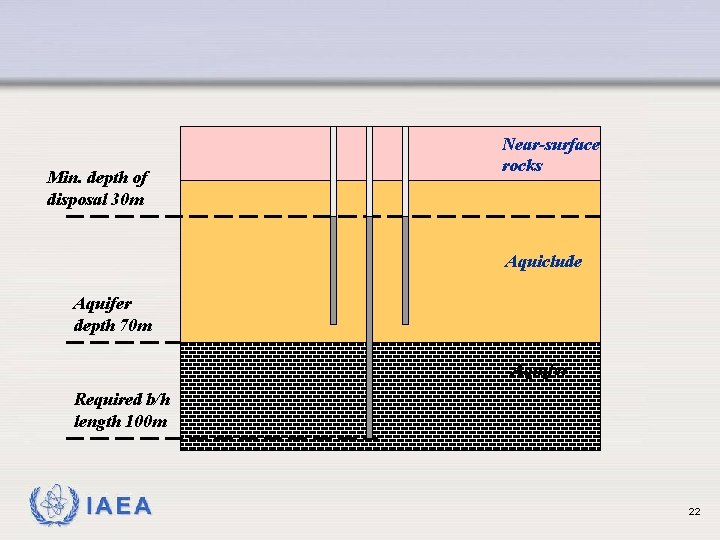
Min. depth of disposal 30 m Near-surface rocks Aquiclude Aquifer depth 70 m Aquifer Required b/h length 100 m IAEA 22
Key safety requirements • Isolation of waste / avoidance of human intrusion • Containment of radionuclides • Passive safety Use of highintegrity containers These aspects will be addressed in other lecture IAEA 23
Implementation requirements (1) FRAMEWORK FOR DISPOSAL 11: Step by step development and evaluation of disposal facilities 12: Preparation, approval and use of the safety case and safety assessment for a disposal facility 13: Scope of the safety case and safety assessment 14: Documentation of the safety case and safety assessments IAEA 24
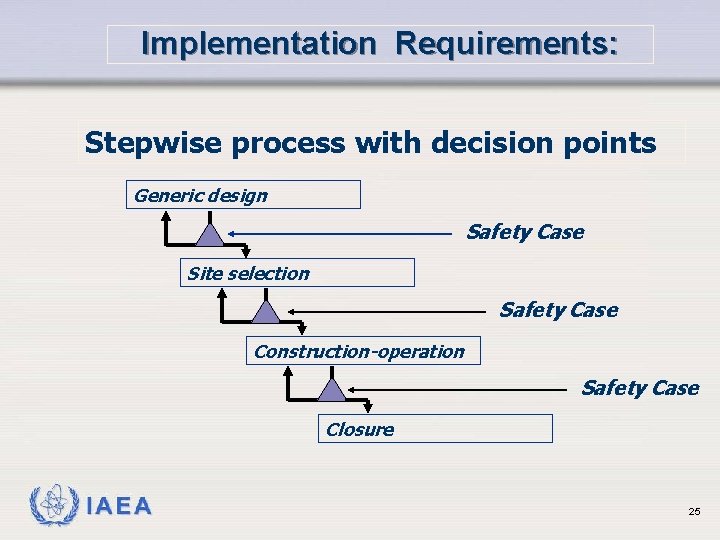
Implementation Requirements: Stepwise process with decision points Generic design Safety Case Site selection Safety Case Construction-operation Safety Case Closure IAEA 25
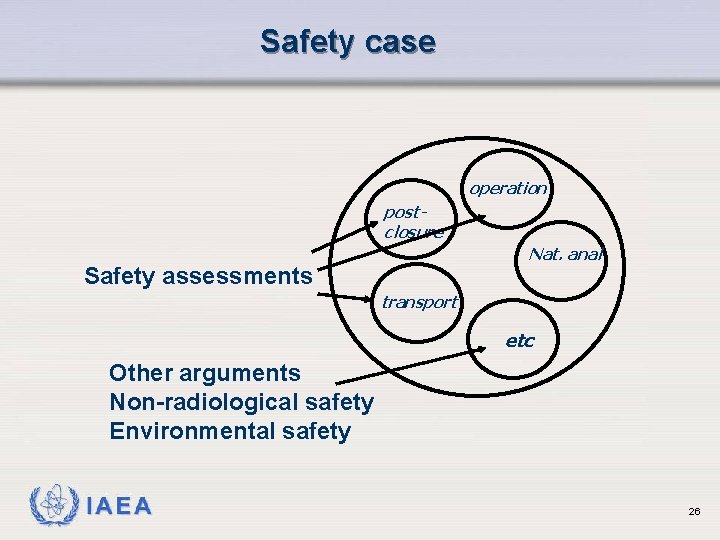
Safety case operation postclosure Nat. anal Safety assessments transport etc Other arguments Non-radiological safety Environmental safety IAEA 26
Safety assessment • The timing and level of detail of the safety assessment are a matter for the operator in consultation with the regulatory body. • In the case of a small scale borehole disposal facility, where the small inventory results in the calculated dose falling well below the regulatory constraint (i. e. there is a large margin of safety), it is likely that the safety assessment and the associated investigations would be relatively simple. IAEA These aspects will be addressed in other lecture 27
Independent review and assessment • The operator of a borehole disposal facility should submit the safety case and its associated safety assessment to the regulatory body for independent review and assessment • Independent review and assessment should judge among other things whether: ü The safety requirements will be complied with; ü The safety case contains sufficient detail; ü The data and information presented are sufficiently accurate; ü The safety case demonstrates that the design has been optimized and, with reasonable assurance, that the safety objectives and criteria will be met; ü The management system(s) is adequate; ü The arrangements proposed for the preservation of records are adequate. IAEA 28
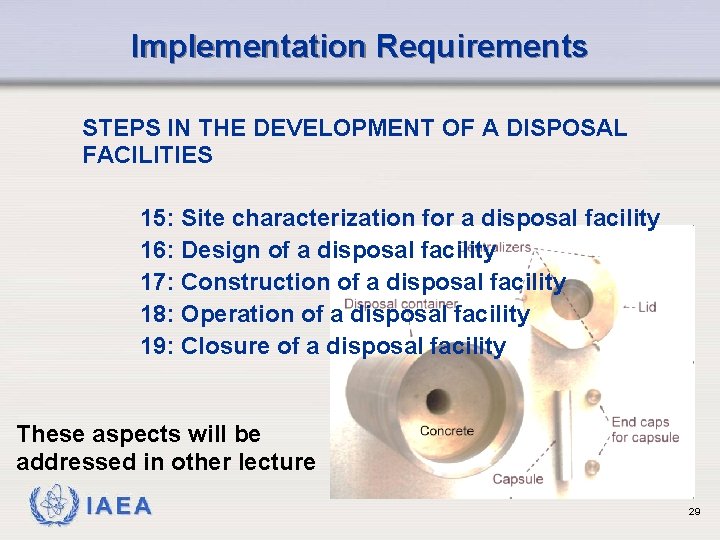
Implementation Requirements STEPS IN THE DEVELOPMENT OF A DISPOSAL FACILITIES 15: Site characterization for a disposal facility 16: Design of a disposal facility 17: Construction of a disposal facility 18: Operation of a disposal facility 19: Closure of a disposal facility These aspects will be addressed in other lecture IAEA 29
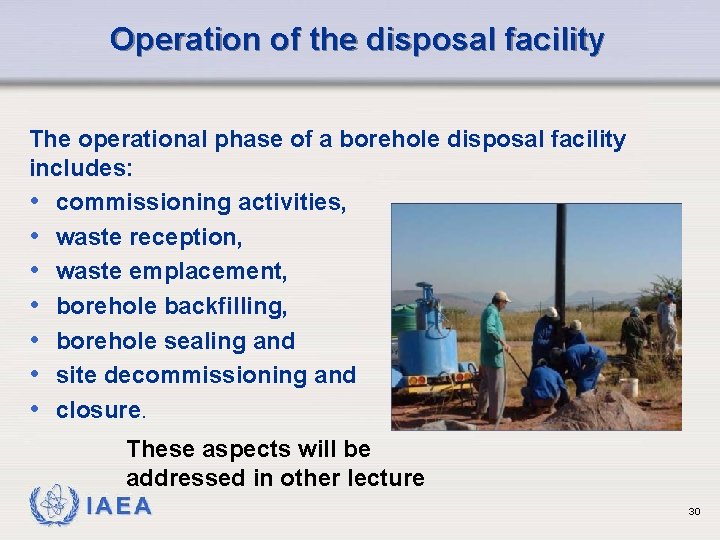
Operation of the disposal facility The operational phase of a borehole disposal facility includes: • commissioning activities, • waste reception, • waste emplacement, • borehole backfilling, • borehole sealing and • site decommissioning and • closure. These aspects will be addressed in other lecture IAEA 30
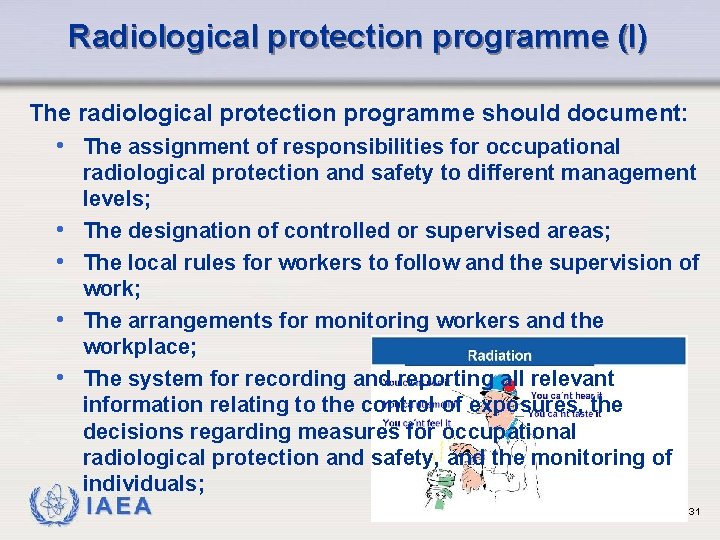
Radiological protection programme (I) The radiological protection programme should document: • The assignment of responsibilities for occupational • • radiological protection and safety to different management levels; The designation of controlled or supervised areas; The local rules for workers to follow and the supervision of work; The arrangements for monitoring workers and the workplace; The system for recording and reporting all relevant information relating to the control of exposures, the decisions regarding measures for occupational radiological protection and safety, and the monitoring of individuals; IAEA 31
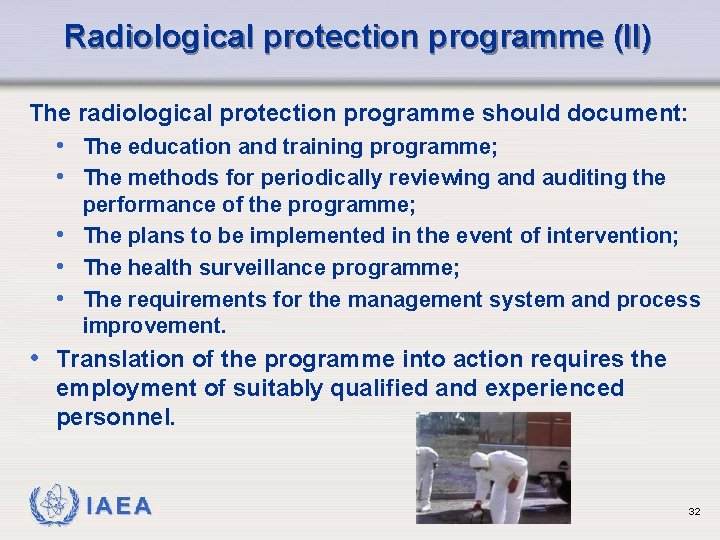
Radiological protection programme (II) The radiological protection programme should document: • The education and training programme; • The methods for periodically reviewing and auditing the performance of the programme; • The plans to be implemented in the event of intervention; • The health surveillance programme; • The requirements for the management system and process improvement. • Translation of the programme into action requires the employment of suitably qualified and experienced personnel. IAEA 32
Recruitment and training of personnel • The operator should determine the organization’s personnel • • requirements in terms of numbers, responsibilities and expertise, and then proceed to recruit and train suitably qualified persons. The training programme should identify the activities that are significant for safety. The training programme should also foster the development of a safety culture. The training should give operational staff a high degree of awareness of the design features of the disposal facility that are significant for safety. The training programme should be updated in the light of experience and staff should be retrained as necessary. IAEA 33
Emplacement strategies (I) • The operation of borehole disposal facilities may be performed on: ü a continuous basis or ü a campaign basis or ü a combination of the two. • Campaign operation provides a short term operational disposal period and would allow individual boreholes to be drilled, filled and sealed in one complete exercise, thus reducing the chances of boreholes degrading or being mismanaged between disposal operations. IAEA These aspects will be addressed in other lecture 34
Inspection and review • The operator should conduct periodic reviews covering issues such as audits, operating conditions, environmental sampling and analysis, occupational health and safety, and maintenance of records. The results of these reviews should then be submitted to the regulatory body. • The regulatory body may also carry out independent audits, inspections and reviews to satisfy itself that appropriate technical and managerial principles are being effectively applied. IAEA 35
Records (I) • An important operational requirement is the recording of relevant information. • Each waste package should have a unique identification. • For each waste package, information should be compiled on its principal characteristics e. g. ü origin of the waste, ü radionuclide content of the package, ü method of encapsulation, ü materials of the waste container, ü method of closure. IAEA 36
Records (II) • Operational records should describe when, how and by whom an operation was carried out and, especially, any non-compliances with the operating procedures. • When waste is emplaced, for instance, the position of the waste package should be recorded (e. g. the number and location of the borehole, the position within the borehole). • Processes such as backfilling and sealing should be similarly recorded. • Consideration should be given to the form of the records to ensure that information is available when needed without interruption or loss. IAEA 37
Implementation Requirements (3) ASSURANCE OF SAFETY 20: Waste acceptance in a disposal facility 21: Monitoring programmes at a disposal facility 22: The period after closure and institutional controls 23: Consideration of the State system of accounting for, and control of, nuclear material 24: Requirements in respect of nuclear security measures 25: Management systems These aspects will be addressed in other lecture IAEA 38
Surveillance and monitoring programmes (I) • A programme of surveillance and monitoring should form part of the safety case and should commence before a disposal facility becomes operational — usually during the site characterization programme. • As the disposal programme moves from one phase to the next, the objectives of the surveillance and monitoring programme will change and additional surveillance and monitoring activities will be added. • Some of these activities may continue through into the period of post-closure institutional control. Through the various phases of development of the facility, the surveillance and monitoring will contribute to the building of confidence in the safety case by testing assumptions and demonstrating compliance. These aspects will be IAEA 39 addressed in other lecture
Post-closure institutional controls (I) • Institutional control is defined as any form of institutional activity, from oversight by international agencies and national governments, to very specific activities such as environmental monitoring. • It is generally expected that institutional controls will assist with the societal acceptability of the disposal facility. • Institutional controls are generally classified into ‘active’ and ‘passive’ controls. IAEA 40
Post-closure institutional controls (II) • Active institutional controls include: ü Maintaining signs, fences and guards at sites to prevent unauthorized access and intrusion by animals; ü Maintaining access, maintaining the grounds, weed control, etc. ; ü Monitoring and surveillance); ü Performing any remedial work that may become necessary, for instance, on the basis of the programme of monitoring and surveillance. • Passive institutional controls include: ü Long term markers; ü Restrictions on land use and ownership; ü The preservation of records; ü Financial assurances. IAEA 41
Post-closure institutional controls (III) • Whether the duration of the institutional control period is defined by law or established on a case by case basis through the approval of closure plans, it should be specified in the site closure plan and justified by reference to its potential future hazard • Institutional control periods, often of the order of 100 to 300 years, are frequently part of the safety concept for many near surface disposal facilities associated with nuclear power programmes. • The site closure plan, including any newly proposed institutional control period, should require the review and approval of the regulatory body before the plan is implemented. IAEA 42
Post-closure institutional controls (IV) • The post-closure arrangements should be documented and should identify the institutional controls that are ü to be provided during the institutional control period, ü who is responsible for providing them and ü how long each control will stay in place. • Earlier removal of any institutional controls should need the prior approval of the regulatory body. IAEA 43
Post-closure institutional controls (IV) • In general, small scale borehole disposal facilities at intermediate depth represent lesser hazards in terms of the surface ‘footprint’, proximity of the waste to the surface and the amount of waste disposed of. • The safety of the facility will not depend on institutional controls and quite short periods may be justifiable, so land could soon be returned to local community use with, possibly, restrictions on ownership and use within a period of a few years. IAEA 44
BOSS Post-closure safety I Natural releases • safety rests on physical containment in near field üimportance of geochemistry • non-engineered barriers secondary üretardation in geosphere üdilution in geosphere, biosphere IAEA 45
BOSS Post-closure safety I Human Intrusion • depth >30 m below local topography • • ülimits intrusion to exploratory drilling small footprint deflector plate reduce removal of casing probability of native soil at top 2 m intrusion IAEA 46
Accounting and control for nuclear material (I) • Systems for accounting and control for nuclear material have been developed to provide for the accountability of nuclear material so as to detect in a timely manner its diversion to unauthorized or unknown purposes in the short and medium term. • As presently organized, systems for accounting and control for nuclear material rely on active surveillance and controls. • Possible malevolent uses of other (non-fissile) material do not fall within the system for accounting and control for nuclear material. IAEA 47
Accounting and control for nuclear material (II) • Borehole disposal is designed primarily to dispose of small volume waste (e. g. disused sealed sources), particularly when they arise in States without well developed systems for dealing with high level radioactive waste deriving from the nuclear fuel cycle. • Such waste may pose a potential security risk but, because of its low fissile content, it will not fall within the system for accounting and control for nuclear material. IAEA 48
Management systems • Management systems are applicable to any organization but, in the context of radioactive waste management, they apply most importantly to the operator. IAEA 49
Information to be archived (I) Information that should be preserved with respect to a borehole disposal facility is primarily: • Its precise location; • Its geology, geochemistry and hydrology derived from site characterization data; • Design details of the facility, including descriptions of the backfill, casing, seals etc. ; • Detailed descriptions of the waste packages, including waste origin, radionuclide content, encapsulation matrix and containers; IAEA 50
Information to be archived (II) Information that should be preserved with respect to a borehole disposal facility is primarily: • Descriptions of the construction and operation, including dates and details such as measured water inflows to boreholes and, especially, any nonconformances and actions taken to rectify them; • The facility safety case and supporting information (e. g. from site characterization); • A description of the post-closure arrangements; • Outputs from the surveillance and monitoring programme, including baseline surveys. Such information should be retained for as long as possible IAEA 51
Security (I) • The operator of a borehole disposal facility will be responsible for the security of the waste from the time it is received from the waste generator. • Precautions should be taken at the disposal site to prevent persons from carrying out unauthorized actions that might jeopardize safety or allow unauthorized removal of the waste. • The extent of security arrangements should reflect the potential for damage to the facility and the assessed risk of unauthorized removal of the waste. IAEA 52
Security (II) • Clearly, waste such as high activity disused sealed radioactive sources will require stricter security than low level waste. • Arrangements and appropriate liaison with competent authorities should be established to obtain timely assistance if this is required. • Waste that constitutes a significant security risk (e. g. sealed radioactive sources for which the radioactive material is in a dispersible form) will not be suitable for near surface disposal. IAEA 53
Security (III) • Even where all the waste in a borehole disposal facility is placed at a depth of more than 30 m, a site security presence will be required throughout the operational period. • In cases where disposals occur in a series of campaigns, it may be preferable to seal all the boreholes that contain waste at the end of each campaign. • Subsequent sealing of the boreholes and closure of the site should aim to allow the lifting of security measures at the site. IAEA 54
26: Existing disposal facilities(1) Safety assessment needed to: ü Assess the post-closure doses ü Assess the doses that would result from intervention (eg retrieval) ü Assess the feasibility and effectiveness of intervention measures IAEA 55
26: Existing disposal facilities(2) Guidance on remediation: ü If post closure dose < 10 m. Sv/a intervention almost certainly not required ü If post closure dose between 10 and 100 m. Sv/a intervention should be considered ü If post closure dose >100 m. Sv/a reasonable efforts required IAEA 56
26: Existing disposal facilities(3) Reasonable remediation efforts: ü improved safety assessment (removal of some conservative assumptions) ü improved institutional control ü improved engineering (unlikely) ü waste retrieval (possibly deferred) IAEA 57
Final Conclusions There is much work to do BUT. . . üGeneric assessments suggest borehole disposal will provide a useful alternative to the more usual disposal techniques üGeology does not need to be extraordinary üThe engineering can be simple üReasonable assurance is good enough - “the best is the enemy of the good” IAEA 58
IAEA Thank you! 59
- Slides: 59