
Safety for Special Kids Project Injury Prevention for
- Slides: 21
Safety for Special Kids Project: Injury Prevention for Children with Special Health Care Needs NASUH MALAS MD/MPH CANDIDATE 2009 UNIVERSITY OF WISCONSIN-MADISON SCHOOL OF MEDICINE AND PUBLIC HEALTH JIM SAVAGE DIRECTOR OF THE KOHL’S SAFETY CENTER AMERICAN FAMILY CHILDREN’S HOSPITAL UNIVERSITY OF WISCONSIN-MADISON
Acknowledgements Thanks to: American Family Children’s Hospital Kohl’s Safety Center Waisman Center The MCH-LEND Program SAFE Kids Coalition of Dane County The Special Needs Advisory Council The Kohl’s Safety Center Partners
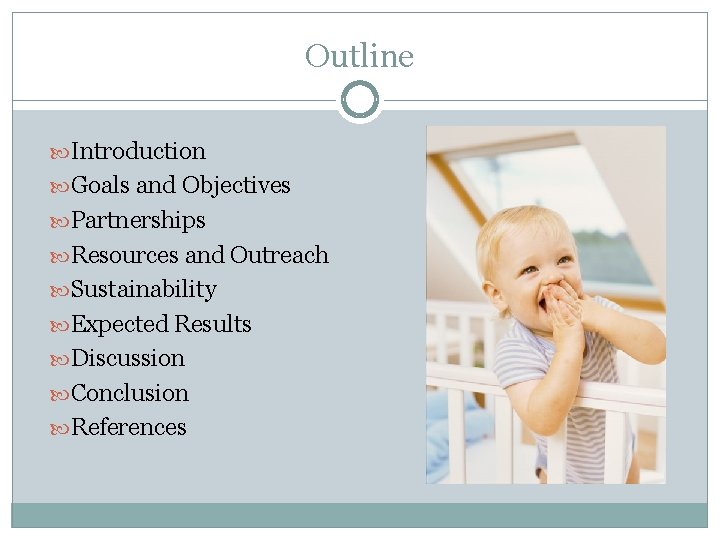
Outline Introduction Goals and Objectives Partnerships Resources and Outreach Sustainability Expected Results Discussion Conclusion References
Injury Prevention and Advocacy “Life affords no greater responsibility, no greater privilege, than the raising of the next generation. ” - C. Everett Koop
Introduction Unintentional Injury Leading cause of mortality for children ≤ 15 years of age 1 35 child deaths each day 2 30 million emergency room visits each year 1 400 billion dollars yearly in expense and lost productivity 1 1. Department of Health and Human Services, Centers for Disease Control and Prevention, National Center for Injury Control and Prevention. “State Injury Indicators Report: 3 rd Edition”. July 2004 2. Brixey, S. et al. “Injuries can be prevented. ” WMJ. Feb 2005. Vol 104. Issue 2. 19 -20
Introduction Wisconsin 70% of all injuries in Wisconsin are due to unintentional injuries 1, 2 31, 623 hospitalizations, of which 2, 288 were for children 1 Over 3, 000 injury-related deaths and approximately 1 of every 6 deaths occurs in children 2, 3 Costs 619 million dollars yearly 2 Motor vehicle injuries account for the majority of Wisconsin injuries, at 40%, followed by falls and poisonings 4 1. Department of Health and Human Services, Centers for Disease Control and Prevention, National Center for Injury Control and Prevention. “State Injury Indicators Report: 3 rd Edition”. July 2004 2. Wisconsin Department of Health and Family Services. “Wisconsin Injury Prevention Program”. http: //www. dhfs. state. wi. us/Health/Injury. Prevention/ Accessed: June 3, 2008 3. Peterson, N. “Community-Based Injury Prevention Programs: Toward a Safer Wisconsin”. WMJ. Dec 2000. Vol 99. No 9. 22 -26 4. Department of Health and Human Services, Centers for Disease Control and Prevention, National Center for Injury Control and Prevention. “State Injury Profile for Wisconsin”. 1989 -1998.
Introduction Unintentional Injury and Children with Special Needs Definition: “…children who have or are at increased risk for a chronic physical, developmental, behavioral, or emotional condition and who also require health and related services of a type or amount beyond that required for children generally. ” 1 13 -18% of the general child population Higher risk for injuries 2, 3, 4 Lack of preventative service and programming 1. Perrin, J. et al. “A family-centered, community-based system of services for child and youth with special health care needs”. Arch of Pediatric Adolescent Med. Oct 2007. Vol 161. No 10. 933 -936 2. Spira-Gaebler, D. et al. “Injury Prevention for children with disabilities”. Physical Medicine and Rehabilitation Clinics of North America. 2002. Vol 13. 891 -906 3. Maternal and Child Health Bureau of Health Resources and Services Administration. Injury Prevention Information for Children with Special Health Care Needs”. http: //mchb. hrsa. gov/child/specialcareneeds. htm Accessed: June 12, 2008 4. Sherrard, J. et al. “Injury risk in young people with intellectual disability”. Jan 2002. Vol 46. No 1. 6 -16
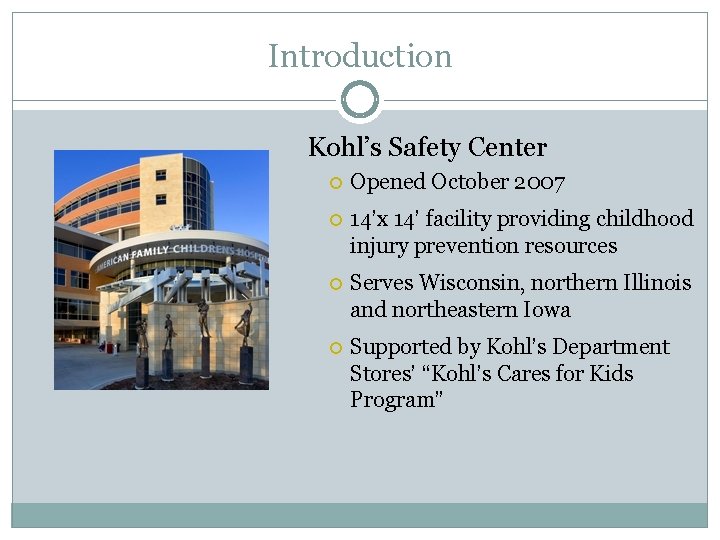
Introduction Kohl’s Safety Center Opened October 2007 14’x 14’ facility providing childhood injury prevention resources Serves Wisconsin, northern Illinois and northeastern Iowa Supported by Kohl’s Department Stores’ “Kohl’s Cares for Kids Program”
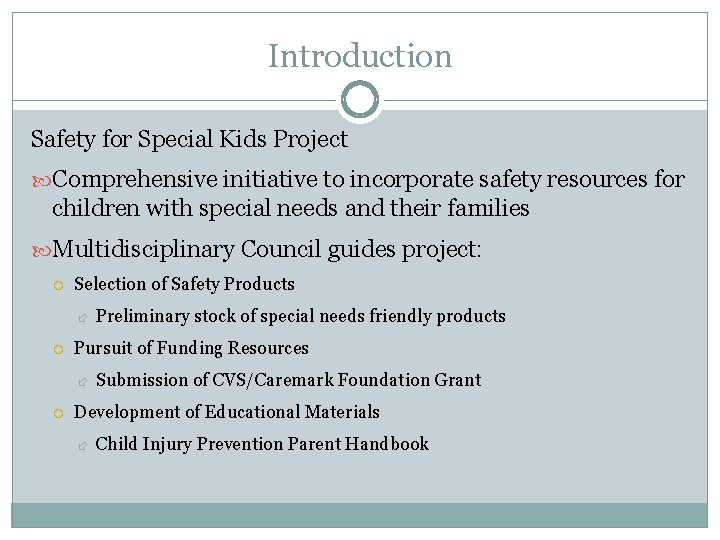
Introduction Safety for Special Kids Project Comprehensive initiative to incorporate safety resources for children with special needs and their families Multidisciplinary Council guides project: Selection of Safety Products Pursuit of Funding Resources Preliminary stock of special needs friendly products Submission of CVS/Caremark Foundation Grant Development of Educational Materials Child Injury Prevention Parent Handbook
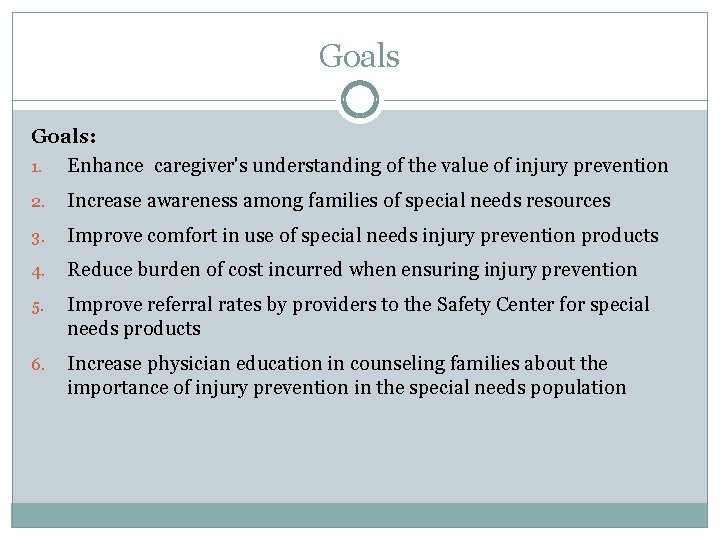
Goals: 1. Enhance caregiver's understanding of the value of injury prevention 2. Increase awareness among families of special needs resources 3. Improve comfort in use of special needs injury prevention products 4. Reduce burden of cost incurred when ensuring injury prevention 5. Improve referral rates by providers to the Safety Center for special needs products 6. Increase physician education in counseling families about the importance of injury prevention in the special needs population
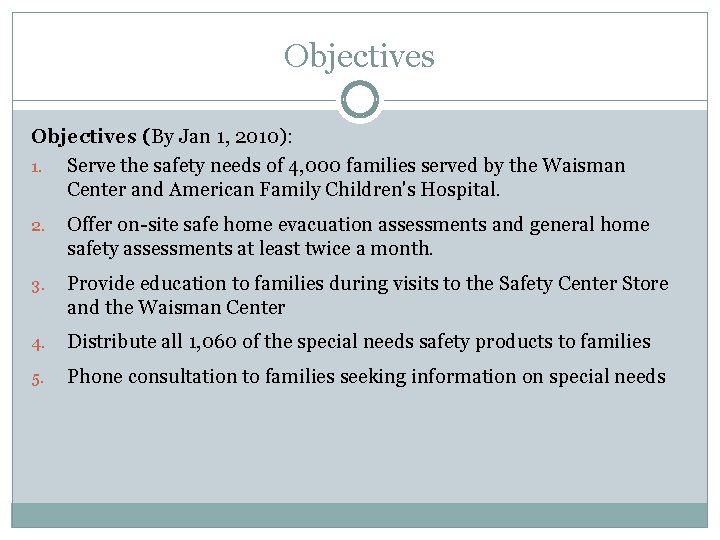
Objectives (By Jan 1, 2010): 1. Serve the safety needs of 4, 000 families served by the Waisman Center and American Family Children's Hospital. 2. Offer on-site safe home evacuation assessments and general home safety assessments at least twice a month. 3. Provide education to families during visits to the Safety Center Store and the Waisman Center 4. Distribute all 1, 060 of the special needs safety products to families 5. Phone consultation to families seeking information on special needs
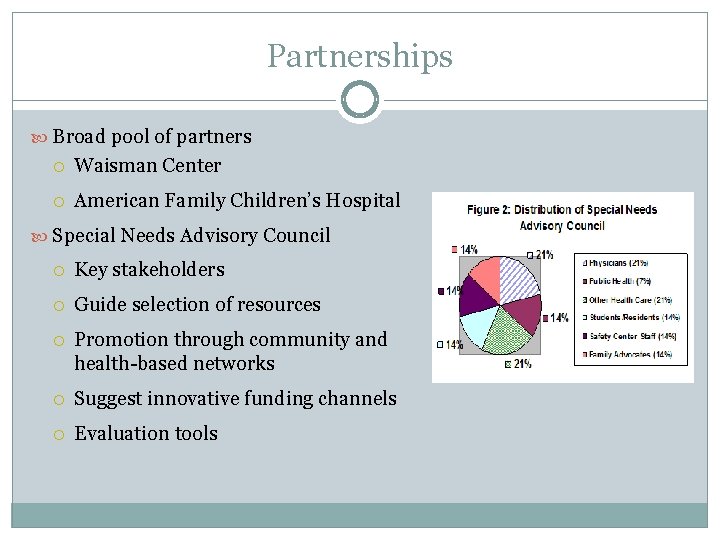
Partnerships Broad pool of partners Waisman Center American Family Children’s Hospital Special Needs Advisory Council Key stakeholders Guide selection of resources Promotion through community and health-based networks Suggest innovative funding channels Evaluation tools
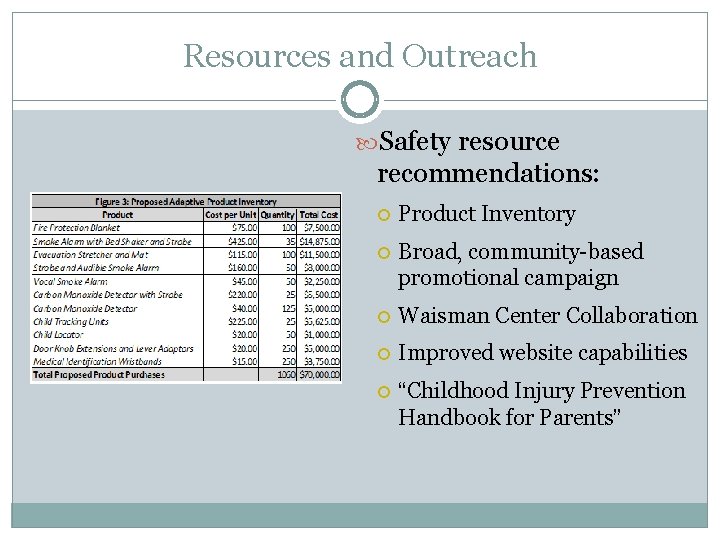
Resources and Outreach Safety resource recommendations: Product Inventory Broad, community-based promotional campaign Waisman Center Collaboration Improved website capabilities “Childhood Injury Prevention Handbook for Parents”
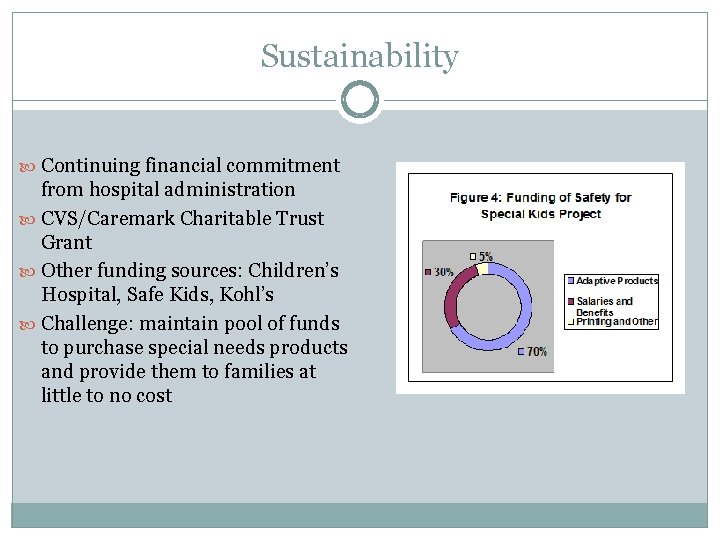
Sustainability Continuing financial commitment from hospital administration CVS/Caremark Charitable Trust Grant Other funding sources: Children’s Hospital, Safe Kids, Kohl’s Challenge: maintain pool of funds to purchase special needs products and provide them to families at little to no cost
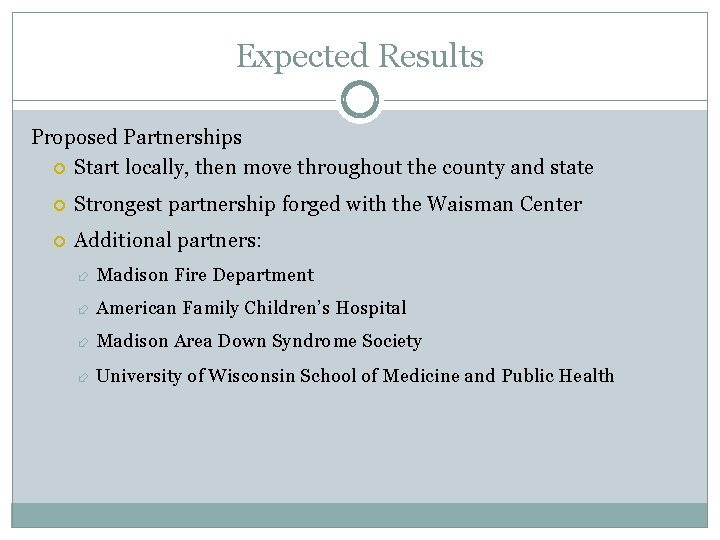
Expected Results Proposed Partnerships Start locally, then move throughout the county and state Strongest partnership forged with the Waisman Center Additional partners: Madison Fire Department American Family Children’s Hospital Madison Area Down Syndrome Society University of Wisconsin School of Medicine and Public Health
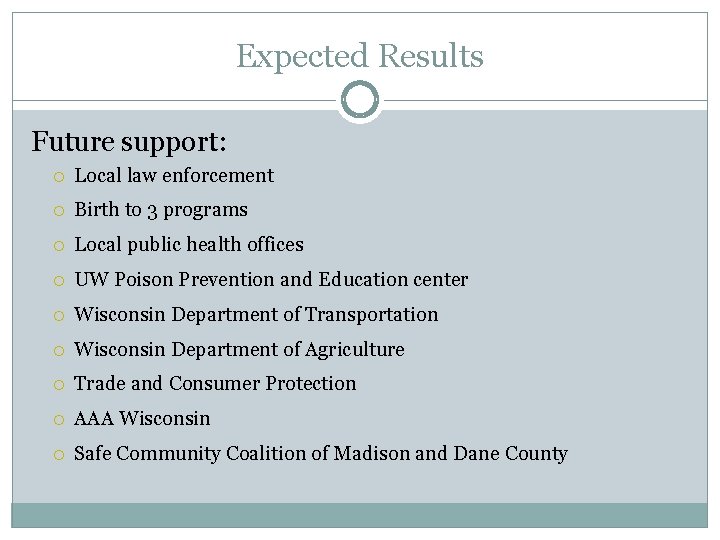
Expected Results Future support: Local law enforcement Birth to 3 programs Local public health offices UW Poison Prevention and Education center Wisconsin Department of Transportation Wisconsin Department of Agriculture Trade and Consumer Protection AAA Wisconsin Safe Community Coalition of Madison and Dane County
Expected Results Evaluation Tools Simple needs assessment Convenience sample of families of children with special needs Offered at clinical visits or other visits to Waisman Center Address epidemiology, safety concerns, and barriers to care Evaluation will be both qualitative and quantitative Qualitative Data Survey at least 1% of our target population, or 40 families Survey providers at Waisman Center and Children’s Hospital Quantitative Data Tally visits or calls requesting special needs safety resources Tabulate number of families that obtain safety products
Discussion Basic foundation to ensure long term success Driving force: large need, dedicated faculty, staff and family advocates Cornerstone of project: Special Needs Advisory Council Unique products and services provide a niche market for the Safety Center Should lead to further financial support and community advocacy for the project
Discussion Limitations: Financial sustainability Staff and Space Addressing the issue of self injurious behavior and child abuse Realize burden of unintentional injury in special needs population Need further study Kohl’s Safety Center: Safety for Special Kids Concise goals and objectives, with quantitative and qualitative evaluative tools, provide requisite measures to gauge progress After one year, able to determine if efforts will bear fruit
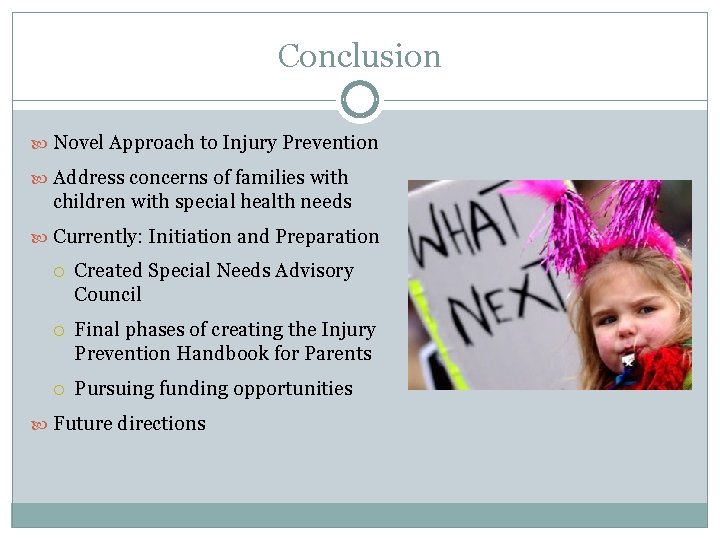
Conclusion Novel Approach to Injury Prevention Address concerns of families with children with special health needs Currently: Initiation and Preparation Created Special Needs Advisory Council Final phases of creating the Injury Prevention Handbook for Parents Pursuing funding opportunities Future directions
Questions?