
Safety Critical Systems T 79 5303 Design for
- Slides: 34
Safety Critical Systems T 79. 5303 Design for safety hardware and software Ilkka Herttua
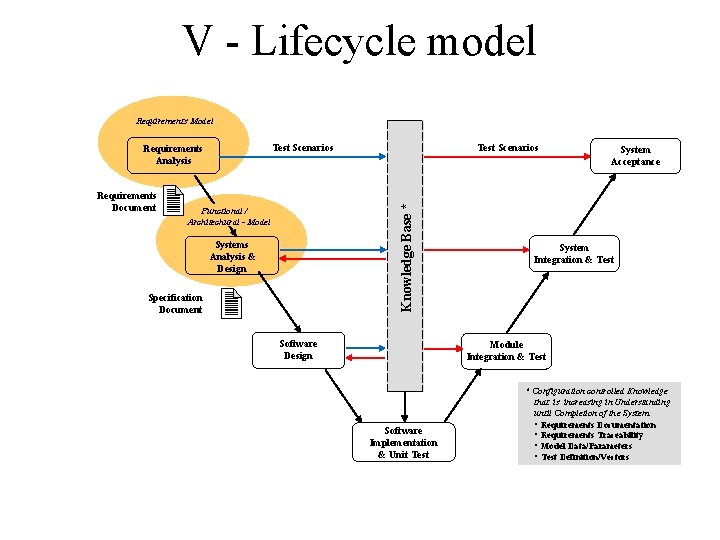
V - Lifecycle model Requirements Model Requirements Document Test Scenarios Knowledge Base * Test Scenarios Requirements Analysis Functional / Architechural - Model Systems Analysis & Design Specification Document Software Design System Acceptance System Integration & Test Module Integration & Test Software Implementation & Unit Test * Configuration controlled Knowledge that is increasing in Understanding until Completion of the System: • Requirements Documentation • Requirements Traceability • Model Data/Parameters • Test Definition/Vectors
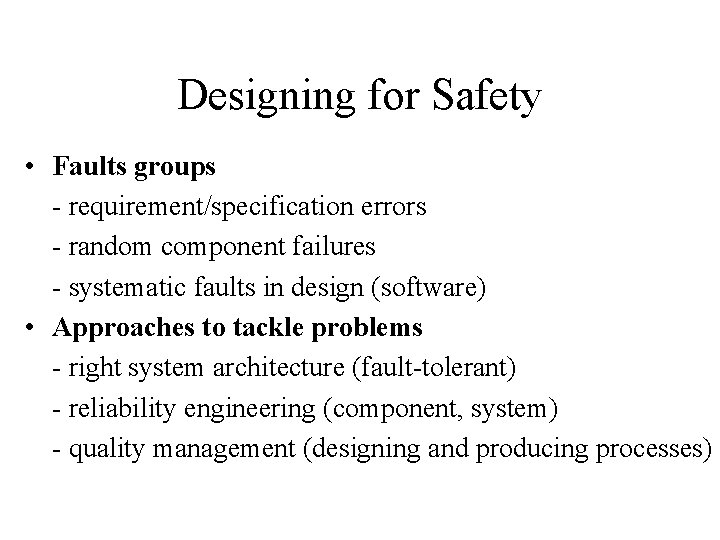
Designing for Safety • Faults groups - requirement/specification errors - random component failures - systematic faults in design (software) • Approaches to tackle problems - right system architecture (fault-tolerant) - reliability engineering (component, system) - quality management (designing and producing processes)
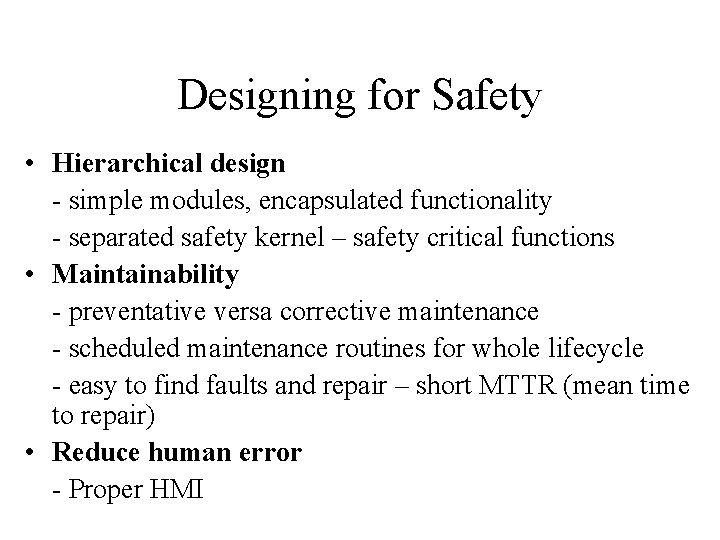
Designing for Safety • Hierarchical design - simple modules, encapsulated functionality - separated safety kernel – safety critical functions • Maintainability - preventative versa corrective maintenance - scheduled maintenance routines for whole lifecycle - easy to find faults and repair – short MTTR (mean time to repair) • Reduce human error - Proper HMI
Hardware Faults Intermittent faults - Fault occurs and recurs over time (loose connector) Transient faults - Fault occurs and may not recur (lightning) - Electromagnetic interference Permanent faults - Fault persists / physical processor failure (design fault – over current)
Fault Tolerance • Fault tolerance hardware - Achieved mainly by redundancy - Adds cost, weight, power consumption, complexity Other means: - Improved maintenance, single system with better materials (higher mean time between failure MTBF)
Redundancy types Active Redundancy: - Redundant units are always operating in parallel Dynamic Redundancy (standby): - Failure has to be detected - Changeover to other module
Hardware redundancy techniques Active techniques: - Parallel (k of N) - Voting (majority/simple) Standby techniques : - Operating - hot stand by - Non-operating – cold stand by
Hardware reliability prediction • Electronic Components - Based on probability and statistical - MIL-Handbook 217 – experimental data on actual device behaviour - Manufacture information and allocated circuit types -Bath tube curve; burn in – useful life – wear out
Safety Critical Hardware Fault Detection: - Routines to check that hardware works - Signal comparisons - Information redundancy –parity check etc. . - Watchdog timers - Bus monitoring – check that processor alive - Power monitoring
Safety Critical Hardware 1. Commercial Microprocessors - - No safety firmware, least assurance Redundancy makes better, but common failures possible Fabrication failures, microcode and documentation errors Use components which have history and statistics.
Safety Critical Hardware 2. Special reliable Microprocessors - Collins Avionics/Rockwell AAMP 2 - Used in Boeing 747 -400 (30+ pieces) - High cost – bench testing, documentation, formal verification - Other models: Sparc. V 7, TSC 695 E, ERC 32 (ESA radiation-tolerant), 68 HC 908 GP 32 (airbag)
Safety Critical Hardware 3. Programmable Logic Controllers (PLC) • Contains power supply, interface and one or more processors. • Designed for high mean time between failure (MTBF) • Solid Firmware • Program stored in EEPROMS • Programmed with ladder or function block diagrams
Safety Critical Software 1. Software development: 2. Normally iteration is needed to develop a working solution. (writing code, testing and modification). 3. In non-critical environment code is accepted, when tests are passed. 4. Testing is not enough for safety critical application – Software needs an assessment process: dynamic/static testing, simulation, code analysis and formal verification.
Safety Critical Software Dependable Software : - Process for development - Work discipline - Well documented - Quality management - Validated/verified
Safety-Critical Software faults: - Requirements defects: failure of software requirements to specify the environment in which the software will be used or unambiguous requirements - Design defects: not satisfying the requirements or documentation defects - Code defects: Failure of code to conform to software designs.
Safety-Critical Software faults: - Subprogram effects: Definition of a called variable may be changed. -Definitions aliasing: Names refer to the same storage location. - Initialising failures: Variables are used before assigned values. - Memory management: Buffer, stack and memory overflows - Expression evaluation errors: Divide-byzero/arithmetic overflow
Safety Critical Software Safety Critical Programming Language: - Logical soundness: Unambiguous definition of the language- no dialects of C++ - Simple definitions: Complexity can lead to errors in compliers or other support tools - Expressive power: Language shall support to express domain features efficiently and easily - Security of definitions: Violations of the language definition shall be detected - Verification: Language supports verification, proving that the produced code is consistent with the specification. - Memory/time constrains: Stack, register and memory usage are controlled.
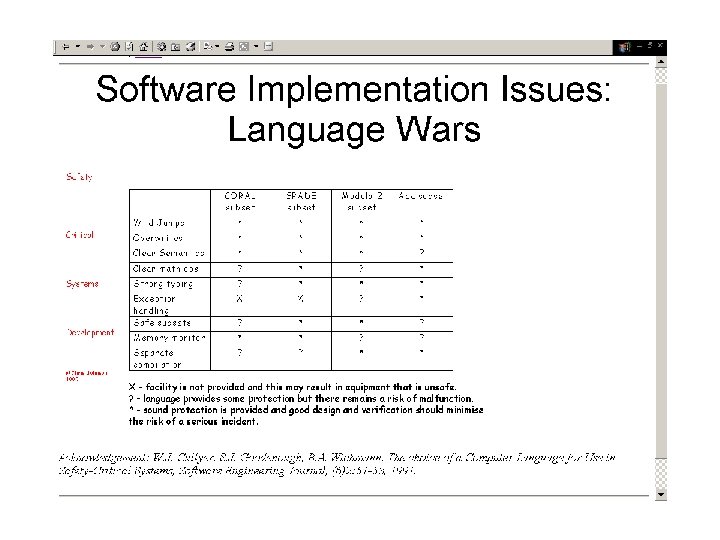
Safety Critical Software Language comparison: -Structured assembler (wild jumps, exhaustion of memory, well understood) - Ada (wild jumps, data typing, exception handling, separate compilation) - Subset languages: CORAL, SPADE and Ada (Alsys CSMART Ada kernel) - Validated compilers for Pascal and Ada - Available expertise: with common languages higher productivity and fewer mistakes, but C still not appropriate.
Safety Critical Software Languages used : - Boeing uses mostly Ada, but still for type 747400 about 75 languages used. - ESA mandated Ada for mission critical systems. - NASA Space station in Ada, some systems with C and Assembler. - Car ABS systems with Assembler - Train control systems with Ada - Medical systems with Ada and Assembler - Nuclear Reactors core and shut down system with Assembler, migrating to Ada.
Safety Critical Software Tools - High reliability and validated tools are required: Faults in the tool can result in faults in the safety critical software. - Widespread tools are better tested - Use confirmed process of the usage of the tool - Analyse output of the tool: static analysis of the object code - Use alternative products and compare results - Use different tools (diversity) to reduce the likelihood of wrong test results.
Safety Critical Software Designing Principles 1 - New software features add complexity, try to keep software simple - Plan for avoiding human error – unambiguous human-computer interface - Removal of hazardous module (Ariane 5 unused code)
Safety Critical Software Designing Principles 2 - Add barriers: hard/software locks for critical parts - Minimise single point failures: increase safety margins, exploit redundancy and allow recovery. - Isolate failures: don‘t let things get worse. - Fail-safe: panic shut-downs, watchdog code - Avoid common mode failures: Use diversity – different programmers, n-version programming
Safety Critical Software Designing Principles 3 - Fault tolerance: Recovery blocks – if one module fails, execute alternative module. - Don‘t relay on run-time systems
Safety-Critical Software Techniques/Tools: -Fault prevention: Preventing the introduction or occurrence of faults by using design supporting tools (UML with CASE tool) -Fault removal: Testing, debugging and code modification
Safety Critical Software tool faults: - Faults in software tools (development/modelling) can results in system faults. -Techniques for software development (language/design notation) can have a great impact on the performance or the people involved and also determine the likelihood of faults. - The characteristics of the programming systems and their runtime determine how great the impact of possible faults on the overall software subsystem can be.
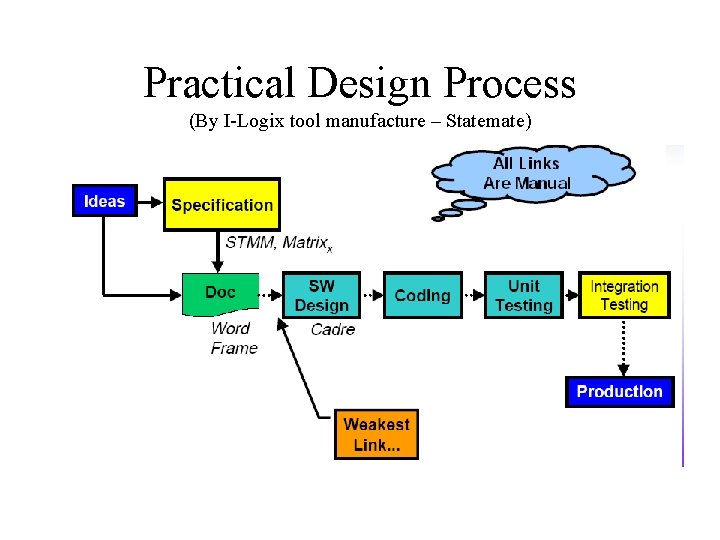
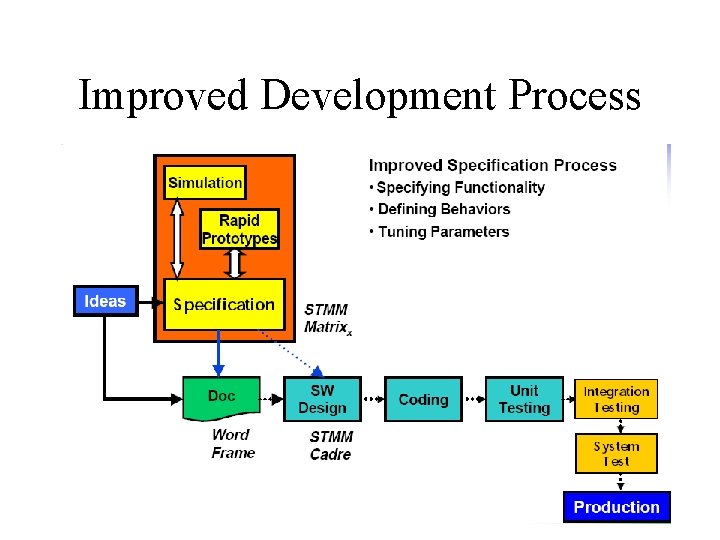
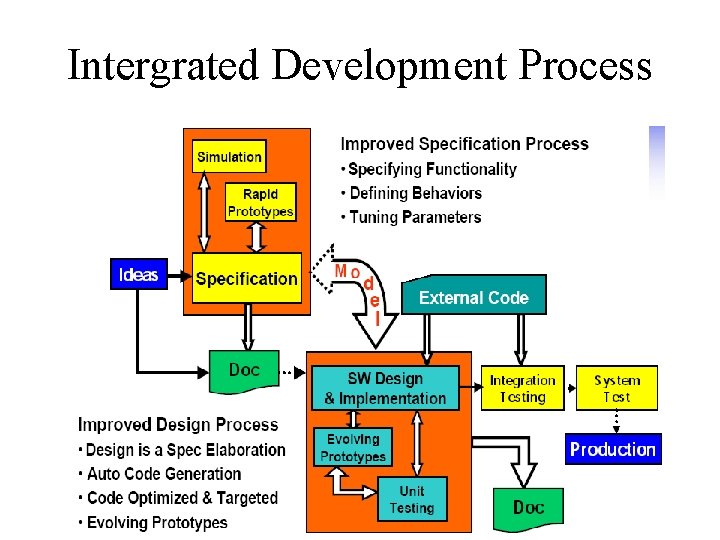
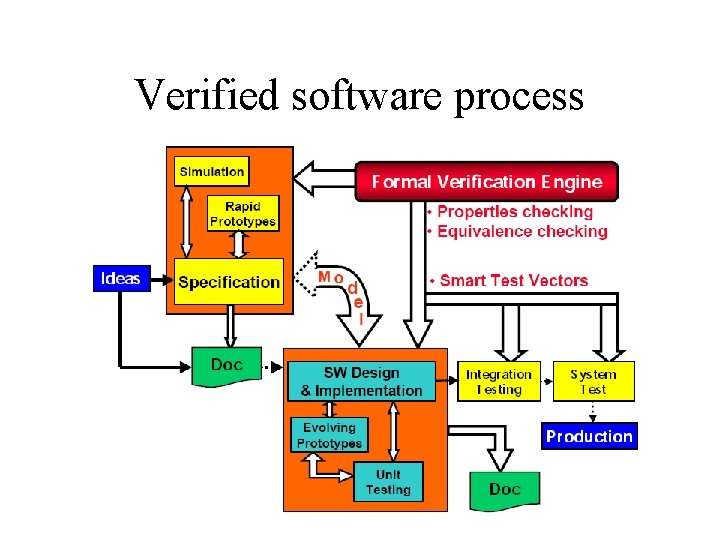
Practical Design Process (By I-Logix tool manufacture – Statemate)
Improved Development Process
Intergrated Development Process
Verified software process
Safety Critical Software Reduction of Hazardous Conditions - Simplify: Code contains only minimum features and no unnecessary or undocumented features or unused executable code - Diversity: Data and control redundancy - Multi-version programming: shared specification leads to common-mode failures, but synchronisation code increases complexity
Home assignments 2 a • Neil Storey’s book: Safety Critical Computer Systems - 5. 10 Describe a common cause of incompleteness within specifications. How can this situation cause problems? - 9. 17 Describe the advantages and disadvantages of the reuse of software within safety critical projects. Cont.
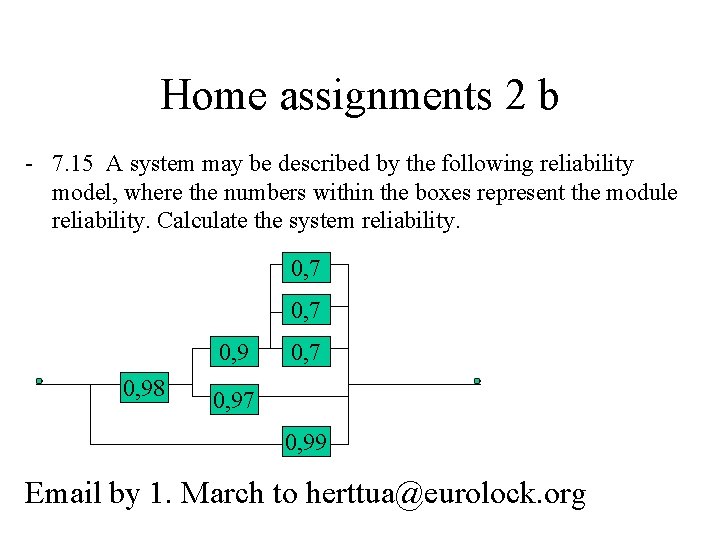
Home assignments 2 b - 7. 15 A system may be described by the following reliability model, where the numbers within the boxes represent the module reliability. Calculate the system reliability. 0, 7 0, 98 0, 7 0, 99 Email by 1. March to herttua@eurolock. org