
Safety at worksite Abstract from Guidelines on Safety
Safety at worksite {Abstract from Guidelines on ‘Safety on Work site’ Issued by RDSO(CAMTECH) No. CAMTECH/2015/C/SAWS/1. 0 Jan. 2015 and Chapter No. 8 of IRPWM}
References: � RDSO(CAMTECH) have issued guidelines on ‘Safety on Work site’ No. AMTECH/2015/C/SAWS/1. 0 in Jan. 2015. � There are JPO’s available in zonal Railways. � PCEs of zonal Rlys have also issued circulars on this subject. � SP-70 and SP-7 (NBC) also deals with safety at work site. � Chapter No. 8 of IRPWM also deals with this subject.
Subject discussion may be divided in ‘THREE’ parts: � Part 1: Matters related to ‘Track safety’ – Track protection etc. � Part 2: Matters related to safety at work site – Safety of Workers and Machinery etc. � Part 3: Matters related to ‘Personal safety’ – Personal Protective equipment (PPE) etc.
We will discuss ‘Part-2’ in detail In Following areas ‘safety’ may be in danger at work site: � Excavation � Piling � Scaffolding � Movement � Ladders � Roof work � Steel erection � Work over water � Demolition of vehicle � Transportation of material � Gin or pulley wheel � Manual handling Environment of site also plays a vital role in safety
Safety in Excavation� Workers Causes for Accidents trapped and buried in an excavation owing to the collapse of the sides. � Workers struck and injured by material falling into the excavation. � Workers falling into the excavation. � Unsafe means of access and insufficient means of escape in case of flooding. � Vehicles driven into or too close to the edge of an excavation, particularly while reversing, causing the sides to collapse. � Asphyxiation or poisoning caused by fumes heavier than air entering the excavation, e. g. exhaust fumes from diesel and petrol engines.
Safety in Excavation- General Precautions for Excavation � Excavation work to - Be inspected by a competent person: every day. � Excavation work - Not too close and deep, adjacent to structure, if so - precautions must be taken by shoring, and so on, to prevent any collapse or fall. � Near edge of an excavation. Never store, or move materials and equipment. � Spoil and waste heaps - kept well away from the edges of excavations.
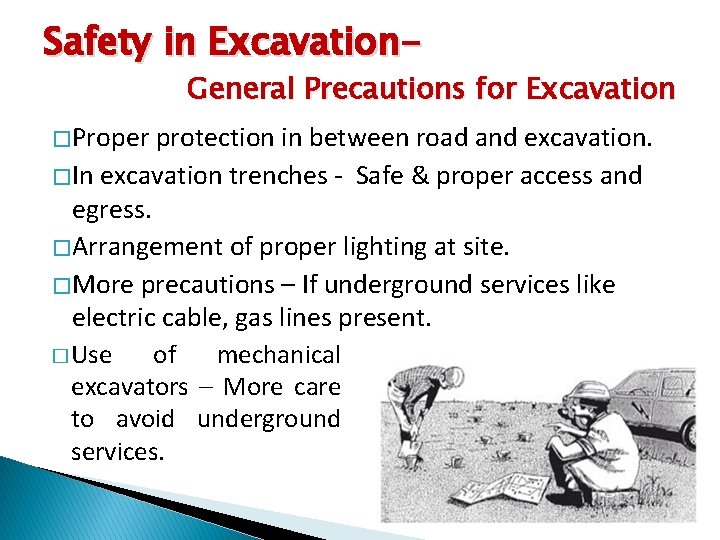
Safety in Excavation- General Precautions for Excavation � Proper protection in between road and excavation. � In excavation trenches - Safe & proper access and egress. � Arrangement of proper lighting at site. � More precautions – If underground services like electric cable, gas lines present. � Use of mechanical excavators – More care to avoid underground services.

Safety precautions to prevent collapse of excavations and falls: � The sides of the excavation – Proper slope or stepped. � Ensure - Sufficient material at site for shoring. � Shoring erection or dismantling - Skilled labour under competent supervision. � Rescue operation - Full awareness of the procedures. � Safeguard against fall into excavations – Suitable barriers (about 1 m) : Projected trench supports can often be used for this purpose.
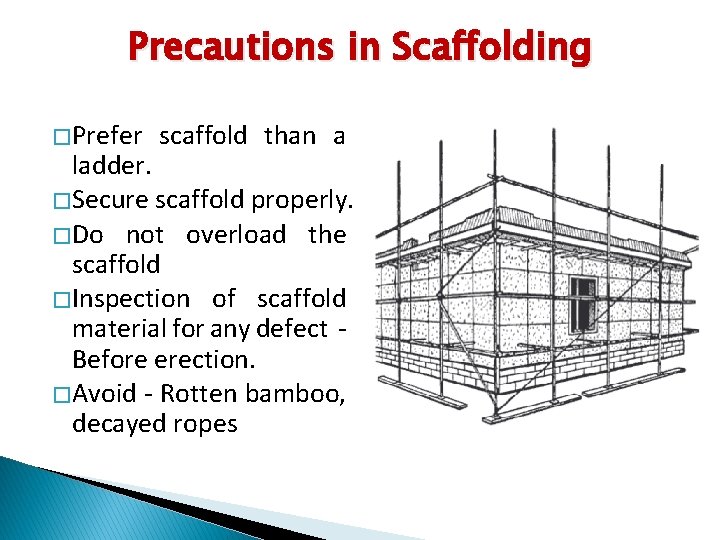
Precautions in Scaffolding � Prefer scaffold than a ladder. � Secure scaffold properly. � Do not overload the scaffold � Inspection of scaffold material for any defect Before erection. � Avoid - Rotten bamboo, decayed ropes
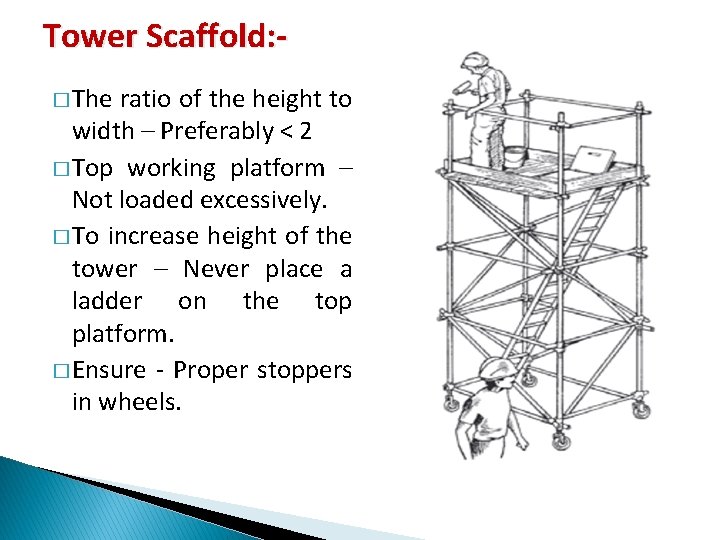
Tower Scaffold: � The ratio of the height to width – Preferably < 2 � Top working platform – Not loaded excessively. � To increase height of the tower – Never place a ladder on the top platform. � Ensure - Proper stoppers in wheels.
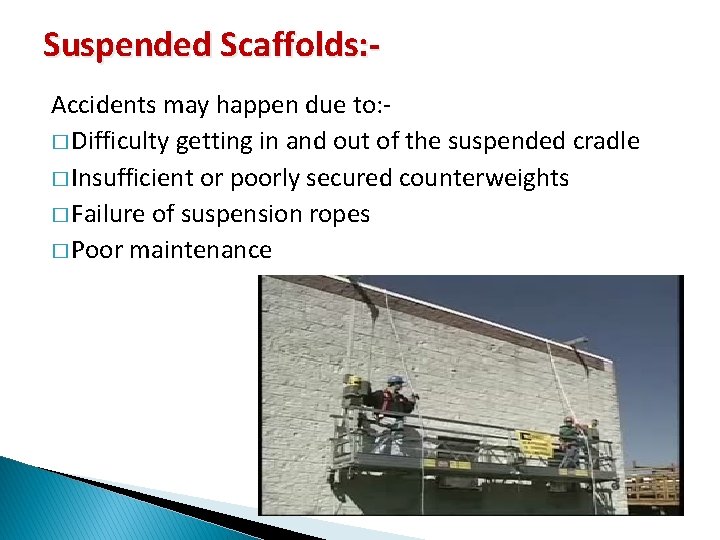
Suspended Scaffolds: Accidents may happen due to: � Difficulty getting in and out of the suspended cradle � Insufficient or poorly secured counterweights � Failure of suspension ropes � Poor maintenance
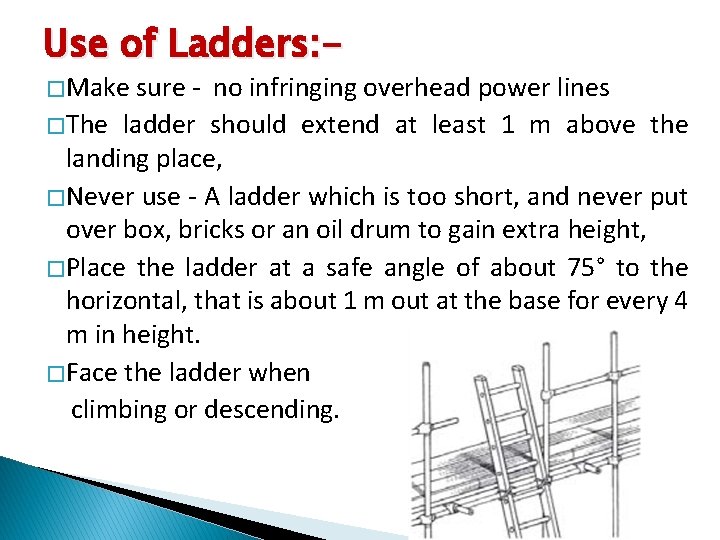
Use of Ladders: � Make sure - no infringing overhead power lines � The ladder should extend at least 1 m above the landing place, � Never use - A ladder which is too short, and never put over box, bricks or an oil drum to gain extra height, � Place the ladder at a safe angle of about 75° to the horizontal, that is about 1 m out at the base for every 4 m in height. � Face the ladder when climbing or descending.
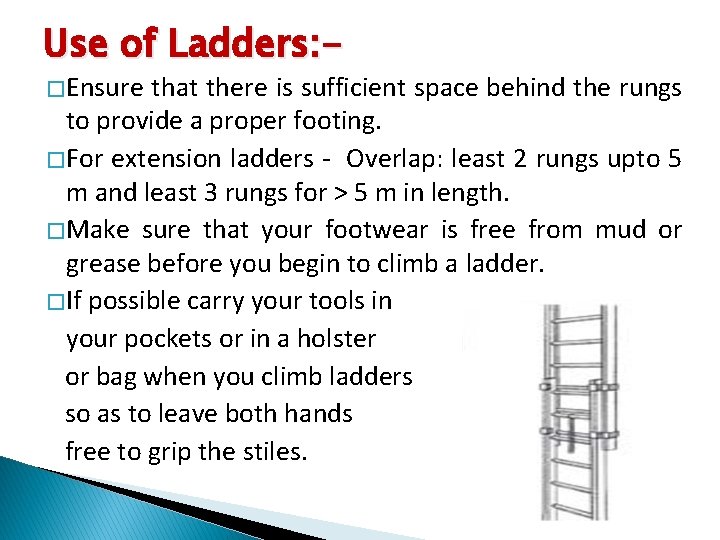
Use of Ladders: � Ensure that there is sufficient space behind the rungs to provide a proper footing. � For extension ladders - Overlap: least 2 rungs upto 5 m and least 3 rungs for > 5 m in length. � Make sure that your footwear is free from mud or grease before you begin to climb a ladder. � If possible carry your tools in your pockets or in a holster or bag when you climb ladders so as to leave both hands free to grip the stiles.
Use of Ladders: � Preferably do not climb with material, use a hoist. � Avoid - Overbalancing or overreaching. � On ladder – Only one person at a time. � While working always atleast hold ladder with one hand. � Restrict movement. � Has to be safely situated and secured.
Safety in Roof Work: Without proper precautions, roof work is among the most hazardous of construction operations. The most common accidents to workers are due to: � Falls from the edge of roofs; � Falls through openings in roofs; � Falls through fragile roof materials.
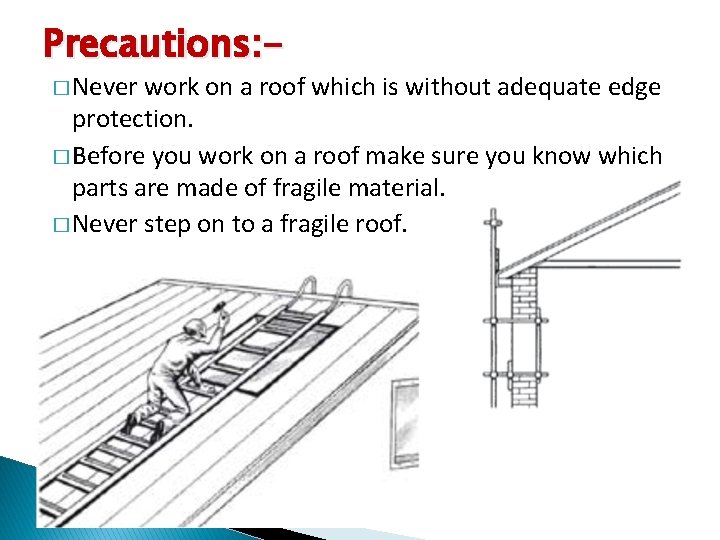
Precautions: � Never work on a roof which is without adequate edge protection. � Before you work on a roof make sure you know which parts are made of fragile material. � Never step on to a fragile roof.
Safety in steel Erection: Following precautions may be adopted: � Safety in steel erection begins at the design stage. � Ensure - proper access and freedom of movement for transport and cranes. � Always wear suitable personal protective equipment. � Trying to save crane time by reducing the number of bolts used in connections is a dangerous practice. � Do not work in high winds or on wet steelwork.
Work over water body: � Make sure that the working platform is secure and has no tripping hazards. � Slippery surfaces - be treated by cleaning, gritting or applying industrial salt or sand. � Check that access ladders, guard-rails and toe boards are firmly fixed in position. � Wear a safety helmet at all times – if you are struck on the head and fall into water you are at special risk. � Wear a life-jacket, and ensure that it is properly fastened.
Work over water body: - � Use any safety nets or safety harness provided. � Check that lifebuoys fitted with lifelines are ready to hand for immediate use. � Make sure that there is a safety boat and that it is manned while you are working above water – if over tidal water or a fast- flowing river, it must have a motor with a self-starting device. � Ensure that you know the routine for raising the alarm and for rescue drill. � Do not work alone when you are working over water. � Check the number of workers regularly to ensure that no one is missing.
Safety in Demolition: The causes of accidents during demolition are: � Incorrect method of demolition; � Unsafe place at demolition site; � Unintentional collapse of the building being demolished, � Collapse of adjoining building and structure, due to lack of temporary support.
Precautions: � During demolition – Everyone must wear personal protective equipment (PPE). � Provide proper and adequate temporary support to adjoining building if necessary. � All service lines like electric, water supply etc. must be disconnected before demolition work. � Demolition site to be protected for the public, wherever feasible, fencing may be erected. � Do not isolate walls or parts of building which are liable to be collapse by the wind effect.
Safety in Movement of vehicles: Common causes are as under; � Bad driving techniques which include reversing blind; � Carelessness or ignorance of special hazards, e. g. work near overhead power lines or excavations; � Carrying unauthorized passengers; � Poor maintenance of vehicles; � Overloading or bad loading; � Site congestion and poor traffic layout; � Lack of proper roads at site combined with uneven ground and debris.
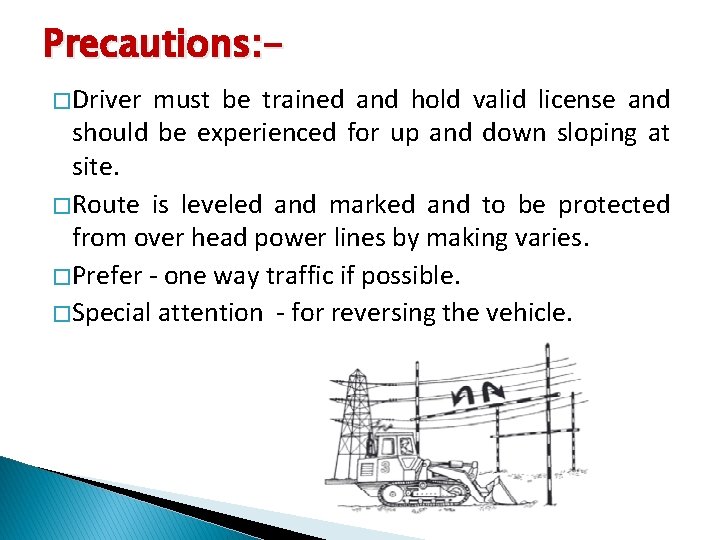
Precautions: � Driver must be trained and hold valid license and should be experienced for up and down sloping at site. � Route is leveled and marked and to be protected from over head power lines by making varies. � Prefer - one way traffic if possible. � Special attention - for reversing the vehicle.
Precautions: � Unattended vehicles must be switched off and suitable protection to be adopted for keeping stable at site. � When machine or vehicle is not in working, ensure that tipping bodies are lowered. � Impose speed limit for movement of vehicles and ensure it. � Distribute the load evenly within the capacity of vehicle. � Load should not be projected beyond the plan area of vehicle. If it is unavoidable, it is protected by flag attachment.
Cranes: Before a crane is used on site, pl consider: � The weight, size and type of load it will have to lift; � The maximum reach or radius required; restrictions on use such as overhead power lines, the state of the site and the type of ground; � The need for trained operators and signallers.
Precautions: � Cranes operated ONLY by skilled and trained workers, � Operator of crane must be over the age of 18 and well trained and experienced. � Suitable signaling system is required for better communication. If driver cannot see the load, help of a signaller may be taken. � Never over load the crane. All cranes are specified for safe working loads. Use safe working load indicators in the cranes. It usually indicates by lighting or by hooter for exceeding the safe load.
Precautions: � Ensure the adequate clearance for the crane jib or boom or counter weight from the traffic and fixed structure. � Ensure that no part of crane is closer to the live over head power lines. � Avoid lifting load having large surface area during heavy wind.
Environment at Work Site: � Minimize the pollution of any type. � Not stored un necessary items at site. � Waste material to be removed from the site regularly. � Staff and workers get trained for safety by imparting training, showing video films etc. � Always keep in mind that safety of staff and workers first.
Works Near Track
Safe working of contractors Contractor shall not start any work on track without presence of railway supervisor or his representative and contractors supervisor at site. (C. S. No. 95)
Rly. Bd. Letter No 98/CE-II/PRA/32 dated 23. 05. 01 Safe working of contractors: � The contractor shall not start any work without the presence of Railway supervisor at site. � Barricading shall be provided wherever justified and feasible as per site condition. � The supervisor/workmen should be counseled about safety measures. � A competency certificate to the contractor’s supervisor shall be issued by an officer, which will be valid only for the work for which it has been issued.
Contd. … � The unloaded P-way materials after unloading along track should be kept clear off moving dimensions and stacked as per the specified heights and distance from the running track. � Supplementary site specific instructions, wherever considered necessary shall be issued by the Engineer in charge.
Competency certificate Certified that shri -------- P. way supervisor of M/s ------ has been examined regarding p. way working on ------- work. His knowledge has been found satisfactory and he is capable of supervising the work safely. Officer in-charge
Measures to be ensured prior to start of the work: Engineer in charge must have – Ø Name & address of contractor assigned to execute the work Ø Registration number of individual vehicle/machine (s) proposed to be used. Ø Names and license particulars of the drivers to be deployed on contractor’s vehicle/machinery
Measures to be ensured prior to start of the work: - Ensure� � Survey of site by supervisor of contractor & Railway’s supervisor to assess the precautions to be taken at site. The land strip adjacent to running track where road vehicle/ machinery is to ply for work shall be demarcated by line in advance at the appropriate distance.
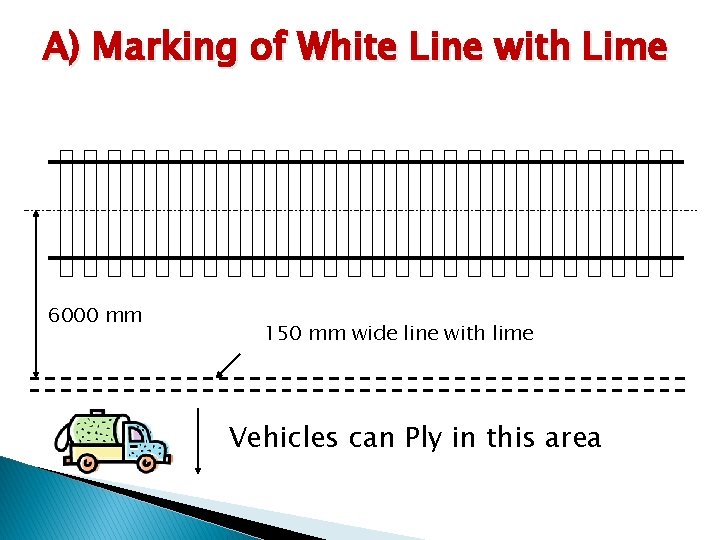
A) Marking of White Line with Lime 6000 mm 150 mm wide line with lime Vehicles can Ply in this area
Measures to be ensured prior to start of the work: � Barricading as per design shall be provided in full length of work area. � The work site shall be suitably demarcated to keep public and passenger away from work area. � Signage boards such as ‘Work in progress’ etc to be provided at appropriate locations to warn public/passengers.
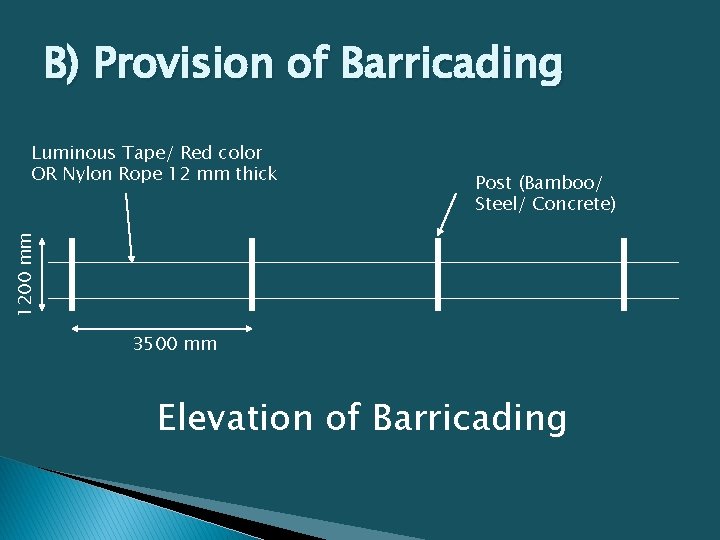
B) Provision of Barricading Post (Bamboo/ Steel/ Concrete) 1200 mm Luminous Tape/ Red color OR Nylon Rope 12 mm thick 3500 mm Elevation of Barricading
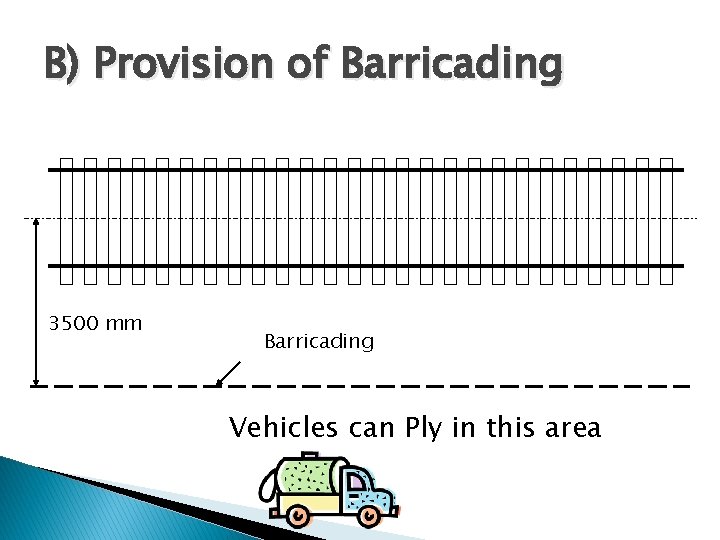
B) Provision of Barricading 3500 mm Barricading Vehicles can Ply in this area
Contd. … For items of barricading, Sign Board like “Work in progress”, walkie – talkie sets, mobile phones, look out man etc. , suitable provision may be incorporated in the tender conditions as per site requirement.
Measures to be ensured execution of the work: � � � during Contractor to depute only trained supervisors at site. Drivers of vehicle/machines to be briefed about safety and precautions to be taken while moving/working close to traffic. No vehicle within 6 meters of centre of running line without presence of Railway Supervisor.
Contd. … � Contractor’s road vehicle/machinery to ply only between Sunset and Sunrise In case of emergency night working may be allowed with provision of sufficient light and additional staff. � Road vehicle/machines to ply in a way so that these not infringe the line of demarcation.
Contd. … � Posting of look out man. � Protection of the track, in case of any infringement. � Individual vehicle/machinery not to be left unattended near running track. If at all it becomes unavoidable then take all precaution against any possibility of roll-off and vehicle/machine to be manned.
Contd. … � All temporary arrangement required to be made during execution of work to be made in such a manner that moving dimensions do not infringe. � Protection of track and issuing caution order in case any vehicle/machinery to work within 6 meter of centre of track but more than 3. 5 meter.
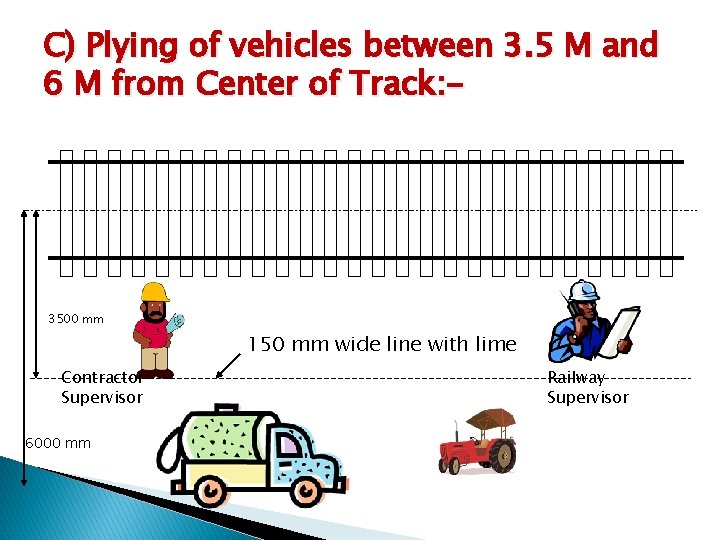
C) Plying of vehicles between 3. 5 M and 6 M from Center of Track: - 3500 mm 150 mm wide line with lime Contractor Supervisor 6000 mm Railway Supervisor
Contd. … � In case work is planned to be done within 3. 5 meter of center line of running track, ensure that work is done under block protection. � Before digging in station area, take proper permission from concerned department and do the work in presence of Railway’s representative. If any cable is found, stop the work
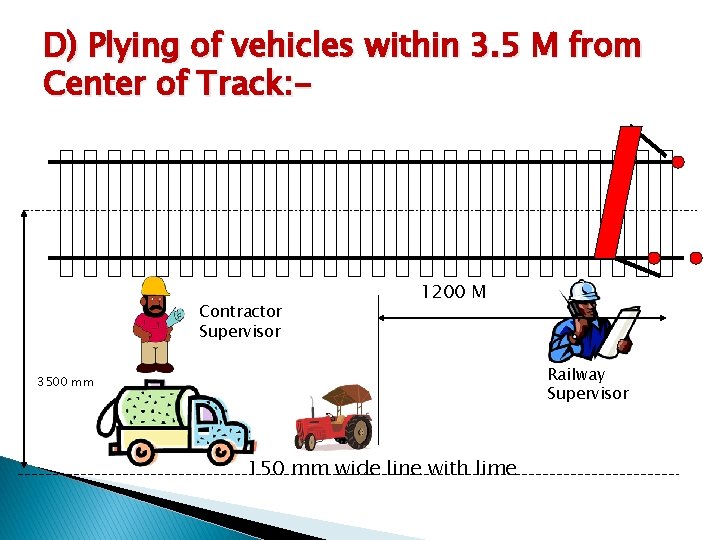
D) Plying of vehicles within 3. 5 M from Center of Track: - Contractor Supervisor 1200 M Railway Supervisor 3500 mm 150 mm wide line with lime
Check list - Before starting the work: 1. 2. 3. 4. 5. Name of work Location Duration of work: From------- to ------Whether Contractor’s supervisor identified/selected, who is going to be site incharge? Whether site inspected by construction’s supervisor/other department’s supervisors along with contractor’s supervisor?
Contd. … 6. Whether Precautions to be taken are identified and listed? 7. Whether Plan of work drawn out by contractor’s supervisor in consultation with Railway’s supervisor? 8. Whether proper line marking/Barricading done before start of work? 9. Caution order issued for the train drivers in case work is being done within 6 mts. of centre line of running track?
Contd. … 10. Whether drivers of vehicle/machinery being used have been identified? 11. Whether drivers of vehicle/machinery briefed about the safe working? 12. Whether sufficient lighting provided at site of work for night working? 13. Whether infringements checked? 14. Availability of communication instruments.

Thanks
- Slides: 51