
Safety and Soft Skills in the Workplace OSHA
- Slides: 29
Safety and Soft Skills in the Workplace
OSHA Occupational Safety and Health Administration • OSHA's mission is to “assure safe and healthful working conditions for working men and women by setting and enforcing standards and by providing training, outreach, education and assistance. ”
OSHA Requirements for Phlebotomists • A phlebotomist's main duty is to draw blood from a patient's vein for diagnostic testing, transfusions or treatments. Phlebotomists risk exposure to a variety of blood borne pathogens including HIV and Hepatitis B and C. The Occupational Safety and Health Administration enforces regulations to ensure the safety and health of phlebotomists in the workplace.
Failure to Follow Guidelines • It is critical that you follow OSHA regulations to prevent injury or exposure to blood borne illnesses. Make your safety and the safety of your co-workers and patients your first priority. • Inspectors cite employers who violate these regulations. Penalties vary based on the severity of the violation.
Example • For example, employers who knowingly violate regulations face a fine between $5, 000 and $70, 000. • If an employee is seriously injured or killed as a result of the violation, the employer faces up to six months in prison and a fine up to $250, 000.
Cleanliness • One of OSHA’s primary requirements for phlebotomists is washing hands before and after working with patients, after removing personal protection equipment such as gloves, and anytime they are exposed to blood or anything else that may carry infection. • In addition, phlebotomists must keep their work areas clean. This includes wiping down and disinfecting surfaces and storing supplies in their proper place.
Cleanliness, continued • Phlebotomists may not eat, drink or store food in areas where blood or infectious materials are collected or processed. Phlebotomists may not apply make-up, put in contact lenses or use lip balm in work areas. (This includes your classroom). • Reasons for Prohibition • The main reasons why eating and drinking are not permitted in areas using or storing hazardous materials are… personal safety risks and risks of non-compliance with regulatory agencies and granting agency requirements that may impact an individual, a work unit, or the institution as a whole.
Professional Dress (UNM VC Syllabus) • Students MUST wear Evergreen Scrubs and long white Lab Coats for each class. • Hair that is shoulder length must be kept up and away from face, bangs need to be pinned back as not to obstruct the view of vision or cover the face.
Professional Dress, continued • White or light closed toes shoes are required, absolutely NO Open toed shoes or heels are permitted, your classroom is part of a professional lab setting. • Fingernails must be kept short with no artificial nails or polish on them. • No food or drink should permitted in the classroom. It is highly recommended that food and drinks remain in a separate area from where students are learning and practicing.
Why is it recommended that I wear my hair up if it’s long? • Long hair that is worn open and loose has no place in a medical and health care setting for several reasons… • It may fall into a sterile or contaminated work area, or chemical and become a source of contamination, or it can interfere with your vision. • Covering long hair with a hair net, or wearing it tied back in a pony tail or up in a bun is a safety measure and safety compliance is important!
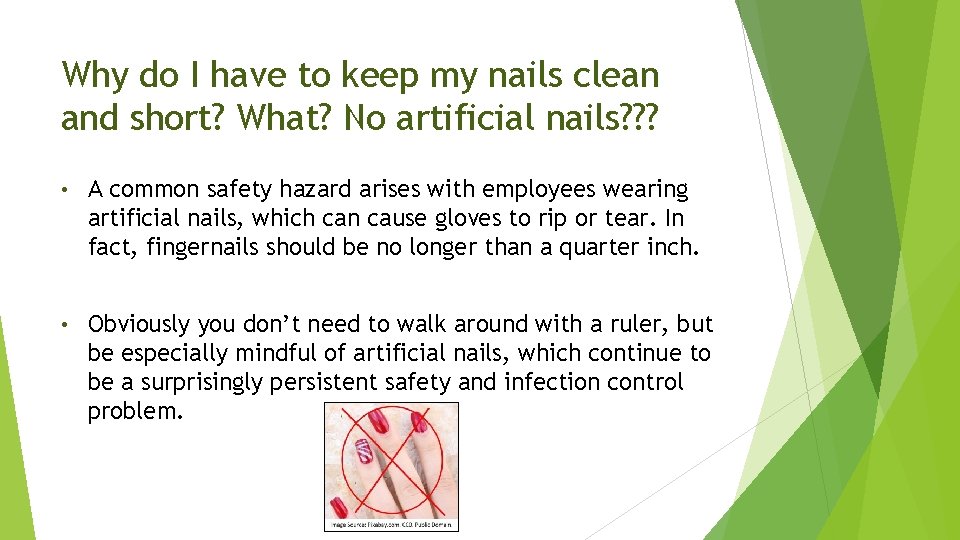
Why do I have to keep my nails clean and short? What? No artificial nails? ? ? • A common safety hazard arises with employees wearing artificial nails, which can cause gloves to rip or tear. In fact, fingernails should be no longer than a quarter inch. • Obviously you don’t need to walk around with a ruler, but be especially mindful of artificial nails, which continue to be a surprisingly persistent safety and infection control problem.
Acrylic Nails in the Health Care Setting • Have you ever taken a look at your doctor’s nails? Are they long, polished or fake? If so, your doctor may not be following the proper health care policy. • Researchers at the University of Michigan and Michigan Veterans Affairs Medical Centers found that 86% of a volunteer group of HCWs with artificial nails had a pathogen such as Staphylococcus aureus, which causes staph infections, or yeast under their nails, compared with 35% of a control group of HCWs without artificial nails.
Acrylic Nails, continued • Staph and yeast both cause infections, ranging from inflammation to blood poisoning. After cleaning their hands with soap or gel, 68% of HCWs with artificial nails still carried pathogens compared to 28% of control HCWs. The study concluded, “Artificial acrylic fingernails could contribute to the transmission of pathogens, and their use by HCWs should be discouraged. ”
The importance of attendance and not being late and classroom/clinical conduct…
Classroom Conduct • Successful students are ready to start class at the appropriate time and have their notebooks open and their pens ready to take notes, because diligently taking notes and being attentive during class shows a professor/Instructor that the student is serious and wants to learn. • Successful students should always conduct themselves in a professional manner because college is a professional environment; it’s just like a job.
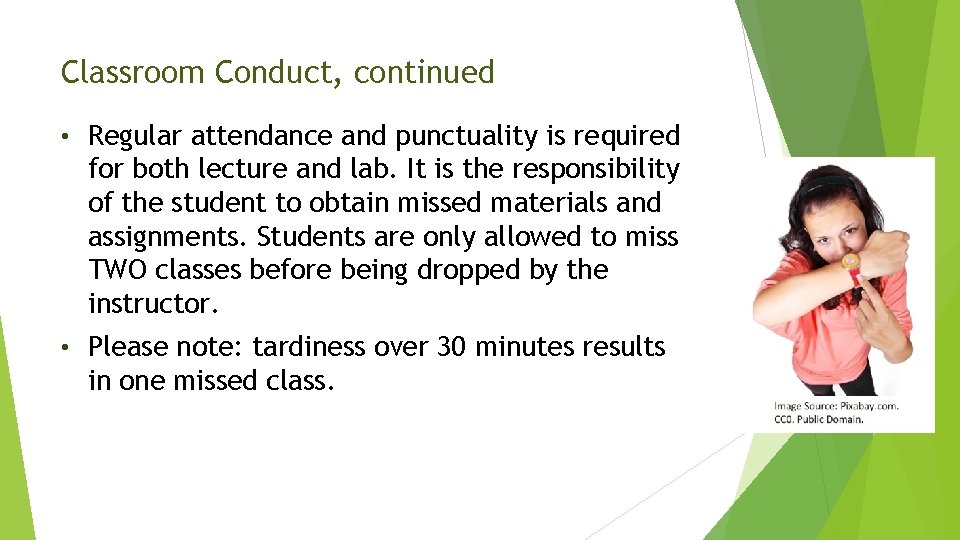
Classroom Conduct, continued • Regular attendance and punctuality is required for both lecture and lab. It is the responsibility of the student to obtain missed materials and assignments. Students are only allowed to miss TWO classes before being dropped by the instructor. • Please note: tardiness over 30 minutes results in one missed class.
The Advantages of Being on Time vs. Being Late to School • Enjoy More Time to Prepare - Students arriving to school with time to spare have the luxury of settling in, preparing their class materials and focusing their minds on the lessons to come. • Never Miss Important Information - Arriving to school after classes have begun cause students to miss more than just the introduction to a new lesson.
The Advantages of Being on Time vs. Being Late to School, continued • Develop Positive Lifelong Habits - Arriving late to school on a consistent basis can have longer-term academic effects. If showing up late to school becomes a habit, students may develop the notion that tardiness is acceptable behavior. This belief can negatively impact their future work ethic and employment opportunities. • Disciplinary Consequences Most schools have specific policies concerning student tardiness. • Please review UNM VC Phlebotomy Course Syllabus at: Link: Syllabus s.
Why is Punctuality Important in the Workplace? • What It Communicates - Punctuality communicates a plethora of positives to your employer and your peers. It shows that you’re dedicated to the job, interested in the work and capable of handling responsibility. When you arrive on time for work-related activities, it shows that you are capable of honoring your word. Being punctual helps employees project a sense of professionalism and commitment.
Punctuality, continued • What It Achieves - When employees are punctual, the workplace operates more smoothly as a whole. For instance, when everyone is on time for a meeting, the meeting is able to start in full stride. Punctuality may help you achieve advancement. • Workplace Effects - Lack of punctuality not only affects the "machine" of the workplace—it affects the people in it. It may lead to resentment, as coworkers who are on time compare themselves to late-comers. Being late throws you out of the loop, as you may miss important information. This causes a harmful division among employees.
Punctuality, continued • Personal Effects - Lateness leads to stress, and stress leads to poor workplace performance. Being consistently late may cause you to start rationalizing your lateness. When this happens, you begin to blame outside circumstances and lose focus on potential solutions. Constant lateness can lock you into a pattern. When tardiness becomes the norm, your job might be in jeopardy.
Additional Advice • Don’t get involved in classroom or work gossip or group cliques. Put your best foot forward, learn all you can and take advantage of this instruction time. • Your instructor is preparing you for your next job as a phlebotomist or Med. Tech. Take advantage of his/her advice and ask lots of questions… Your instructor is the expert!
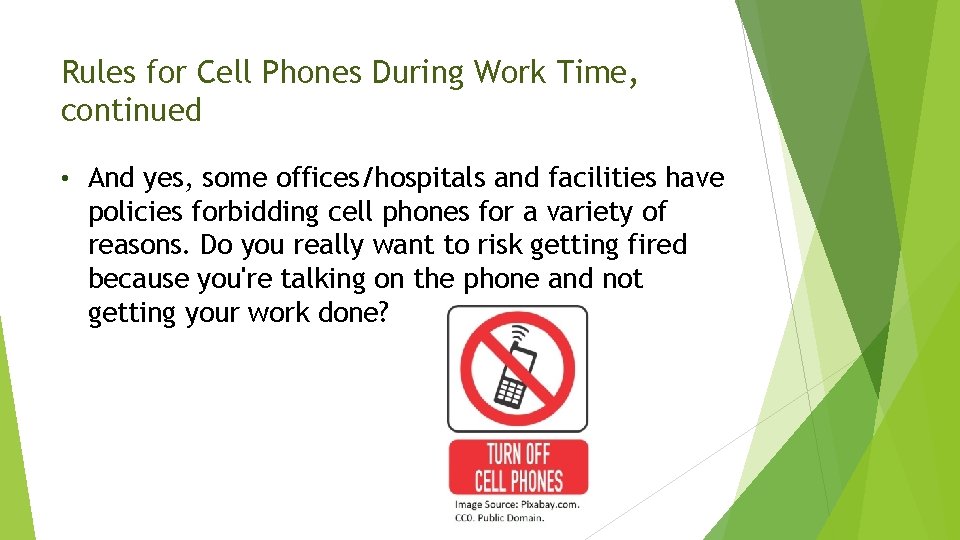
Classroom and Clinical Rules – Cell Phone Usage • Do not allow your cell phone or any other electronic device to ring or sound while you are in the classroom/lab/clinical rotation. • Do not take calls, texts, IM, etc. during this instructional/training time. • Please do not prompt the instructor to ask you to put your device away. You have to treat your clinicals as OJT (On the Job Training). This is your chance to shine or be overlooked by an employer.
Rules for Cell Phones During Work Time • Remember… You are being paid to work, not chat and text. Some work places have work rules that state your phone must be switched off, as a condition of employment. This seems fair, since you are not on your own time. • Chat during lunch or breaks.
Rules for Cell Phones During Work Time, continued • And yes, some offices/hospitals and facilities have policies forbidding cell phones for a variety of reasons. Do you really want to risk getting fired because you're talking on the phone and not getting your work done?
Cell phone usage in an allied health field during work time can lead to several mistakes and jeopardize patient safety. • Phlebotomy is, in line with other practical skills in health care, a complex procedure. Theoretical knowledge and manual skills, accuracy, and caring comportment, as well as good interaction between the health care personnel and the patient are essential when performing complex procedures.
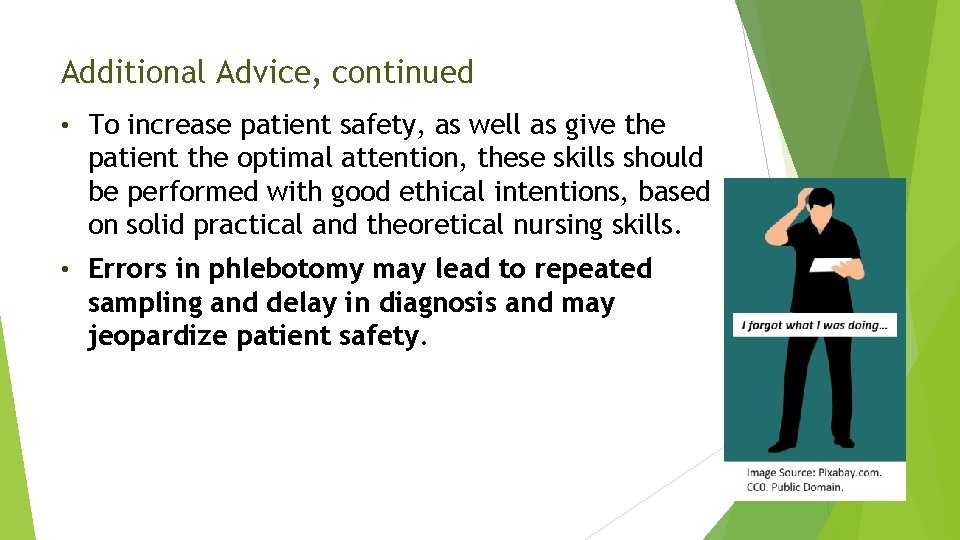
Additional Advice, continued • To increase patient safety, as well as give the patient the optimal attention, these skills should be performed with good ethical intentions, based on solid practical and theoretical nursing skills. • Errors in phlebotomy may lead to repeated sampling and delay in diagnosis and may jeopardize patient safety.
Good Luck in your Clinicals! • Tri. Core’s Recruiter will be here next week to meet with you all. He will be taking about: • Various open positions. • Minimum qualifications. • Requirements. • Expectations of the job.
Acknowledgements This workforce product was funded by a grant awarded by the U. S. Department of Labor’s Employment and Training Administration. The product was created by the grantee and does not necessarily reflect the official position of the U. S. Department of Labor. The U. S. Department of Labor makes no guarantees, warranties, or assurances of any kind, express or implied, with respect to such information, including any information on linked sites and including, but not limited to, accuracy of the information or its completeness, timeliness, usefulness, adequacy, continued availability, or ownership. Although the authoring institution of this educational resource has made every effort to ensure that the information presented is correct, the institution assumes no liability to any party for any loss, damage, or disruption caused by errors or omissions. Except where otherwise noted, this work by SUN PATH Consortium/University of New Mexico-Valencia is licensed under the Creative Commons Attribution 4. 0 International License. To view a copy of this license, click on the following link: Creative Commons License 4. 0.