
Safety and Securement of Epicardial Pacing Wires Introduction
- Slides: 1
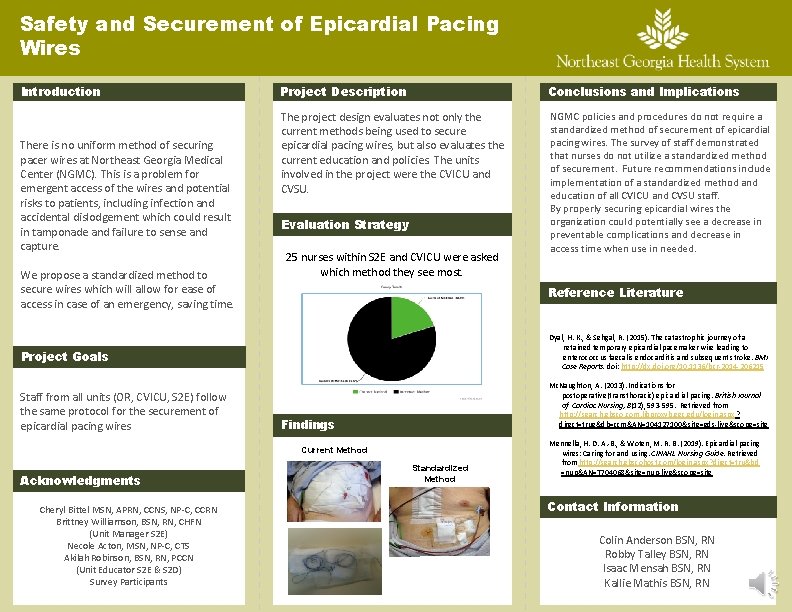
Safety and Securement of Epicardial Pacing Wires Introduction There is no uniform method of securing pacer wires at Northeast Georgia Medical Center (NGMC). This is a problem for emergent access of the wires and potential risks to patients, including infection and accidental dislodgement which could result in tamponade and failure to sense and capture. We propose a standardized method to secure wires which will allow for ease of access in case of an emergency, saving time. Project Description Conclusions and Implications The project design evaluates not only the current methods being used to secure epicardial pacing wires, but also evaluates the current education and policies. The units involved in the project were the CVICU and CVSU. NGMC policies and procedures do not require a standardized method of securement of epicardial pacing wires. The survey of staff demonstrated that nurses do not utilize a standardized method of securement. Future recommendations include implementation of a standardized method and education of all CVICU and CVSU staff. By properly securing epicardial wires the organization could potentially see a decrease in preventable complications and decrease in access time when use in needed. Evaluation Strategy 25 nurses within S 2 E and CVICU were asked which method they see most. Reference Literature Dyal, H. K. , & Sehgal, R. (2015). The catastrophic journey of a retained temporary epicardial pacemaker wire leading to enterococcus faecalis endocarditis and subsequent stroke. BMJ Case Reports. doi: http: //dx. doi. org/10. 1136/bcr-2014 -206215 Project Goals Staff from all units (OR, CVICU, S 2 E) follow the same for the securement “Weprotocol recommend Margie’s Travel of epicardial pacingwho wires to anyone will listen to us. They anticipated every need and solved every potential stressor. ” Acknowledgments ~ Henriette Andersen Cheryl Bittel MSN, APRN, CCNS, NP-C, CCRN Brittney Williamson, BSN, RN, CHFN (Unit Manager S 2 E) Necole Acton, MSN, NP-C, CTS Akilah Robinson, BSN, RN, PCCN (Unit Educator S 2 E & S 2 D) Survey Participants Findings margie’s travel 4567 Main Street NC 02134 Current Method Raleigh, Standardized (718) 555 -1234 Method contact@margiestravel. com www. margiestravel. com Mc. Naughton, A. (2013). Indications for postoperative(transthoracic) epicardial pacing. British Journal of Cardiac Nursing, 8(12), 593 -595. Retrieved from http: //search. ebsco. com. libproxyb. ggc. edu/login. aspx ? direct=true&db=ccm&AN=104127100&site=eds-live&scope=site Mennella, H. D. A. -B. , & Woten, M. R. B. (2019). Epicardial pacing wires: Caring for and using. CINAHL Nursing Guide. Retrieved from http: //search. ebscohost. com/login. aspx? direct=tru&bd =nup&AN=T 704068&site=nup-live&scope=site Contact Information Colin Anderson BSN, RN Robby Talley BSN, RN Isaac Mensah BSN, RN Kallie Mathis BSN, RN