
Safety and Risk Framework Concepts and Applications Barry
Safety and Risk Framework: Concepts and Applications Barry Salovitz Senior Director Casey Family Programs
“The sacred requirement… …to assess a child’s safety in the home and respond appropriately, should not be simply a required agency event, or only a form completion compliance task. You must make it more a way of thinking”.
What is a “Framework”? A basic conceptual structure that ties together a set of mutually congruent and supportive beliefs, values, principles and strategies seeking to address a common purpose.
Flying Without a Safety and Risk Framework - Dangers 1. 2. 3. 4. 5. 6. 7. Idiosyncratic beliefs, practice, decision-making Conscious and unconscious bias Errors in decision-making Inconsistencies Documentation is haphazard Consultation and supervision suffers Lack of standards for quality assurance and quality improvement
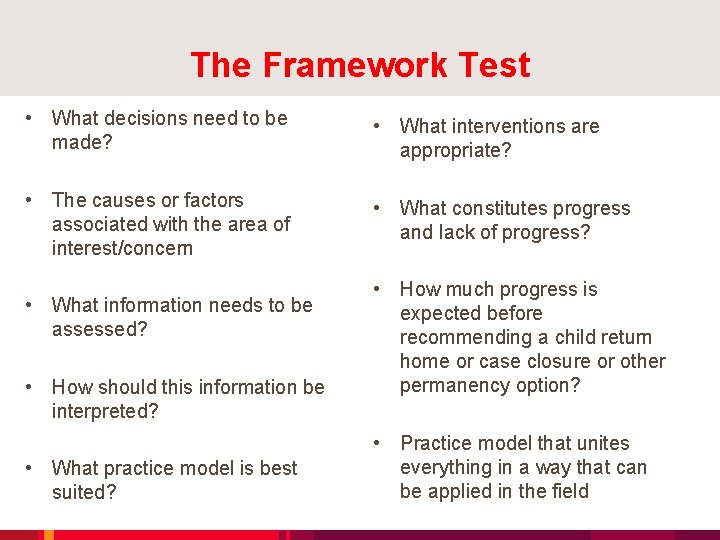
The Framework Test • What decisions need to be made? • What interventions are appropriate? • The causes or factors associated with the area of interest/concern • What constitutes progress and lack of progress? • What information needs to be assessed? • How should this information be interpreted? • What practice model is best suited? • How much progress is expected before recommending a child return home or case closure or other permanency option? • Practice model that unites everything in a way that can be applied in the field
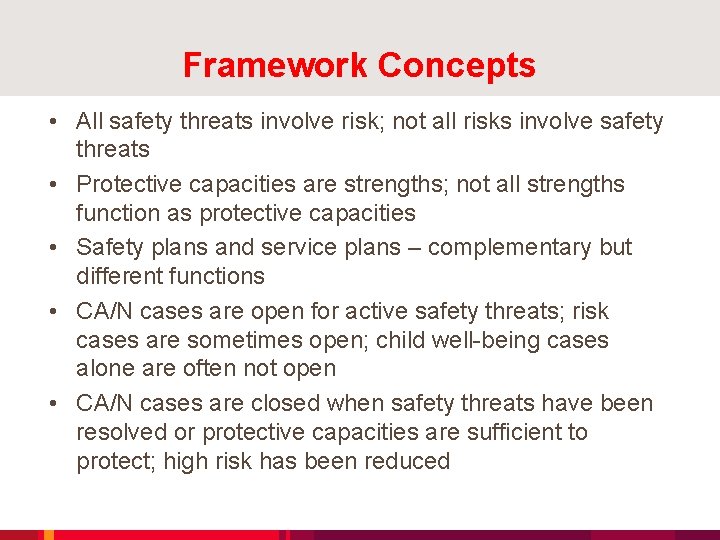
Framework Concepts • All safety threats involve risk; not all risks involve safety threats • Protective capacities are strengths; not all strengths function as protective capacities • Safety plans and service plans – complementary but different functions • CA/N cases are open for active safety threats; risk cases are sometimes open; child well-being cases alone are often not open • CA/N cases are closed when safety threats have been resolved or protective capacities are sufficient to protect; high risk has been reduced
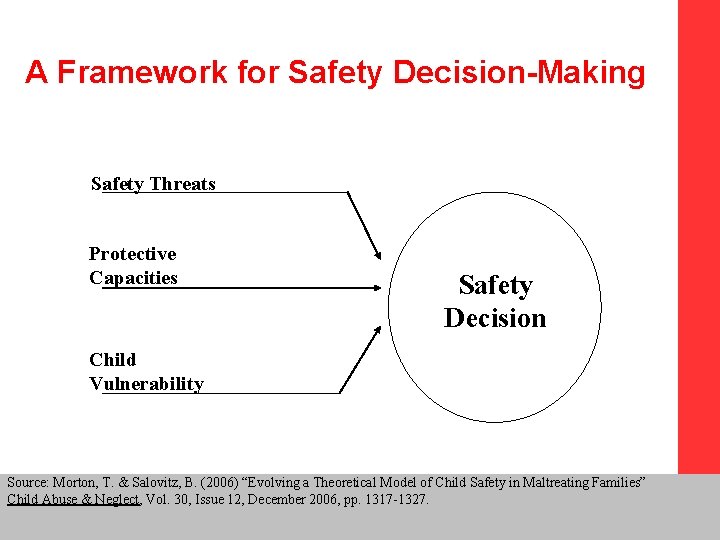
A Framework for Safety Decision-Making Safety Threats Protective Capacities Safety Decision Child Vulnerability Source: Morton, T. & Salovitz, B. (2006) “Evolving a Theoretical Model of Child Safety in Maltreating Families” Child Abuse & Neglect, Vol. 30, Issue 12, December 2006, pp. 1317 -1327.
Safe • caregiver provides protective capacities sufficient to protect his/her child from serious harm
Unsafe • caregiver does not provide protective capacities sufficient to protect his/her child from immediate or imminent serious harm
Serious Harm • actual or threatened consequence of an active safety threat or missing or insufficient protective capacities that is significantly affected by a child’s degree of vulnerability and: o is life-threatening or risk thereof; o substantively retards the child’s mental health or development or risk thereof; o produces substantial physical suffering, disfigurement or disability, whether permanent or temporary, or risk thereof; involves sexual victimization.
Safety Factors • • set of specific signs of present danger combine with a child's vulnerability may directly impact a child's safety status unless offset or mitigated by sufficient protective capacities (Handout)
What primary strengths do you look for… …in a caregiver for your child, niece, nephew, grandchild, or godchild?

Protective Capacities • behavioral, cognitive, and emotional characteristics of a parent/caregiver • specifically and directly can be associated with reducing, controlling and/or preventing serious harm to a child (Handout)
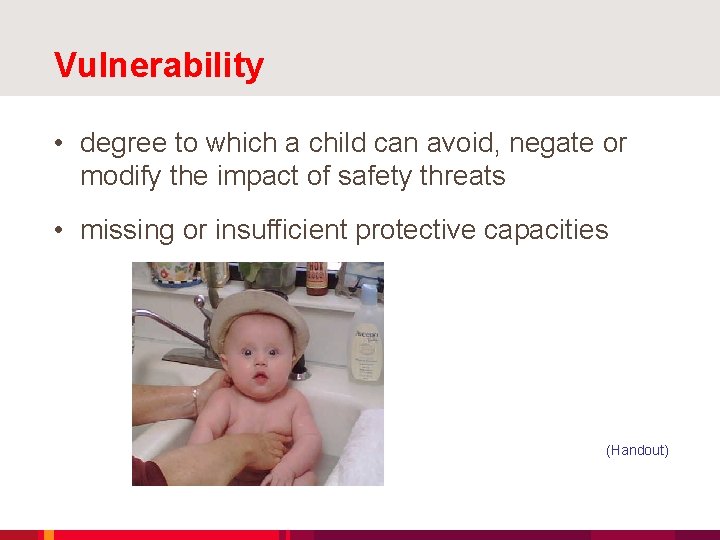
Vulnerability • degree to which a child can avoid, negate or modify the impact of safety threats • missing or insufficient protective capacities (Handout)
Safety Threat family situation, behavior, emotion, motive, perception, or capacity that is out of control, immediate or imminent, and is likely to have serious effects on a vulnerable child
A Safety Threat May Be a…. . • Situation (e. g. unsafe home, criminal activity) • Behavior (e. g. impulsive actions, assaults) • Emotion (e. g. immobilizing depression) • Motive (e. g. intention to hurt the child) • Perception (e. g. viewing child as a devil) • Capacity (e. g. physical disability) (Handout) (Example)
Safety Threats Involve: Underlying Conditions needs of family members, perceptions, beliefs, values, feelings, cultural practices and/or previous life experiences that influence the maltreatment dynamic within a family system and can increase the likelihood of child maltreatment or its severity AND Contributing Factors social problems or conditions (family or community), that can increase the likelihood of child maltreatment or its severity (Examples)
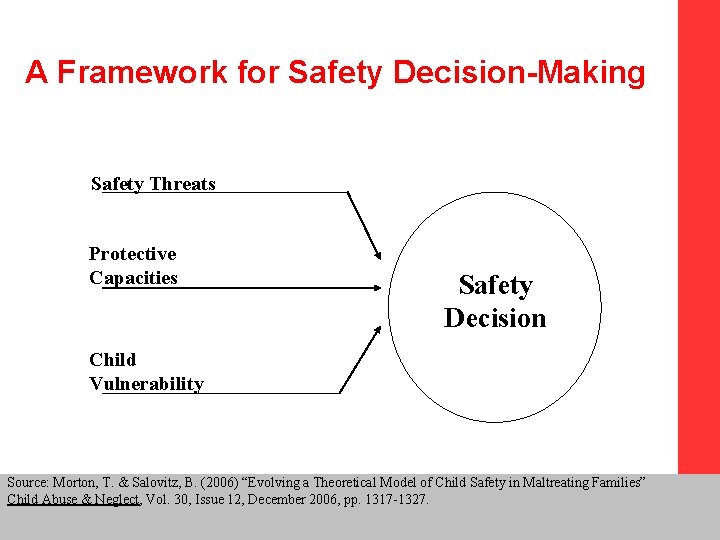
A Framework for Safety Decision-Making Safety Threats Protective Capacities Safety Decision Child Vulnerability Source: Morton, T. & Salovitz, B. (2006) “Evolving a Theoretical Model of Child Safety in Maltreating Families” Child Abuse & Neglect, Vol. 30, Issue 12, December 2006, pp. 1317 -1327.
Risk • likelihood of any harm to a child in the future due to abuse or neglect
Risk Factors • highlight the family system • may include demographics, needs, strengths, safety threats, functioning levels • associated with understanding the nature of the family’s involvement with the CW system (maltreatment, underlying conditions & contributing factors) • likelihood of future A/N
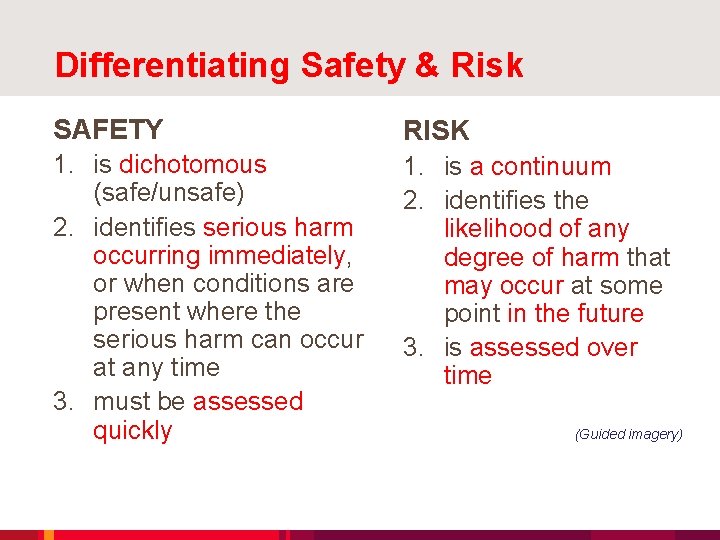
Differentiating Safety & Risk SAFETY RISK 1. is dichotomous (safe/unsafe) 2. identifies serious harm occurring immediately, or when conditions are present where the serious harm can occur at any time 3. must be assessed quickly 1. is a continuum 2. identifies the likelihood of any degree of harm that may occur at some point in the future 3. is assessed over time (Guided imagery)
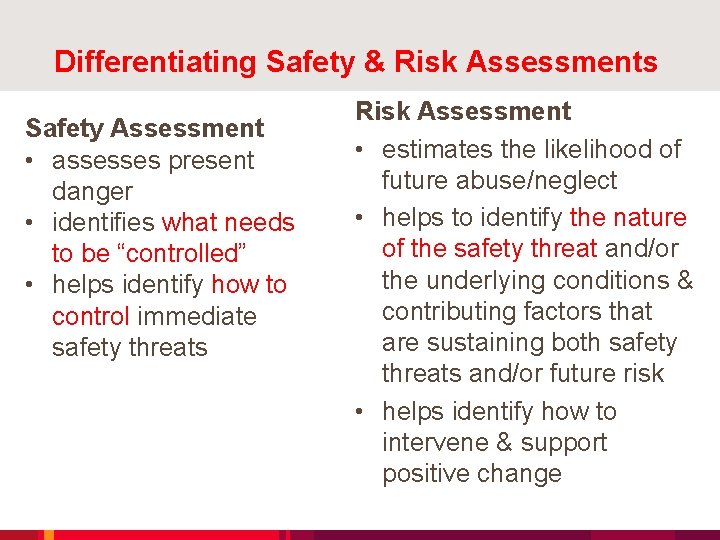
Differentiating Safety & Risk Assessments Safety Assessment • assesses present danger • identifies what needs to be “controlled” • helps identify how to control immediate safety threats Risk Assessment • estimates the likelihood of future abuse/neglect • helps to identify the nature of the safety threat and/or the underlying conditions & contributing factors that are sustaining both safety threats and/or future risk • helps identify how to intervene & support positive change
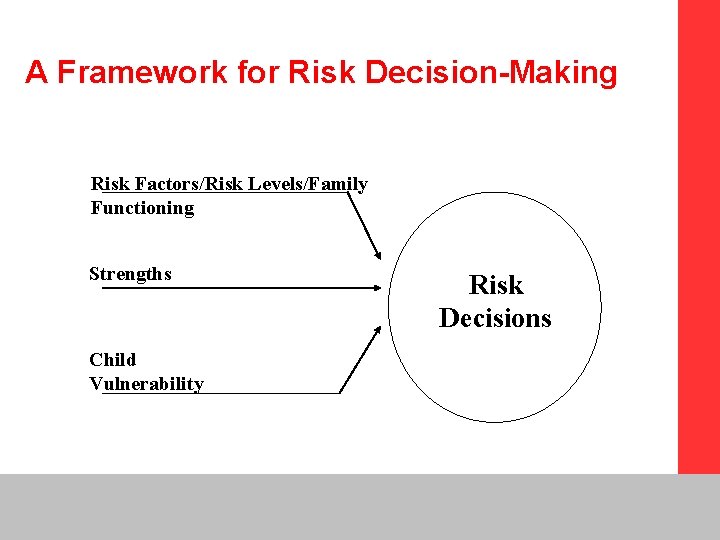
A Framework for Risk Decision-Making Risk Factors/Risk Levels/Family Functioning Strengths Child Vulnerability Risk Decisions
Emerging Danger • likelihood of serious harm that is not immediate; • threats are starting to surface or escalating in intensity, pervasiveness, duration and/or frequency • protective capacities are weakening
Emerging Danger Examples alcohol use increasing stress over difficult child behavior elevating child’s grandmother told mother that she can no longer “dump the child on her” when the mother goes out drinking perception of the child increasingly negative caregiver reports having to spank the child more often frustrations with the demands of the child increasing caregiver not home at the time of last two scheduled caseworker visits missed last two appointments w/ drug and alcohol counselor inconsistent responses to “accidental injuries” to child’s willingness to talk with you has significantly changed (case example)
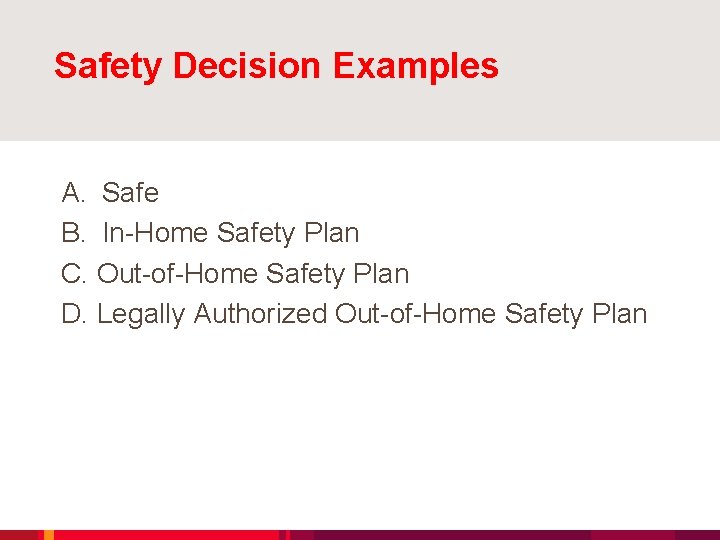
Safety Decision Examples A. Safe B. In-Home Safety Plan C. Out-of-Home Safety Plan D. Legally Authorized Out-of-Home Safety Plan
Safety Plan intervention strategy to control a safety threat or supplement insufficient protective capacities to protect a child from serious harm
Supplementation of Protective Capacities The addition of additional protective capacities to the family system without removal of the child
Safety Planning Guidelines • specific and concrete control strategy • must be implemented immediately • whenever possible, parent should have a prominent role in its development and implementation • should employ least restrictive strategies possible while assuring the child’s safety
Safety Planning Guidelines (con’t) • can often be developed and implemented by incorporating identified protective capacities • must assess the caregivers willingness and capability to agree and abide by the terms of the safety plan • active participants must be capable of monitoring/enforcing its terms
Safety Plan Guidelines (con’t) • must be continuously re-evaluated and modified, whenever necessary • cases should not be terminated, outside a court order, when an agency managed safety plan is active
Guidelines for Discontinuing a Safety Plan ü When a threat of serious harm no longer exists or ü control of the threat within the family is probable; can be maintained without safety focused intervention or active safety plan monitoring
Service Plan Intervention strategy designed to: üresolve safety threats üreduce risk üpromote child well-being and üattain permanency
Critical Issues for Reunification/Case Closure The safety re-assessment must focus on the extent to which: • Underlying conditions or contributing factors related to safety threats have been resolved/diminished • Protective capacities have increased • Child vulnerabilities have been reduced • Feasible plan for reunification support exists (Case) (Handout)
The Key Question: Not whether the threats will ever appear again, but: Whether they can be controlled with the child in the family…
- Slides: 35