
Safety and Efficacy of Back Beat Cardiac Neuromodulation
Safety and Efficacy of Back. Beat™ Cardiac Neuromodulation Therapy (CNT™) in Patients with Hypertension: Final Results of a Double-Blind Randomized Trial Karl-Heinz Kuck, MD On behalf of coauthors: Z. Kalarus, B. Merkely, P. Neuzil, M. Grabowski, G. Marinskis, A. Erglis, J. Kazmierczak, P. Mitkowski, T. Sturmberger, F. Malek, A. Kolodzinska, D. Burkhoff, A. Sokal, L. Geller and the Moderato 2 Study Investigators Study Sponsored By: Back. Beat Medical, Inc. a subsidiary of Orchestra Bio. Med, Inc. 1

Disclosure Statement of Financial Interest I, (Karl-Heinz Kuck, MD) DO NOT have a financial interest/arrangement or affiliation with one or more organizations that could be perceived as a real or apparent conflict of interest in the context of the subject of this presentation. 2
Back. Beat™ Cardiac Neuromodulation Therapy (CNT™) • Cardiac pacing to reduce blood pressure through two mechanisms: Reduction in LV Filling (preload) to provide an acute effect Neuromodulation to maintain effect chronically (afterload) • Delivered via implantable pulse generator (IPG) using standard lead positions IPG also provides standard pacemaker functionality 3
Back. Beat CNT Initial Target Population • Hypertension patients indicated for pacemaker � >1 M pacemaker implants globally per year � >70% of pacemaker patients have hypertension • ~ 60% uncontrolled despite treatment � Older, co-morbid population at increased risk of major events � High rate of Isolated Systolic Hypertension (ISH) 4

MODERATO II Study • Prospective, multi-center, randomized, double-blind study of Back. Beat CNT vs. Medical Therapy (Control) 9 sites in EU � Pilot study to inform the design and power of the pivotal study � • Objective: to assess the efficacy and safety of Back. Beat CNT in reducing blood pressure in patients with hypertension despite medical therapy who are also indicated for a pacemaker 5
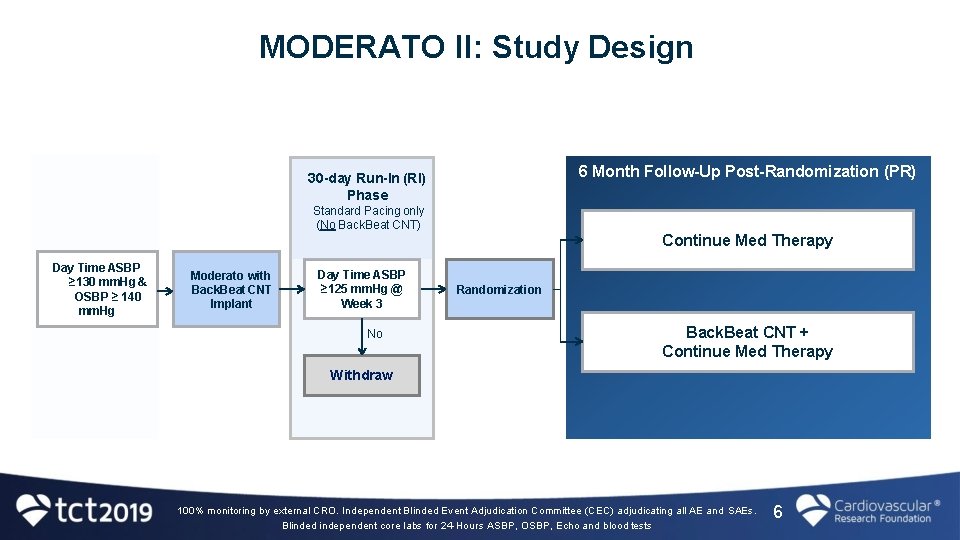
MODERATO II: Study Design 6 Month Follow-Up Post-Randomization (PR) 30 -day Run-In (RI) Phase Standard Pacing only (No Back. Beat CNT) Continue Med Therapy Day Time ASBP ≥ 130 mm. Hg & OSBP ≥ 140 mm. Hg Moderato with Back. Beat CNT Implant Day Time ASBP ≥ 125 mm. Hg @ Week 3 No Randomization Back. Beat CNT + Continue Med Therapy Withdraw 100% monitoring by external CRO. Independent Blinded Event Adjudication Committee (CEC) adjudicating all AE and SAEs. Blinded independent core labs for 24 -Hours ASBP, OSBP, Echo and blood tests 6
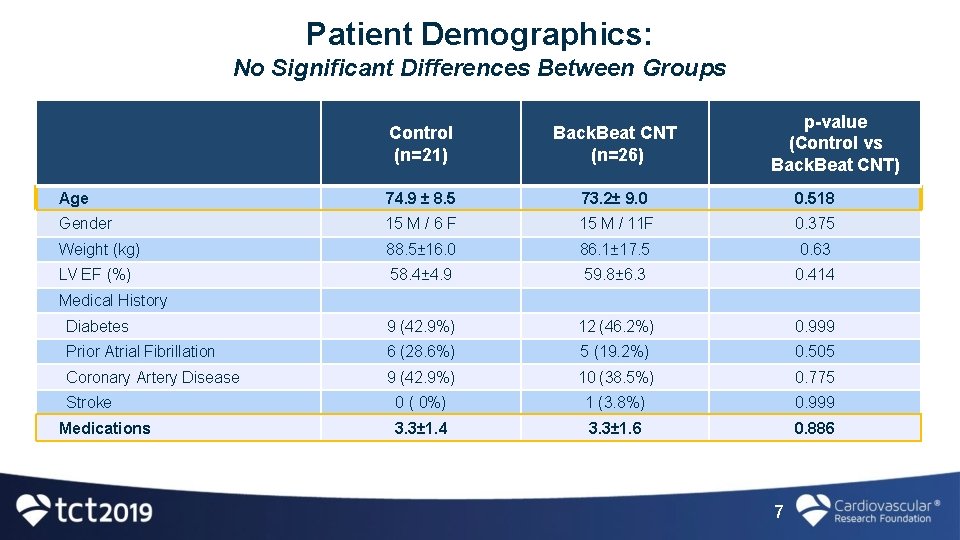
Patient Demographics: No Significant Differences Between Groups p-value (Control vs Back. Beat CNT) Control (n=21) Back. Beat CNT (n=26) Age 74. 9 ± 8. 5 73. 2± 9. 0 0. 518 Gender 15 M / 6 F 15 M / 11 F 0. 375 Weight (kg) 88. 5± 16. 0 86. 1± 17. 5 0. 63 LV EF (%) 58. 4± 4. 9 59. 8± 6. 3 0. 414 Diabetes 9 (42. 9%) 12 (46. 2%) 0. 999 Prior Atrial Fibrillation 6 (28. 6%) 5 (19. 2%) 0. 505 Coronary Artery Disease 9 (42. 9%) 10 (38. 5%) 0. 775 0 ( 0%) 1 (3. 8%) 0. 999 3. 3± 1. 4 3. 3± 1. 6 0. 886 Medical History Stroke Medications 7
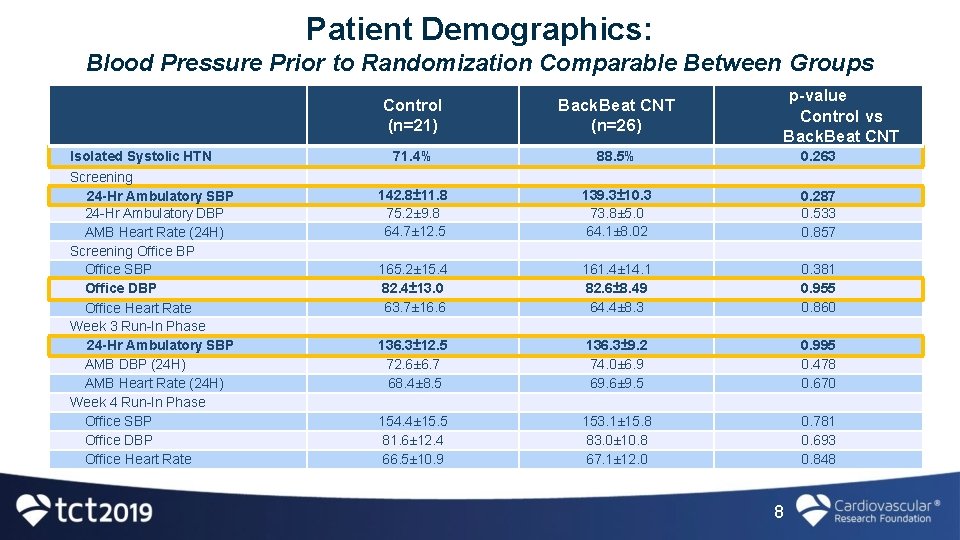
Patient Demographics: Blood Pressure Prior to Randomization Comparable Between Groups Isolated Systolic HTN Screening 24 -Hr Ambulatory SBP 24 -Hr Ambulatory DBP AMB Heart Rate (24 H) Screening Office BP Office SBP Office DBP Office Heart Rate Week 3 Run-In Phase 24 -Hr Ambulatory SBP AMB DBP (24 H) AMB Heart Rate (24 H) Week 4 Run-In Phase Office SBP Office DBP Office Heart Rate p-value Control vs Back. Beat CNT Control (n=21) Back. Beat CNT (n=26) 71. 4% 88. 5% 0. 263 142. 8± 11. 8 75. 2± 9. 8 64. 7± 12. 5 139. 3± 10. 3 73. 8± 5. 0 64. 1± 8. 02 0. 287 0. 533 0. 857 165. 2± 15. 4 82. 4± 13. 0 63. 7± 16. 6 161. 4± 14. 1 82. 6± 8. 49 64. 4± 8. 3 0. 381 0. 955 0. 860 136. 3± 12. 5 72. 6± 6. 7 68. 4± 8. 5 136. 3± 9. 2 74. 0± 6. 9 69. 6± 9. 5 0. 995 0. 478 0. 670 154. 4± 15. 5 81. 6± 12. 4 66. 5± 10. 9 153. 1± 15. 8 83. 0± 10. 8 67. 1± 12. 0 0. 781 0. 693 0. 848 8
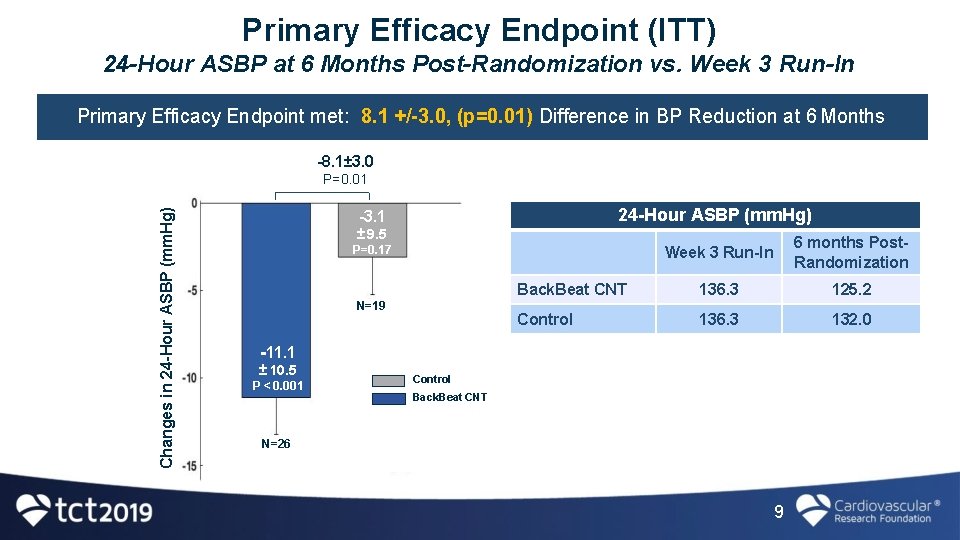
Primary Efficacy Endpoint (ITT) 24 -Hour ASBP at 6 Months Post-Randomization vs. Week 3 Run-In Primary Efficacy Endpoint met: 8. 1 +/-3. 0, (p=0. 01) Difference in BP Reduction at 6 Months -8. 1± 3. 0 Changes in 24 -Hour ASBP (mm. Hg) P=0. 01 24 -Hour ASBP (mm. Hg) -3. 1 ± 9. 5 Week 3 Run-In 6 months Post. Randomization Back. Beat CNT 136. 3 125. 2 Control 136. 3 132. 0 P=0. 17 N=19 -11. 1 ± 10. 5 P < 0. 001 Control Back. Beat CNT N=26 9
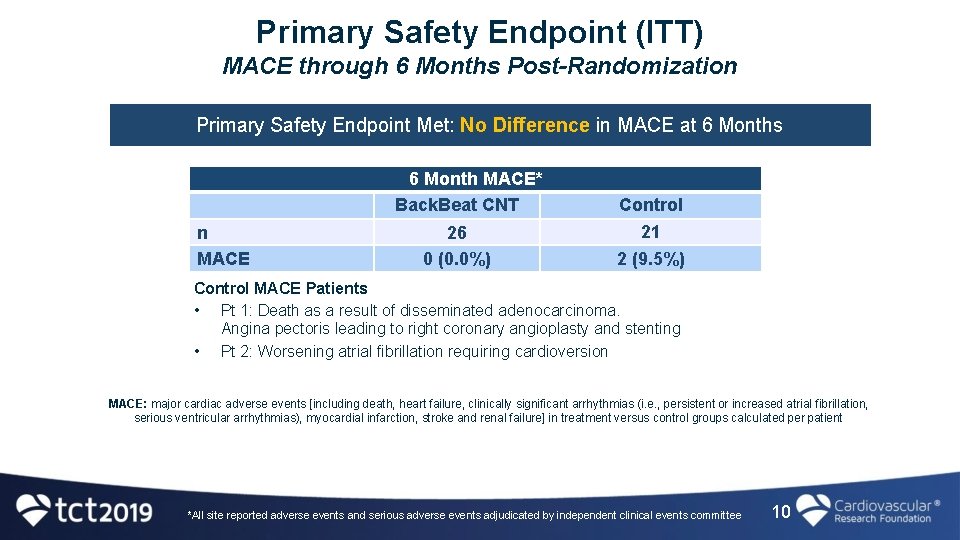
Primary Safety Endpoint (ITT) MACE through 6 Months Post-Randomization Primary Safety Endpoint Met: No Difference in MACE at 6 Months 6 Month MACE* Back. Beat CNT n MACE 26 0 (0. 0%) Control 21 2 (9. 5%) Control MACE Patients • Pt 1: Death as a result of disseminated adenocarcinoma. Angina pectoris leading to right coronary angioplasty and stenting • Pt 2: Worsening atrial fibrillation requiring cardioversion MACE: major cardiac adverse events [including death, heart failure, clinically significant arrhythmias (i. e. , persistent or increased atrial fibrillation, serious ventricular arrhythmias), myocardial infarction, stroke and renal failure] in treatment versus control groups calculated per patient *All site reported adverse events and serious adverse events adjudicated by independent clinical events committee 10
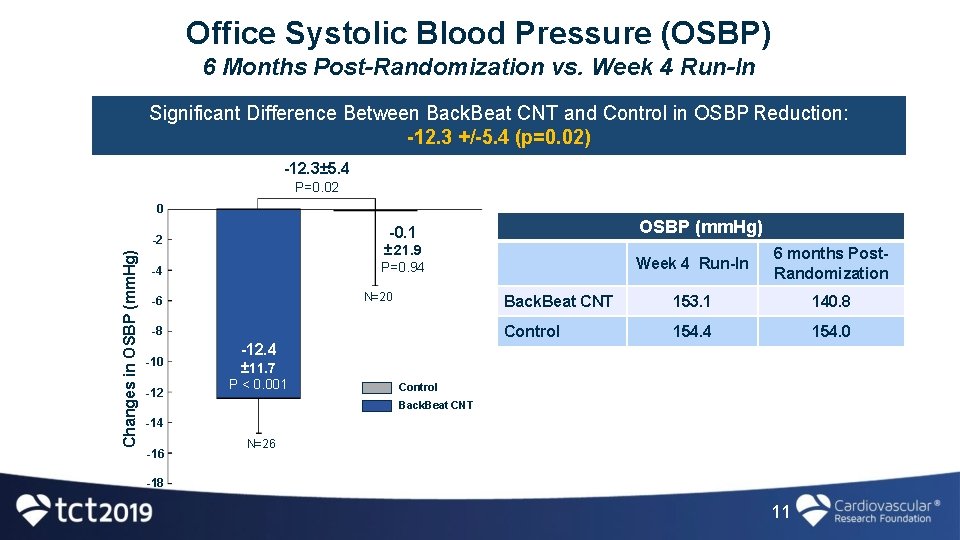
Office Systolic Blood Pressure (OSBP) 6 Months Post-Randomization vs. Week 4 Run-In Significant Difference Between Back. Beat CNT and Control in OSBP Reduction: -12. 3 +/-5. 4 (p=0. 02) -12. 3± 5. 4 P=0. 02 0 Changes in OSBP (mm. Hg) ± 21. 9 P=0. 94 -4 N=20 -6 -8 -10 -12 OSBP (mm. Hg) -0. 1 -2 Week 4 Run-In 6 months Post. Randomization Back. Beat CNT 153. 1 140. 8 Control 154. 4 154. 0 -12. 4 ± 11. 7 P < 0. 001 Control Back. Beat CNT -14 -16 N=26 -18 11
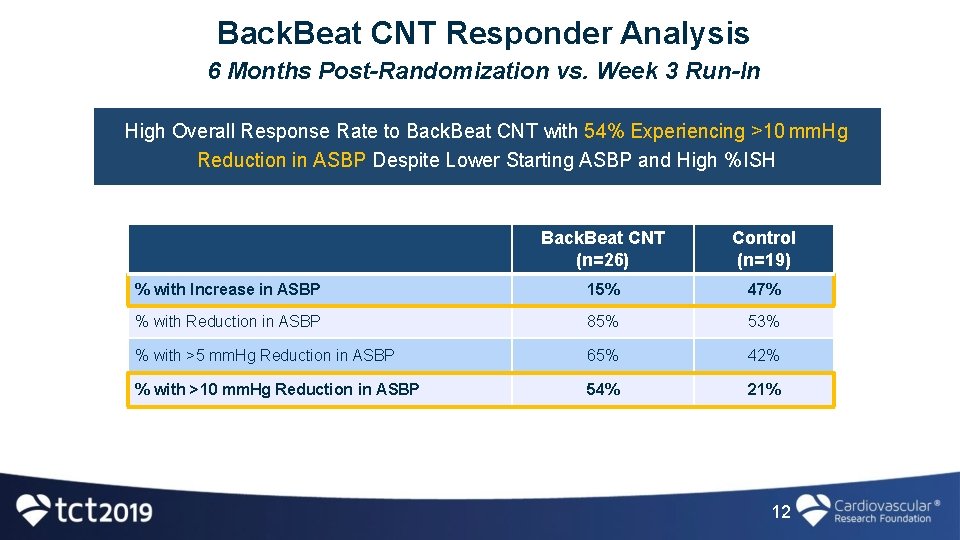
Back. Beat CNT Responder Analysis 6 Months Post-Randomization vs. Week 3 Run-In High Overall Response Rate to Back. Beat CNT with 54% Experiencing >10 mm. Hg Reduction in ASBP Despite Lower Starting ASBP and High % ISH Back. Beat CNT (n=26) Control (n=19) % with Increase in ASBP 15% 47% % with Reduction in ASBP 85% 53% % with >5 mm. Hg Reduction in ASBP 65% 42% % with >10 mm. Hg Reduction in ASBP 54% 21% 12
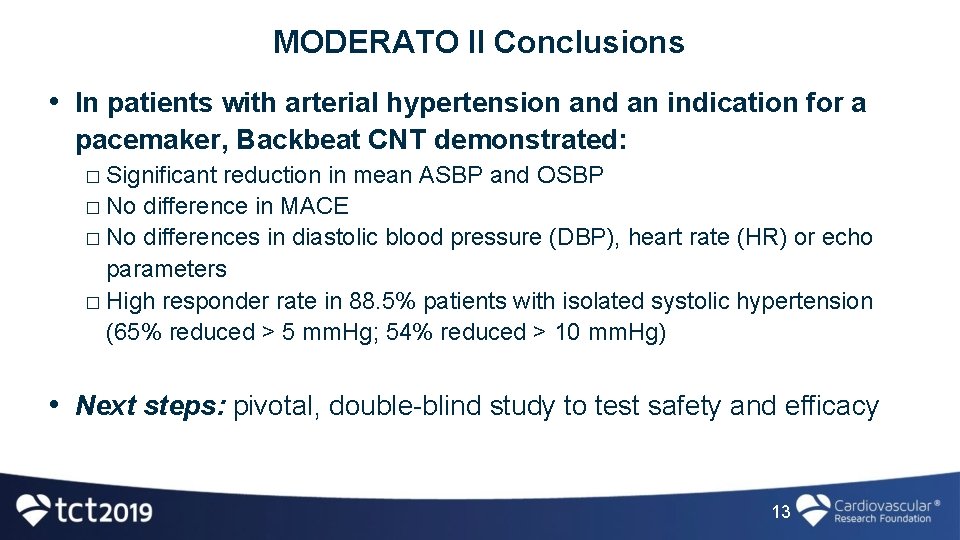
MODERATO II Conclusions • In patients with arterial hypertension and an indication for a pacemaker, Backbeat CNT demonstrated: Significant reduction in mean ASBP and OSBP � No difference in MACE � No differences in diastolic blood pressure (DBP), heart rate (HR) or echo parameters � High responder rate in 88. 5% patients with isolated systolic hypertension (65% reduced > 5 mm. Hg; 54% reduced > 10 mm. Hg) � • Next steps: pivotal, double-blind study to test safety and efficacy 13
THANK YOU! 14
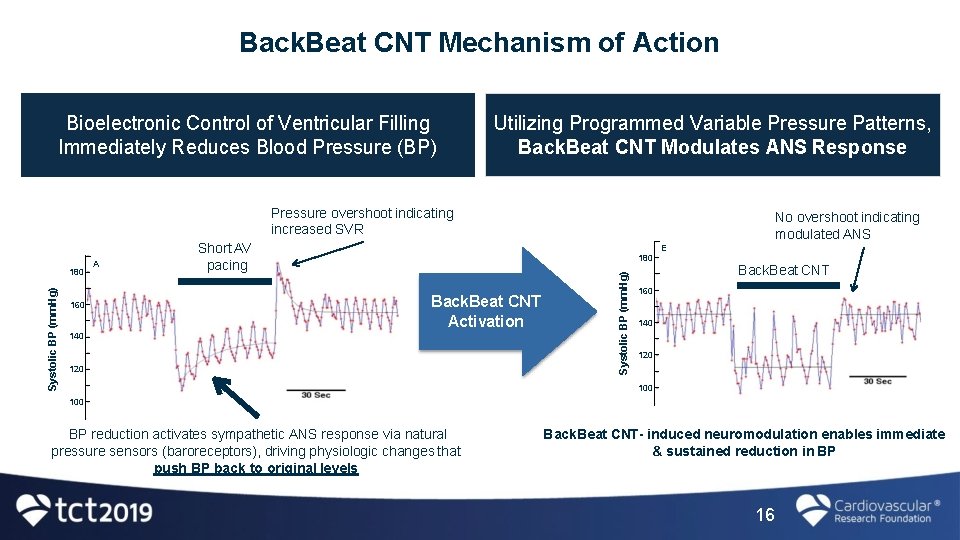
Back. Beat CNT Mechanism of Action Bioelectronic Control of Ventricular Filling Immediately Reduces Blood Pressure (BP) Utilizing Programmed Variable Pressure Patterns, Back. Beat CNT Modulates ANS Response Pressure overshoot indicating increased SVR 160 A 180 Back. Beat CNT Activation 140 120 Systolic BP (mm. Hg) 180 Short AV pacing No overshoot indicating modulated ANS E Back. Beat CNT 160 140 120 100 BP reduction activates sympathetic ANS response via natural pressure sensors (baroreceptors), driving physiologic changes that push BP back to original levels Back. Beat CNT- induced neuromodulation enables immediate & sustained reduction in BP 16
- Slides: 15