
Safety and Benefits of Food Colors Christi Simon
Safety and Benefits of Food Colors Christi Simon Sensient
IACM Objectives • To protect and expand the worldwide use of colors. • To serve as a trusted resource to interact with regulatory bodies and global organizations. • To enhance confidence in the safe use of color. • To provide members with a central source of scientific and regulatory expertise. • To advocate global harmonization of standards and regulations.
Current Members
Agenda • Uses and Benefits of Colors • Regulation of Colors in the United States • Safety of Colors in the United States – Safety Data Sets – Pre-Market Approval • Labeling of Colors in Food • Colors at Codex
USES AND BENEFITS OF COLORS
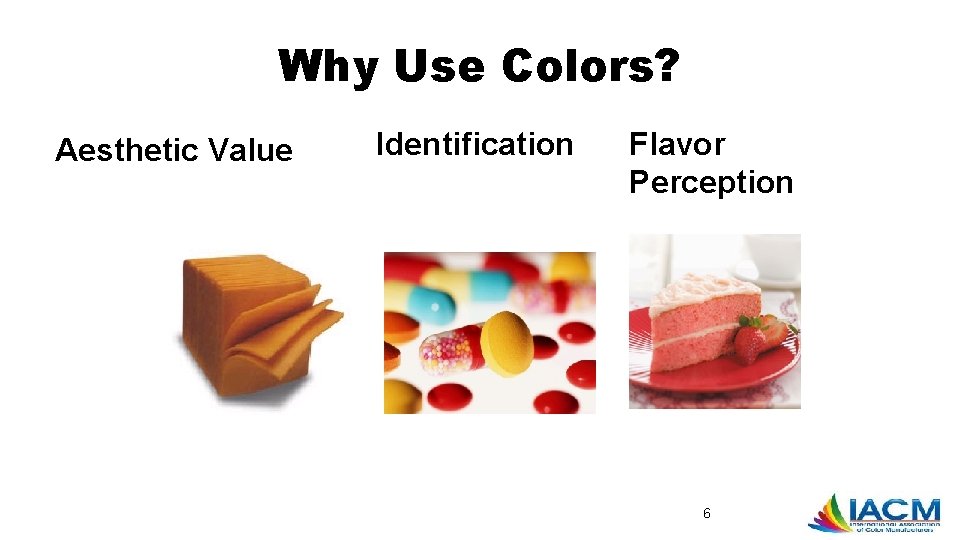
Why Use Colors? Aesthetic Value Identification Flavor Perception 6
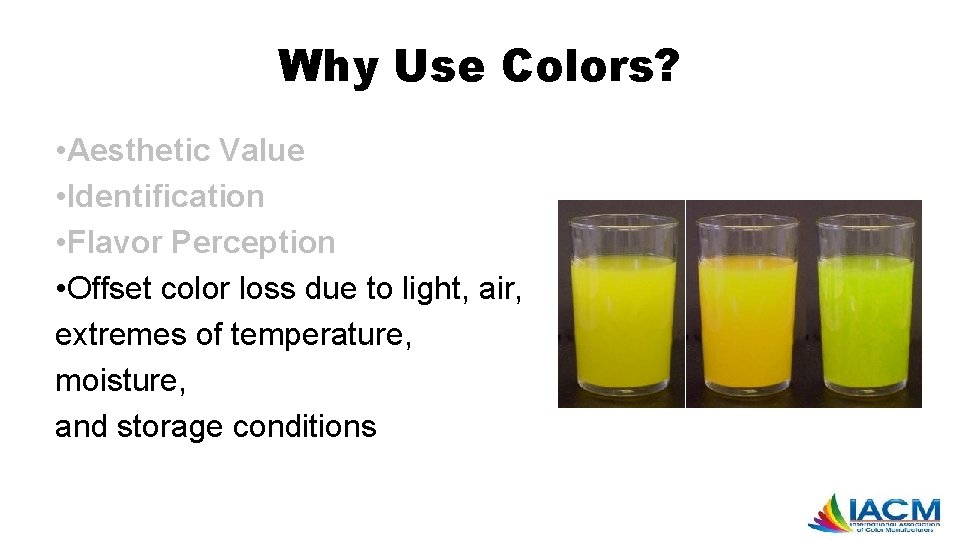
Why Use Colors? • Aesthetic Value • Identification • Flavor Perception • Offset color loss due to light, air, extremes of temperature, moisture, and storage conditions
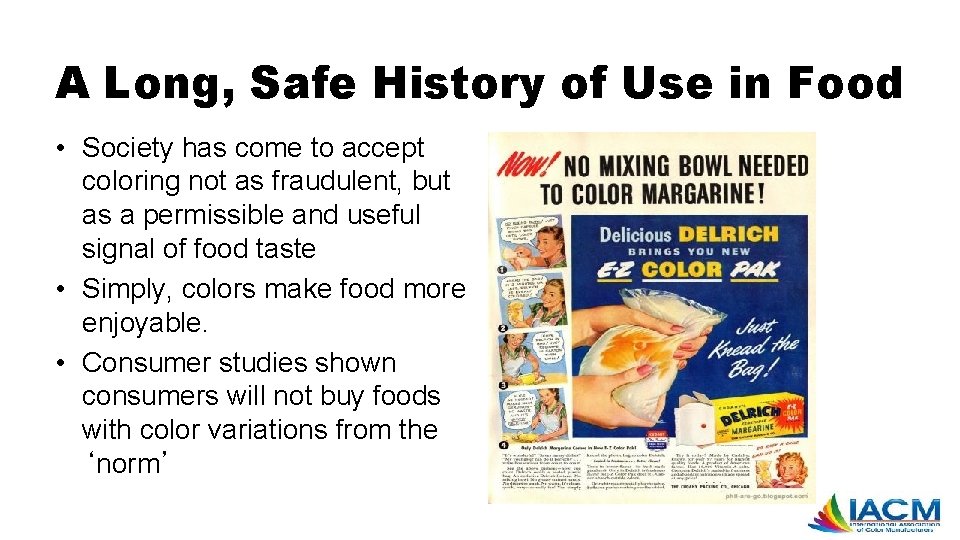
A Long, Safe History of Use in Food • Society has come to accept coloring not as fraudulent, but as a permissible and useful signal of food taste • Simply, colors make food more enjoyable. • Consumer studies shown consumers will not buy foods with color variations from the ‘norm’
REGULATION OF COLORS IN THE UNITED STATES
US FDA Legal Framework • 1906 Pure Food and Drug Act – Defined "misbranding" and "adulteration" for the first time and prescribed penalties for each – Regulated food and drugs moving in interstate commerce • 1938 Food, Drug, and Cosmetics Act – Established safety standard – harmless and suitable – Established certification/FD&C certified • 1960 Color Additive Amendments – – Defined color additive Identified new safety standard – reasonable certainty of no harm Required pre-market approval Authorized exempt from certification
FDA Definition of Color Additive (FD&C Act Section 201(t)) • A material which is a dye, pigment, or other substance … and when added or applied to a food, drug, or cosmetic, or to the human body or any part thereof, is capable (alone or through reaction with other substance) of imparting color thereto; – Excludes substances determined by the Secretary to be used solely for a purpose other than coloring • A color additive is unsafe if not used in accord with a regulation/exemption • No generally recognized as safe (GRAS) exemption

Types of FDA Regulated Colors Certified Colors Exempt from Certification – Are known as FD&C colors – Known structure/Synthetically produced – Generally do not impart undesirable flavors to food –High purity specifications established by the FDA –Each batch is tested by the FDA to confirm safety based on identity and specifications –Impart intense, uniform color –Less expensive –Blend more easily –Stable – Colors typically referred to as ‘natural colors’ by the food industry –Synthetic duplicates of naturally existing colorants –No batch testing required –Derived from natural sources such as vegetables, minerals, or animals –May not be stable in certain food –May add unintended flavors to food 12
Safety Data Sets SAFETY OF COLORS IN THE UNITED STATES
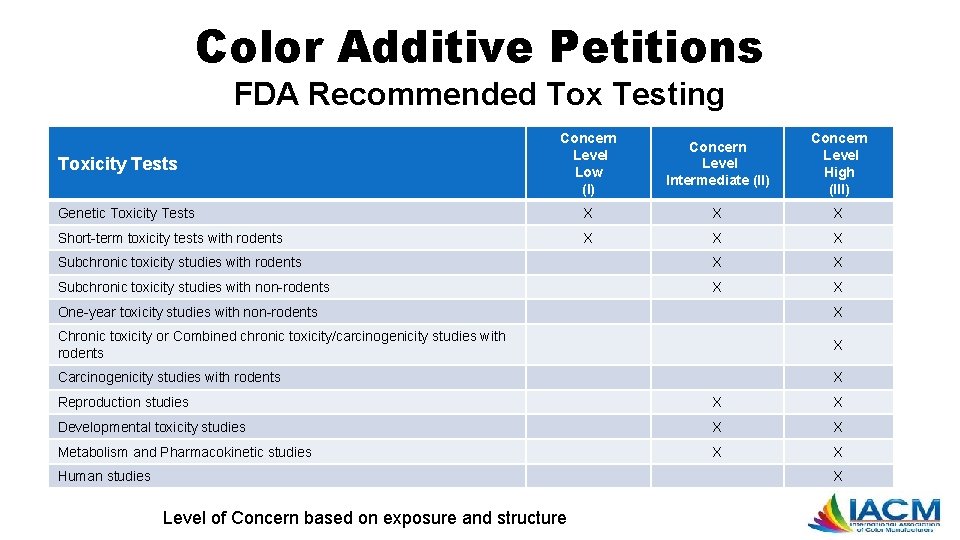
Color Additive Petitions FDA Recommended Tox Testing Concern Level Low (I) Concern Level Intermediate (II) Concern Level High (III) Genetic Toxicity Tests X X X Short-term toxicity tests with rodents X X X Subchronic toxicity studies with rodents X X Subchronic toxicity studies with non-rodents X X Toxicity Tests One-year toxicity studies with non-rodents X Chronic toxicity or Combined chronic toxicity/carcinogenicity studies with rodents X Carcinogenicity studies with rodents X Reproduction studies X X Developmental toxicity studies X X Metabolism and Pharmacokinetic studies X X Human studies X Level of Concern based on exposure and structure
Color Risk Assessment • US requirements for color additive petitions have created substantial safety data for many colors • This data has also been reviewed by WHO/FAO Joint Expert Committee on Food Additives (JECFA) to establish acceptable daily intakes (ADIs) • Some additional data has been collected since FDA & JECFA reviews – Genotoxicity, allergenicity, other studies
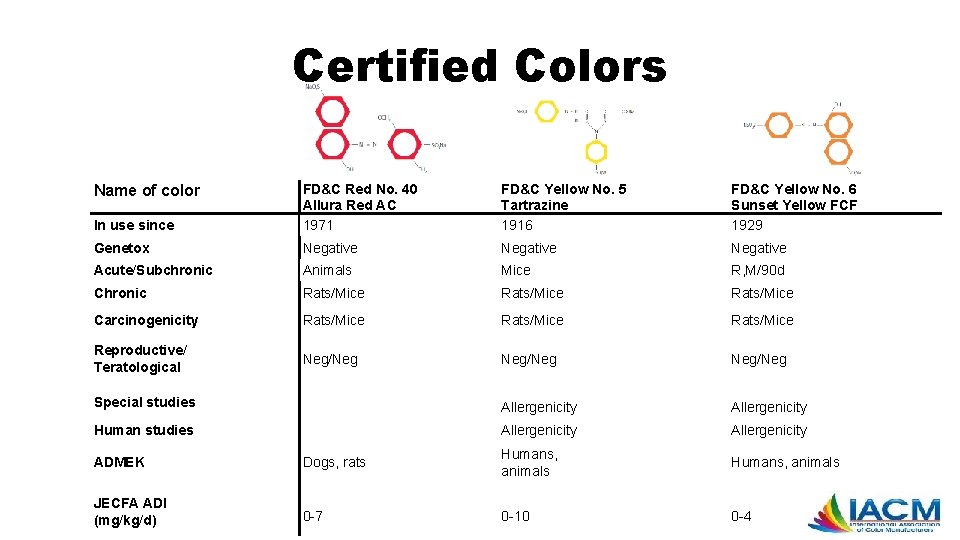
Certified Colors In use since FD&C Red No. 40 Allura Red AC 1971 FD&C Yellow No. 5 Tartrazine 1916 FD&C Yellow No. 6 Sunset Yellow FCF 1929 Genetox Negative Acute/Subchronic Animals Mice R, M/90 d Chronic Rats/Mice Carcinogenicity Rats/Mice Reproductive/ Teratological Neg/Neg Special studies Allergenicity Human studies Allergenicity Name of color ADMEK Dogs, rats Humans, animals JECFA ADI (mg/kg/d) 0 -7 0 -10 0 -4
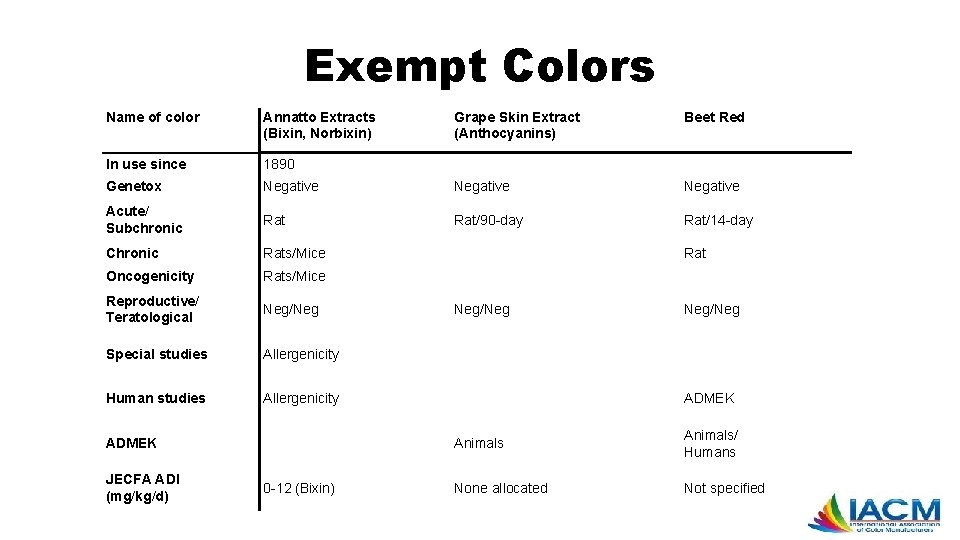
Exempt Colors Name of color Annatto Extracts (Bixin, Norbixin) Grape Skin Extract (Anthocyanins) Beet Red In use since 1890 Genetox Negative Acute/ Subchronic Rat/90 -day Rat/14 -day Chronic Rats/Mice Oncogenicity Rats/Mice Reproductive/ Teratological Neg/Neg Special studies Allergenicity Human studies Allergenicity ADMEK JECFA ADI (mg/kg/d) 0 -12 (Bixin) Rat Neg/Neg ADMEK Animals/ Humans None allocated Not specified
Pre-Market Approval SAFETY OF COLORS IN THE UNITED STATES
Color Additives Require Pre-Market Approval in US • All color additives, except for some hair dyes, are subject to FDA pre-market approval before they may be used in: – Food – Drugs – Cosmetics – Medical devices that come in contact with the bodies of people or animals for a significant period of time
Color Additive Petition Review • What exactly is the substance and what is the projected exposure? – – – Identity and composition Method of manufacture Specifications and purity Use level and exposure Technological justification • Is it safe for its intended use? – Toxicology studies – FDA Redbook requirements • Is other case-specific information needed?
Color Additive Petition Identity and Specifications • Chemical Identity – Analytical chemistry and spectra – For plant sources, description of plant source – Physical, chemical and biological properties • Specifications and Methods (for enforcing specs) – Multi-batch analyses – Identification of secondary coloring matters – Identification of non-coloring matters, impurities • Manufacturing Process – Conditions; methods – Solvents; reagents – Variation/purity • Stability
Color Additive Petition Use/Technological Justification • What food categories will the color additive be used in? Dairy Products, Baked Goods, etc. • How much is required for technical effect? generally ppm, excluding caramel color and some unique applications • How will application levels vary within a food category? 10 -100 ppm? 100 -1000 ppm? • Tolerances and restrictions • Why is the color additive useful?
Color Additive Petitions Exposure • Petitions must include exposure estimate – Proposed concentrations that will be used in food – Consumer intake of foods that will contain the potential color additive • For main color additive, FDA generally considers chronic intake • Worst case scenario of exposure is considered • FDA experts will produce an Estimated Daily Intake (EDI) for the color additive, and determine safety based on results of toxicity testing and no-observed effect levels
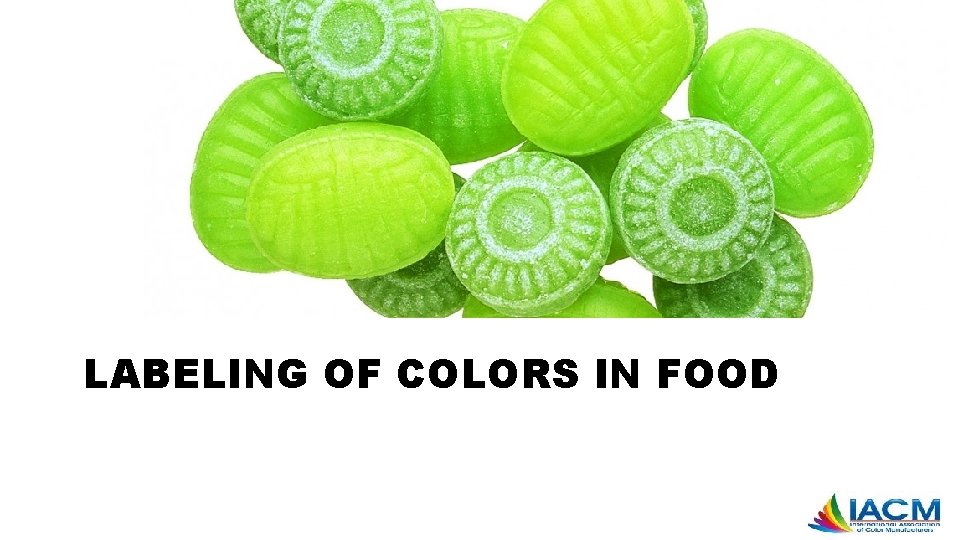
LABELING OF COLORS IN FOOD
US Labeling • In the US all color additives are considered artificial for labeling purposes – Artificial Color – Color Added • The addition of color to a product must be indicated on a label regardless of whether it is an exempt or certified (FD & C) color. • Cannot label any color additive in the US as a “Natural Color”
European Labeling • In Europe, all food additives are given labeling codes commonly referred to as “E-numbers” • Colors are traditionally labeled not by name but by Enumber • Europe now requires labeling for 6 synthetic colors included in the Southampton Study: – “may have effects on activity and attention in children”
FDA Food Advisory Committee Meeting • Reviewed USFDA report discussing available scientific data and whethere is evidence for a link between synthetic colors and hyperactive behavior in children • 2 -Day meeting, March 30/31, 2011 • Food Advisory Committee, 14 members – Academic experts (pediatrics, psychiatry, neurotoxicity, behavioral, development) – 2 consumer representatives – 2 industry representatives (no voting privileges) • Invited participants, consumer groups – IACM only industry representative
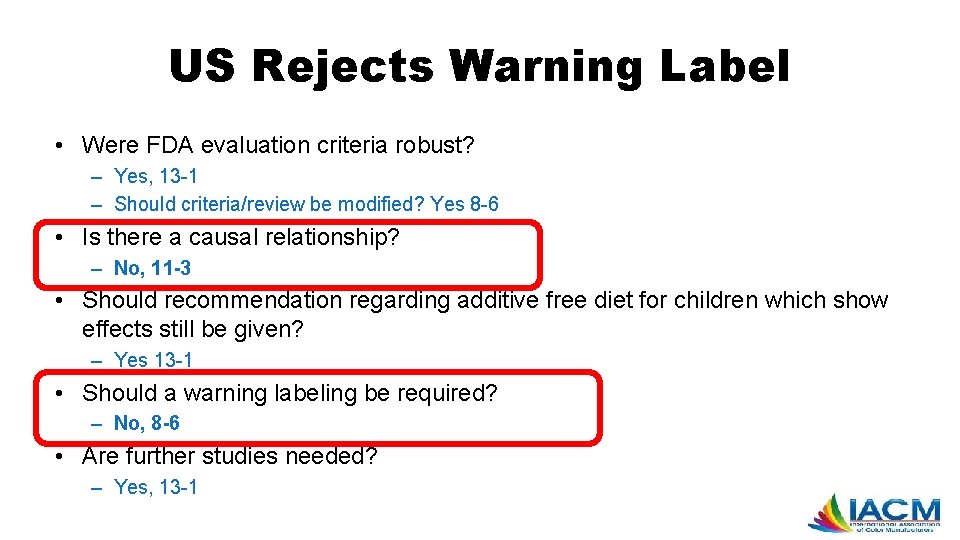
US Rejects Warning Label • Were FDA evaluation criteria robust? – Yes, 13 -1 – Should criteria/review be modified? Yes 8 -6 • Is there a causal relationship? – No, 11 -3 • Should recommendation regarding additive free diet for children which show effects still be given? – Yes 13 -1 • Should a warning labeling be required? – No, 8 -6 • Are further studies needed? – Yes, 13 -1
Do ingredient labels need a warning for colors? • IACM does not support a warning for colors on ingredient labels • Governments should make regulatory decisions based on sound science, rather than respond to emotionally charged requests or political pressure
COLORS AT CODEX
Colors at Codex • IACM participates as non-governmental observer (NGO) at Codex Alimentarius – Active participant in Committee on Food Additives (CCFA) • IACM encourages countries to look to Codex standards and levels when developing new or amending food regulations – However, some colors approved for use in US and/or EU not currently in General Standard for Food Additives (GSFA) due to slow, deliberate Codex process, not due to safety concerns
GSFA Not a Positive List • Additionally, it was not the intent of the creators of the GSFA for it to be adopted as a positive list at this stage of development. Footnote 1 of the GSFA states, – Notwithstanding the provisions of this Section of the General Standard, the lack of reference to a particular additive or to a particular use of an additive in a food in the General Standard as currently drafted, does not imply that the additive is unsafe or unsuitable for use in food. The Commission shall review the necessity for maintaining this footnote on a regular basis, with a view to its deletion once the General Standard is substantially complete.
Codex GSFA Step Process • 46 colors with draft and/or adopted provisions in GSFA – 1, 895 draft and adopted provisions for colors in the GSFA • Colors that have not completed the Step process for adoption are largely at Steps 4 and 7. – Step 4: the draft text has been prepared, circulated to member countries and all interested parties for comment and are awaiting review at the Committee level before being sent to the Commission for review – Step 7 additives have already been endorsed by the Commission, agreed to be put forth for finalization and are simply awaiting finalization by the Committee
IACM Supports Global Harmonization • Since current omission from GSFA not due to safety concerns, IACM encourages countries to consider colors approved for use in US, EU OR Codex as basis for regulations – Adopting the GSFA as a positive list means that currently approved colors and/or uses for certain colors will be banned • Due to Note 161 concerns, no new colors are being considered for inclusion in GSFA currently – Each country takes its own approach to color additive approval and reauthorization and should consider need for colors not in GSFA – Populations have different needs and requirements for colors due to cultural variations There is no reason for a country to disallow the use of a color or a use already approved due its position at Step 7 rather than Step 8
Key Takeaways • Colors are useful additives that provide important and beneficial technical effects • Strong and robust dataset supports the safety of colors • Colors are clearly labeled as ingredients in the US and this allows consumers to make informed choices • IACM supports science-based regulations on color use and labeling and global harmonization to the extent possible • Codex GSFA should not be adopted as positive list; need to consider draft provisions as well as those already adopted
Thank You
- Slides: 36