
SAFETY 2020 LIFE SAVING RULES Kimberly Miller EHS
SAFETY 2020 LIFE SAVING RULES Kimberly Miller, EHS Reconditioning Allen Coppolo, EHS Small Packaging Nick Sheets, EHS Large Packaging November 4, 2019


LIFE SAVING RULES DEFINED Rules that describe key safety principles that will protect employees against serious injury or death.

LIFE SAVING RULES DEFINED • Life Saving Rules are developed around hazards specific to Mauser Packaging Solutions. • Rules are: • Life saving or prevent serious injury • Few and focused • Clear and simple • Actionable • Observable Safety Controls Hot Work Confined Space Safe Driving Energy Isolation Line of Fire Hazardous Materials Fall Protection 4
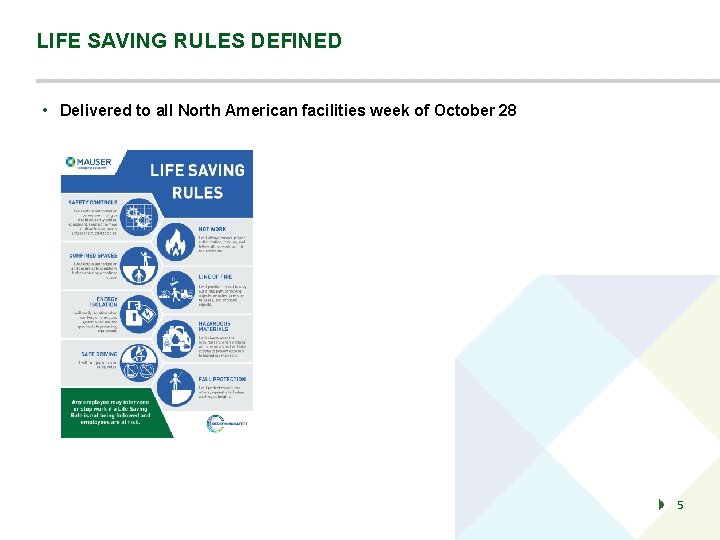
LIFE SAVING RULES DEFINED • Delivered to all North American facilities week of October 28 5

SAFETY CONTROLS I have been trained to use equipment without removing or disabling safeguards. I understand the fatal consequences could occur when safeguards are removed or disabled. • I will never do the following without proper authorization and alternate protective measures: • remove a safety guard, • disable or override a safety device, • ignore or cross a safety barrier. 6

SAFETY CONTROLS Do not remove or disable safety controls Case Study A new employee was asked to fill in for an experienced operator on a piece of machinery removing dents from steel drums. Upon loading a drum onto the machine, the drum became jammed. The employee reached beneath a safety guard to unjam the drum. When the drum began rotating, the employee’s thumb rotated under the roller resulting in the amputation of the tip of the thumb. An investigation determined that plant maintenance had removed a two-button operation, reducing the operation to a single-button operations, which contributed to the failure of the unit to remain energized (lack of redundancy). Life Saving Rules Violated: • By-passing a Safety Guard: The employee reached into the guard which was there to prevent contact with the rollers. • By-passing safety feature: The maintenance team replaced a two-button operation with onebutton to get the machine running when the a part was not available. The single-button got “stuck” and failed to raise up and stop energization of the unit. 7
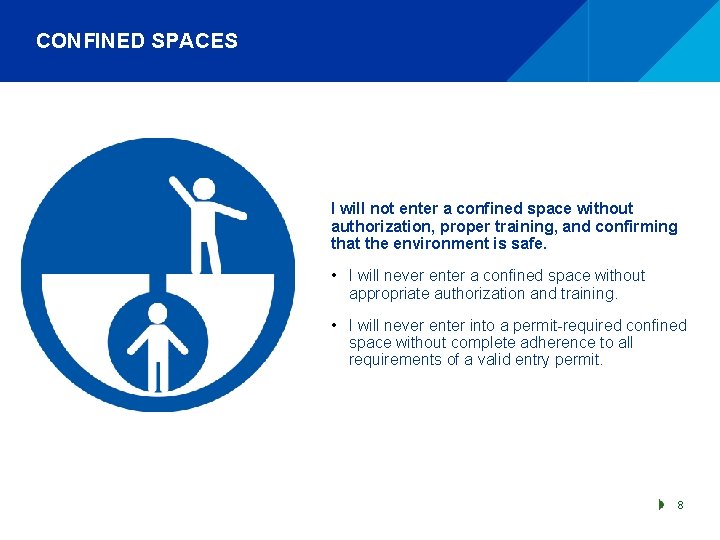
CONFINED SPACES I will not enter a confined space without authorization, proper training, and confirming that the environment is safe. • I will never enter a confined space without appropriate authorization and training. • I will never enter into a permit-required confined space without complete adherence to all requirements of a valid entry permit. 8

CONFINED SPACE Do not enter a confined space without proper training and procedures. Case Study A facility maintenance team recognized the need to clean out a 5, 000 gallon above ground storage tank with a floor level port hole. This was a non-routine task. The team did not have any procedures for entering the tank and did not have equipment to test the quality of the air prior. Fortunately, no one was injured in the event; however, a potential for a fatality may have occurred had the air been insufficient with oxygen or contained a flammable material that may have ignited. This activity risked the lives of employees. Life Saving Rules Violated: • The maintenance team failed to observe life saving rules around confined space entry. Remember to pay attention to your confined space training and recognize anything that may be a confined space and refuse to enter without proper procedures and testing. • A confined space, such as a vessel, tank, pipe, cellar, or excavation can contain: - explosive gas, - toxic or asphyxiating atmosphere - or other dangers such: as energy releases, lack of oxygen, exposure to hazardous chemicals, things that can fall on you or crush you, or that you can fall from.

SAFE DRIVING I will follow safe driving rules. • I will wear a seatbelt and my passengers will too. • I will be rested and alert while driving. • While driving, I will not: • speed, • use any hand held device, such as a cell phone, • drive under the influence of drugs or alcohol. 10

SAFE DRIVING Follow safe driving rules to stay safe. Fact: • The U. S. Center for Disease Control (CDC) reports that approximately nine people are killed and more than 1, 000 injured daily in the United States in incidents involving a distracted driver. • According to the National Highway Transportation Safety Administration, approximately 481, 000 drivers driving during daylight hours across America are using cell phones while driving. When traveling at 55 mph, sending, typing, or reading a text takes your eyes off the road for about five seconds. Five seconds = the distance of a football field. 11
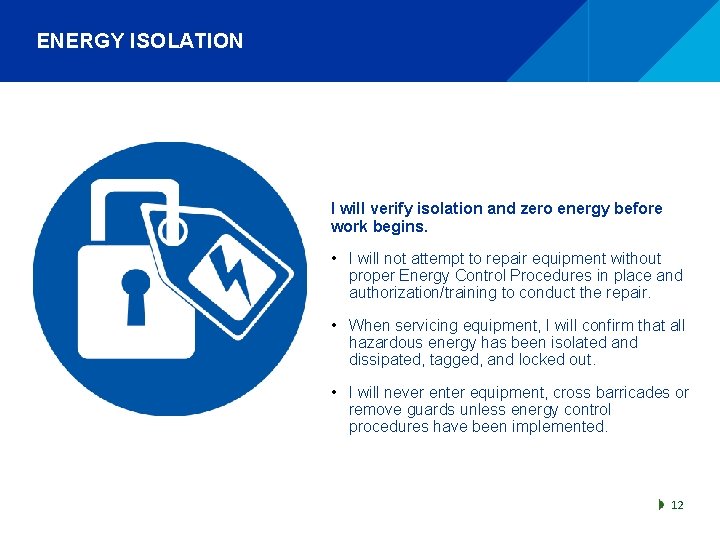
ENERGY ISOLATION I will verify isolation and zero energy before work begins. • I will not attempt to repair equipment without proper Energy Control Procedures in place and authorization/training to conduct the repair. • When servicing equipment, I will confirm that all hazardous energy has been isolated and dissipated, tagged, and locked out. • I will never enter equipment, cross barricades or remove guards unless energy control procedures have been implemented. 12
ENERGY ISOLATION Verify isolation and zero energy before work begins. Case Study Two maintenance employees were conducting a repair on a conveyor and did not use two locks (one assigned to each employee) during the lock out. The employee who applied the lock removed it and reenergized the conveyor as the second employee was replacing the guard. The conveyor chain caught the employee’s finger, causing an amputation to the finger at the first knuckle. Life Saving Rules Violated: • These employees broke the Energy Isolation life saving rule by failing to ensure that hazardous energy was properly controlled by all parties involved in the repair. • Any time work is performed on a machine, all energy sources must be isolated and under exclusive control of EACH person doing the work. Lockout / Tagout (LOTO) is essential to prevent catastrophic injuries from occurring at Mauser Packaging Solutions. 13
HOT WORK I will not conduct hot work (welding, cutting, grinding, etc. ) without proper authorization and training. • Before starting any hot work, I pull and follow the required hot-work permit. • I will follow all hot work permit requirements. I will always: • Confirm flammable materials has been removed or isolated, • Provide fire protection, • Appoint a fire watch, • Maintain surveillance for the required time following completion. 14
HOT WORK Control flammables and ignition sources Case Study A March 2014 fire in Boston’s Back Bay neighborhood was caused when a welding spark from a residential staircase railings project ignited a nearby shed. The blaze grew into a nine-alarm fire ultimately taking the lives of two firefighters and injuring 18. OSHA found that the company lacked an effective fire prevention and protection program, failed to train employees in fire safety, did not have a fire watch present, and failed to move the railing to an alternate location where welding could be performed safely. Facts: • Hot work continues to be a leading cause of industrial fires, and it has been responsible for many of industry's most severe fire losses. • Hot work is often synonymous with welding and cutting but also includes any work activity with potential to produce ignition sources or excess heat, such as burning, brazing, grinding, soldering, thermal resistance heating, or torch applied roofing. 15

LINE OF FIRE I will position myself to stay out of the path of moving objects, vehicles, pressure releases, and dropped objects. • I will never stand under suspended loads. • I will establish and obey barriers and exclusion zones. • I will take action to secure loose objects and report any potential for dropped objects. 16
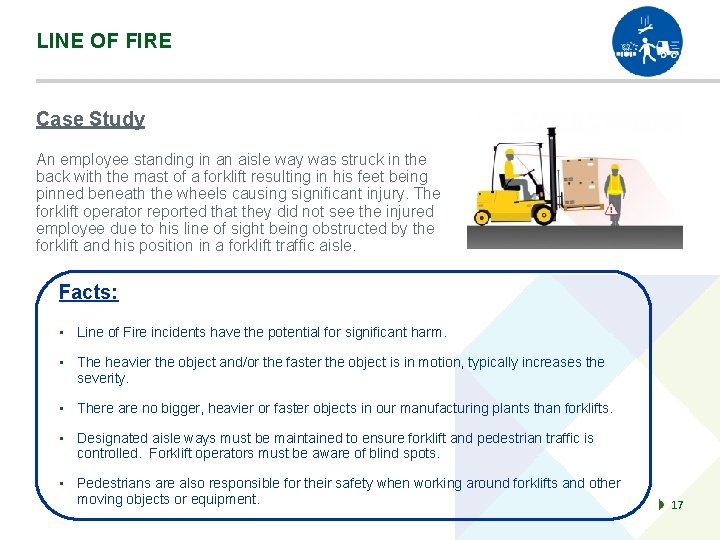
LINE OF FIRE Case Study An employee standing in an aisle way was struck in the back with the mast of a forklift resulting in his feet being pinned beneath the wheels causing significant injury. The forklift operator reported that they did not see the injured employee due to his line of sight being obstructed by the forklift and his position in a forklift traffic aisle. Facts: • Line of Fire incidents have the potential for significant harm. • The heavier the object and/or the faster the object is in motion, typically increases the severity. • There are no bigger, heavier or faster objects in our manufacturing plants than forklifts. • Designated aisle ways must be maintained to ensure forklift and pedestrian traffic is controlled. Forklift operators must be aware of blind spots. • Pedestrians are also responsible for their safety when working around forklifts and other moving objects or equipment. 17
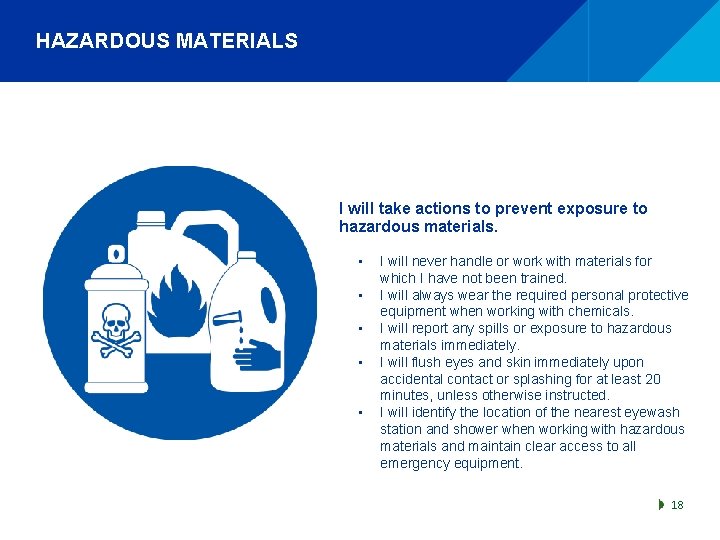
HAZARDOUS MATERIALS I will take actions to prevent exposure to hazardous materials. • • • I will never handle or work with materials for which I have not been trained. I will always wear the required personal protective equipment when working with chemicals. I will report any spills or exposure to hazardous materials immediately. I will flush eyes and skin immediately upon accidental contact or splashing for at least 20 minutes, unless otherwise instructed. I will identify the location of the nearest eyewash station and shower when working with hazardous materials and maintain clear access to all emergency equipment. 18

HAZARDOUS MATERIALS Case Study An employee working in a reconditioning plant experienced a chemical exposure on his arm at the wrist because he rolled his protective glove down exposing skin. The employee briefly rinsed the material from his arm and went back to work. Later when at home, the area of exposure developed into a blister and later a painful burn, requiring a trip to the emergency room. Life Saving Rules Violated: • Failure to wear PPE appropriately. • Failure to properly flush exposed area for 20 minutes. • Failure to report exposure. 19
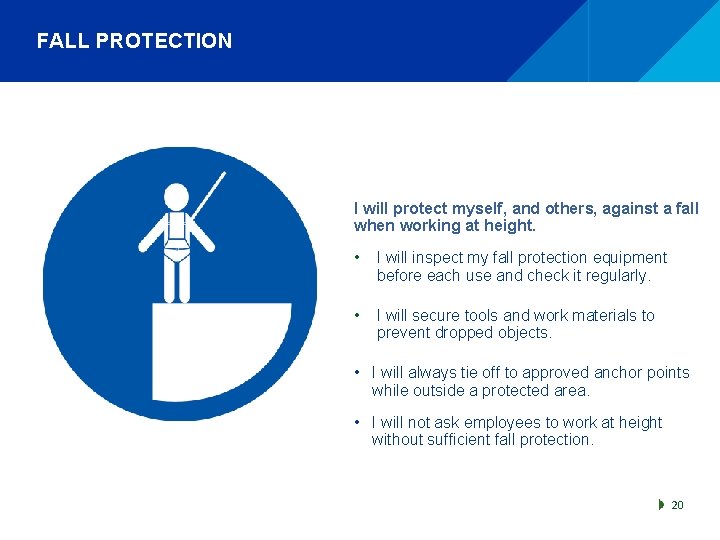
FALL PROTECTION I will protect myself, and others, against a fall when working at height. • I will inspect my fall protection equipment before each use and check it regularly. • I will secure tools and work materials to prevent dropped objects. • I will always tie off to approved anchor points while outside a protected area. • I will not ask employees to work at height without sufficient fall protection. 20
FALL PROTECTION Protect yourself against a fall when working at height Case Study A maintenance employee used a forklift as a man lift; however, instead of using an approved man lift he used a dilapidated IBC cage. He did not wear a harness and did not tie off to the forklift. The IBC cage slipped from the forklift sending him to fall to the floor landing on his leg suffering a severe broken leg. The employee required surgery and his recovery took several months. Life Saving Rules Violated: • Failure to secure to an approved anchor point. • Other considerations for working at height include ladders, work over water, rope access, floor openings, access hatches, and inspection pits. Floor openings should be protected with physical barriers to prevent falls. 21

STOP Stop. Intervene. § Any employee may intervene or stop work if a Life Saving Rule is not being followed and employees are at risk. § We are all authorized to intervene or stop work. 22

STOP Intervention can be the last opportunity to prevent injury or death. It’s not always the easiest to tell someone to stop the job but it’s the right thing to do. Even if you have to stop your boss from unsafe behavior. Safety depends on everyone. It’s better to have an comfortable conversation than to risk someone being injured or killed. 23
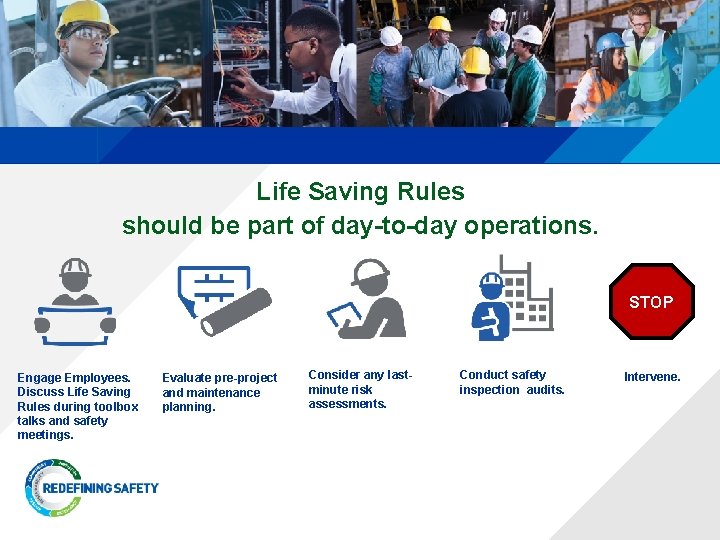
Life Saving Rules should be part of day-to-day operations. STOP Engage Employees. Discuss Life Saving Rules during toolbox talks and safety meetings. Evaluate pre-project and maintenance planning. Consider any lastminute risk assessments. Conduct safety inspection audits. Intervene.
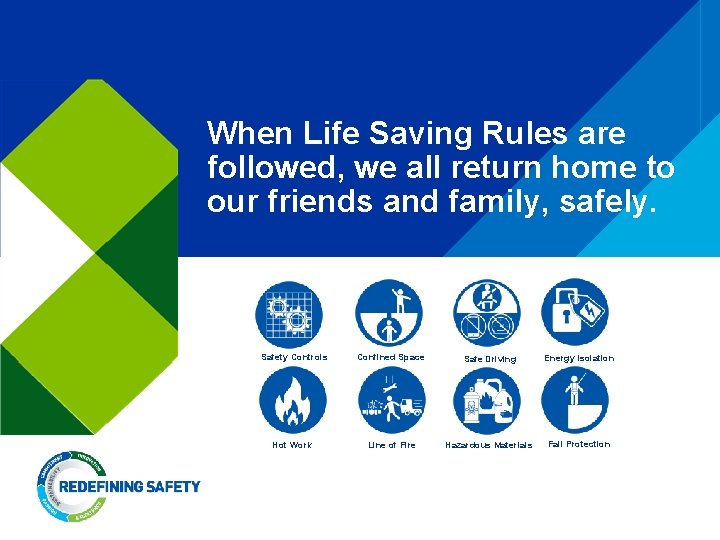
When Life Saving Rules are followed, we all return home to our friends and family, safely. Safety Controls Confined Space Safe Driving Energy Isolation Hot Work Line of Fire Hazardous Materials Fall Protection
- Slides: 25