
SAFELY ABROAD Health Safety Turvallisuuspankki FINVET fi PREPARATION
SAFELY ABROAD, Health Safety Turvallisuuspankki FINVET. fi
PREPARATION FOR FLIGHT Wear comfy, loose and warm clothes on flight. Compression stockings prevent swelling and deep vein thromboses. Definitely use compression stockings on long-haul flights if you smoke or take contraceptive pills. Have light meals.
ON THE FLIGHT Drink plenty of water. Air in the airplane cabin is dry. During the flight it’s good to drink at least 1 dl per hour more than usually. It’s better to avoid alcohol, coffee and tea because of their diuretic effect. Sparkling beverages cause flatulence. Rotate your hands open or the fist clenched. Get up and walk especially during long-haul flights.
EARS BLOCKED ON FLIGHT If you have caught a cold, take nasal spray and painkillers for the flight. Earache can be relieved with nasal spray or nasal drops, which you can buy at a pharmacy. Put the drops deep into nostrils in the supine position so that you feel them to flow into the pharynx. This way the liquid flows into the Eustachian tubes, what helps them to stay open. Chew chewing gum. Blow air into the ears holding your nose tight and keeping your mouth shut.
ARE YOU AFRAID OF FLYING? Flights are booked on safe airlines. Flying on a plane is much safer than travelling by car. An experienced crew takes care of the safety on your flight. You can tell the cabin crew about your aerophobia at the departure. During the flight concentrate on something else: read a book, listen to music, watch a movie, relax. Alcohol and tranquilizers might relieve the symptoms for a moment but they are not recommended.
ALLERGIES AND ASTHMA Take with you: Enough allergy and asthma medicines. The phone number of your GP in Finland. Written documents about the disease and the used medicines in English. The contact details of your next of kin. Written list in English about the food ingredients you possibly are allergic to as well as about other allergies. If you have had severe allergic symptoms, take a disposable epinephrine injection (Epipen®) with you. You can consider if you should take a pillow and mattres cover or even a pillow of your own with you. A breathing mask can be necessary in dusty conditions.
FOOD ALLERGIES If you have a severe allergy, be careful, what you eat and drink. Get acquainted with the food of your destination country in advance. Have first aid medicines with you: epinephrine injection or antihistamines. Coloured food and beverages: Check their ingredients, e. g. green pasta has been coloured with spinach.
LACTOSE INTOLERANCE There is lactose i. e. milk sugar in dairy products, ice cream as well as in pastry, sausages, potato mash, butter and margarine. Lactose free dairy products are seldom well known abroad. You can buy lactase enzyme tablets at the pharmacy for the trip. (Lactrase®) It’s possible that you won’t experience any symptoms, although you consume local products that include milk.
COELIAC DISEASE The words gluten-free and coeliac disease are not always well known abroad. Take with you a translation that you can show in a restaurant (keliakialiitto. fi). Take some gluten-free products from home with you. Be careful with dishes in a restaurant and tell about the coeliac disease to the waiter. www. keliakianuoret. fi
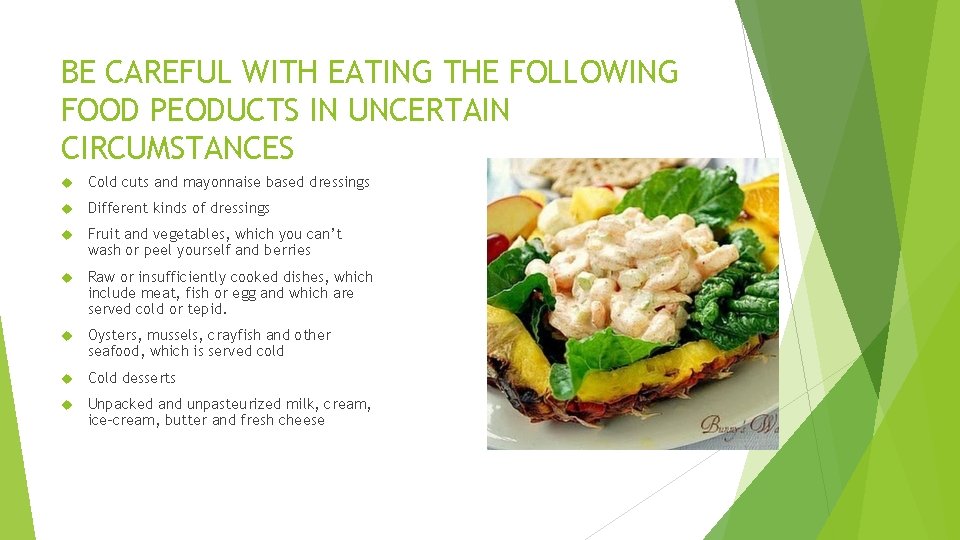
BE CAREFUL WITH EATING THE FOLLOWING FOOD PEODUCTS IN UNCERTAIN CIRCUMSTANCES Cold cuts and mayonnaise based dressings Different kinds of dressings Fruit and vegetables, which you can’t wash or peel yourself and berries Raw or insufficiently cooked dishes, which include meat, fish or egg and which are served cold or tepid. Oysters, mussels, crayfish and other seafood, which is served cold Cold desserts Unpacked and unpasteurized milk, cream, ice-cream, butter and fresh cheese
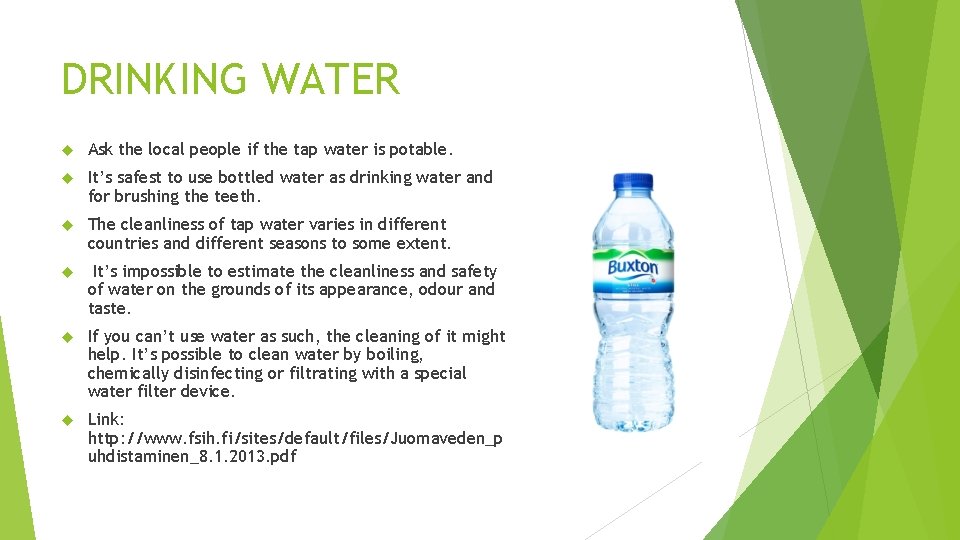
DRINKING WATER Ask the local people if the tap water is potable. It’s safest to use bottled water as drinking water and for brushing the teeth. The cleanliness of tap water varies in different countries and different seasons to some extent. It’s impossible to estimate the cleanliness and safety of water on the grounds of its appearance, odour and taste. If you can’t use water as such, the cleaning of it might help. It’s possible to clean water by boiling, chemically disinfecting or filtrating with a special water filter device. Link: http: //www. fsih. fi/sites/default/files/Juomaveden_p uhdistaminen_8. 1. 2013. pdf
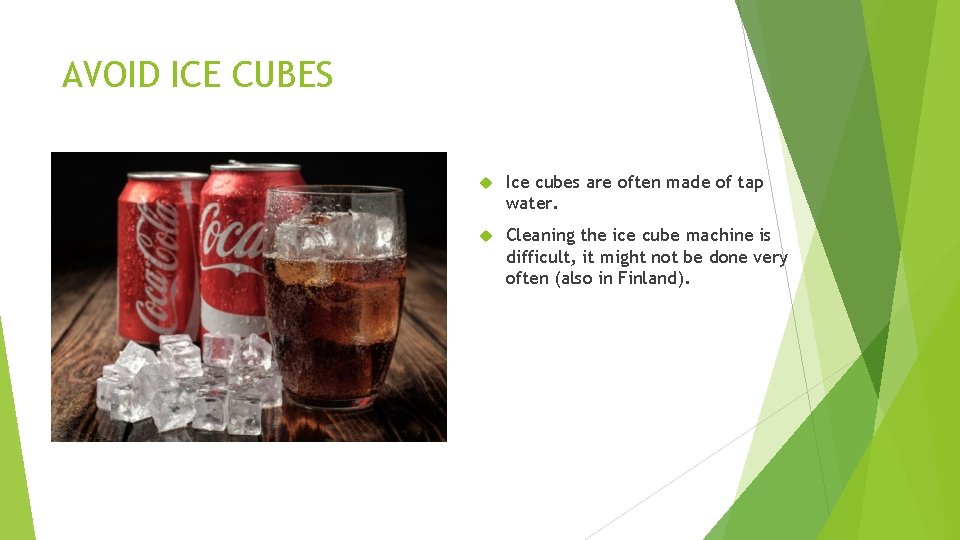
AVOID ICE CUBES Ice cubes are often made of tap water. Cleaning the ice cube machine is difficult, it might not be done very often (also in Finland).
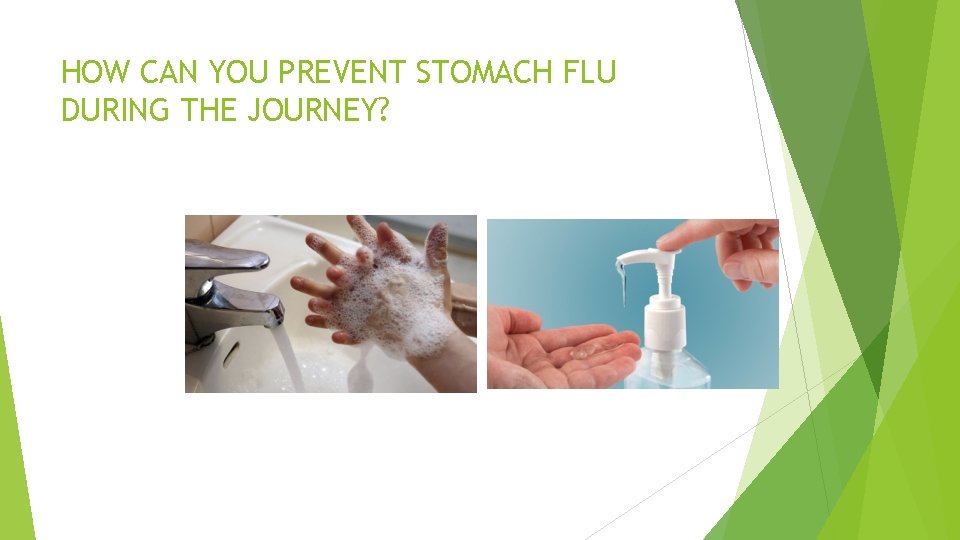
HOW CAN YOU PREVENT STOMACH FLU DURING THE JOURNEY?
GOOD HAND HYGIENE Wash your hands with soap or disinfect them with an alcoholbased sanitizer always before touching food ingredients and before meals as well as after using the toilet. You can buy hand sanitizers at pharmacies or shops. Sanitizing hand wipes are also handy to have in the bag.
TRAVELLER’S DIARRHEA It breaks out 6 -72 hours after being infected. Symptoms: Diarrhea of different grade for 3 -5 days, stomach cramps and nausea. Fever, headache
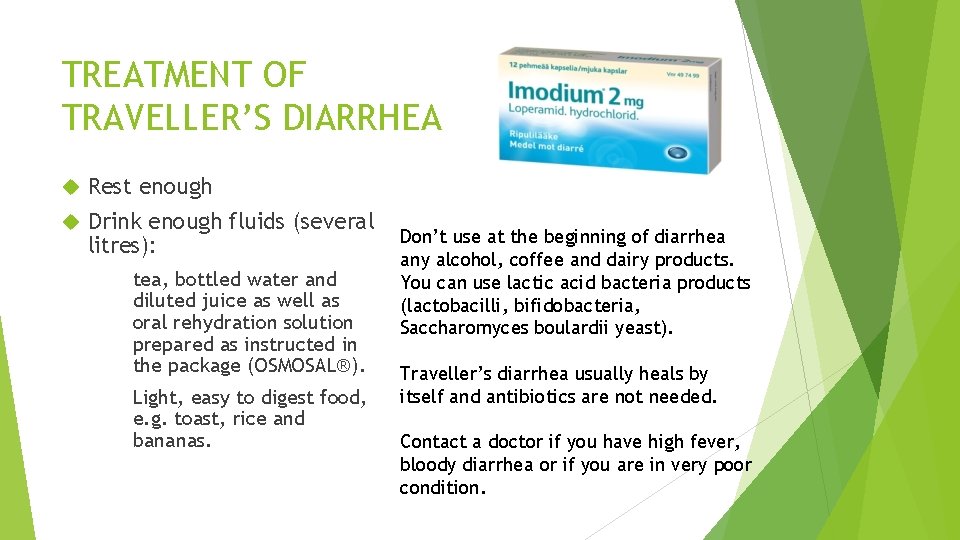
TREATMENT OF TRAVELLER’S DIARRHEA Rest enough Drink enough fluids (several litres): tea, bottled water and diluted juice as well as oral rehydration solution prepared as instructed in the package (OSMOSAL®). Light, easy to digest food, e. g. toast, rice and bananas. Don’t use at the beginning of diarrhea any alcohol, coffee and dairy products. You can use lactic acid bacteria products (lactobacilli, bifidobacteria, Saccharomyces boulardii yeast). Traveller’s diarrhea usually heals by itself and antibiotics are not needed. Contact a doctor if you have high fever, bloody diarrhea or if you are in very poor condition.
TEMPERATURE Dehydration -> drink bottled water at least 2 -3 litres/day You have to be able to urinate Protection from the sunlight Light cotton clothes Headwear and head scarves Sun glasses Shadow Effective sunscreens Salty snacks -> large amounts of salt are lost
COLD WEATHER AND HARD WIND Moving to different climate is very hard for the body, many people catch a cold or have an otitis media in the first weeks. Days can be warm but the nights cold. There can be a hard wind even on a warm day. Dressing in layers, tights, sports underwear, woollen socks and a light quilted jacket, beanie and gloves might be necessary.
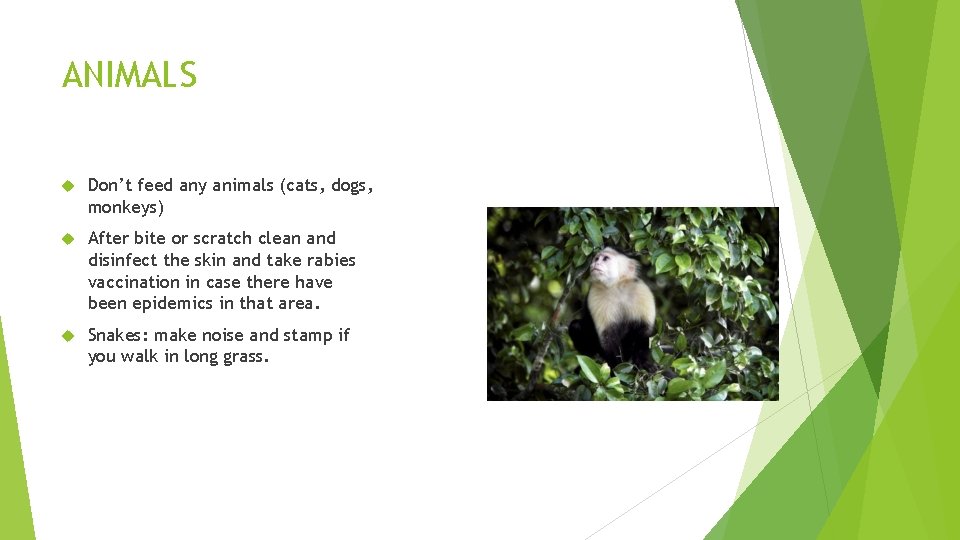
ANIMALS Don’t feed any animals (cats, dogs, monkeys) After bite or scratch clean and disinfect the skin and take rabies vaccination in case there have been epidemics in that area. Snakes: make noise and stamp if you walk in long grass.
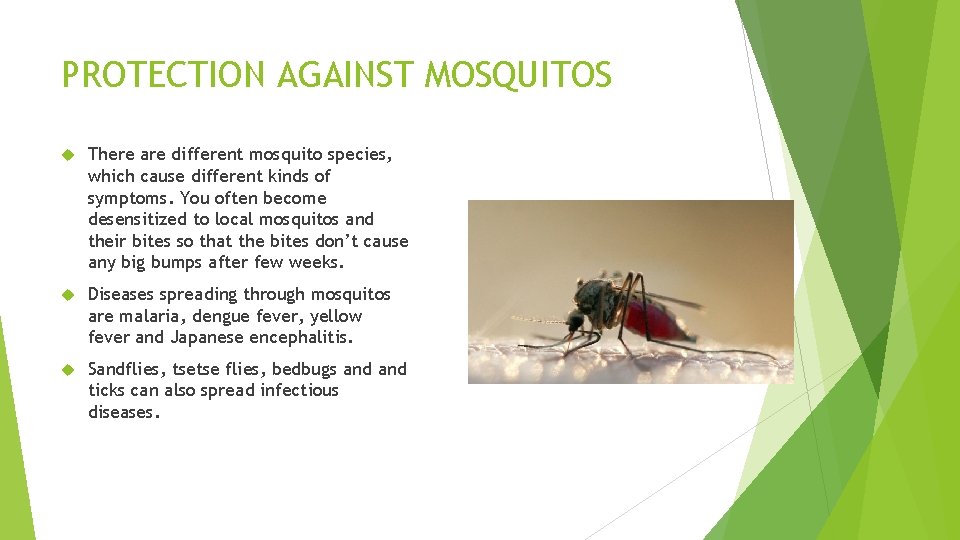
PROTECTION AGAINST MOSQUITOS There are different mosquito species, which cause different kinds of symptoms. You often become desensitized to local mosquitos and their bites so that the bites don’t cause any big bumps after few weeks. Diseases spreading through mosquitos are malaria, dengue fever, yellow fever and Japanese encephalitis. Sandflies, tsetse flies, bedbugs and ticks can also spread infectious diseases.
PROTECTION AGAINST MOSQUITOS: CLOTHING Cover as large part of the body as possible. Wear preferably light coloured, long sleeve and long legged clothes. Notice that a mosquito can bite through thin clothes. Protect your head with headwear. Protect especially the ankles and feet with socks and shoes. Place the socks over the trousers. Boots are more recommendable than sandals. Clothes must be ironed after washing (also the underwear) to destroy the fly eggs/maggots.
PROTECTING AGAINST THE MOSQUITOS: MOSQUITO REPELLENTS Use effective mosquito repellent on bare skin. Before going to bed close the door and window nets and exterminate the mosquitos from bedrooms with a mosquito repellent spray. In malaria areas sleep under a bed net, which has been treated with a mosquito repellent. The edges of the net must be tucked carefully under the mattress. A net treated with Permethrin mosquito repellent is the most effective.
PROTECTING AGAINST BEDBUGS AND COCKROACHES It’s difficult to notice bedbugs in the flat. You might notice them only from the bites on the skin. The bedbug eggs are destroyed from clothes in +60°C water or in +45°C air, e. g. in a tumble dryer in two hours and in +60 °C in half an hour. Textiles can also be taken outdoors in freezing cold weather. Before unpacking your luggage at home, you can take it to a hot sauna or outdoors in freezing cold weather. Cockroaches move only in the dark. They like moist places. It’s difficult to destroy them but perhaps you can have the lights on in the toilet at night. Pest problem can be reduced with careful cleaning. More information: http: //sisatilojentuholaiset. fi/vinkke ja-matkailijalle/ 9. 9. 2020
SWIMMING It’s safest to swim on a supervised beach Don’t ever swim alone and in the dark Use sandals (marine animal bites or stings, sharp objects) The effect of sunscreen decreases in swimming There can be strong rip currents in the sea, which pull the swimmer away from shore.
HIV AND STDs Think carefully before having casual sexual realtionships. HIV is transmitted through unprotected sex and blood transfusion. All STDs can be protected by using condom. Condom has to be used all the time during intercourse both in vaginal and anal intercourse. It’s best to buy the condoms in Finland.
USE OF INTOXICANTS An intoxicated person is prone to accidents and becoming a victim of a crime abroad. If you are allowed to drink alcohol, use it wisely, don’t get drunk. Alcohol can affect your body in a different way than at home, especially if the climate of the destination country is very different. Alcohol might not always be, what you ask, order or buy.
KNOCKOUT DROPS https: //www. youtube. com/watch? v=z 4 Ax. Gkzz. DUw Take care of your drink in a restaurant ALL the time. Keep the drink in your hand keep an eye on it. It might be better to order the drink in a bottle. Don’t leave your drink unattended if you go dancing or to the bathroom. Don’t accept a drink from a foreign person if there is something suspicious in the situation. If a new acquaintance necessarily wants to buy you something to drink, go to the counter, so that you see your glass all the time. Go immediately to the hospital or take your friend there if you think you have got knockout drops.
DRUGS Drugs can be available rather easily and they might be offered and peddled to you. Experiment with drugs and their use is unquestionably forbidden during the exchange period. In case there is reason to suspect the experiment or use, the exchange period is terminated and the grant is demanded to be paid back. The possession or delivery of drugs can result in long prison sentences or even death sentence in some countries, e. g. in Thailand, India, Malaysia and Middle East. Avoid suspicious areas and company and if you have to go outside at night, don’t walk alone. Don’t credulously believe, what strange people and new acquaintances say. All people don’t have good intensions.
PRESCRIBED MEDICINES Take the prescriptions with you. Patient instruction printed by the physician A signed summary in English You can ask the physician for an explanation about your medication and its reasons, diagnosis information about your disease and epicrises. Sometimes it might be reasonable to have the documents translated into English or the language of the destination country.
PRESCRIBED MEDICINES Take the medicines in their original packages in carry-on luggage. The import regulations about personal medicines and about their allowed ingredients and amount depend on the destination country. More precise information is found on the webpage of the customs of the destination country or calling its Embassy. It’s necessary for a diabetic to have a certificate about the need of needles.
NARCOTIC MEDICINES When you are travelling in the Schengen area, you have to have a Schengen certificate with you, which proves the necessity of the medicines. In Finland you’ll get the Schengen certificate from the pharmacy. Take the medicine package, prescription of the medicine and a travel document (passport or ID card) with you, when you fetch the certificate. If you are travelling outside the Schengen area you have to check the regulations in the Embassy concerned.
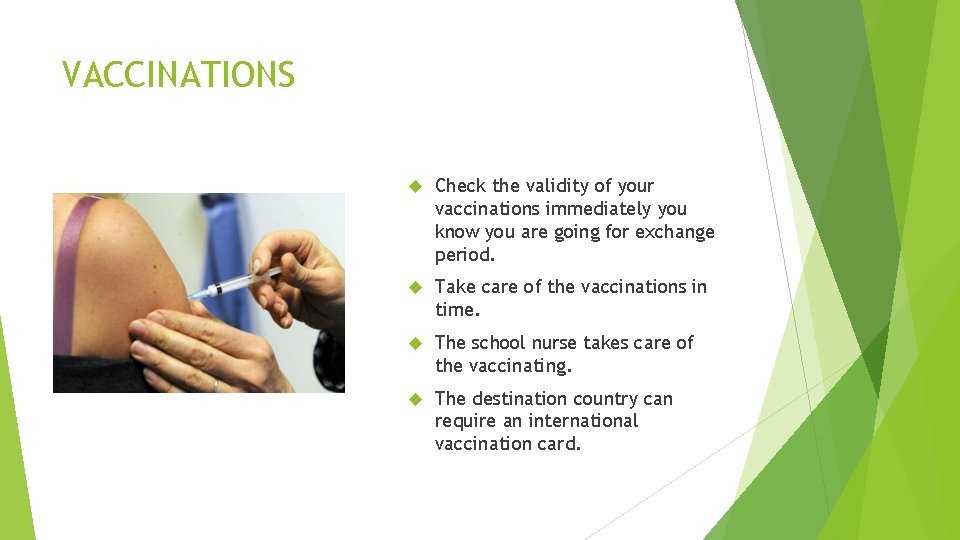
VACCINATIONS Check the validity of your vaccinations immediately you know you are going for exchange period. Take care of the vaccinations in time. The school nurse takes care of the vaccinating. The destination country can require an international vaccination card.
MALARIA PROPHYLAXIS Ø The need of prophylaxis has to be checked with the school nurse. 9. 9. 2020
FALLING ILL DURING THE EXCHANGE • Seek always the appropriate doctor if you need medical care abroad. Ask the local contact person for help. • The European Health Insurance Card allows you to receive medical care in the EU and EEA countries as well as in Switzerland. • You get from the sending institution an insurance card or certificate, which you can show, when you are seeing the doctor. • Ask the doctor abroad a written certificate about the medicine prescribed or used by the doctor. Purchase the medicines always at a pharmacy and try to make sure that the medicines are original. • Beware of counterfeit medicines!
TRAVEL PHARMACY • If your exchange period is long or outside of Europe, it might be wise to prepare yourself for falling ill with a travel pharmacy. It could include e. g. : Ø Diarrhea and constipation medicine - Antihistamine Ø Painkillers and antipyretic - 1% hydrocortisone cream Ø Thermometer Ø Moisturizing eye drops - Sunscreen and moisturizing cream Ø Hand sanitizer, wet wipes, condoms, tampons, - Herpes cream sanitary towels - Antifungal cream (especially in the tropics) Ø Wound care instruments Ø (Water purification tablets Ø A course of antibiotics)
MENTAL HEALTH ABROAD - There can be disappointments with the long-awaited journey -> stress Contradictions at home and school might surprisingly follow you abroad Possible accidents or close calls. Familiarization with the destination country and its culture, realistic expectations prevention of mental health problems. It’s important to discuss the feelings with someone. In most cases talking is helpful. Attitudes towards mental health problems vary in different countries. If you use antidepressants, they should not be changed close before the journey.
USEFUL LINKS Terveyskirjaston Matkailijan terveysopas/Health Library, Traveller’s Guidebook www. terveyskirjasto. fi David Livingstone –seura/The Finnish Society for International Health: www. fsih. fi/matkailijan-ohjeet Web pages of the Embassies
HAVE A NICE AND SAFE JOURNEY
- Slides: 38