
Safeguarding September 2020 Updated Statutory Guidance KCSi E
Safeguarding (September 2020)
• Updated Statutory Guidance – KCSi. E Sept 20, all school staff must read and understand Part 1 • It is essential that you read this document and ask if there is any aspect of it you do not understand – it helps to safeguard you as a professional as well as the children in your care. • You need to ensure you have read and that you follow our own school safeguarding policy, that you know who your DSL and DDSLs are and understand procedures in our school.
KCSIE 2020 • The original proposal that the Df. E published in Feb had wide ranging changes. • Due to Covid, the consultation was suspended in March. • The Df. E therefore pulled back on the extent of change to this year’s document. • The new document is now published, with only minimal changes. • The new guidance comes into effect on 1 September 2020. All staff must familiarise themselves with Part 1 and Annex A.
So what’s new? Summary; Covid 19 is referenced in a new paragraph. The non-statutory ‘safeguarding in schools’ guidance is linked. • The rationale for changes this year are outlined, which are limited to: • where legislation requires change, eg RSE • to add helpful additional information to support schools • to provide further clarification
Part one – information for all staff The definition of safeguarding has been updated; Safeguarding is defined as promoting the welfare of children and protecting them from harm. This means: • protecting children from abuse and maltreatment; • preventing impairment of children's mental and physical health or development; • ensuring that children grow up in circumstances consistent with the provision of safe and effective care; • taking action to enable all children to have the best outcomes.
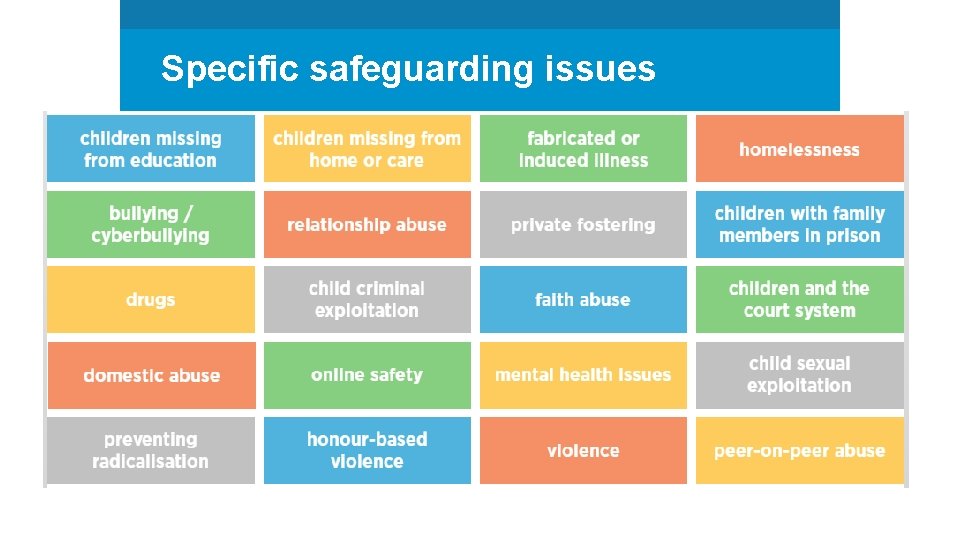
Specific safeguarding issues
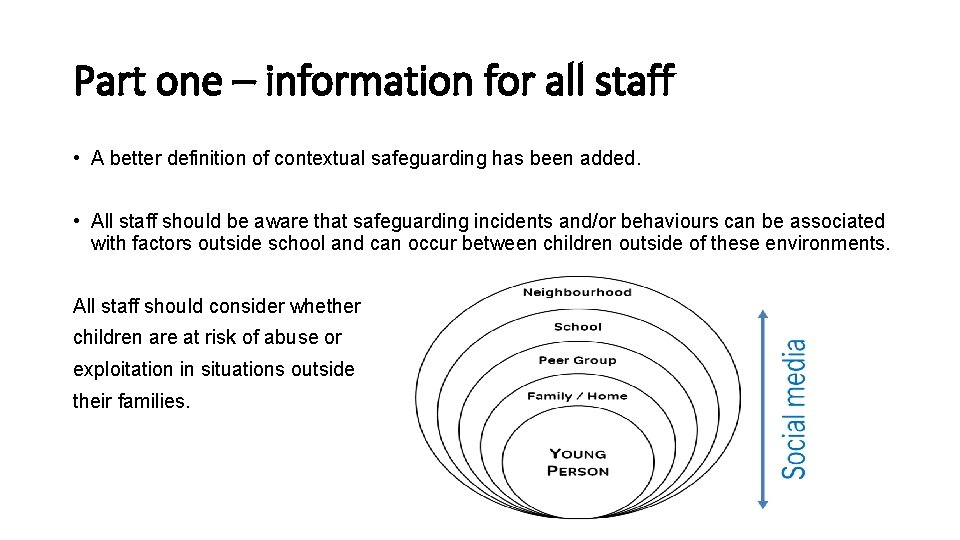
Part one – information for all staff • A better definition of contextual safeguarding has been added. • All staff should be aware that safeguarding incidents and/or behaviours can be associated with factors outside school and can occur between children outside of these environments. All staff should consider whether children are at risk of abuse or exploitation in situations outside their families.
Part one – information for all staff New paragraphs added with additional information on: • CCE and CSE • Mental health and its links to safeguarding, including being trauma aware
Part two – management of safeguarding • • • New link to ‘when to call the Police’ guidance from NSPCC. Updated paragraphs on multi agency working and change to partnership. Updated paragraph on GDPR and storing and sharing of information. New data protection toolkit – p 100 New paragraphs added re compulsory RSHE • New section on children who need a social worker which requires schools to: 1. Know who these children are and; 2. Have the CSC plan inform decisions at school eg. missing, pastoral support • New section on children’s mental health and its link to safeguarding.
Part four – allegations against professionals This section has two significant changes this year. The criteria for allegations management now includes when an individual: • Behaved in a way that has harmed or may have harmed a child; • Possibly committed a criminal offence against or related to a child; • Behaved towards a child or children in a way that indicates they may pose a risk of harm AND NOW • Behaved or may have behaved in a way that indicates they may not be suitable to work with children • Poll 2 • This is about transferable risk and can relate to incidents outside of school.
Annex A This is the supplementary information (alongside part one) for all staff that work directly with children. It had additional information, indicators etc in relation to safeguarding topics. This year, the sections that have been updated for further clarification are: • CCE • CSE • County Lines • Domestic abuse (including Op Encompass) • Honour based abuse • Preventing radicalisation • Upskirting
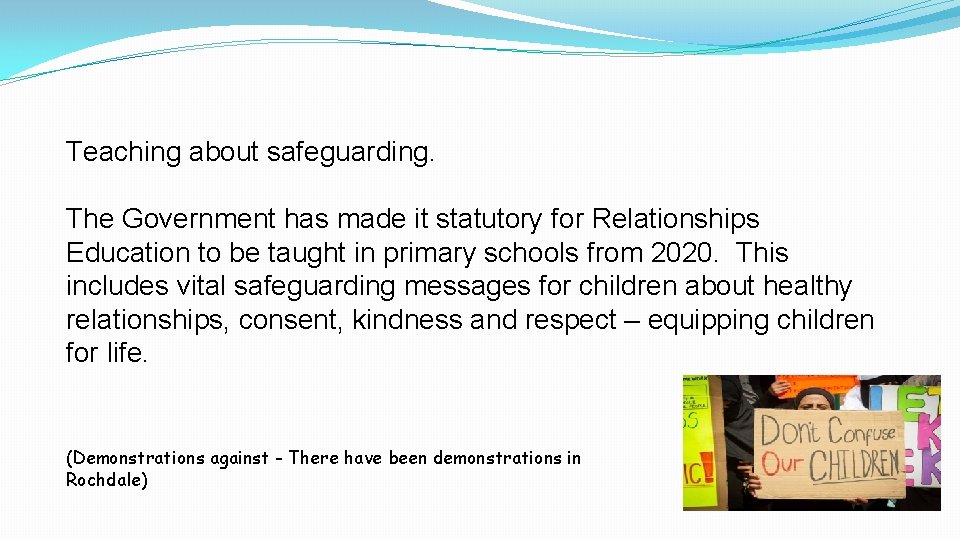
Teaching about safeguarding. The Government has made it statutory for Relationships Education to be taught in primary schools from 2020. This includes vital safeguarding messages for children about healthy relationships, consent, kindness and respect – equipping children for life. (Demonstrations against - There have been demonstrations in Rochdale)
Guidance for safe working practice � Outlines what behaviour is expected of someone working in a school, as a role model for children. � Supports staff not to place themselves in situations which could render them particularly vulnerable, in work and in your life outside school, including online. � It is really important that you read, understand work within it. � Some important information for us all to note: “Schools should make clear their expectation that staff should disclose any relationship or association (in the real world or online) that may impact on the school’s ability to safeguard pupils. This applies to all staff in all schools, not just those in early or later years childcare”. � Guidance on use of photography/recording in schools: “Adults should not take images of a child’s injury, bruising or similar (e. g. following a disclosure of abuse) even if requested to by children’s social care”.
Encompass �Encompass is a system in place so schools are aware of domestic abuse incidents reported to Police involving our students or their parents/carers �Domestic abuse notifications received day following incident, the idea being to reduce delays in information sharing �Notifications are emailed directly to DSL, Head and our Welfare Team email address and are recorded in student’s confidential safeguarding file and if any action is required then Welfare Team will initiate
ALWAYS ACT in the best interests of the Child. Never promise Confidentiality. KNOW HOW to identify children who may benefit from early help KNOW THE DIFFERENT Types of abuse and neglect so that you can identify children who may be in need of help or protection
ØDomestic violence ØDrug or Alcohol misuse ØInappropriate sexual activity or behaviour for age ØPoor school attendance ØLack of boundaries at home ØPoor Parenting ØEngaging in Criminal activity ØMental health issues ØMissing episodes ØIsolation ØDifficult family relationships Ø‘Risky’ behaviours ØDisabilities ØLearning Difficulties
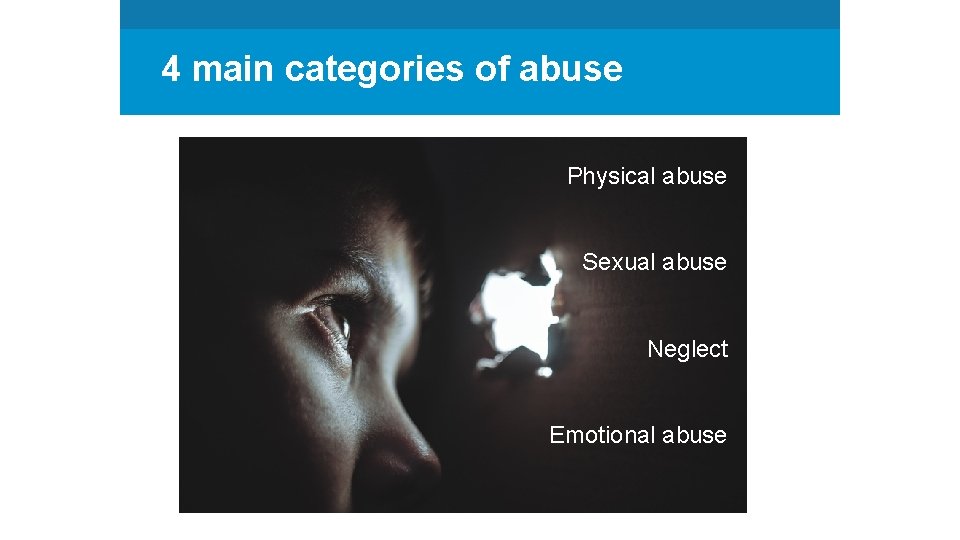
4 main categories of abuse Physical abuse Sexual abuse Neglect Emotional abuse
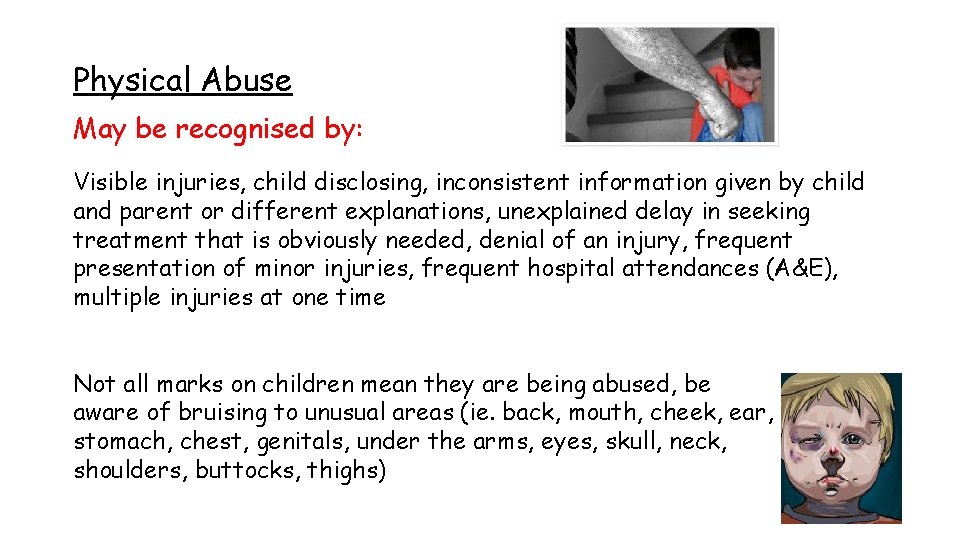
Physical Abuse May be recognised by: Visible injuries, child disclosing, inconsistent information given by child and parent or different explanations, unexplained delay in seeking treatment that is obviously needed, denial of an injury, frequent presentation of minor injuries, frequent hospital attendances (A&E), multiple injuries at one time Not all marks on children mean they are being abused, be aware of bruising to unusual areas (ie. back, mouth, cheek, ear, stomach, chest, genitals, under the arms, eyes, skull, neck, shoulders, buttocks, thighs)
Sexual Abuse • Forcing, enticing, tricking a child to take part in sexual activities whether or not the child is aware of what is happening, Assault by penetration (rape/oral sex), Non-penetrative (kissing, masturbation, touching – including over clothing) • Non-contact (grooming, photographing child for sexual purposes, making a child look at pornographic images or films, engaging in sexual activity in front of a child, adults exposing themselves for sexual gratification, engaging child in prostitution)
May be recognised by: Inappropriate sexualised contact, sexually harmful behaviour, age inappropriate sexualised play or conversation, self-harm, eating disorders, complaints of pain or itching in genital area, disturbed behaviour, loss of self-esteem, continual or inappropriate masturbation, running away from home. Disclosure of sexual abuse must be taken seriously as it is recognised that pupils are frequently scared to disclose due to guilt or fear. Parents must not be informed of the disclosure.
Sexual Exploitation Can take many forms ranging from the seemingly ‘consensual’ relationship (tricked into believing in a loving relationship), to serious organised crime by gangs or groups. Exchange of something (ie. Food, accommodation, drugs, alcohol, gifts, money) for engaging in sexual activities Involves varying degrees of coercion, enticement, intimidation, control, force, threats, manipulation. Can be online exploitation – deceiving children into producing indecent images, engaging in sexual chat or activities over webcams. Vulnerability often due to economic or personal circumstances which leave young person with little choice.
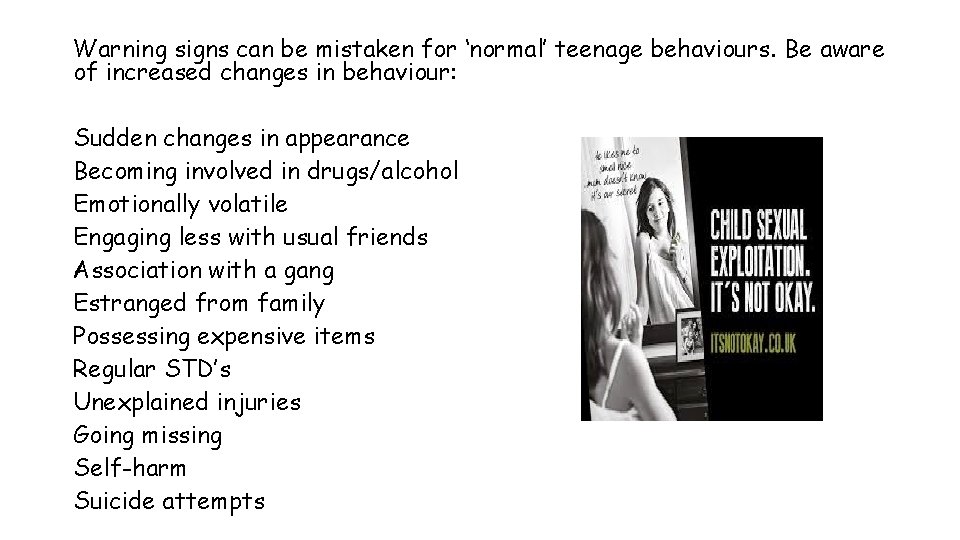
Warning signs can be mistaken for ‘normal’ teenage behaviours. Be aware of increased changes in behaviour: Sudden changes in appearance Becoming involved in drugs/alcohol Emotionally volatile Engaging less with usual friends Association with a gang Estranged from family Possessing expensive items Regular STD’s Unexplained injuries Going missing Self-harm Suicide attempts
Neglect The persistent failure to meet the child’s basic needs, resulting in significant impairment of child’s health and development. ØFailure to provide adequate food, clothing or shelter ØFailure to carry out important aspects of care ØFailure to protect child from harm or danger ØLack of appropriate supervision ØLeaving vulnerable children home alone ØFailing to meet the child’s health or developmental needs or attend medical appointments
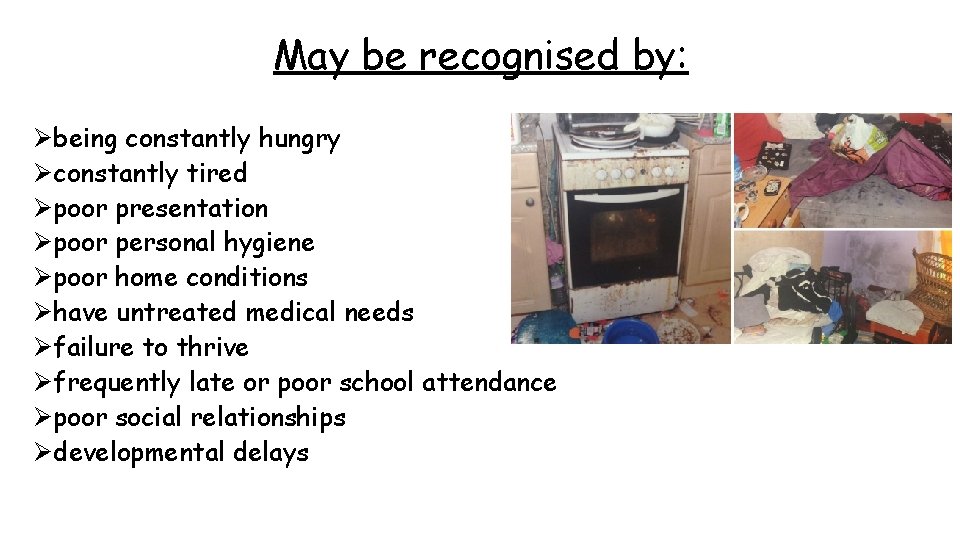
May be recognised by: Øbeing constantly hungry Øconstantly tired Øpoor presentation Øpoor personal hygiene Øpoor home conditions Øhave untreated medical needs Øfailure to thrive Øfrequently late or poor school attendance Øpoor social relationships Ødevelopmental delays
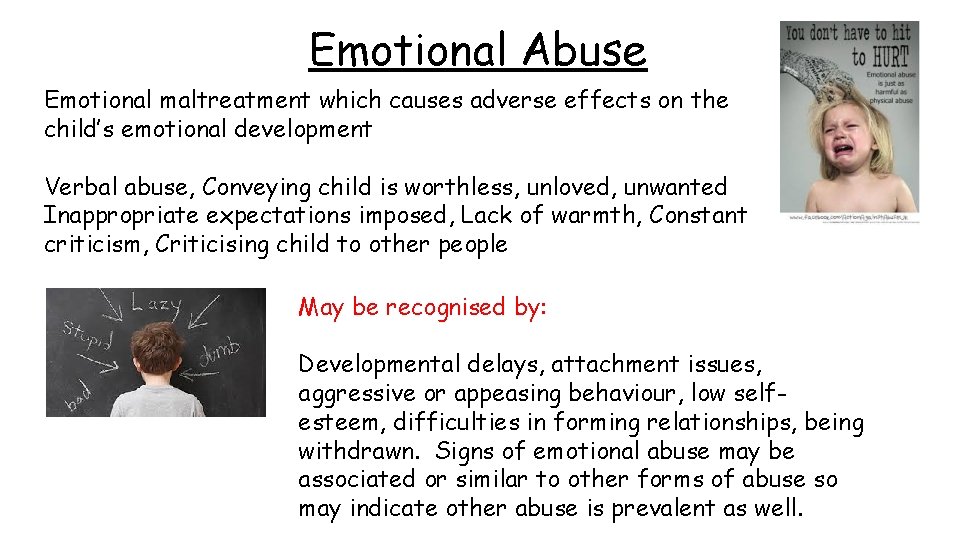
Emotional Abuse Emotional maltreatment which causes adverse effects on the child’s emotional development Verbal abuse, Conveying child is worthless, unloved, unwanted Inappropriate expectations imposed, Lack of warmth, Constant criticism, Criticising child to other people May be recognised by: Developmental delays, attachment issues, aggressive or appeasing behaviour, low selfesteem, difficulties in forming relationships, being withdrawn. Signs of emotional abuse may be associated or similar to other forms of abuse so may indicate other abuse is prevalent as well.
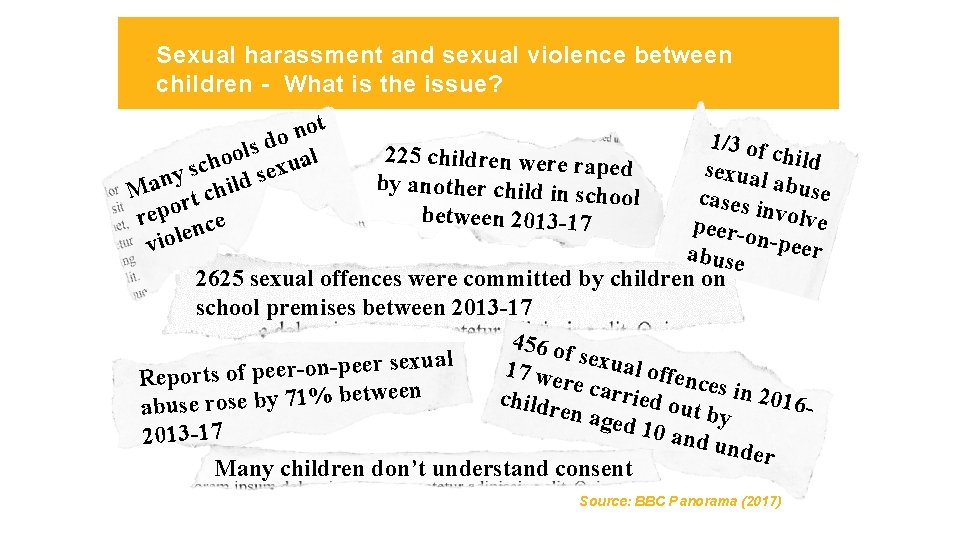
Sexual harassment and sexual violence between children - What is the issue? t o n o 1/3 of d s l child o 225 children were ra l o a h u c p e d s exual y s ild sex n abuse b y a another child in scho M rt ch cases i ol o nvolve p between 2013 -17 re nce peer-o e l n-peer o vi abuse 2625 sexual offences were committed by children on school premises between 2013 -17 456 of sexua l a u x e s r e e p n o l offen 17 we Reports of peerre car ces in n e e w t e b r 2016 ied ou childr abuse rose by 71% en age t by d 10 an 2013 -17 d und er Many children don’t understand consent Source: BBC Panorama (2017)
A whole-school approach Curriculum themes: Healthy and respectful relationships What respectful behaviour looks like Consent Gender roles, stereotyping, equality Body confidence and self-esteem Prejudiced behaviour That sexual violence and sexual harassment are always wrong Addressing cultures of sexual harassment
Modern Slavery • Modern slavery is a form of organised crime in which individuals including children and young people are treated as commodities and exploited for criminal gain. • Grooming methods are used to gain the trust of a child. • Children are not considered able to give ‘informed consent’ to their own exploitation (including criminal exploitation), so it is not necessary to consider the means used for the exploitation whether they were forced, coerced or deceived. • Criminal exploitation can involve young people as drug carriers, begging and pick-pocketing. Debt bondage (forced to work to pay off debts that realistically they will never be able to)
Child Criminal Exploitation (CCE) Many cases nationally and locally in Rochdale where CCE has been uncovered as part of Police operations into criminal gangs and drug activity. Some of our students have been moved out of the Borough due to CCE or had threats to life. Positive is that professionals are more aware of this form of exploitation. There is more recognition that children aren’t making an informed “lifestyle choice” but are victims who are potentially entrapped in what is modern slavery and/or human trafficking. Increasingly seeing younger children being drawn into exploitative criminal activities through siblings/friends within their community (primary age onwards). Emerging concerns; children as young as 11, happens for a significant period of time before people act, levels of physical risk & risk to life more evident than in CSE
Private Fostering A private fostering arrangement is one that is made privately (without the involvement of a local authority) for the care of a child under the age of 16 years (under 18, if disabled) by someone other than a parent or close relative, in their own home, with the intention that it should last for 28 days or more. There is no duty for schools to be given information about a child who is privately fostered by the family, carer or the local authority. There is however a legal duty on schools to inform children’s services where they become aware of such an arrangement.
Prevent Strategy From 1 st July 2015 all schools are subject to a duty under Section 26 of the Counter. Terrorism and Security Act 2015 to have “due regard to the need to prevent people from being drawn into terrorism”. This duty is known as the Prevent duty. Schools can build pupil’s resilience to radicalisation by promoting fundamental British values and enabling them to challenge extremist views. The Prevent duty is not intended to stop pupils debating controversial issues but to the contrary schools should provide a safe space in which young people can understand the risks associated with terrorism and develop the knowledge and skills to challenge extremist arguments. Statutory guidance makes clear the need for school to ensure that children are safe from terrorist and extremist material when accessing the internet in school and therefore there needs to be suitable filtering in place.
Children with special educational needs and disabilities: Children with SEN can face additional safeguarding challenges. Additional barriers can exists: ØAssumptions that indicators of possible abuse such as behaviour, injury, mood relate to child’s disability without further exploration ØCan be disproportionally impacted by things like bullying, without outwardly showing signs ØCommunication barriers, difficulties overcoming these barriers
BLC Students during COVID-19 Whilst we offered provision throughout COVID-19 to our most vulnerable students, some attended and some declined. An example of safeguarding issues which arose: • Increase in domestic abuse incidents within some family homes • Parent & student - overdoses, increased alcohol/drug misuse, deterioration in mental health • Some young people going into Care • Family relationship breakdowns • Allegations of Rape & sexual assault – with students as alleged perpetrators and victims • Increase in self-harming • Students with increased anxiety levels/OCD conditions deteriorating
How we supported our students and their families during COVID-19 We maintained regular communication with all of our students; the most vulnerable had daily phone calls and weekly home visits if they did not attend the provision offered, other students received weekly phone calls from their teaching staff, welfare team continued to support students and families they were already involved with, a counselling helpline was provided for emotional support to students and their parents/carers. We provided work/learning packs for our students to access learning at home, food parcels and free school meal vouchers, some students received laptops and 4 G to access online learning. We made referrals to other agencies for appropriate support or intervention when this was required. So well done everyone! We have been very busy, despite small numbers of students attending.
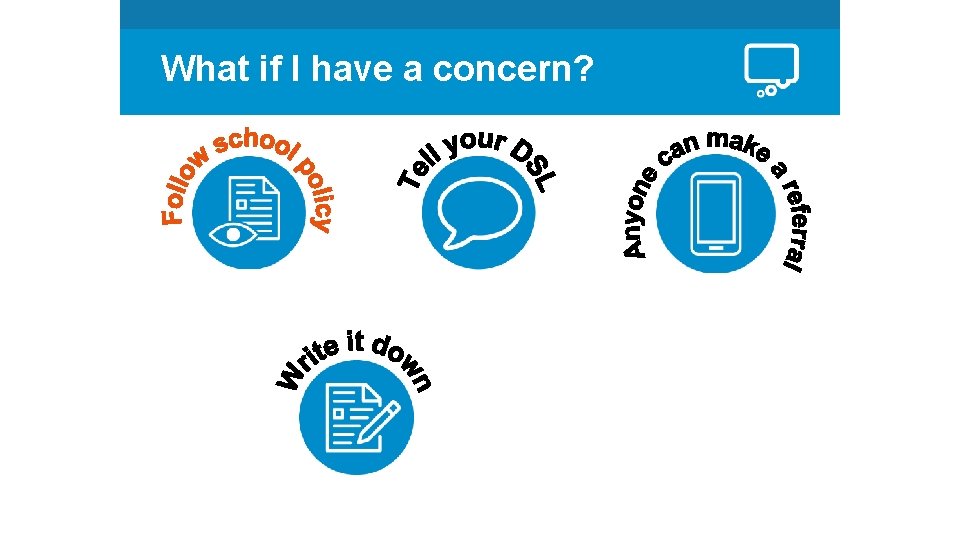
What if I have a concern?
Children need the right help at the right time • Act on child protection concerns • Don’t wait till the end of the school day • Notify parents of information which raises concerns for their child’s health/welfare (ie. Drug use, criminal activity, sexual activity etc)
What are your specific concerns? Do you have any factual evidence to support your concerns? What are the child’s circumstances that you are aware of? What, if anything has the child said or done to add to or increase your concerns? What, if anything has the parent/carer said or done? What is the parents’ response? (Are they aware? Are they pro-active? Do they need support – in what form? )
Recordings All concerns, discussions and reasons for any decisions must be recorded in writing. Child Protection Incident Report Forms must be completed then emailed to the Welfare Team in a timely manner. Urgent child protection concerns must be shared verbally in addition to a written record being made. The recording needs to contain factual information with as much detail as possible as it may be required as evidence in Police investigations or Court Hearings. Recordings must be dated and signed.
1 Records must be clear �The safeguarding record you make today needs to still make sense 3, 6 or 12 months, or many years from now, when you won’t remember what you meant. �The content of your record needs to be understood by anyone else reading it and should not need you to interpret. �Use straightforward, unambiguous language, �Re-read what you have recorded to sense check it. �Always include your full name and the date and time that the record is being made (including the year).
2 Records must be accurate �Get the information down in a timely way. For a record to be accurate, it needs to be made as soon as possible after the event. �Ensure that you record sufficient detail. What happened, where, when, who was present/involved, how did the information come to light. �Be specific with descriptions eg NOT “cut over eye” which eye, how big was the cut? �Use a body map to record injuries. �We NEVER take photographs of children’s injuries. �We are only human! Check for any errors.
3 Records must be factual �Take care to record the facts �If it is appropriate to state your opinion, make sure you clearly differentiate between what is fact and what is professional judgement. But we never express opinion about the validity of an allegation or disclosure made by a child. �Where a child has made a disclosure, always record this in the child’s own words. Even if the language is childlike (or they use swear words/ bad language)
4 Records must be appropriate �Think carefully about your choice of language. A child’s record may be read out as part of a formal meeting or even in court. �Parents have the right to request copies of safeguarding records held by school about their child. Imagine mum is reading what you have recorded about her child or them, or the child accessing their file when they are an adult. �Do not use derogatory language to describe a child �Do not record personal and/or irrelevant comments, �Think about what impression your records could present of you as a professional and the school.
5 Records must be complete �Make sure you record what action you took – the so what factor. �If you spoke to a parent/ carer, record who you spoke to and the content of the discussion. �If you made a decision to take some form of action in addition to speaking to parent, record what you did �If you spoke to a colleague, record who and the content of the discussion.
Your Responsibilities: Ø Your responsibility is to act if you have concerns Ø It is NOT your responsibility to decide whether the abuse has taken place or to determine who the perpetrator is Ø Share information with the Safeguarding Lead as soon as possible and agree what action is to be taken. If necessary contact the Police or Children’s Services (for eg. If in immediate danger or if out of hours) Ø Any staff member can make a referral to Children’s Services (but should inform the Safeguarding Lead if they do so)
Whistleblowing Anyone who has contact with children is in a position of trust. Everyone has a personal responsibility to act properly and professionally and to safeguard and promote the welfare of children. Working with young people can make adults vulnerable to allegations, so it is important that safer working practice procedures and codes of conduct are adhered to. Any safeguarding concerns about a member of staff or adult within BLC must be referred to the Head Teacher or a member of the SLT.
Most important of all…. � Safeguarding is a collective, shared responsibility – we all have a vital part to play. � The safety and welfare of the child is always paramount. � Don’t make assumptions, � Be constantly curious. It IS your business. Speak to your DSL, Welfare Team Duty worker or SLT/SMT member if you want advice or guidance or just to talk through a concern. � Maintain respectful uncertainty. Do not take at face value explanations that don’t ring true. � We need to remain alert and vigilant to what we see/hear. You are all busy professionals. � Don’t forget that all of you can make a massive difference to keeping a child safe just by simple things……listening, noticing, sharing information and working together. � You could be the difference.
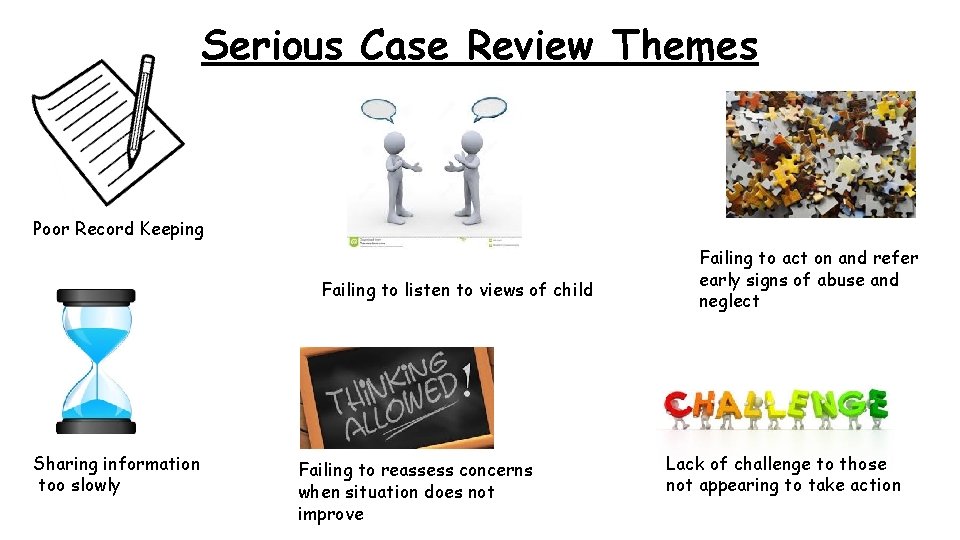
Serious Case Review Themes Poor Record Keeping Failing to listen to views of child Sharing information too slowly Failing to reassess concerns when situation does not improve Failing to act on and refer early signs of abuse and neglect Lack of challenge to those not appearing to take action
A high number of our students face the unthinkable; many are currently experiencing, or have experienced abuse. These issues do happen here and can happen anywhere.

- Slides: 49